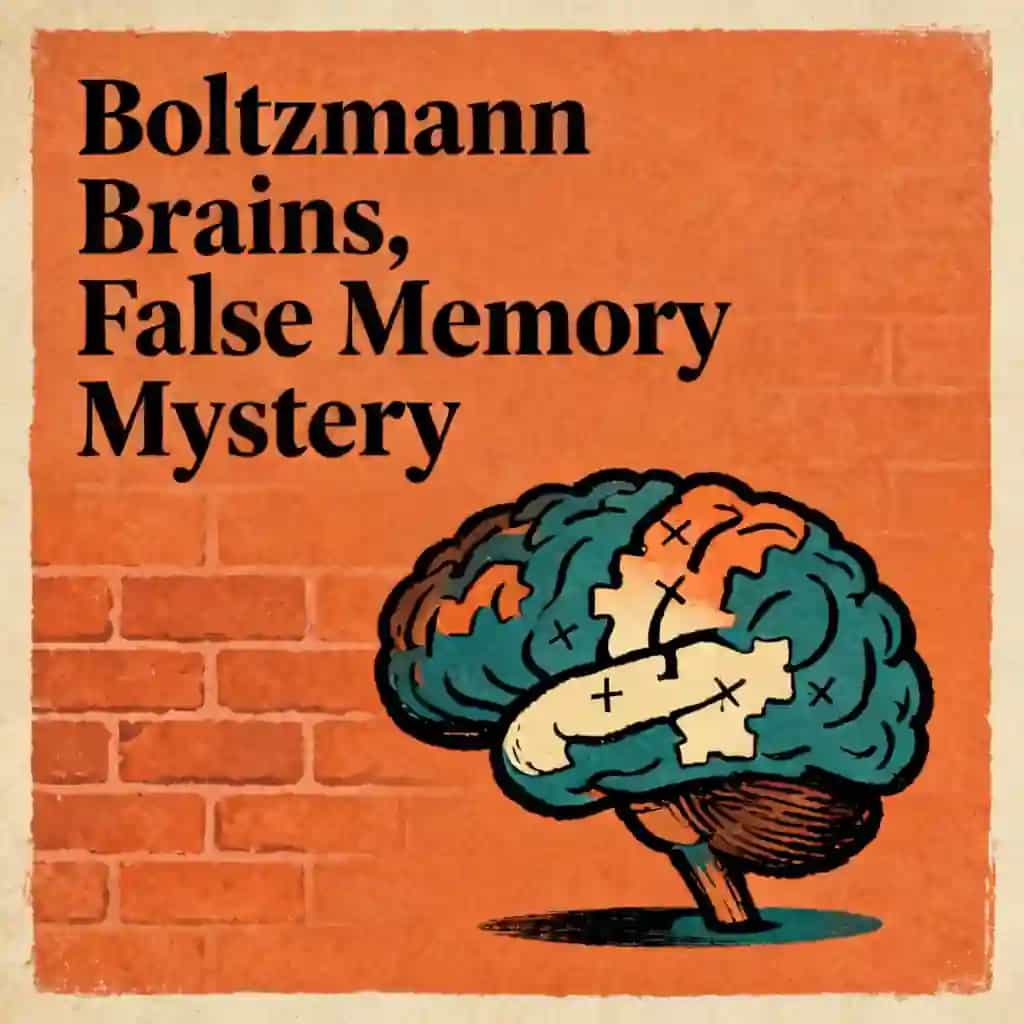
Is your memory just a glitch? Explore why physics suggests a lone brain in the void is more likely than the universe, and what it means for reality.
Best quote from The Boltzmann Brain Paradox and Why You Might Not Exist
“
The math of statistical mechanics is ruthless. It says that the smaller the fluctuation, the more often it happens. Statistically, the 'cheapest' way to get an observer who thinks they are in a universe is to just make the observer, not the whole universe.
”
E
Generated by Entropy
Input question
I want to know everything about the whole Boltzmann Brain thing.
Host voices
Lena
Nia
Knowledge sources
Frequently Asked Questions
A Boltzmann Brain is a theoretical "disembodied" brain that spontaneously flickers into existence in the vacuum of space due to random thermal fluctuations. According to the laws of statistical mechanics, in an infinite or eternal universe, it is mathematically more probable for a single brain with "fake" memories of a life to fluctuate into existence for a brief moment than it is for an entire, complex universe with billions of years of history to form. This creates a paradox because it suggests that you are statistically more likely to be a momentary hallucination in the void than a human being with a real past.
This concept is based on "entropy cost." To create our observable universe, trillions of particles must be arranged into a very specific, low-entropy state, which requires a massive amount of statistical "luck." In contrast, arranging just enough particles to form a three-pound human brain configured to perceive a universe requires far fewer resources and less luck. Because smaller fluctuations happen much more frequently than large ones, the math suggests the universe would produce "budget" observers (lone brains) far more often than "luxury" observers (humans evolved over billions of years).
Physicists use the Boltzmann Brain as a "diagnostic tool" or a reductio ad absurdum to identify flaws in cosmological models. If a specific theory about the universe—such as certain versions of Eternal Inflation—predicts that Boltzmann Brains should vastly outnumber ordinary observers, scientists generally consider that theory "cognitively unstable" or disqualified. The logic is that if we were Boltzmann Brains, we couldn't trust the very observations and memories used to create the theory in the first place, meaning the theory effectively undermines itself.
While it is difficult to prove from the "inside," some cosmologists suggest that if the universe is not eternal—meaning it decays or ends before Boltzmann Brains have time to dominate the statistics—then ordinary observers remain the majority. Recent data regarding Dark Energy suggests the universe might not be stable forever, which would "save" our reality by preventing the infinite production of freak observers. Additionally, the fact that we experience a continuous flow of time and can verify our memories against external records (like photo albums or historical sites) makes our existence "more expensive" and less likely to be a random, momentary glitch.
From Columbia University alumni | built in San Francisco
BeFreed Brings Together A Global Community Of Curious Minds
4.7
avg rating
7.84k+ App Rating
BeFreed Community
Seriously I haven’t even explored this app fully yet but from using it the last few days I am so impressed... BeFreed is on a different level from any other learning app I have used. This makes it ultra engaging and can actually improve your concentration which is great for all the doom scrollers!
@ladyInfinity
I bought BeFreed exactly 23 days ago, and I have used it every single day since. It has completely embedded itself into my daily workflow and learning habit.
@jayallen
The truth is, the app has exceeded all my expectations. I can ask it to generate audio on any topic, whatever it may be, and the result is impressive. My professional field is a specialization in psychotherapy and it is multidisciplinary; however, the answers are very accurate.
@Raguipa
What I appreciate most is how much it's reduced my scrolling – I'm spending less time searching and more time absorbing information. The combination of full audiobooks, podcasts, the learning plans are brilliant.
@colonyofcreatorsNGO
I have been a PhotoReading Accelerated Learning Instructor for the past 24 years... books and reading and learning are my thing, and BeFreed has done a great job in providing an innovative approach to disseminating and delivering information in an easy to consume way.
@BeFreed user
It is not just a book summary app, I have used the 'fun reading' option and it's a much better summary and way to grasp ideas the traditional way, that alone is worth this deal.
@austinakon
I love this app. Used it for several days and I cannot stop listening. Such a great way to start.
@jcrules328
I really like the program; I have already tested it for around one month, and I feel that it's an amazing gem. It works so well because I can use BeFreed to create my own topics, and the voice is so good with unlimited choice of narrations.
@DanielCZ
Seriously I haven’t even explored this app fully yet but from using it the last few days I am so impressed... BeFreed is on a different level from any other learning app I have used. This makes it ultra engaging and can actually improve your concentration which is great for all the doom scrollers!
@ladyInfinity
I bought BeFreed exactly 23 days ago, and I have used it every single day since. It has completely embedded itself into my daily workflow and learning habit.
@jayallen
The truth is, the app has exceeded all my expectations. I can ask it to generate audio on any topic, whatever it may be, and the result is impressive. My professional field is a specialization in psychotherapy and it is multidisciplinary; however, the answers are very accurate.
@Raguipa
What I appreciate most is how much it's reduced my scrolling – I'm spending less time searching and more time absorbing information. The combination of full audiobooks, podcasts, the learning plans are brilliant.
@colonyofcreatorsNGO
I have been a PhotoReading Accelerated Learning Instructor for the past 24 years... books and reading and learning are my thing, and BeFreed has done a great job in providing an innovative approach to disseminating and delivering information in an easy to consume way.
@BeFreed user
It is not just a book summary app, I have used the 'fun reading' option and it's a much better summary and way to grasp ideas the traditional way, that alone is worth this deal.
@austinakon
I love this app. Used it for several days and I cannot stop listening. Such a great way to start.
@jcrules328
I really like the program; I have already tested it for around one month, and I feel that it's an amazing gem. It works so well because I can use BeFreed to create my own topics, and the voice is so good with unlimited choice of narrations.
@DanielCZ
I love the fact that I can get useful, condensed, information and ideas in a 8 - 15 minute podcast style audio. I'm not a general fan of podcasts because of all the fluff, but this cuts through all that.
@BeFreed user
I am finishing up my doctorate, and have to read a lot of unfamiliar material... With BeFreed, you simply enter a prompt, and the app finds source material for you and generates an audio podcast. I find the process in BeFreed to be more streamlined than NotebookLM.
@Brad
I often search YouTube for something to listen to whilst making breakfast, when I'm out walking, commuting, etc, and BeFreed has provided an even more targeted approach, without the adverts and the fluff!
@BeFreed user
The absolute best part about this platform is its versatility. There is literally no subject that is off-topic. It handles whatever you throw at it... It is rare to find an learning tool with zero limitations that actually delivers on its promises.
@jayallen
BeFreed is fantastic. The user-friendly design means I spend less time navigating and more time learning. The mix of audiobooks, podcasts, and learning plans is a genius combo that has completely changed my daily routine.
@BeFreed user
At the start I needed a while to understand how to create podcasts in italian language and boom! It is so great! I can ask to explain every argument and it does so well and so smartly!
@matteo77
BeFreed has become my daily app for audio books tools... What I like the most is the way you put your text and come with an audio that you can listen on the go.
@kotanzu1
I love the fact that I can get useful, condensed, information and ideas in a 8 - 15 minute podcast style audio. I'm not a general fan of podcasts because of all the fluff, but this cuts through all that.
@BeFreed user
I am finishing up my doctorate, and have to read a lot of unfamiliar material... With BeFreed, you simply enter a prompt, and the app finds source material for you and generates an audio podcast. I find the process in BeFreed to be more streamlined than NotebookLM.
@Brad
I often search YouTube for something to listen to whilst making breakfast, when I'm out walking, commuting, etc, and BeFreed has provided an even more targeted approach, without the adverts and the fluff!
@BeFreed user
The absolute best part about this platform is its versatility. There is literally no subject that is off-topic. It handles whatever you throw at it... It is rare to find an learning tool with zero limitations that actually delivers on its promises.
@jayallen
BeFreed is fantastic. The user-friendly design means I spend less time navigating and more time learning. The mix of audiobooks, podcasts, and learning plans is a genius combo that has completely changed my daily routine.
@BeFreed user
At the start I needed a while to understand how to create podcasts in italian language and boom! It is so great! I can ask to explain every argument and it does so well and so smartly!
@matteo77
BeFreed has become my daily app for audio books tools... What I like the most is the way you put your text and come with an audio that you can listen on the go.
If reality is more fluid than it seems, how do we know what's real? Explore the paradoxes of quantum physics and AI to redefine your own consciousness.
If the brain stops, how does consciousness continue? Explore how near-death experiences and quantum physics suggest our reality is a dimensional shift.
Discover how your three-pound brain constructs reality, debunking myths about the "lizard brain" while exploring genetics, neural networks, and the social wiring that shapes every decision you make.
From atoms existing in superposition to surprising connections between cancer and Alzheimer's, we explore how cutting-edge science is blurring the boundaries between quantum physics and everyday reality.
Journey from Heisenberg's island breakthrough to quantum entanglement, exploring how particles exist in multiple states, consciousness shapes reality, and ancient wisdom meets cutting-edge science in the strangest theory ever proven.