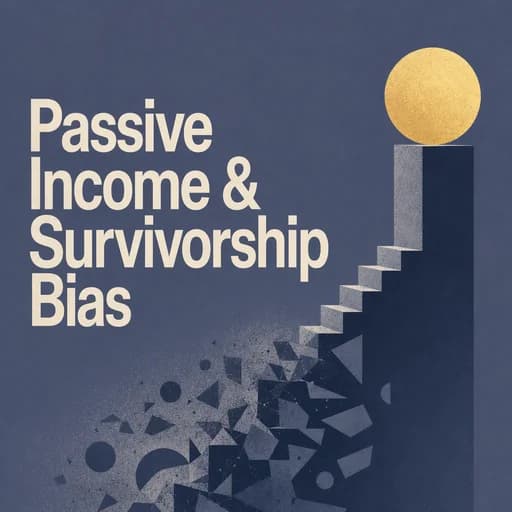
The Intoxicating Allure of the Invisible Win
Have you ever found yourself scrolling through social media at two in the morning, watching a video of someone explaining how they made $10,000 a month while sitting on a beach in Bali? It is a specific kind of modern torture. You are exhausted from a long day at a job that feels like a treadmill, and here is someone claiming they have cracked the code to "passive income"—that magical state where money flows into your bank account without you having to lift a finger. It feels like a lifeline, doesn't it? But before you buy that ₹999 course or start a drop-shipping store for jade face rollers, I want you to consider a very uncomfortable possibility: what if the success you are seeing is an optical illusion? This isn't just about skepticism; it's about a deep-seated psychological glitch called survivorship bias. We are biologically wired to look at the winners—the "survivors"—and assume their path is repeatable, while we completely ignore the silent graveyard of thousands who did the exact same thing and lost everything. In a world where seventy-two percent of Americans are now chasing a side hustle, often fueled by the rising cost of living that jumped over twenty percent in just four years, the stakes of this delusion have never been higher. You are being sold a map that is missing ninety percent of the terrain—specifically the cliffs that everyone else fell off. Today, we are going to look past the highlight reels and examine why the dream of passive income is often a mathematical impossibility for the average person, and how the "winners" you see are frequently just the lucky remnants of a much larger, invisible failure. Let's start by deconstructing the very foundation of this dream.