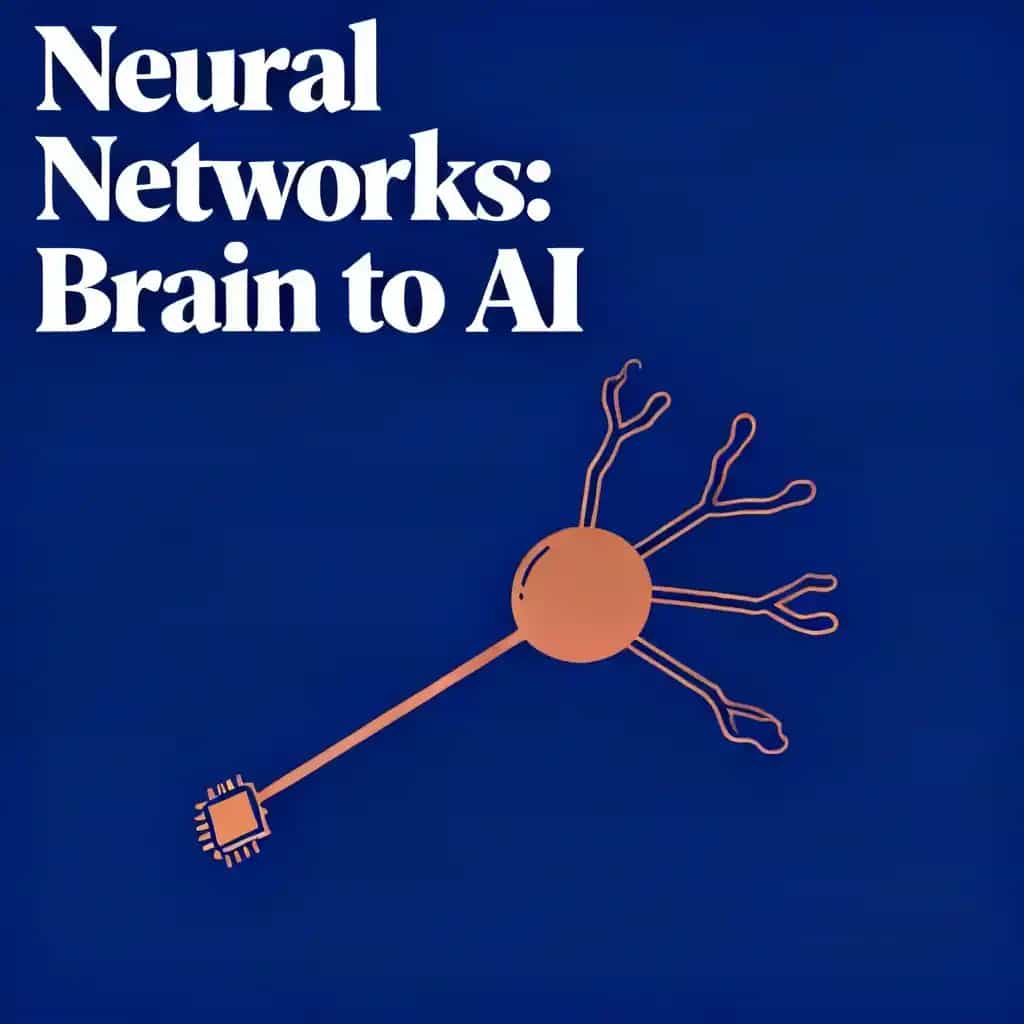
If AI is inspired by the brain, why do so many projects fail? Learn how stacking neurons creates complex intelligence and how to avoid common traps.
Best quote from Neural networks and why depth matters
“
The 'magic' happens with the activation function—that little non-linear step at the end of the neuron’s calculation. Without it, the network is stuck in a world of flat planes and straight lines; with it, it can model folds, twists, and complex pockets in the data.
”
K
Generated by Kira
Input question
Neural networks (AI)
Host voices
Lena
Miles
Knowledge sources
Frequently Asked Questions
While a single neuron acts as a linear gatekeeper only capable of drawing straight lines to separate data, complexity arises when they are stacked into layers. The "magic" that allows these networks to represent curves, spirals, and complex decision boundaries is the activation function. This non-linear step at the end of a neuron's calculation allows the network to "bend" the mathematical space, moving from flat planes to modeled folds and twists, much like the difference between a flat piece of paper and origami.
Backpropagation is the mathematical method used to assign "blame" for errors back through the layers of a network. Since a model can have millions of weights, it uses the chain rule from calculus to calculate the sensitivity of each connection to the final error. By calculating these derivatives from the output layer backward, the network identifies exactly how much each weight contributed to an incorrect prediction. This efficiency allows the system to update millions of parameters without having to recalculate the entire chain for every single change.
According to the Universal Approximation Theorem, a shallow network with one hidden layer can theoretically approximate any function, but doing so would require an astronomical, practically infinite number of neurons. Deep learning is more efficient because it creates a hierarchy of features through "feature reuse." Lower layers detect basic patterns like edges or shapes, while higher layers combine those patterns into complex concepts like faces or objects. This hierarchical structure mirrors human perception and makes complex reasoning computationally feasible.
Overfitting occurs when a model is too powerful for its dataset and begins to "memorize" specific noise and quirks rather than learning general rules. To prevent this, architects use a "validation set" to monitor when the model stops generalizing to new data. They also employ "regularization" techniques, such as adding complexity penalties to the math or using "Dropout"—randomly turning off neurons during training. These methods force the network to find the simplest, most resilient explanations for the data rather than relying on insignificant details.
From Columbia University alumni | built in San Francisco
BeFreed Brings Together A Global Community Of Curious Minds
4.7
avg rating
7.84k+ App Rating
BeFreed Community
Seriously I haven’t even explored this app fully yet but from using it the last few days I am so impressed... BeFreed is on a different level from any other learning app I have used. This makes it ultra engaging and can actually improve your concentration which is great for all the doom scrollers!
@ladyInfinity
I bought BeFreed exactly 23 days ago, and I have used it every single day since. It has completely embedded itself into my daily workflow and learning habit.
@jayallen
The truth is, the app has exceeded all my expectations. I can ask it to generate audio on any topic, whatever it may be, and the result is impressive. My professional field is a specialization in psychotherapy and it is multidisciplinary; however, the answers are very accurate.
@Raguipa
What I appreciate most is how much it's reduced my scrolling – I'm spending less time searching and more time absorbing information. The combination of full audiobooks, podcasts, the learning plans are brilliant.
@colonyofcreatorsNGO
I have been a PhotoReading Accelerated Learning Instructor for the past 24 years... books and reading and learning are my thing, and BeFreed has done a great job in providing an innovative approach to disseminating and delivering information in an easy to consume way.
@BeFreed user
It is not just a book summary app, I have used the 'fun reading' option and it's a much better summary and way to grasp ideas the traditional way, that alone is worth this deal.
@austinakon
I love this app. Used it for several days and I cannot stop listening. Such a great way to start.
@jcrules328
I really like the program; I have already tested it for around one month, and I feel that it's an amazing gem. It works so well because I can use BeFreed to create my own topics, and the voice is so good with unlimited choice of narrations.
@DanielCZ
Seriously I haven’t even explored this app fully yet but from using it the last few days I am so impressed... BeFreed is on a different level from any other learning app I have used. This makes it ultra engaging and can actually improve your concentration which is great for all the doom scrollers!
@ladyInfinity
I bought BeFreed exactly 23 days ago, and I have used it every single day since. It has completely embedded itself into my daily workflow and learning habit.
@jayallen
The truth is, the app has exceeded all my expectations. I can ask it to generate audio on any topic, whatever it may be, and the result is impressive. My professional field is a specialization in psychotherapy and it is multidisciplinary; however, the answers are very accurate.
@Raguipa
What I appreciate most is how much it's reduced my scrolling – I'm spending less time searching and more time absorbing information. The combination of full audiobooks, podcasts, the learning plans are brilliant.
@colonyofcreatorsNGO
I have been a PhotoReading Accelerated Learning Instructor for the past 24 years... books and reading and learning are my thing, and BeFreed has done a great job in providing an innovative approach to disseminating and delivering information in an easy to consume way.
@BeFreed user
It is not just a book summary app, I have used the 'fun reading' option and it's a much better summary and way to grasp ideas the traditional way, that alone is worth this deal.
@austinakon
I love this app. Used it for several days and I cannot stop listening. Such a great way to start.
@jcrules328
I really like the program; I have already tested it for around one month, and I feel that it's an amazing gem. It works so well because I can use BeFreed to create my own topics, and the voice is so good with unlimited choice of narrations.
@DanielCZ
I love the fact that I can get useful, condensed, information and ideas in a 8 - 15 minute podcast style audio. I'm not a general fan of podcasts because of all the fluff, but this cuts through all that.
@BeFreed user
I am finishing up my doctorate, and have to read a lot of unfamiliar material... With BeFreed, you simply enter a prompt, and the app finds source material for you and generates an audio podcast. I find the process in BeFreed to be more streamlined than NotebookLM.
@Brad
I often search YouTube for something to listen to whilst making breakfast, when I'm out walking, commuting, etc, and BeFreed has provided an even more targeted approach, without the adverts and the fluff!
@BeFreed user
The absolute best part about this platform is its versatility. There is literally no subject that is off-topic. It handles whatever you throw at it... It is rare to find an learning tool with zero limitations that actually delivers on its promises.
@jayallen
BeFreed is fantastic. The user-friendly design means I spend less time navigating and more time learning. The mix of audiobooks, podcasts, and learning plans is a genius combo that has completely changed my daily routine.
@BeFreed user
At the start I needed a while to understand how to create podcasts in italian language and boom! It is so great! I can ask to explain every argument and it does so well and so smartly!
@matteo77
BeFreed has become my daily app for audio books tools... What I like the most is the way you put your text and come with an audio that you can listen on the go.
@kotanzu1
I love the fact that I can get useful, condensed, information and ideas in a 8 - 15 minute podcast style audio. I'm not a general fan of podcasts because of all the fluff, but this cuts through all that.
@BeFreed user
I am finishing up my doctorate, and have to read a lot of unfamiliar material... With BeFreed, you simply enter a prompt, and the app finds source material for you and generates an audio podcast. I find the process in BeFreed to be more streamlined than NotebookLM.
@Brad
I often search YouTube for something to listen to whilst making breakfast, when I'm out walking, commuting, etc, and BeFreed has provided an even more targeted approach, without the adverts and the fluff!
@BeFreed user
The absolute best part about this platform is its versatility. There is literally no subject that is off-topic. It handles whatever you throw at it... It is rare to find an learning tool with zero limitations that actually delivers on its promises.
@jayallen
BeFreed is fantastic. The user-friendly design means I spend less time navigating and more time learning. The mix of audiobooks, podcasts, and learning plans is a genius combo that has completely changed my daily routine.
@BeFreed user
At the start I needed a while to understand how to create podcasts in italian language and boom! It is so great! I can ask to explain every argument and it does so well and so smartly!
@matteo77
BeFreed has become my daily app for audio books tools... What I like the most is the way you put your text and come with an audio that you can listen on the go.
Discover how artificial neural networks mimic human brains to power everything from face recognition to self-driving cars. Learn the elegant math behind machine intelligence and explore real-world applications transforming our daily lives.
Journey from AI's theoretical origins to today's breakthroughs. Nia and Eli decode neural networks, explore real applications, and reveal how humans and machines can work together to shape our intelligent future.
Struggling to understand how neurons create consciousness? Learn how biological models bridge the gap between AI and human thought to predict brain health.
Explore the eight core limitations holding back AI progress that experts can't agree on—from hallucinations to energy costs—and discover why the future might be more complex than either optimists or pessimists predict.
Explore the evolution of neural networks from their 1965 origins through the AI winter to today's revolution, as we unpack how these brain-inspired systems are transforming technology across industries.
















![[f9b5853f-e5ae-4e34-9579-a74604076aac:c0000] If you accept as the truth that we're going to be running… p1-1](/_next/image?url=https%3A%2F%2Fd1y2du6z1jfm9e.cloudfront.net%2Fassets%2Fpodcast%2Fyellow.png&w=1024&q=50)