Microeconomics: The Science of Scarcity and Constrained Optimization
Explore microeconomics with John Gruber as we dive into the science of scarcity, constrained optimization, and how trade-offs shape our daily decision-making.
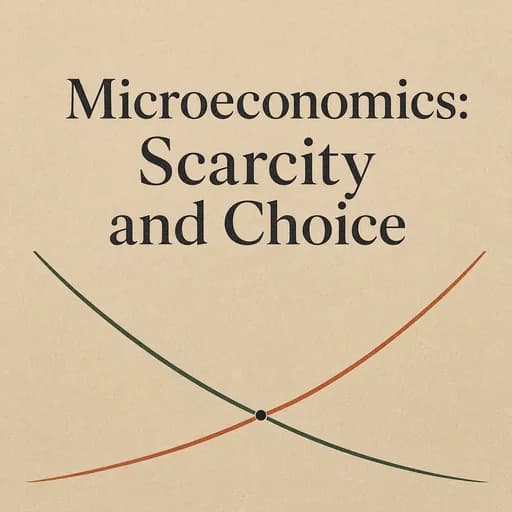
Best quote from Microeconomics: The Science of Scarcity and Constrained Optimization
Microeconomics is just taking engineering principles and applying them to businesses and human lives. It’s like building a robot, but the robot is your career or your company.
Generated by Yashvi
Provide a deep dive into the topics discussed in the video: https://youtu.be/_OkTw766oCs?si=YtmgQhrbYaFyvYOe. Explore the core concepts, underlying logic, and context in detail.





![[PDF] Some Hypotheses on How Tractability Has Shaped Economic Models](https://d1y2du6z1jfm9e.cloudfront.net/assets/podcast/blue.png)
Frequently Asked Questions
The core focus of this discussion is how individuals and firms navigate a world of scarcity. Based on John Gruber's framing, microeconomics is the study of how we make decisions when faced with limited resources like time, money, and energy. It explores the concept of constrained optimization, where we attempt to live our best lives and maximize happiness while working within a specific 'starter pack' of available resources.
John Gruber acknowledges the traditional label of economics as the 'dismal science' but rebrands it as a form of engineering for people's lives. He describes it as the science of scarcity or even the 'science of FOMO.' By focusing on how people actually tick, he explains that microeconomics is about understanding the mechanics of human choices and the trade-offs required to stay afloat in a resource-constrained environment.
Constrained optimization is the process of trying to achieve the best possible outcome under specific limitations. In microeconomics, this means recognizing that because we do not have infinite resources, every choice to spend time or money on one thing—like binge-watching a show—is an optimization of happiness that prevents us from doing something else. It is the fundamental way individuals and firms manage trade-offs to balance their competing needs and desires.
From Columbia University alumni built in San Francisco
"Instead of endless scrolling, I just hit play on BeFreed. It saves me so much time."


"I never knew where to start with nonfiction—BeFreed’s book lists turned into podcasts gave me a clear path."


"Perfect balance between learning and entertainment. Finished ‘Thinking, Fast and Slow’ on my commute this week."
"Crazy how much I learned while walking the dog. BeFreed = small habits → big gains."
"Reading used to feel like a chore. Now it’s just part of my lifestyle."

"Feels effortless compared to reading. I’ve finished 6 books this month already."
"BeFreed turned my guilty doomscrolling into something that feels productive and inspiring."

"BeFreed turned my commute into learning time. 20-min podcasts are perfect for finishing books I never had time for."
"BeFreed replaced my podcast queue. Imagine Spotify for books — that’s it. 🙌"

"It is great for me to learn something from the book without reading it."
"The themed book list podcasts help me connect ideas across authors—like a guided audio journey."
"Makes me feel smarter every time before going to work"
 Ask ChatGPT
 Ask Claude
From Columbia University alumni built in San Francisco
"Instead of endless scrolling, I just hit play on BeFreed. It saves me so much time."
"I never knew where to start with nonfiction—BeFreed’s book lists turned into podcasts gave me a clear path."
"Perfect balance between learning and entertainment. Finished ‘Thinking, Fast and Slow’ on my commute this week."
"Crazy how much I learned while walking the dog. BeFreed = small habits → big gains."
"Reading used to feel like a chore. Now it’s just part of my lifestyle."
"Feels effortless compared to reading. I’ve finished 6 books this month already."
"BeFreed turned my guilty doomscrolling into something that feels productive and inspiring."
"BeFreed turned my commute into learning time. 20-min podcasts are perfect for finishing books I never had time for."
"BeFreed replaced my podcast queue. Imagine Spotify for books — that’s it. 🙌"
"It is great for me to learn something from the book without reading it."
"The themed book list podcasts help me connect ideas across authors—like a guided audio journey."
"Makes me feel smarter every time before going to work"
"Instead of endless scrolling, I just hit play on BeFreed. It saves me so much time."
"I never knew where to start with nonfiction—BeFreed’s book lists turned into podcasts gave me a clear path."
"Perfect balance between learning and entertainment. Finished ‘Thinking, Fast and Slow’ on my commute this week."
"Crazy how much I learned while walking the dog. BeFreed = small habits → big gains."
"Reading used to feel like a chore. Now it’s just part of my lifestyle."
"Feels effortless compared to reading. I’ve finished 6 books this month already."
"BeFreed turned my guilty doomscrolling into something that feels productive and inspiring."
"BeFreed turned my commute into learning time. 20-min podcasts are perfect for finishing books I never had time for."
"BeFreed replaced my podcast queue. Imagine Spotify for books — that’s it. 🙌"
"It is great for me to learn something from the book without reading it."
"The themed book list podcasts help me connect ideas across authors—like a guided audio journey."
"Makes me feel smarter every time before going to work"
"Instead of endless scrolling, I just hit play on BeFreed. It saves me so much time."
"I never knew where to start with nonfiction—BeFreed’s book lists turned into podcasts gave me a clear path."
"Perfect balance between learning and entertainment. Finished ‘Thinking, Fast and Slow’ on my commute this week."
"Crazy how much I learned while walking the dog. BeFreed = small habits → big gains."
"Reading used to feel like a chore. Now it’s just part of my lifestyle."
"Feels effortless compared to reading. I’ve finished 6 books this month already."
"BeFreed turned my guilty doomscrolling into something that feels productive and inspiring."
"BeFreed turned my commute into learning time. 20-min podcasts are perfect for finishing books I never had time for."
"BeFreed replaced my podcast queue. Imagine Spotify for books — that’s it. 🙌"
"It is great for me to learn something from the book without reading it."
"The themed book list podcasts help me connect ideas across authors—like a guided audio journey."
"Makes me feel smarter every time before going to work"