Markov Blankets: The Science of Boundaries and Selfhood
Explore Markov blankets and the science of boundaries. Learn how Judea Pearl and Karl Friston use Bayesian networks to define selfhood and system identity.
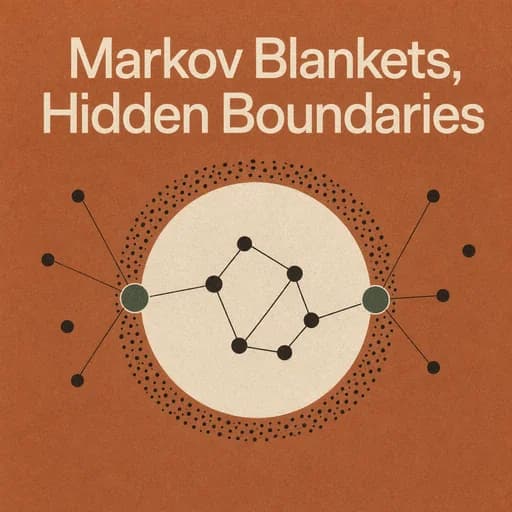
Best quote from Markov Blankets: The Science of Boundaries and Selfhood
You aren't your molecules; you’re the statistical boundary that manages them. You exist because you maintain a Markov blanket that separates your internal 'beliefs' from the external chaos.
Generated by Meindert
A deep, broad, and thorough explanation of Markov Blankets, focusing on the fundamental concept of what they are and how they define boundaries between a system and its environment. The explanation should be straightforward, with each section building on the last for full comprehension, using clear language suitable for a general adult audience without mentioning age.






Frequently Asked Questions
A Markov blanket is a statistical concept used to define the boundary between a system and its environment. Originally derived from Judea Pearl’s work on Bayesian networks, it provides a mathematical answer to what makes a 'thing' a distinct entity. Without these blankets, the universe would appear as an undifferentiated soup of particles; instead, this framework allows us to define specific systems like cells, brains, or even entire societies.
The theory of selfhood explores where an individual ends and the rest of the world begins. While we often point to skin as a boundary, biological realities like sloughing cells and essential gut bacteria make that line blurry. Researchers like Karl Friston have applied the Markov blanket concept to create a foundational theory of selfhood, explaining how distinct systems maintain their identity despite constant interaction with the outside world.
The concept of the Markov blanket originated in the 1980s with Judea Pearl, who developed it within the study of Bayesian networks. Since then, the theory has been expanded significantly by figures such as Karl Friston. Friston transitioned the concept from a high-level mathematical tool into a foundational theory used to understand biological boundaries, system identity, and the very nature of how we define ourselves as distinct from our environment.
From Columbia University alumni built in San Francisco
"Instead of endless scrolling, I just hit play on BeFreed. It saves me so much time."


"I never knew where to start with nonfiction—BeFreed’s book lists turned into podcasts gave me a clear path."


"Perfect balance between learning and entertainment. Finished ‘Thinking, Fast and Slow’ on my commute this week."
"Crazy how much I learned while walking the dog. BeFreed = small habits → big gains."
"Reading used to feel like a chore. Now it’s just part of my lifestyle."

"Feels effortless compared to reading. I’ve finished 6 books this month already."
"BeFreed turned my guilty doomscrolling into something that feels productive and inspiring."

"BeFreed turned my commute into learning time. 20-min podcasts are perfect for finishing books I never had time for."
"BeFreed replaced my podcast queue. Imagine Spotify for books — that’s it. 🙌"

"It is great for me to learn something from the book without reading it."
"The themed book list podcasts help me connect ideas across authors—like a guided audio journey."
"Makes me feel smarter every time before going to work"
From Columbia University alumni built in San Francisco
"Instead of endless scrolling, I just hit play on BeFreed. It saves me so much time."
"I never knew where to start with nonfiction—BeFreed’s book lists turned into podcasts gave me a clear path."
"Perfect balance between learning and entertainment. Finished ‘Thinking, Fast and Slow’ on my commute this week."
"Crazy how much I learned while walking the dog. BeFreed = small habits → big gains."
"Reading used to feel like a chore. Now it’s just part of my lifestyle."
"Feels effortless compared to reading. I’ve finished 6 books this month already."
"BeFreed turned my guilty doomscrolling into something that feels productive and inspiring."
"BeFreed turned my commute into learning time. 20-min podcasts are perfect for finishing books I never had time for."
"BeFreed replaced my podcast queue. Imagine Spotify for books — that’s it. 🙌"
"It is great for me to learn something from the book without reading it."
"The themed book list podcasts help me connect ideas across authors—like a guided audio journey."
"Makes me feel smarter every time before going to work"
"Instead of endless scrolling, I just hit play on BeFreed. It saves me so much time."
"I never knew where to start with nonfiction—BeFreed’s book lists turned into podcasts gave me a clear path."
"Perfect balance between learning and entertainment. Finished ‘Thinking, Fast and Slow’ on my commute this week."
"Crazy how much I learned while walking the dog. BeFreed = small habits → big gains."
"Reading used to feel like a chore. Now it’s just part of my lifestyle."
"Feels effortless compared to reading. I’ve finished 6 books this month already."
"BeFreed turned my guilty doomscrolling into something that feels productive and inspiring."
"BeFreed turned my commute into learning time. 20-min podcasts are perfect for finishing books I never had time for."
"BeFreed replaced my podcast queue. Imagine Spotify for books — that’s it. 🙌"
"It is great for me to learn something from the book without reading it."
"The themed book list podcasts help me connect ideas across authors—like a guided audio journey."
"Makes me feel smarter every time before going to work"
"Instead of endless scrolling, I just hit play on BeFreed. It saves me so much time."
"I never knew where to start with nonfiction—BeFreed’s book lists turned into podcasts gave me a clear path."
"Perfect balance between learning and entertainment. Finished ‘Thinking, Fast and Slow’ on my commute this week."
"Crazy how much I learned while walking the dog. BeFreed = small habits → big gains."
"Reading used to feel like a chore. Now it’s just part of my lifestyle."
"Feels effortless compared to reading. I’ve finished 6 books this month already."
"BeFreed turned my guilty doomscrolling into something that feels productive and inspiring."
"BeFreed turned my commute into learning time. 20-min podcasts are perfect for finishing books I never had time for."
"BeFreed replaced my podcast queue. Imagine Spotify for books — that’s it. 🙌"
"It is great for me to learn something from the book without reading it."
"The themed book list podcasts help me connect ideas across authors—like a guided audio journey."
"Makes me feel smarter every time before going to work"