Love at First Sight: Spark or Science?
Is that instant spark destiny or just a biological calculation? Explore the data behind the gaze and how to turn a sudden rush into a lasting bond.
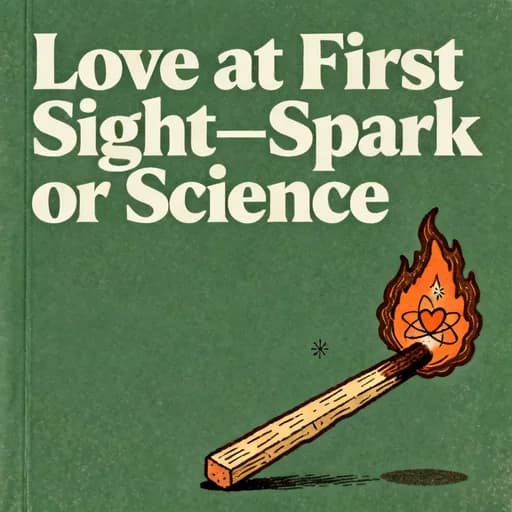
Best quote from Love at First Sight: Spark or Science?
Love at first sight is essentially a 0.2-second drug hit where the brain’s reward system lights up for a high-value visual stimulus, but it has zero predictive value for whether a relationship will actually work.
Generated with BeFreed
The Truth About Love at First Sight






Frequently Asked Questions
While the intense feeling is real, science suggests it is not actually "love" in the sense of deep intimacy or commitment. Instead, it is a high-speed biological calculation where the brain releases a cocktail of chemicals like dopamine, oxytocin, and adrenaline in about 0.2 seconds. Research indicates that what people experience is typically "lust at first sight," triggered primarily by physical attraction and visual cues rather than a cosmic or soulful connection.
Researchers often categorize these stories as "confabulated memories" or "positive illusions." Couples who are currently happy and passionate tend to project their present feelings of love back onto their first meeting to create a more destined and unique origin story. This hindsight bias is actually functional, as it helps strengthen the relationship's narrative and long-term stability, even if the initial attraction was not actually mutual or deeply emotional at the time.
High-tech eye-tracking studies show a significant disconnect between what people say they want and what they actually look at. While people claim to value personality or specific traits, their eyes automatically fixate on "expressive anchors" like faces and "grooming cues" such as hairstyles or beards. Additionally, people often spend a surprising amount of time scanning "same-sex targets" for social comparison and analyzing physical markers like shoulder width or waist-to-hip ratios to calculate mating potential.
The primary difference lies in the transition from "fear-based performance" to "emotional safety." Lust is often ego-driven, focused on the present, and characterized by an obsessive need to present the best version of oneself. Real love is collaborative and builds over time through vulnerability and shared future planning. Experts suggest that because the initial hormonal rush usually fades within three to six months, a relationship's longevity depends on whether the couple has built emotional intimacy during that window.
Data from speed dating events suggests that "love at first sight" is almost never reciprocal in the moment; usually, one person feels an intense reaction while the other does not. However, this doesn't mean the relationship is doomed. While the initial spark is a powerful launchpad that can lead to more passionate relationships later on, it has zero predictive value for long-term success. A lasting bond is formed through earned trust and reciprocity rather than a simultaneous lightning bolt of attraction.
From Columbia University alumni built in San Francisco
"Instead of endless scrolling, I just hit play on BeFreed. It saves me so much time."


"I never knew where to start with nonfiction—BeFreed’s book lists turned into podcasts gave me a clear path."


"Perfect balance between learning and entertainment. Finished ‘Thinking, Fast and Slow’ on my commute this week."
"Crazy how much I learned while walking the dog. BeFreed = small habits → big gains."
"Reading used to feel like a chore. Now it’s just part of my lifestyle."

"Feels effortless compared to reading. I’ve finished 6 books this month already."
"BeFreed turned my guilty doomscrolling into something that feels productive and inspiring."

"BeFreed turned my commute into learning time. 20-min podcasts are perfect for finishing books I never had time for."
"BeFreed replaced my podcast queue. Imagine Spotify for books — that’s it. 🙌"

"It is great for me to learn something from the book without reading it."
"The themed book list podcasts help me connect ideas across authors—like a guided audio journey."
"Makes me feel smarter every time before going to work"
From Columbia University alumni built in San Francisco
"Instead of endless scrolling, I just hit play on BeFreed. It saves me so much time."
"I never knew where to start with nonfiction—BeFreed’s book lists turned into podcasts gave me a clear path."
"Perfect balance between learning and entertainment. Finished ‘Thinking, Fast and Slow’ on my commute this week."
"Crazy how much I learned while walking the dog. BeFreed = small habits → big gains."
"Reading used to feel like a chore. Now it’s just part of my lifestyle."
"Feels effortless compared to reading. I’ve finished 6 books this month already."
"BeFreed turned my guilty doomscrolling into something that feels productive and inspiring."
"BeFreed turned my commute into learning time. 20-min podcasts are perfect for finishing books I never had time for."
"BeFreed replaced my podcast queue. Imagine Spotify for books — that’s it. 🙌"
"It is great for me to learn something from the book without reading it."
"The themed book list podcasts help me connect ideas across authors—like a guided audio journey."
"Makes me feel smarter every time before going to work"
"Instead of endless scrolling, I just hit play on BeFreed. It saves me so much time."
"I never knew where to start with nonfiction—BeFreed’s book lists turned into podcasts gave me a clear path."
"Perfect balance between learning and entertainment. Finished ‘Thinking, Fast and Slow’ on my commute this week."
"Crazy how much I learned while walking the dog. BeFreed = small habits → big gains."
"Reading used to feel like a chore. Now it’s just part of my lifestyle."
"Feels effortless compared to reading. I’ve finished 6 books this month already."
"BeFreed turned my guilty doomscrolling into something that feels productive and inspiring."
"BeFreed turned my commute into learning time. 20-min podcasts are perfect for finishing books I never had time for."
"BeFreed replaced my podcast queue. Imagine Spotify for books — that’s it. 🙌"
"It is great for me to learn something from the book without reading it."
"The themed book list podcasts help me connect ideas across authors—like a guided audio journey."
"Makes me feel smarter every time before going to work"
"Instead of endless scrolling, I just hit play on BeFreed. It saves me so much time."
"I never knew where to start with nonfiction—BeFreed’s book lists turned into podcasts gave me a clear path."
"Perfect balance between learning and entertainment. Finished ‘Thinking, Fast and Slow’ on my commute this week."
"Crazy how much I learned while walking the dog. BeFreed = small habits → big gains."
"Reading used to feel like a chore. Now it’s just part of my lifestyle."
"Feels effortless compared to reading. I’ve finished 6 books this month already."
"BeFreed turned my guilty doomscrolling into something that feels productive and inspiring."
"BeFreed turned my commute into learning time. 20-min podcasts are perfect for finishing books I never had time for."
"BeFreed replaced my podcast queue. Imagine Spotify for books — that’s it. 🙌"
"It is great for me to learn something from the book without reading it."
"The themed book list podcasts help me connect ideas across authors—like a guided audio journey."
"Makes me feel smarter every time before going to work"