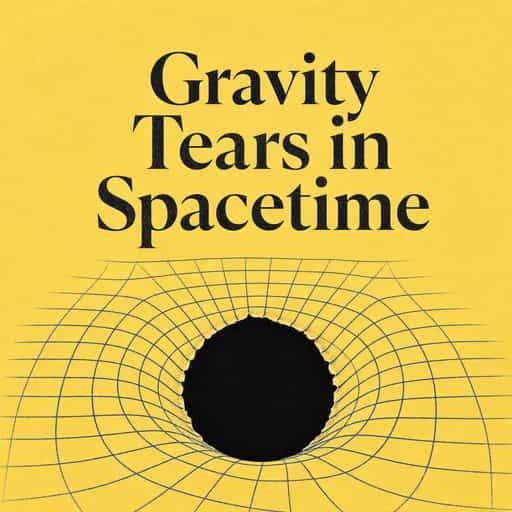
Is the holographic universe a projection of 2D data?
If 3D reality feels solid, why does physics suggest it's a 2D projection? Explore how black holes and quantum information reveal our cosmic code.

Best quote from Is the holographic universe a projection of 2D data?
The 3D world we see might be a projection of information encoded on a distant, two-dimensional boundary. It shifts the focus from matter to information, as if physical objects are just the output of a program running on the edges of space.
Generated by Entropy
In depth, but easy to understand overview of the holographic universe theory.



Frequently Asked Questions
The holographic principle suggests that our three-dimensional universe is actually a projection of information encoded on a distant, two-dimensional boundary. Similar to how a 2D credit card chip can display a 3D shimmering image, this theory proposes that the volume of space we experience is an emergent "user interface" derived from a deeper 2D data set. This concept originated from studying black holes, where scientists discovered that the information a black hole holds is proportional to its surface area rather than its internal volume.
Physicists like Mark Van Raamsdonk have proposed that space is woven together by quantum entanglement, the "spooky action at a distance" where particles remain linked regardless of separation. Mathematical models show that if you "turn off" the entanglement between particles on the 2D boundary, the 3D space in the interior literally tears apart and vanishes. This suggests that our physical sense of distance and the fabric of spacetime are actually reflections of how much quantum information is shared between different points.
The AdS/CFT correspondence is a mathematical discovery by Juan Maldacena that proves a universe with gravity (the "bulk") is mathematically identical to a quantum theory without gravity sitting on its boundary. This "duality" allows physicists to solve complex gravity problems by translating them into the simpler language of particle interactions on a flat surface. While it was originally developed using a "toy model" of a saddle-shaped universe, it provides a rigorous mathematical bridge between Einstein’s theory of gravity and quantum mechanics.
Yes, the script explains that our observable universe—often called a "static patch"—has a finite cosmic horizon with a limited surface area. According to the Gibbons-Hawking entropy, this means there is a hard limit on the total amount of information or "bandwidth" that can exist within our view. As the universe expands and objects move beyond this horizon, we effectively lose access to that data, suggesting the universe functions like a system with a bounded storage capacity and a specific "clock speed" defined by the speed of light.
The holonomic brain theory suggests that the human brain processes and stores memories holographically rather than in specific physical locations. Just as every part of a holographic plate contains the data for the whole image, the brain may transform sensory input into spectral frequencies to create a coherent internal "scene." This implies a "double hologram" effect: the universe projects a 3D reality from 2D data, and our brains act as holographic receivers that reconstruct a personal model of that world to help us navigate it.
From Columbia University alumni built in San Francisco
"Instead of endless scrolling, I just hit play on BeFreed. It saves me so much time."


"I never knew where to start with nonfiction—BeFreed’s book lists turned into podcasts gave me a clear path."


"Perfect balance between learning and entertainment. Finished ‘Thinking, Fast and Slow’ on my commute this week."
"Crazy how much I learned while walking the dog. BeFreed = small habits → big gains."
"Reading used to feel like a chore. Now it’s just part of my lifestyle."

"Feels effortless compared to reading. I’ve finished 6 books this month already."
"BeFreed turned my guilty doomscrolling into something that feels productive and inspiring."

"BeFreed turned my commute into learning time. 20-min podcasts are perfect for finishing books I never had time for."
"BeFreed replaced my podcast queue. Imagine Spotify for books — that’s it. 🙌"

"It is great for me to learn something from the book without reading it."
"The themed book list podcasts help me connect ideas across authors—like a guided audio journey."
"Makes me feel smarter every time before going to work"
 Ask ChatGPT
 Ask Claude
From Columbia University alumni built in San Francisco
"Instead of endless scrolling, I just hit play on BeFreed. It saves me so much time."
"I never knew where to start with nonfiction—BeFreed’s book lists turned into podcasts gave me a clear path."
"Perfect balance between learning and entertainment. Finished ‘Thinking, Fast and Slow’ on my commute this week."
"Crazy how much I learned while walking the dog. BeFreed = small habits → big gains."
"Reading used to feel like a chore. Now it’s just part of my lifestyle."
"Feels effortless compared to reading. I’ve finished 6 books this month already."
"BeFreed turned my guilty doomscrolling into something that feels productive and inspiring."
"BeFreed turned my commute into learning time. 20-min podcasts are perfect for finishing books I never had time for."
"BeFreed replaced my podcast queue. Imagine Spotify for books — that’s it. 🙌"
"It is great for me to learn something from the book without reading it."
"The themed book list podcasts help me connect ideas across authors—like a guided audio journey."
"Makes me feel smarter every time before going to work"
"Instead of endless scrolling, I just hit play on BeFreed. It saves me so much time."
"I never knew where to start with nonfiction—BeFreed’s book lists turned into podcasts gave me a clear path."
"Perfect balance between learning and entertainment. Finished ‘Thinking, Fast and Slow’ on my commute this week."
"Crazy how much I learned while walking the dog. BeFreed = small habits → big gains."
"Reading used to feel like a chore. Now it’s just part of my lifestyle."
"Feels effortless compared to reading. I’ve finished 6 books this month already."
"BeFreed turned my guilty doomscrolling into something that feels productive and inspiring."
"BeFreed turned my commute into learning time. 20-min podcasts are perfect for finishing books I never had time for."
"BeFreed replaced my podcast queue. Imagine Spotify for books — that’s it. 🙌"
"It is great for me to learn something from the book without reading it."
"The themed book list podcasts help me connect ideas across authors—like a guided audio journey."
"Makes me feel smarter every time before going to work"
"Instead of endless scrolling, I just hit play on BeFreed. It saves me so much time."
"I never knew where to start with nonfiction—BeFreed’s book lists turned into podcasts gave me a clear path."
"Perfect balance between learning and entertainment. Finished ‘Thinking, Fast and Slow’ on my commute this week."
"Crazy how much I learned while walking the dog. BeFreed = small habits → big gains."
"Reading used to feel like a chore. Now it’s just part of my lifestyle."
"Feels effortless compared to reading. I’ve finished 6 books this month already."
"BeFreed turned my guilty doomscrolling into something that feels productive and inspiring."
"BeFreed turned my commute into learning time. 20-min podcasts are perfect for finishing books I never had time for."
"BeFreed replaced my podcast queue. Imagine Spotify for books — that’s it. 🙌"
"It is great for me to learn something from the book without reading it."
"The themed book list podcasts help me connect ideas across authors—like a guided audio journey."
"Makes me feel smarter every time before going to work"


![[da9a7a32-2c81-459d-9d3d-aae744c3c285:c0002] Everything you are, everything you do, everything you see… p1-1](/_next/image?url=https%3A%2F%2Fd1y2du6z1jfm9e.cloudfront.net%2Fassets%2Fpodcast%2Fblue.png&w=1024&q=50)