How to Build LLM Agents for Automated Digital Solutions

Building LLM agents for workflow automation: episode overview
This BeFreed audio guide explores the practical architecture behind autonomous AI agents. Rather than focusing on theoretical concepts, we dive into the fundamental building blocks of agentic systems, including how to structure tool use, manage state, and orchestrate multiple agents to handle complex business workflows safely.
Create Your Podcast in a Click
Generated by Patrick
Input question
How to build llm agents that can produce any digital solution, use all communication channels, schedule workflows and automate almost anything because they can integrate any tech or tool by just asking for it
Host voices

What you'll learn about LLM agent architecture and automation
- 1
Beyond Prompts: Building Autonomous Agents
 00:0000:00
Lena: Hey Miles, I was just thinking about how many of us use AI as basically a glorified search engine. You ask a question, it gives you text. But have you seen what’s happening with actual agents lately? Miles: It’s a massive shift, Lena. We’re moving from "chatbots with autocomplete" to systems that actually own a goal. I mean, think about a support ticket. A human might spend 10 minutes jumping between Stripe and a database just to triage it. An agent can sequence those tools and finish the whole workflow in under two seconds. Lena: Two seconds! That’s wild. But the mistake most people make is just writing longer prompts, right? They think the "magic" is in the instructions. Miles: Exactly. But a real agent needs a toolbelt—APIs, shell commands, even browser automation. It’s about building a system that can plan, act, and remember. Lena: So let’s explore how to move beyond simple prompts and actually build these autonomous loops.
- 2
The Spectrum of Agency: Balancing Workflows and Autonomy
Lena: You know, Miles, that distinction you just made—about the toolbelt versus the instructions—it really highlights how we need to think about architecture differently. I was looking at some of the design patterns in the Dapr documentation, and they talk about this spectrum of agency. It’s not just "agent" or "not agent." It’s more of a gradual climb from a simple workflow to a fully autonomous system. Miles: That’s a great way to frame it. Think of it like a GPS versus a self-driving car. A GPS gives you a turn-by-turn workflow—it's prescriptive. A self-driving car has a goal—"get to the office"—and it has to dynamically navigate traffic, construction, and pedestrians. In the software world, we start with the Augmented LLM. That’s the baseline—the foundational building block where you take a standard model and give it memory and a few basic tools. Lena: Right, like a personal assistant that remembers you prefer decaf or a research tool that knows how to query a specific database. But Dapr suggests that even with those tools, if the steps are always the same, you’re still in a workflow. You’re just using an LLM to "talk" through the steps. Miles: Exactly. And for many enterprise tasks, that’s actually what you want. Reliability is king in business. If you’re processing an invoice, you don’t necessarily want the AI to "improvise" a new way to do it every Tuesday. You want a predictable path. Dapr calls this "Workflow as Code," where the LLM might be involved in specific nodes of the graph, but the path is defined by the developer. It’s durable, it’s recoverable, and if the server crashes, the workflow picks up exactly where it left off because the state is persisted. Lena: So, the goal isn't always "maximum autonomy." Sometimes the goal is "maximum predictability with a splash of intelligence." Miles: Spot on. But as tasks get messier—like, say, "Fix this bug in a codebase with ten thousand files"—a fixed workflow breaks down. You can’t write an if-then statement for every possible bug. That’s where you move further down the spectrum toward things like the Orchestrator-Workers pattern or the Durable Agent. Lena: I love the sound of "Durable Agent." It sounds like something that just won't quit. Miles: It literally won't! In the Dapr world, a Durable Agent is an autonomous entity that manages its own planning but is backed by a workflow engine. So even if it’s a long-running task that takes three days—maybe it’s waiting for a human to approve a budget or waiting for a third-party API to clear a rate limit—the agent "remembers" its progress perfectly. It’s not just living in the RAM of a single server; its state is in a persistent store. Lena: This is such a departure from the way most people think about AI. We’re used to these "one-and-done" interactions. You send a prompt, you get an answer. If you close the tab, it’s gone. But building a digital worker that can integrate any tech just by asking for it requires this memory layer. It’s like giving the AI a "long-term brain" that survives the restart of the system. Miles: And that brain needs to know how to use its hands—meaning the tools. I was reading a piece by Arun Baby about this "Brain-Body-Nervous System" architecture. The LLM is the brain, the tools are the body, and the "Nervous System" is the event-driven middleware—like Dapr or Kafka—that connects them. If the brain says "I need to check the inventory in the SQL database," the nervous system carries that signal to the body, the body executes the SQL query, and the result is sent back to the brain as an "observation." Lena: It’s fascinating because it separates the "thinking" from the "doing." The LLM doesn’t actually "know" how to connect to a database; it just knows how to ask for it in a way the system understands. Miles: Precisely. And that separation is what allows the agent to be "tech-agnostic." It doesn’t care if it’s talking to a 20-year-old COBOL system or a brand-new GraphQL API, as long as there’s a tool schema defined for it. It just asks, the nervous system provides, and the agent moves to the next step of its plan.
- 3
The Cognitive Blueprint: Brain, Body, and Nervous System
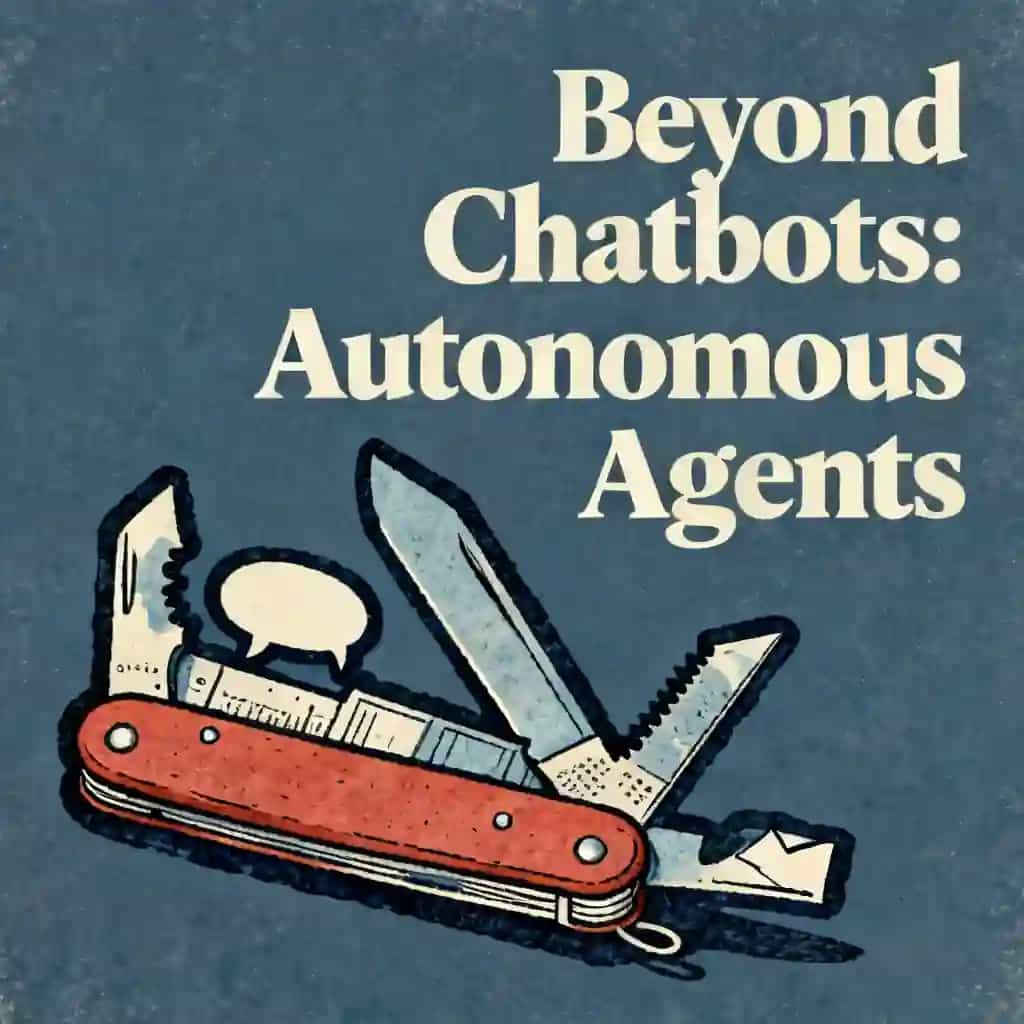
Lena: So if we take that "Brain-Body-Nervous System" analogy further, the real challenge isn't just getting the brain to speak; it’s making sure the "Nervous System" doesn’t fail when things get complicated. I was looking at how these systems handle scaling—like if you have a million agents running at once. You can’t just have a million open connections to a single database, right? Miles: No way. That would crash any traditional infrastructure. To support that kind of scale, you need what’s called an event-driven architecture. When the "Brain" makes a decision, it doesn't wait around in a "blocked" state for the tool to finish. It emits an event—say, "Search Google"—to an event bus like Redis Streams or Kafka. Then a separate worker, the "Body," picks up that event, does the work, and sends an "Observation" event back. Lena: That makes so much sense. It’s asynchronous. So the brain can "sleep" while the body is busy searching the web, which saves a ton of compute resources. Miles: Exactly. It’s about being "wise" enough to handle ambiguity. One of the big concepts in the literature is this idea of a memory hierarchy. Just like a computer has L1 cache and a hard drive, an agent needs different levels of memory. L1 is the immediate context window—what’s happening right now. L4 is a massive knowledge graph of everything the agent has ever learned about the business or the user. Lena: I noticed that Dapr handles memory persistence automatically, which is a huge relief for developers. But even with persistent memory, don’t these agents get "confused" if they have too much information? Like, if I tell an agent everything about my company’s history, and then ask it to just write a simple email, does it get bogged down in the details? Miles: That’s a real risk called "Context Collapse" or "Entropy Drift." As an agent runs for a long time, its memory becomes "polluted" with irrelevant stuff. The solution mentioned in the research is a "Dreamer" process—basically a background task that "prunes" the memory. It looks at all the raw observations and "crystallizes" them into facts. Instead of remembering ten different times you mentioned you like blue, it just stores one fact: "User Preference: Blue." Lena: Oh, I love that! It’s like a digital de-cluttering. It keeps the "Mental Model" lean so the reasoning stays sharp. Miles: It’s essential for building agents that can "automate almost anything." If an agent is going to integrate with your CRM, your email, and your project management tools, it’s going to encounter a lot of noise. Without that synaptic pruning—that "garbage collection of thoughts"—it’ll eventually start hallucinating because its "head" is too full of conflicting data. Lena: And speaking of integrating everything, we have to talk about how the agent actually "asks" for these tools. I was reading about the "Tool Sprawl" problem. If you give an LLM forty different tools at once, it gets overwhelmed. It’s like handing someone a Swiss Army knife with a thousand blades—they’ll probably cut themselves trying to find the scissors. Miles: That’s a perfect analogy. The "Selection Accuracy" drops as the number of tools increases. The model starts hallucinating parameters or just picks the wrong tool entirely. The fix is a three-layer architecture: Base Tools, Toolkits, and Dynamic Routing. Lena: So the "Base Tools" are the core skills—things like web search or basic memory management—that are always available? Miles: Right. Those are the "operating system" of the agent. Then you have "Toolkits," which are domain-specific modules. You might have a "Stripe Toolkit" and a "Salesforce Toolkit." The magic is in the "Dynamic Routing" layer. When you ask a question, a "Router" (which could be a smaller, faster model or even just a keyword matcher) looks at your intent and only "activates" the relevant toolkit. Lena: So if I say, "Check my latest invoices and email a summary to the team," the router sees "invoices" and "email," then only loads the Stripe and SendGrid tools into the agent’s context. The agent doesn't even see the tools for, I don’t know, controlling the office thermostat. Miles: Exactly! You’re keeping the context window clean. This reduces token costs significantly—because you’re not sending forty JSON schemas with every single prompt—and it keeps the agent’s focus razor-sharp. You can have hundreds of specialized tools stored in a registry, but the agent only ever "holds" the three or four it needs for the task at hand.
- Chapter 4
Orchestration Patterns: From Supervisors to Swarms
**Lena:** Okay, so we’ve got the brain-body architecture and the dynamic tool routing. But what happens when the task is just too big for one agent? Like the example in the sources about an "Agentic ERP" for global logistics. You’ve got port delays, trucking negotiations, financial ROI calculations—that feels like a lot for one "mind" to handle, even with a great toolkit. **Miles:** You’re moving into the world of Multi-Agent Orchestration. This is where you stop thinking about "the agent" and start thinking about "the team." There are a few different ways to organize this. The most common is the "Supervisor Pattern." Imagine one central agent—the Project Manager—who receives the big goal. It doesn't do the work itself; it delegates. It sends the "Research" task to one specialist, the "Coding" task to another, and the "QA" task to a third. **Lena:** I saw a similar idea called the "Orchestrator-Workers" pattern. It’s perfect for when you don't know how many sub-tasks there are going to be. The orchestrator looks at the input, realizes it needs to analyze five different files, and spins up five "workers" to handle them in parallel. **Miles:** Parallelization is huge for efficiency. If you’re building a complex digital solution, you don’t want to wait for the agent to do things one by one. You want it to fork off multiple child tasks—like, "Generate the UI," "Build the API," and "Write the Database Schema"—and then "Join" those results back together once they’re done. **Lena:** That sounds powerful, but how do they collaborate without stepping on each other's toes? Is there a shared workspace? **Miles:** There is! It’s often called the "Blackboard Pattern." Think of it like a literal whiteboard in a conference room. All the agents can see the current state of the project on the blackboard. A "Coder Agent" might post a snippet of code, and the "Tester Agent" is watching the blackboard. As soon as it sees new code, it grabs it, runs tests, and posts the results back to the board. **Lena:** That’s such a cool image. But who makes sure they don’t just argue forever? I remember reading about a "Debate" or "Consensus" pattern where agents actually argue different sides of a decision. **Miles:** Oh, the "Debate" pattern is fascinating. You might have one agent proposing a risky architectural change and another acting as the "Devil’s Advocate." A third agent, the "Judge" or "Chairperson," listens to both and makes the final call. It’s a great way to reduce hallucinations and avoid "Agentic Drift," where the system slowly moves away from the original goal because it got caught in a loop. **Lena:** Speaking of loops—that "Stochastic Loop of Doom" mentioned in the sources sounds terrifying. The agent gets an error, tries the same thing again, gets the same error, and just repeats it a thousand times, burning through your entire API budget in minutes. **Miles:** It happens more than you’d think! The fix is what’s called an "Entropy Monitor." You measure the "Semantic Distance" between the agent’s thoughts. If the last five thoughts are almost identical—meaning the agent is just saying "I should try again" over and over—the system triggers a "State Reset." It purges the short-term history, bumps up the "temperature" of the model to encourage more creative thinking, and injects a warning: "Hey, you’re stuck in a loop. Try a different tool or re-plan." **Lena:** It’s like a tap on the shoulder. "Hey, buddy, that’s not working. Try something else." **Miles:** Exactly. And that’s why "Observability" is so different for agents. You can’t just look at "HTTP 200" codes. You need "Semantic Tracing." You need to record the *rationale* behind every action. Why did the agent choose to search Google instead of looking in the database? If you don’t have that "Trace of Thought," you can’t debug why it failed. **Lena:** It really is like managing a person. You’re not just looking at their output; you’re looking at their reasoning. And that brings us to the "Evaluator-Optimizer" pattern. One model generates a solution, and another model—the critic—evaluates it against specific criteria. If it’s not good enough, it sends it back with feedback. It’s an iterative loop of refinement. **Miles:** That’s how you get high-quality code or content. It’s not about getting it right the first time; it’s about having a system that can self-correct until the "Success" criteria are met. It’s that shift from "prediction" to "outcomes."
Chapter 5Securing the Sandbox: Safety and PII in an Autonomous World
**Lena:** Miles, we’ve talked a lot about what these agents *can* do, but we have to talk about what they *shouldn't* do. If I’m building an agent that can "integrate any tech or tool," I’m essentially giving it the keys to my digital kingdom. That feels... a bit risky, right? If the agent has access to my company’s Slack, my Jira, and my database, how do I make sure it doesn't accidentally leak customer data or delete a production server? **Miles:** You’re hitting on the biggest hurdle for enterprise adoption. It’s the "Agentic Firewall" problem. You cannot just give an LLM raw access to your OS or your network. You have to use what’s called an "Isolated Sandbox." Think of tools like gVisor or AWS Firecracker. These are syscall-intercepting kernels that create a tiny, secure container for the agent’s "Body" to live in. **Lena:** So the agent *thinks* it’s running commands on a real computer, but it’s actually in a high-tech "playpen" where it can’t see the rest of the system? **Miles:** Exactly. It has zero-trust network policies. If it wants to call an API, it has to request a proxy token for a specific domain. It can’t just scan your internal network for open ports. And then there’s the PII—Personally Identifiable Information. You don’t want to send raw customer emails or SSNs to a third-party LLM provider like OpenAI or Anthropic. **Lena:** Right, that would be a massive compliance nightmare. So how do we handle that? **Miles:** We use "PII Masking at the Edge." Before any data leaves your secure environment and goes to the "Brain," it passes through a scrubber. Names, addresses, and private keys are replaced with tokens like `[NAME_1]` or `[SSN_TOKEN]`. The mapping is stored in your local, secure vault. The LLM sees the tokens, reasons about them—"Okay, I need to update the record for `[NAME_1]`"—and sends back the instruction. Then, your local system "unmasks" the token before actually making the database call. **Lena:** That’s clever! The "Brain" knows what it’s doing, but it doesn't actually see the sensitive data. It’s reasoning on an abstract level. **Miles:** It’s essential. And for really high-stakes actions—like merging code to the "main" branch or authorizing a $10,000 payment—you need a "Dual-Key Approval System." The agent produces a "Signed Intent" with its rationale. The system pauses the workflow and pings a human engineer. The human reviews the agent’s plan in a dashboard, and the action only executes after the human provides a digital signature. **Lena:** So the agent is autonomous, but it’s not *unsupervised*. It’s like an intern with a lot of power—you still want to sign off on the big stuff. **Miles:** Precisely. And that ties back to the idea of "Constitutional Code." You have a core set of safety guardrails that are stored in a read-only, hardware-protected region. No matter how much the agent "re-plans" or "evolves," it can never overwrite those fundamental rules. It’s the "First Law of Robotics" but implemented at the architectural level. **Lena:** I also saw this concept of "Shadow Mode." I thought that was a great way to build trust. The agent lives in the environment, observes what the user is doing, and builds up its memory, but it doesn't actually *act* yet. It just logs what it *would* have done. **Miles:** It’s a "Parity Test." You can compare the agent’s "Shadow Log" with the human’s actual actions. If the semantic distance between the human’s decision and the agent’s plan is low, you start to gain confidence. You only flip the switch to "active" once the agent reaches a 90% or 95% confidence score. **Lena:** It’s such a rigorous way to think about software. We’re moving away from "write once, run anywhere" to "train, observe, and gradually delegate." It requires a whole new set of KPIs, too. I remember seeing "Plan Fidelity" and "Thought-to-Action Ratio." **Miles:** Right! If an agent has a high "Thought-to-Action Ratio," it’s "over-thinking"—burning your tokens on internal monologues without actually doing anything. If it has a low ratio, it’s "impulsive"—doing things without a clear rationale. You want that Goldilocks zone where every thought leads to a meaningful, safe action.
Chapter 6The Middleware Layer: Dapr and the Multi-Tenant OAuth Nightmare
**Lena:** So, Miles, let’s get tactical. If someone is listening and they want to build this *today*, they’re going to run into the "Multi-Tenant OAuth Nightmare." I mean, if I have fifty customers, each with their own Salesforce account, how does an agent manage all those different tokens without getting confused? **Miles:** This is where a proxy layer is your best friend. You should never, ever let the LLM see an OAuth token. Instead, you use a system like Dapr or a specialized integration proxy. The agent just says, "Fetch the contacts for Customer A." The proxy layer intercepts that request, looks up Customer A’s encrypted credentials, checks the token expiry, and—this is the key—proactively refreshes the token if it’s about to expire. **Lena:** So the agent never sees a "401 Unauthorized" error? **Miles:** Exactly. Because if the agent sees a 401, it might try to "hallucinate" a fix. It might apologize to the user and stop, or worse, try to "guess" a new token. By handling the auth at the proxy level, the agent just sees a slightly longer response time while the token refreshes. It’s transparent. **Lena:** And that same proxy layer can handle rate limits, too, right? Because an agent can move a lot faster than a human. It could easily fire off a hundred requests to HubSpot in a second and get immediately blocked. **Miles:** Oh, absolutely. The proxy layer sees the "429 Too Many Requests" from the vendor API and implements "Exponential Backoff with Jitter." It pauses the request, waits a few seconds, and retries. Again, the agent just experiences this as "thinking time." It doesn't need to know the messy details of HubSpot’s rate-limiting headers. **Lena:** It’s about "Normalization." We’re normalizing the chaos of the internet into a clean interface for the agent. I was reading about "Pagination Normalization," too. Some APIs use cursors, some use offsets, some use page numbers. If you give all that raw data to an LLM, it’s going to get the next page wrong half the time. **Miles:** It’ll mangle the cursor string or try to decode a base64-encoded URL. The fix is to have the proxy layer translate everything into a standard `next_cursor` format. The agent just sees a simple "more data" flag and an opaque string. It passes that string back to the tool, and the proxy "un-translates" it for the specific API. **Lena:** This is why I think the "Agentic SDKs" like the one from Claude are so interesting. They’re starting to package these tools—Bash, Edit, Read, WebSearch—directly into the library. You don't have to build the "Body" from scratch anymore. **Miles:** It’s a huge time-saver. You can literally just "permit" the agent to use the Bash tool, and suddenly it can run git operations, scripts, or terminal commands. But you still need those guardrails we talked about. You need "Edit Approval Mode" where the agent can *propose* a file change, but a human has to hit "Accept" before it hits the disk. **Lena:** And for teams that use a lot of different tools, there’s the Model Context Protocol, or MCP. It’s becoming the industry standard for how agents talk to external systems. Instead of writing a custom wrapper for every single API, you just point the agent at an MCP server for PostgreSQL, or Slack, or GitHub. **Miles:** It’s like the "USB port" for AI. It solves that "M-by-N" problem where you have M models and N tools. Without MCP, you’d need a custom integration for every combination. With MCP, you just build the tool once, and any model—Claude, GPT-4, Llama—can use it immediately. **Lena:** It’s such a powerful shift. We’re building a "Universal Interface" for digital labor. If the agent can "ask" for any tool that supports MCP, then it really can "automate almost anything" just by discovering the right server.
Chapter 7Production-Grade Agents: Scheduling, Durability, and State
**Lena:** We’ve covered a lot of the "how," but I want to talk about the "where." Most people think of AI as a synchronous thing—I ask, it answers. But the listener's goal was about "scheduling workflows" and "automating almost anything." That implies things happening while we’re asleep. **Miles:** That’s where "Headless Agents" come in. These are autonomous systems that don't live behind a chat bubble. They’re triggered by external events—maybe a new row in a database, a webhook from Stripe, or just a scheduled cron job. Dapr’s "Durable Agent" is perfect for this because it can be served behind a FastAPI app or subscribed to a Pub/Sub topic. **Lena:** So, imagine a "Tracker Agent." Its job is to poll shipping APIs for container delays. It’s not waiting for a human to ask; it’s running every hour on a schedule. If it detects a delay, it automatically spins up a "Negotiator Agent" to find a new trucking route. **Miles:** And because it’s "Durable," if the server it’s running on crashes mid-negotiation, another server picks up the task. The agent’s "Mental Model"—its plan, its current progress, its conversation history—is all persisted in the state store. It "wakes up" and knows exactly where it left off. **Lena:** This is the "Software 3.0" shift we were talking about. In Software 1.0, we wrote explicit logic. In 2.0, we used models to predict text. In 3.0, we’re architecting entities that *reason* and *act* across distributed systems. **Miles:** It’s about managing "Agentic Entropy." As a task runs longer, it gets more complex. You need a system that can "Snapshot" the agent’s state. I was reading about a technique called "CRIU"—Checkpoint/Restore in Userspace. It allows you to take a snapshot of the agent’s memory and "restore" it in under 100 milliseconds. **Lena:** 100 milliseconds! So an agent can "go to sleep" to save money and "wake up" the instant a new event arrives, with all its "thoughts" perfectly intact. **Miles:** Exactly. That’s how you scale to a million agents. You can’t keep a million Python processes running in memory all the time. You "suspend" them to a database and "resume" them on demand. It’s the same way your phone suspends apps in the background. **Lena:** And when you’re building these "Digital Solutions," you have to think about "Token Economics." Not every "Thought" needs a massive GPT-4o model. You can use "Model Cascading." **Miles:** Oh, absolutely. Use a small, fast model like Llama-3 8B for the repetitive stuff—like "Paginating results" or "Formatting JSON." Only "escalate" the reasoning to the heavyweight models when the "Confidence Score" of the smaller model is low. **Lena:** It’s like having a team with different levels of experience. You don’t ask the Senior Architect to fix a typo in the documentation. You give that to the junior model and save your "Reasoning Budget" for the hard stuff. **Miles:** And you can even use "Prompt Compression." There are tools like LLMLingua that remove redundant tokens from the history before sending it back to the flagship model. You can save up to 40% in costs just by "de-fragging" the prompt. It’s all about building a system that is not just smart, but *efficient*.
Chapter 8Practical Playbook: Your Action Plan for Building Agents
**Lena:** Okay, Miles, let’s wrap this up into something our listeners can actually use. If someone is sitting at their desk right now, wanting to build an agent that can "integrate any tech or tool," what’s their step-by-step playbook? **Miles:** Step one: Stop thinking about prompts and start thinking about tool schemas. Define your "Base Tools" in JSON Schema or a Pydantic model. Be incredibly descriptive. The LLM chooses the tool based on its description, so use verbose docstrings. Explain *when* to use it and *what* the parameters mean. **Lena:** Step two: Choose your orchestration pattern. Don’t jump straight to full autonomy. Start with "Prompt Chaining" or a "Supervisor Pattern." It’s much easier to debug a series of small, specialized agents than one "god-agent" that tries to do everything. **Miles:** Step three: Implement a durable state manager. Don’t just store conversation history in a Python list. Use something like Dapr or a sharded Postgres database to checkpoint the agent’s state after *every* tool call. If the system fails, you want to be able to resume, not restart. **Lena:** Step four: Build the "Nervous System." Use an event-driven architecture. Let your agent emit events for tool calls and receive events for observations. This allows for asynchronous work, parallelization, and much better scaling. **Miles:** Step five: Secure the environment. Run your tool execution in an isolated sandbox like gVisor or Firecracker. Implement PII masking at the edge so your sensitive data never leaves your network. And always, always include a "Human-in-the-Loop" for high-stakes mutations. **Lena:** Step six: Monitor the "Mental Trace." Don’t just look at success/failure. Look at the *rationale*. Use semantic observability to track *why* the agent is making decisions. If you see it getting stuck in a loop, implement an entropy monitor to force a re-plan. **Miles:** Step seven: Optimize your "Token-per-Task." Use model cascading to send simple tasks to smaller models and save the big brains for the complex reasoning. Use prompt compression to keep your context window lean and your costs low. **Lena:** And finally, step eight: Embrace the "Agentic Protocol." Use standard ways for agents to talk to each other and to tools—like the Model Context Protocol. It prevents vendor lock-in and allows your system to grow as new models and tools are released. **Miles:** That’s the playbook. It’s a shift from "Chatbot Builder" to "Agentic Architect." It’s about building a system that doesn't just talk, but actually *works*. **Lena:** It feels like we’re building a new kind of infrastructure. It’s not just code; it’s a living, reasoning system that can navigate the digital world on our behalf. **Miles:** And the best part? We’re just at the beginning. The tools and patterns we’ve talked about today are the foundation for a future where software isn't just a tool we use, but a partner that helps us achieve our goals.
Chapter 9Closing Reflection: Architecting the Future of Digital Labor
**Lena:** You know, Miles, as we bring this to a close, I’m struck by how much this is a philosophical shift as much as a technical one. We’re moving from a world where we tell computers exactly *how* to do things to a world where we tell them *what* we want to achieve and give them the wisdom and the tools to figure it out. **Miles:** You’ve hit the nail on the head, Lena. It’s "Philosophy as Engineering." We’re teaching machines to care about *outcomes*, not just tokens. The "Principal Engineer" of the future won't just be writing code; they’ll be writing "Constitutions" for their agents. They’ll be optimizing for "Intent Alignment" and "Reasoning Fidelity." **Lena:** It’s an exciting—and slightly daunting—new frontier. But by focusing on durable state, isolated execution, and hierarchical planning, we can build agents that are not only powerful but also safe and reliable. **Miles:** Absolutely. We’re architecting autonomy. We’re building the nervous system that allows these digital brains to act effectively in the real world. It’s a challenge, for sure—filled with hallucinations and infinite loops—but for those who master these principles, the reward is a whole new paradigm of computing. **Lena:** So, to everyone listening, I hope this gives you a clear path forward. Whether you’re building a simple research assistant or a global logistics engine, the principles are the same. Start small, build with durability in mind, and always keep an eye on the "Mental Trace." **Miles:** Well said. It’s about moving from "chat" to "agency." And I can’t wait to see what you all build with it. **Lena:** Thanks for joining us on this deep dive, Miles. It’s been fascinating. **Miles:** Always a pleasure, Lena. **Lena:** And thank you to everyone for listening. Take a moment to reflect on your own workflows. Is there a task you do every day that could be handled by a "Durable Agent"? What tools would it need? What would its "Constitution" look like? Try applying just one of these patterns this week—maybe start with tool schemas or a simple prompt chain—and see how it changes your approach to AI. Happy building!
What people search for about building LLM agents for workflow automation
Developers and automation enthusiasts frequently search for practical examples of how to build LLM agents for workflow automation. Many are looking for ways to integrate models with existing tools like Copilot, ChatGPT, or workflow builders like n8n. The core interest lies in moving beyond basic chat interfaces to create systems that can execute multi-step tasks, integrate with APIs, and handle specific automated workflows.
A practical guide to building LLM agents for workflow automation
Designing an agentic system requires a structured approach to software architecture. The foundation of most functional LLM agents relies on three core components: function calling, orchestration patterns, and safety permissions.
Implementing Function Calling
Function calling enables an LLM to interact with external APIs and databases. By defining available tools in a structured format, the model can decide when to invoke a specific function, pass the correct parameters, and use the returned data to continue its workflow.
Multi-Agent Orchestration Patterns
For complex workflows, a single agent often struggles to maintain context. Multi-agent architectures solve this by dividing tasks among specialized agents. Common patterns include routers (directing tasks to the right agent), subagents (breaking down complex tasks), and sequential handoffs (passing context down an assembly line of agents).
Safety Permissions and Guardrails
Autonomous systems require strict safety boundaries. Agents should operate with the principle of least privilege, requiring human-in-the-loop approvals for sensitive actions like deleting data or sending emails. Proper guardrails ensure the system operates predictably within defined parameters.
Best quote from How to Build LLM Agents for Automated Digital Solutions
We’re moving from 'chatbots with autocomplete' to systems that actually own a goal. It’s about building a system that can plan, act, and remember by moving beyond simple prompts to building autonomous loops.
Knowledge sources





FAQ
You can start building AI agents for free by utilizing open-source models on platforms like Hugging Face, or by using the free tiers of workflow automation tools like n8n combined with affordable API access to models like Claude or OpenAI.
A common example is a customer support routing agent. The system uses function calling to read incoming tickets, queries an internal knowledge base via an API, drafts a response, and routes complex issues to a specialized subagent or human operator based on confidence scores.
Function calling is a feature that allows a large language model to output structured data (like JSON) matching a predefined schema. This enables the model to reliably trigger external APIs, query databases, or execute code as part of its automated workflow.
Common multi-agent patterns include sequential workflows (where agents pass tasks down a line), hierarchical routers (where a supervisor agent delegates tasks to worker subagents), and group chat or concurrent models where multiple specialized agents collaborate on a single complex problem.
From Columbia University alumni built in San Francisco
"Instead of endless scrolling, I just hit play on BeFreed. It saves me so much time."


"I never knew where to start with nonfiction—BeFreed’s book lists turned into podcasts gave me a clear path."


"Perfect balance between learning and entertainment. Finished ‘Thinking, Fast and Slow’ on my commute this week."
"Crazy how much I learned while walking the dog. BeFreed = small habits → big gains."
"Reading used to feel like a chore. Now it’s just part of my lifestyle."

"Feels effortless compared to reading. I’ve finished 6 books this month already."
"BeFreed turned my guilty doomscrolling into something that feels productive and inspiring."

"BeFreed turned my commute into learning time. 20-min podcasts are perfect for finishing books I never had time for."
"BeFreed replaced my podcast queue. Imagine Spotify for books — that’s it. 🙌"

"It is great for me to learn something from the book without reading it."
"The themed book list podcasts help me connect ideas across authors—like a guided audio journey."
"Makes me feel smarter every time before going to work"
From Columbia University alumni built in San Francisco
"Instead of endless scrolling, I just hit play on BeFreed. It saves me so much time."
"I never knew where to start with nonfiction—BeFreed’s book lists turned into podcasts gave me a clear path."
"Perfect balance between learning and entertainment. Finished ‘Thinking, Fast and Slow’ on my commute this week."
"Crazy how much I learned while walking the dog. BeFreed = small habits → big gains."
"Reading used to feel like a chore. Now it’s just part of my lifestyle."
"Feels effortless compared to reading. I’ve finished 6 books this month already."
"BeFreed turned my guilty doomscrolling into something that feels productive and inspiring."
"BeFreed turned my commute into learning time. 20-min podcasts are perfect for finishing books I never had time for."
"BeFreed replaced my podcast queue. Imagine Spotify for books — that’s it. 🙌"
"It is great for me to learn something from the book without reading it."
"The themed book list podcasts help me connect ideas across authors—like a guided audio journey."
"Makes me feel smarter every time before going to work"
"Instead of endless scrolling, I just hit play on BeFreed. It saves me so much time."
"I never knew where to start with nonfiction—BeFreed’s book lists turned into podcasts gave me a clear path."
"Perfect balance between learning and entertainment. Finished ‘Thinking, Fast and Slow’ on my commute this week."
"Crazy how much I learned while walking the dog. BeFreed = small habits → big gains."
"Reading used to feel like a chore. Now it’s just part of my lifestyle."
"Feels effortless compared to reading. I’ve finished 6 books this month already."
"BeFreed turned my guilty doomscrolling into something that feels productive and inspiring."
"BeFreed turned my commute into learning time. 20-min podcasts are perfect for finishing books I never had time for."
"BeFreed replaced my podcast queue. Imagine Spotify for books — that’s it. 🙌"
"It is great for me to learn something from the book without reading it."
"The themed book list podcasts help me connect ideas across authors—like a guided audio journey."
"Makes me feel smarter every time before going to work"
"Instead of endless scrolling, I just hit play on BeFreed. It saves me so much time."
"I never knew where to start with nonfiction—BeFreed’s book lists turned into podcasts gave me a clear path."
"Perfect balance between learning and entertainment. Finished ‘Thinking, Fast and Slow’ on my commute this week."
"Crazy how much I learned while walking the dog. BeFreed = small habits → big gains."
"Reading used to feel like a chore. Now it’s just part of my lifestyle."
"Feels effortless compared to reading. I’ve finished 6 books this month already."
"BeFreed turned my guilty doomscrolling into something that feels productive and inspiring."
"BeFreed turned my commute into learning time. 20-min podcasts are perfect for finishing books I never had time for."
"BeFreed replaced my podcast queue. Imagine Spotify for books — that’s it. 🙌"
"It is great for me to learn something from the book without reading it."
"The themed book list podcasts help me connect ideas across authors—like a guided audio journey."
"Makes me feel smarter every time before going to work"