Breakneck: China’s Engineering State vs. US Lawyerly Society
Explore Dan Wang’s thesis on China’s engineering state versus the US lawyerly society. Learn how infrastructure and high-speed rail define this global rivalry.
Best quote from Breakneck: China’s Engineering State vs. US Lawyerly Society
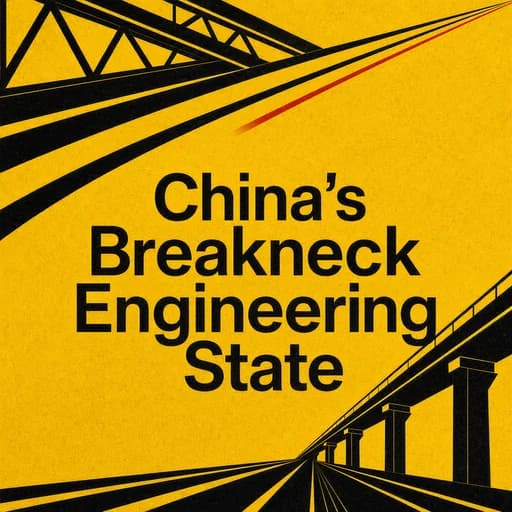
We have a system that is great at protection but bad at building, facing off against a system that is great at building but terrible at protection.
Generated by Aditya
Create a cinematic, intellectually sharp audio lesson based strictly on the book 'Breakneck: China’s Quest to Engineer the Future' by Dan Wang. Structure the lesson around the central tension between China as an 'engineering state' and the US as a 'lawyerly society.' Lead with the strongest counterarguments to Wang's thesis, testing where the comparison holds and where it fails. Cover key themes: the physical build-out (Guizhou, high-speed rail), the human costs of treating society as an engineering problem (One-Child policy, Zero-Covid), and the strategic tech competition. Use concrete cases from the book to explain why physical construction matters. Distinguish between Wang's claims and evidence, tagging conclusions with confidence levels (HIGH/MODERATE/LOW). Contrast state capacity with institutional/legal protections. Conclude with a synthesis of building capacity versus pluralism and provide 5 concise mental model takeaways. Follow the specific analytical and stylistic rules provided in the prompt.


Frequently Asked Questions
The core thesis explores the fundamental differences in how China and the United States organize their societies and leadership. Technology analyst Dan Wang argues that China operates as an 'engineering state,' prioritizing rapid physical construction and infrastructure development. In contrast, he describes the United States as a 'lawyerly society,' where legal processes and environmental studies often slow down physical progress, leading to a sense of stagnation in the Western built environment.
The leadership styles differ significantly based on the professional backgrounds of those in power. In China, the top levels of government, including the Politburo’s standing committee, have historically been dominated by individuals with engineering degrees. This contrasts sharply with the United States, where the halls of power are primarily occupied by lawyers, including half of Congress and five of the last ten presidents, influencing how each nation approaches problem-solving and development.
China’s ability to construct mega-cities and high-speed rail networks at a 'breakneck' pace is attributed to its identity as an engineering state. While the West may spend years on environmental impact studies and legal hurdles, China’s engineering-led governance prioritizes rapid physical execution. This allows them to complete massive infrastructure projects in the same amount of time it takes Western nations to navigate the preliminary bureaucratic and legal phases of construction.
From Columbia University alumni built in San Francisco
"Instead of endless scrolling, I just hit play on BeFreed. It saves me so much time."


"I never knew where to start with nonfiction—BeFreed’s book lists turned into podcasts gave me a clear path."


"Perfect balance between learning and entertainment. Finished ‘Thinking, Fast and Slow’ on my commute this week."
"Crazy how much I learned while walking the dog. BeFreed = small habits → big gains."
"Reading used to feel like a chore. Now it’s just part of my lifestyle."

"Feels effortless compared to reading. I’ve finished 6 books this month already."
"BeFreed turned my guilty doomscrolling into something that feels productive and inspiring."

"BeFreed turned my commute into learning time. 20-min podcasts are perfect for finishing books I never had time for."
"BeFreed replaced my podcast queue. Imagine Spotify for books — that’s it. 🙌"

"It is great for me to learn something from the book without reading it."
"The themed book list podcasts help me connect ideas across authors—like a guided audio journey."
"Makes me feel smarter every time before going to work"
 Ask ChatGPT
 Ask Claude
From Columbia University alumni built in San Francisco
"Instead of endless scrolling, I just hit play on BeFreed. It saves me so much time."
"I never knew where to start with nonfiction—BeFreed’s book lists turned into podcasts gave me a clear path."
"Perfect balance between learning and entertainment. Finished ‘Thinking, Fast and Slow’ on my commute this week."
"Crazy how much I learned while walking the dog. BeFreed = small habits → big gains."
"Reading used to feel like a chore. Now it’s just part of my lifestyle."
"Feels effortless compared to reading. I’ve finished 6 books this month already."
"BeFreed turned my guilty doomscrolling into something that feels productive and inspiring."
"BeFreed turned my commute into learning time. 20-min podcasts are perfect for finishing books I never had time for."
"BeFreed replaced my podcast queue. Imagine Spotify for books — that’s it. 🙌"
"It is great for me to learn something from the book without reading it."
"The themed book list podcasts help me connect ideas across authors—like a guided audio journey."
"Makes me feel smarter every time before going to work"
"Instead of endless scrolling, I just hit play on BeFreed. It saves me so much time."
"I never knew where to start with nonfiction—BeFreed’s book lists turned into podcasts gave me a clear path."
"Perfect balance between learning and entertainment. Finished ‘Thinking, Fast and Slow’ on my commute this week."
"Crazy how much I learned while walking the dog. BeFreed = small habits → big gains."
"Reading used to feel like a chore. Now it’s just part of my lifestyle."
"Feels effortless compared to reading. I’ve finished 6 books this month already."
"BeFreed turned my guilty doomscrolling into something that feels productive and inspiring."
"BeFreed turned my commute into learning time. 20-min podcasts are perfect for finishing books I never had time for."
"BeFreed replaced my podcast queue. Imagine Spotify for books — that’s it. 🙌"
"It is great for me to learn something from the book without reading it."
"The themed book list podcasts help me connect ideas across authors—like a guided audio journey."
"Makes me feel smarter every time before going to work"
"Instead of endless scrolling, I just hit play on BeFreed. It saves me so much time."
"I never knew where to start with nonfiction—BeFreed’s book lists turned into podcasts gave me a clear path."
"Perfect balance between learning and entertainment. Finished ‘Thinking, Fast and Slow’ on my commute this week."
"Crazy how much I learned while walking the dog. BeFreed = small habits → big gains."
"Reading used to feel like a chore. Now it’s just part of my lifestyle."
"Feels effortless compared to reading. I’ve finished 6 books this month already."
"BeFreed turned my guilty doomscrolling into something that feels productive and inspiring."
"BeFreed turned my commute into learning time. 20-min podcasts are perfect for finishing books I never had time for."
"BeFreed replaced my podcast queue. Imagine Spotify for books — that’s it. 🙌"
"It is great for me to learn something from the book without reading it."
"The themed book list podcasts help me connect ideas across authors—like a guided audio journey."
"Makes me feel smarter every time before going to work"