Discover the fascinating history of how we say hi, from Thomas Edison’s telephone revolution to the ancient cultural rituals of handshakes, bows, and air kisses.
Best quote from Beyond the Hello: The Global Evolution of Greetings
“
Every greeting—from the nose bump to the air kiss—is a ritual of recognition that says, 'I acknowledge your presence, I respect your space, and I’m inviting you into mine.'
”
F
Generated by Freedee_7C2A31E1
Input question
Hello
Host voices
Jackson
Miles
Knowledge sources
Frequently Asked Questions
While Alexander Graham Bell originally preferred the nautical greeting "Ahoy," Thomas Edison is credited with popularizing "hello." Edison pushed for its use because he believed the word was distinct and powerful enough to be heard clearly from a distance of ten to twenty feet, making it ideal for early telephonic communication.
The handshake originated in Ancient Greece as a practical safety inspection. By grasping an individual's right hand, a person could confirm that the other party was not wielding a weapon. The physical "shake" was specifically intended to dislodge any daggers or weapons that might be hidden up a sleeve. Later, in the 17th century, the Quakers adopted the gesture as a symbol of universal equality to replace the hierarchical practice of bowing to social superiors.
The hongi involves pressing one's nose and forehead against another person's, but its significance lies in the "sharing of breath," or ha. In Māori culture, breath is considered the sacred essence of life. By participating in this physical exchange, a visitor is no longer considered a stranger and becomes spiritually integrated with the people of the land.
While many Western greetings began as "safety checks" to prove one was unarmed, greetings like Namaste and As-salamu alaykum are rooted in spiritual recognition. Namaste translates to "the light in me sees the light in you," shifting the focus from physical safety to an acknowledgment of the divine essence within another. Similarly, As-salamu alaykum serves as a verbal contract of peace, literally meaning "Peace be upon you."
This unique tradition dates back to a 9th-century king named Lang Darma, who was known for his cruelty and reportedly had a black tongue. Following his death, people began sticking out their tongues to one another to prove they were not his reincarnation. Over time, this evolved into a formal gesture to demonstrate that the speaker is "pure" and comes in peace.
From Columbia University alumni | built in San Francisco
BeFreed Brings Together A Global Community Of Curious Minds
4.7
avg rating
7.84k+ App Rating
BeFreed Community
Seriously I haven’t even explored this app fully yet but from using it the last few days I am so impressed... BeFreed is on a different level from any other learning app I have used. This makes it ultra engaging and can actually improve your concentration which is great for all the doom scrollers!
@ladyInfinity
I bought BeFreed exactly 23 days ago, and I have used it every single day since. It has completely embedded itself into my daily workflow and learning habit.
@jayallen
The truth is, the app has exceeded all my expectations. I can ask it to generate audio on any topic, whatever it may be, and the result is impressive. My professional field is a specialization in psychotherapy and it is multidisciplinary; however, the answers are very accurate.
@Raguipa
What I appreciate most is how much it's reduced my scrolling – I'm spending less time searching and more time absorbing information. The combination of full audiobooks, podcasts, the learning plans are brilliant.
@colonyofcreatorsNGO
I have been a PhotoReading Accelerated Learning Instructor for the past 24 years... books and reading and learning are my thing, and BeFreed has done a great job in providing an innovative approach to disseminating and delivering information in an easy to consume way.
@BeFreed user
It is not just a book summary app, I have used the 'fun reading' option and it's a much better summary and way to grasp ideas the traditional way, that alone is worth this deal.
@austinakon
I love this app. Used it for several days and I cannot stop listening. Such a great way to start.
@jcrules328
I really like the program; I have already tested it for around one month, and I feel that it's an amazing gem. It works so well because I can use BeFreed to create my own topics, and the voice is so good with unlimited choice of narrations.
@DanielCZ
Seriously I haven’t even explored this app fully yet but from using it the last few days I am so impressed... BeFreed is on a different level from any other learning app I have used. This makes it ultra engaging and can actually improve your concentration which is great for all the doom scrollers!
@ladyInfinity
I bought BeFreed exactly 23 days ago, and I have used it every single day since. It has completely embedded itself into my daily workflow and learning habit.
@jayallen
The truth is, the app has exceeded all my expectations. I can ask it to generate audio on any topic, whatever it may be, and the result is impressive. My professional field is a specialization in psychotherapy and it is multidisciplinary; however, the answers are very accurate.
@Raguipa
What I appreciate most is how much it's reduced my scrolling – I'm spending less time searching and more time absorbing information. The combination of full audiobooks, podcasts, the learning plans are brilliant.
@colonyofcreatorsNGO
I have been a PhotoReading Accelerated Learning Instructor for the past 24 years... books and reading and learning are my thing, and BeFreed has done a great job in providing an innovative approach to disseminating and delivering information in an easy to consume way.
@BeFreed user
It is not just a book summary app, I have used the 'fun reading' option and it's a much better summary and way to grasp ideas the traditional way, that alone is worth this deal.
@austinakon
I love this app. Used it for several days and I cannot stop listening. Such a great way to start.
@jcrules328
I really like the program; I have already tested it for around one month, and I feel that it's an amazing gem. It works so well because I can use BeFreed to create my own topics, and the voice is so good with unlimited choice of narrations.
@DanielCZ
I love the fact that I can get useful, condensed, information and ideas in a 8 - 15 minute podcast style audio. I'm not a general fan of podcasts because of all the fluff, but this cuts through all that.
@BeFreed user
I am finishing up my doctorate, and have to read a lot of unfamiliar material... With BeFreed, you simply enter a prompt, and the app finds source material for you and generates an audio podcast. I find the process in BeFreed to be more streamlined than NotebookLM.
@Brad
I often search YouTube for something to listen to whilst making breakfast, when I'm out walking, commuting, etc, and BeFreed has provided an even more targeted approach, without the adverts and the fluff!
@BeFreed user
The absolute best part about this platform is its versatility. There is literally no subject that is off-topic. It handles whatever you throw at it... It is rare to find an learning tool with zero limitations that actually delivers on its promises.
@jayallen
BeFreed is fantastic. The user-friendly design means I spend less time navigating and more time learning. The mix of audiobooks, podcasts, and learning plans is a genius combo that has completely changed my daily routine.
@BeFreed user
At the start I needed a while to understand how to create podcasts in italian language and boom! It is so great! I can ask to explain every argument and it does so well and so smartly!
@matteo77
BeFreed has become my daily app for audio books tools... What I like the most is the way you put your text and come with an audio that you can listen on the go.
@kotanzu1
I love the fact that I can get useful, condensed, information and ideas in a 8 - 15 minute podcast style audio. I'm not a general fan of podcasts because of all the fluff, but this cuts through all that.
@BeFreed user
I am finishing up my doctorate, and have to read a lot of unfamiliar material... With BeFreed, you simply enter a prompt, and the app finds source material for you and generates an audio podcast. I find the process in BeFreed to be more streamlined than NotebookLM.
@Brad
I often search YouTube for something to listen to whilst making breakfast, when I'm out walking, commuting, etc, and BeFreed has provided an even more targeted approach, without the adverts and the fluff!
@BeFreed user
The absolute best part about this platform is its versatility. There is literally no subject that is off-topic. It handles whatever you throw at it... It is rare to find an learning tool with zero limitations that actually delivers on its promises.
@jayallen
BeFreed is fantastic. The user-friendly design means I spend less time navigating and more time learning. The mix of audiobooks, podcasts, and learning plans is a genius combo that has completely changed my daily routine.
@BeFreed user
At the start I needed a while to understand how to create podcasts in italian language and boom! It is so great! I can ask to explain every argument and it does so well and so smartly!
@matteo77
BeFreed has become my daily app for audio books tools... What I like the most is the way you put your text and come with an audio that you can listen on the go.
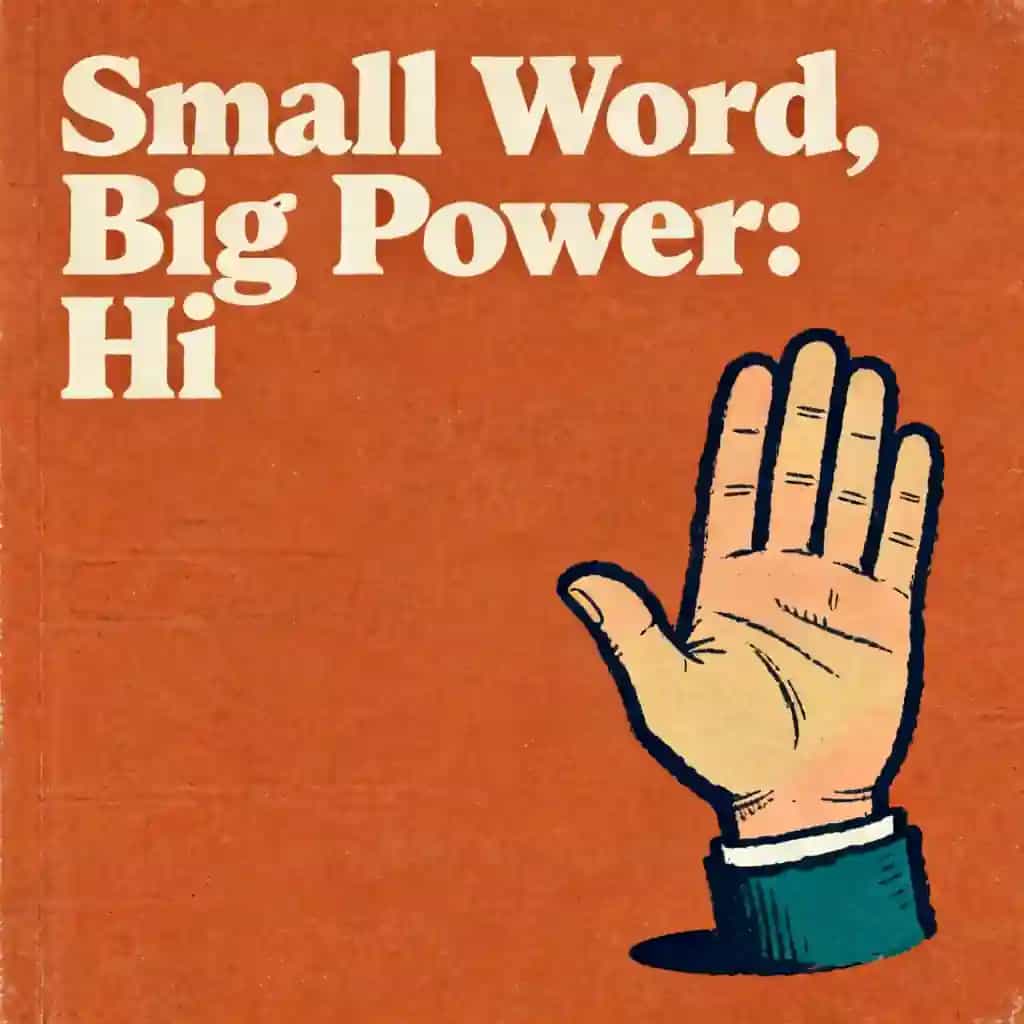
Explore why this tiny two-letter word became our universal greeting and whether casual 'hellos' actually create genuine human connection or just social autopilot.
We use 'hi' every day, but it's more than just a greeting. Learn the history and body language behind a first impression to master your next introduction.
Discover how adding extra letters to greetings like 'hii' creates emotional warmth and reveals which internet communities you belong to. A fascinating dive into modern digital communication.
Explore the fascinating social dynamics behind our daily greetings, from automatic responses to cultural differences, and discover how this simple question shapes human connection.
Explore how simple greetings like 'What's up' have become powerful social shortcuts in digital culture, creating instant connections and even viral moments across platforms worldwide.
Learn practical, pressure-free techniques to start meaningful conversations with people you're attracted to, from reading social cues to building genuine connections that go beyond awkward small talk.