Amtrak: The Great American Survival Story
Explore how a 'temporary' 1971 experiment saved U.S. passenger rail from collapse, evolving from a mismatched fleet into a modern national network.

Best quote from Amtrak: The Great American Survival Story
That tension has defined Amtrak’s entire existence: are they a business or a utility? It’s a shift from a 'struggling business' to a 'national asset,' moving past the idea that a national transport network has to be a profitable business in the traditional sense.
Generated by angela
Give me a very brief history of Amtrak



Frequently Asked Questions
Amtrak was established as a "quasi-public" compromise to prevent the total collapse of the U.S. freight rail system. By the late 1960s, private railroads like Penn Central were losing hundreds of millions of dollars on passenger service, which they were legally required to maintain. The Nixon administration created Amtrak to lift this financial burden off the freight lines, with many officials viewing it as a temporary "last hurrah" for passenger rail before it eventually disappeared.
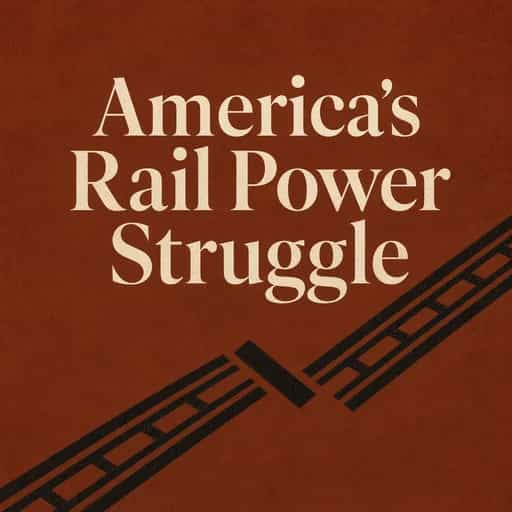
Outside of the Northeast Corridor, Amtrak owns very little track and operates as a "guest" on rails owned by freight companies like CSX and BNSF. Although federal law mandates that passenger trains receive "preference" or priority over freight, freight dispatchers often prioritize their own heavy cargo trains to maintain network fluidity. This conflict, combined with infrastructure limitations like single-track bottlenecks, leads to significant on-time performance issues for long-distance routes.
The statutory requirement for Amtrak to be a "for-profit" corporation creates a constant tension between its role as a public utility and its need to cut costs. This is most visible in the "battle of the dining car," where Congress has pressured Amtrak to eliminate losses on food and beverage service. To satisfy these mandates without cutting essential services on multi-day trips, Amtrak has used strategies ranging from "contemporary" pre-packaged meals to accounting shifts that allocate a portion of ticket revenue specifically to food costs.
The IIJA represents a major philosophical shift, moving Amtrak from a state of "managed decline" to one of expansion. It provided sixty-six billion dollars to address a massive maintenance backlog in the Northeast Corridor and to replace an aging fleet of railcars that, in some cases, were over thirty years old. Crucially, the law changed Amtrak’s statutory goal from "minimizing subsidies" to "maximizing the benefits of federal investment," officially treating the rail system as a national asset rather than a struggling business.
Unlike Amtrak, which relies on federal grants and serves a social mission to connect rural areas, private companies like Brightline focus on high-traffic "sweet spot" corridors of 200 to 300 miles. Brightline uses a unique business model where it acts as a real estate developer, increasing the value of land it owns around its stations. While these private ventures offer premium service and modern infrastructure, they generally focus on profitable urban pairs rather than the money-losing long-distance routes that Amtrak is mandated to provide.
From Columbia University alumni built in San Francisco
"Instead of endless scrolling, I just hit play on BeFreed. It saves me so much time."


"I never knew where to start with nonfiction—BeFreed’s book lists turned into podcasts gave me a clear path."


"Perfect balance between learning and entertainment. Finished ‘Thinking, Fast and Slow’ on my commute this week."
"Crazy how much I learned while walking the dog. BeFreed = small habits → big gains."
"Reading used to feel like a chore. Now it’s just part of my lifestyle."

"Feels effortless compared to reading. I’ve finished 6 books this month already."
"BeFreed turned my guilty doomscrolling into something that feels productive and inspiring."

"BeFreed turned my commute into learning time. 20-min podcasts are perfect for finishing books I never had time for."
"BeFreed replaced my podcast queue. Imagine Spotify for books — that’s it. 🙌"

"It is great for me to learn something from the book without reading it."
"The themed book list podcasts help me connect ideas across authors—like a guided audio journey."
"Makes me feel smarter every time before going to work"
 Ask ChatGPT
 Ask Claude
From Columbia University alumni built in San Francisco
"Instead of endless scrolling, I just hit play on BeFreed. It saves me so much time."
"I never knew where to start with nonfiction—BeFreed’s book lists turned into podcasts gave me a clear path."
"Perfect balance between learning and entertainment. Finished ‘Thinking, Fast and Slow’ on my commute this week."
"Crazy how much I learned while walking the dog. BeFreed = small habits → big gains."
"Reading used to feel like a chore. Now it’s just part of my lifestyle."
"Feels effortless compared to reading. I’ve finished 6 books this month already."
"BeFreed turned my guilty doomscrolling into something that feels productive and inspiring."
"BeFreed turned my commute into learning time. 20-min podcasts are perfect for finishing books I never had time for."
"BeFreed replaced my podcast queue. Imagine Spotify for books — that’s it. 🙌"
"It is great for me to learn something from the book without reading it."
"The themed book list podcasts help me connect ideas across authors—like a guided audio journey."
"Makes me feel smarter every time before going to work"
"Instead of endless scrolling, I just hit play on BeFreed. It saves me so much time."
"I never knew where to start with nonfiction—BeFreed’s book lists turned into podcasts gave me a clear path."
"Perfect balance between learning and entertainment. Finished ‘Thinking, Fast and Slow’ on my commute this week."
"Crazy how much I learned while walking the dog. BeFreed = small habits → big gains."
"Reading used to feel like a chore. Now it’s just part of my lifestyle."
"Feels effortless compared to reading. I’ve finished 6 books this month already."
"BeFreed turned my guilty doomscrolling into something that feels productive and inspiring."
"BeFreed turned my commute into learning time. 20-min podcasts are perfect for finishing books I never had time for."
"BeFreed replaced my podcast queue. Imagine Spotify for books — that’s it. 🙌"
"It is great for me to learn something from the book without reading it."
"The themed book list podcasts help me connect ideas across authors—like a guided audio journey."
"Makes me feel smarter every time before going to work"
"Instead of endless scrolling, I just hit play on BeFreed. It saves me so much time."
"I never knew where to start with nonfiction—BeFreed’s book lists turned into podcasts gave me a clear path."
"Perfect balance between learning and entertainment. Finished ‘Thinking, Fast and Slow’ on my commute this week."
"Crazy how much I learned while walking the dog. BeFreed = small habits → big gains."
"Reading used to feel like a chore. Now it’s just part of my lifestyle."
"Feels effortless compared to reading. I’ve finished 6 books this month already."
"BeFreed turned my guilty doomscrolling into something that feels productive and inspiring."
"BeFreed turned my commute into learning time. 20-min podcasts are perfect for finishing books I never had time for."
"BeFreed replaced my podcast queue. Imagine Spotify for books — that’s it. 🙌"
"It is great for me to learn something from the book without reading it."
"The themed book list podcasts help me connect ideas across authors—like a guided audio journey."
"Makes me feel smarter every time before going to work"