AI Inference Data Centers Are Changing Everything

AI inference data center architecture: episode overview
In this BeFreed audio guide, we dive into the technical realities of AI inference data center architecture. You will discover how facilities are adapting to the immense power and cooling demands of dense GPU clusters, and why real-time AI processing requires an entirely different infrastructure approach compared to conventional cloud computing.
Create Your Podcast in a Click
Generated by Freedee_A9C1E17C
Input question
I would like to learn everything about data centers for AI inference
Host voices

What you'll learn about AI data center architecture
- 1
Inside the AI Infrastructure Boom
 00:0000:00
Lena: You know, Miles, I was looking at some infrastructure stats this morning, and it’s mind-blowing. In 2025 alone, just four companies—Microsoft, Google, Amazon, and Meta—committed over $300 billion to AI data centers. That is literally more than the GDP of most countries! Miles: It’s staggering, right? And what’s even more wild is that these aren’t just bigger versions of the server rooms we’ve used for decades. We are talking about high-density "fortresses" where a single rack can pull up to 130 kilowatts. To put that in perspective, a traditional rack usually only needs about 5 to 15 kilowatts. Lena: Exactly, it’s a total structural redesign. I’m really curious about the "how" behind all this—especially the difference between training these massive models and then actually using them, or what the experts call inference. Miles: That is the perfect place to start because the hardware priorities for "building the brain" versus "using the brain" are completely different. Let’s dive into why the design goals for inference are quickly becoming the main growth engine for the entire industry.
- 2
High-Availability Architectures for a Real-Time World
Miles: So, Lena, let’s get into the heart of why inference is different. When you’re training a model, like Llama 3 or GPT-4, you’re essentially running one massive, synchronized job for weeks or months. If it pauses for a second, it’s a headache for the engineers, but the world doesn’t stop. But inference? That’s the "live" part. When you ask a chatbot a question or a medical AI analyzes a scan, that has to happen right now. Lena: Right, it’s the difference between writing a textbook and then having to answer questions about it in a live oral exam. The pressure is on! And I saw some research from McKinsey suggesting that by 2030, inference is actually going to make up more than half of all AI workloads. It’s moving from this experimental phase into the backbone of how we actually do business. Miles: Exactly. And because it’s live, the infrastructure has to be built for "high availability." In the industry, they’re talking about moving toward full 2N redundancy. That basically means every single critical component—every power supply, every cooling pump, every network switch—has a mirror image ready to take over instantly. We’re moving away from the "best-effort" model of the old cloud and into a deterministic world where downtime isn't just an inconvenience—it’s a massive loss of revenue. Lena: That makes sense. If an AI is powering a customer service line for a global bank, it can’t just "go down" for maintenance at 2:00 AM. But how does that affect where these data centers are actually built? I read that training clusters can be tucked away in remote, power-rich areas because they don’t care about a few milliseconds of delay. Is inference the same? Miles: Not at all. That’s one of the biggest shifts. For training, you can go to the middle of a desert if the electricity is cheap. But for inference, you need to be near the users to keep the "round-trip time" low. We’re seeing a rise in what people call "Tier 2" markets—places like Des Moines, Iowa, or Columbus, Ohio—where you can still get land and power relatively fast, but you’re still close enough to the major fiber backbones to serve users in Chicago or New York without a lag. Lena: Oh, I see. So it’s a balancing act between having enough power to run these thirsty GPUs and being physically close to the fiber optic "highways." It sounds like the "where" is just as important as the "what." Miles: Absolutely. And it’s not just about the city—it’s about the specific campus design. Hyperscalers are starting to build "mixed-use" engines. They’ll have these massive "core" campuses where about 70 percent of the space is shared between general cloud computing and AI inference. They’re literally redrawing the blueprints so that inference racks are sitting right next to the data storage and the network entry points. It’s all about shaving off every microsecond of latency. Lena: It’s fascinating how the physical layout of a building is being dictated by how fast we want a chatbot to reply. But wait, if these racks are pulling so much more power than traditional servers, doesn't that create a massive heat problem? I mean, 130 kilowatts in a single rack sounds like a literal furnace. Miles: You’ve hit on the biggest physical bottleneck we’re facing. Traditional air cooling—you know, just blowing cold air through the aisles—stops being effective once you cross about 30 or 40 kilowatts per rack. For the latest Blackwell chips from NVIDIA, which can pull 1,000 watts per GPU, we’re moving into liquid cooling as the standard. It’s no longer an exotic option for supercomputers; it’s a requirement for the modern AI data center. Lena: So we’re literally plumbing the racks now? That sounds like a nightmare for maintenance. Imagine a leak in a room full of multi-million dollar electronics! Miles: It’s definitely a new skill set for data center operators. But liquid is just so much better at carrying heat away than air. Microsoft has been testing "microfluidics" where the cooling actually happens inside the silicon itself—it can dissipate more than one kilowatt per square centimeter! That’s like trying to cool the surface of the sun. But even with standard "direct-to-chip" cooling, you’re looking at energy savings of nearly 50 percent compared to air cooling. It’s the only way to keep these "exa-scale" thermals under control.
- 3
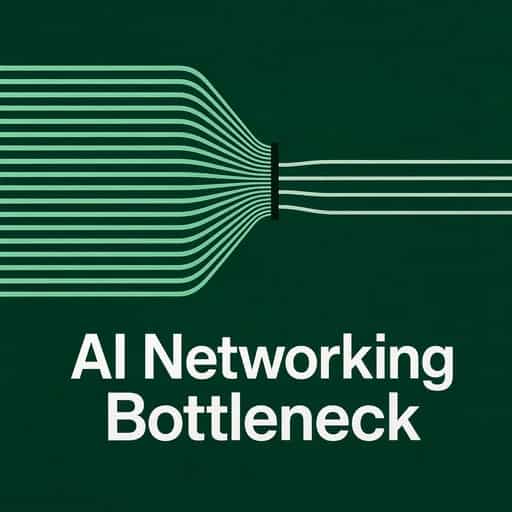
The Network is the Computer in Distributed Inference
Lena: Okay, so we’ve got the power and the cooling sorted, but how do all these GPUs actually talk to each other? I’ve heard this phrase "the network is the computer" thrown around a lot lately. What does that actually look like in an inference context? Miles: It’s all about how data flows "East-West." In a traditional data center, most traffic was "North-South"—meaning it goes from a user on the internet, into the server, and back out. But AI is different. When you’re running a model that’s too big for one GPU, those chips have to talk to each other constantly to share the workload. If the network between them is slow, the GPUs just sit there idling, which is incredibly expensive. Lena: Right, like having a team of geniuses who can only communicate by sending letters through the mail. They’re brilliant, but they’re not going to get much done quickly. Miles: Perfect analogy. That’s why we’re seeing a huge debate between two different networking standards: InfiniBand and RoCEv2. InfiniBand is the "legacy" standard from the high-performance computing world. It’s "lossless" by design, meaning it almost never drops a packet. But it’s also proprietary and expensive. On the other side, you have RoCEv2, which stands for RDMA over Converged Ethernet. It basically tries to make standard Ethernet act like a supercomputing network. Lena: And let me guess—the "hyperscalers" like Meta and Microsoft are leaning toward the Ethernet side? Miles: Exactly. They love the "unified fabric." They already know how to manage Ethernet at a massive scale. By using RoCEv2, they can use standard switches from companies like Arista or Cisco but still get that ultra-low-latency, "CPU-bypass" performance that AI needs. Meta’s AI Research Supercluster, with 16,000 GPUs, is built on this kind of Ethernet fabric. It allows them to scale up to tens of thousands of ports without the limits of traditional InfiniBand subnets. Lena: That’s interesting. So they’re basically "hacking" the standard internet protocols to handle these massive AI bursts. But I also read something about "Elephant Flows." That sounds like a very colorful way to describe a technical problem. Miles: It’s a huge problem! In a normal network, you have millions of tiny "mouse flows"—small packets of data. But AI operations, like "AllReduce," create these massive, persistent "elephant flows" that can clog up a network path. If you use standard "Equal-Cost Multi-Path" routing, you might accidentally send two elephants down the same narrow bridge while another bridge is completely empty. Lena: Ouch. That sounds like a recipe for a total traffic jam. How do they fix that? Miles: They use something called "Adaptive Routing" or "Packet Spraying." Instead of picking one path and sticking to it, the network switches look at the congestion in real-time. If one path is full, they’ll instantly spray the packets across every available link. Some of the newest 800G switches from Broadcom or NVIDIA can do this at the hardware level, making sure the network is always perfectly balanced. Lena: So it’s like a GPS that doesn’t just tell you there’s traffic, but actually splits your car into five pieces and sends them down different side streets to get you there faster? Miles: Ha! In the digital world, that’s exactly what happens. The receiving NIC—that’s the Network Interface Card—then has to be smart enough to put all those out-of-order packets back together. It’s incredibly complex, but it’s the only way to get near-perfect utilization out of a multi-billion dollar cluster. Lena: It’s wild to think about the sheer amount of engineering just to make sure a GPU doesn’t have to wait for data. And speaking of GPUs, I know NVIDIA is the big player here, but I’ve been seeing more talk about "custom silicon." Is the industry trying to move away from being so dependent on one company? Miles: They are certainly trying. Google has its TPUs—Tensor Processing Units—and Amazon has Trainium and Inferentia. These are "ASICs"—Application-Specific Integrated Circuits. They’re designed to do one thing—AI math—very, very efficiently. Google’s latest "Ironwood" TPU is supposedly on par with NVIDIA’s best. But NVIDIA’s "moat" isn’t just the chips; it’s the software, the CUDA ecosystem. That’s the "language" every AI developer speaks. Lena: Right, it’s like trying to get everyone to switch from English to a new language that’s technically "more efficient" for science. Even if it’s better, getting everyone to change their habits is the hard part. Miles: Exactly. But for inference, where you’re running the same model over and over again for millions of users, that’s where the custom chips really shine. If you can save 30 percent on your power bill by using a custom ASIC for inference, that adds up to hundreds of millions of dollars at hyperscale. That’s why we’re seeing this "dual frontier"—NVIDIA for the cutting-edge training, and a mix of GPUs and custom silicon for the massive inference fleets.
- Chapter 4
Physical Limits and the Power Grid Bottleneck
Lena: We’ve talked a lot about what’s inside the data center, but I want to zoom out for a second. I keep hearing that the biggest thing holding back AI right now isn’t even the chips anymore—it’s just getting enough electricity from the grid. Is it really that bad? Miles: It’s the "binding constraint" for the entire industry. In some major markets like Northern Virginia or Singapore, there are literal moratoriums on new data centers because the grid just can’t handle any more load. We’re talking about a seven-year wait in some places just to get a new connection. Think about that—AI technology changes every twelve months, but it takes seven years to get the power to run it! Lena: Seven years! By the time you get the power, the chips you bought are basically ancient history. That must be a massive headache for planning. How are companies dealing with that? Miles: They’re becoming their own utilities. Microsoft and Amazon are now negotiating directly with power plants. We’re seeing "behind-the-meter" configurations where they build the data center right next to a nuclear plant or a massive solar farm to bypass the public grid entirely. There’s even a 1-gigawatt fuel cell deal with Bloom Energy that would be the largest in history. Lena: So they’re basically building "islands" of compute that are independent of the rest of us? Miles: In a way, yeah. It’s called "grid-optional" strategy. By using on-site generation—like natural gas turbines or even small modular reactors in the future—they can cut their "time-to-power" by two or three years. It’s a total shift in real estate strategy. Instead of looking for a place with good fiber, they’re looking for a place with "uncongested" power. That’s why we’re seeing new hubs popping up in places like Mississippi or Indiana. Lena: It’s like the new gold rush, but instead of gold, they’re hunting for spare megawatts. And I read that these AI workloads aren’t just "heavy," they’re "swingy." They create these massive power oscillations that can actually damage the local grid if they aren’t managed. Miles: You’re absolutely right. When a massive training job starts or stops, the power draw can surge or drop by 60 percent in milliseconds. That’s like a whole city turning its lights on and off at the same time. To manage that, they’re building "energy storage" on-site—massive batteries that can act as a buffer. They also use software-driven solutions that introduce "supplementary workloads" to smooth out those spikes. Lena: It’s incredible. The data center is evolving into this intelligent, self-regulating organism that has to manage its own "heartbeat" of power. But wait, what about the water? I remember seeing a stat that AI data centers could need 1.7 trillion gallons of freshwater by 2027. That sounds... well, not very sustainable. Miles: It’s a huge concern, especially in water-stressed areas. But that’s another reason for the move to "closed-loop" liquid cooling. Instead of using evaporative cooling—where you literally boil off water to stay cool—these new systems just cycle the same liquid over and over again through a chiller plant. Microsoft’s new "Fairwater" design in Georgia only needs as much water as 20 homes use in a year. Once it’s filled, they only replace the water if the chemistry gets "off." Lena: Oh, that’s a relief! So they’re finding ways to be more efficient. But it still feels like we’re building these massive cathedrals of compute that most people will never see. What does this mean for a regular enterprise that wants to use AI? Do they have to build their own "fortress"? Miles: Most won't. They’ll either use the hyperscale clouds or go with "colocation" providers. But even then, they have to be careful. Most older colocation centers were built for 5 to 20 kilowatts per rack. If you try to roll in a Blackwell NVL72 rack that needs 120 kilowatts, they’ll literally laugh you out of the building. We’re seeing a "generational filter" where only the newest, most advanced facilities can even host the latest AI hardware. Lena: So there’s going to be a real divide between the "AI-ready" infrastructure and the legacy stuff. It’s like trying to run a modern electric car charger off a house built in the 1920s. The wiring just isn't there. Miles: Exactly. And that’s why "retrofitting" is such a big business right now. Companies are spending $20 million to $30 million per megawatt just to upgrade their old sites. They’re tearing out the floors, putting in liquid cooling manifolds, and beefing up the transformers. It’s expensive and risky, but it’s often faster than building a whole new campus from scratch.
Chapter 5The Evolution of the GPU: Memory vs Compute
Lena: Let’s get back to the chips for a second. We keep talking about GPUs like they’re one thing, but I’ve been reading about the H100 versus the new H200 and L40S. It seems like the industry is starting to care more about "memory" than just raw "speed." Why is that? Miles: That’s a really sharp observation. For the longest time, the goal was just "more FLOPS"—more floating-point operations per second. But as models got bigger, we hit the "memory wall." It doesn’t matter how fast your processor is if it’s waiting for data to be fetched from memory. That’s why the H200 was such a big deal—it didn’t actually increase the compute speed of the H100 much, but it jumped from 80 gigs of memory to 141 gigs. Lena: So it’s like having a chef who can chop vegetables at lightning speed, but they only have a tiny cutting board. They spend half their time moving stuff on and off the board. Giving them a bigger "cutting board"—the memory—lets them actually use that speed. Miles: Exactly! And for inference, memory bandwidth is king. When you’re serving a model, you’re reading the "weights" of the model over and over again. The H200 uses HBM3e memory, which has nearly 5 terabytes per second of bandwidth. That’s what allows for those "large context windows"—the ability for an AI to remember a whole book you just uploaded while you’re chatting with it. Lena: I see. And then there’s the L40S, which you mentioned is more of a "versatile" card. Where does that fit in? It doesn’t have that fancy HBM memory, right? Miles: Right, it uses GDDR6, which is more like what you’d find in a high-end gaming PC. It’s much cheaper to make, but it has lower bandwidth. But the L40S is a "beast" when it comes to raw FP32 throughput—it’s actually 5 times faster than the older A100 for some tasks. It’s the perfect "utility player." You can use it for AI inference, but also for 3D rendering, video encoding, or virtual workstations. Lena: So if you’re a company that isn’t training a trillion-parameter model every day, the L40S might actually be the better ROI? Miles: Absolutely. In fact, some benchmarks show that for inference on smaller models—like the 7-billion or 8-billion parameter ones—the L40S can actually be more cost-effective per million tokens than an H100. It’s all about "right-sizing" the hardware to the workload. You don't want to use a Ferrari to go to the grocery store. Lena: Right, the "Ferrari" being the H100 or the new Blackwell chips. Speaking of Blackwell, I saw that the B200 is basically two chips stitched together? That sounds like we’re reaching the limits of how big a single chip can even be. Miles: We are! It’s called the "reticle limit." You literally can’t make a single chip much bigger than a certain size because of the way the manufacturing equipment works. So NVIDIA’s "Blackwell" B200 is two separate dies connected by a high-speed link that makes them act like one giant 208-billion transistor chip. It’s a massive engineering feat. Lena: And then they take 72 of those and put them in a single rack with the NVLink Switch? That’s the NVL72 we keep hearing about. Miles: Yep. That’s the "atomic unit" of the modern AI supercomputer. It allows all 72 GPUs to talk to each other at 1.8 terabytes per second. To the software, it looks like one massive GPU with 13.5 terabytes of HBM memory. That’s how Microsoft’s Azure NDv6 cluster can deliver 92 exaFLOPS of inference. It’s just an unfathomable amount of power in a single room. Lena: It’s almost scary. But I also saw something about "low-precision" math—like FP4. Does that mean the AI is getting "less accurate" to stay fast? Miles: It’s a clever trade-off. It turns out that for a lot of AI math, you don’t need 32 or 64 bits of precision. You can get away with 8 bits or even 4 bits (FP4) without the model getting "stupid." By using fewer bits, you can pack more operations into the same second and use less memory. It’s like shrinking the size of the numbers so you can fit more of them through the pipe at once. The latest Blackwell chips are optimized specifically for this "low-precision" math. Lena: So it’s not about being less accurate; it’s about being "efficiently accurate." I like that. It’s all about getting more "intelligence per watt."
Chapter 6The Storage Problem: Feeding the Beast
Lena: We’ve talked about the brain and the nerves, but what about the "stomach"? These models need massive amounts of data to learn and to operate. How do you get petabytes of data into these GPUs fast enough? Miles: That is a huge bottleneck that often gets overlooked. If your storage is slow, your $30,000 GPU is just sitting there doing nothing. We’re moving away from traditional "centralized" storage and toward "GPUDirect Storage." Lena: GPUDirect? That sounds like a shortcut. Miles: That’s exactly what it is. In a traditional system, data has to go from the storage, through the CPU, into the system RAM, and then finally into the GPU. It’s like a long, winding road with lots of traffic lights. GPUDirect lets the data flow straight from the NVMe drives or the network card into the GPU memory, bypassing the CPU entirely. Lena: Wow, so the CPU is just becoming a "traffic cop" that tells the data where to go, rather than actually carrying it? Miles: Precisely. The CPU is almost a bottleneck now. We’re seeing a rise in "All-Flash" storage arrays that can pump out hundreds of gigabytes per second. For training, you need to read the entire dataset over and over—that’s called an "epoch." If you have a 100-terabyte dataset, you need a storage fabric that can keep up with those massive read bursts. Lena: And I’m guessing this also uses the same RDMA technology we talked about for the networking? Miles: Exactly. "NFS over RDMA" is becoming the gold standard for AI storage. It uses the same "zero-copy" trick to move data across the network with almost zero latency. Whether you’re using Lustre—which is common in supercomputers—or high-end enterprise storage from companies like NetApp or Pure Storage, the goal is the same: eliminate every single millisecond of delay. Lena: It’s interesting how everything is converging on this one goal of "zero-delay." But what about when we aren’t training? For inference, do we still need that much storage speed? Miles: For inference, the storage needs are a bit different. You’re not reading the whole dataset; you’re usually just pulling in a specific "context"—like a customer's history or a set of documents for a RAG system. RAG stands for Retrieval-Augmented Generation. It’s basically giving the AI a "library" to look things up in real-time. Lena: Oh, I’ve heard of RAG! It’s how you keep the AI from "hallucinating" by making it cite its sources, right? Miles: Exactly. But for RAG to work, you need a "Vector Database." This is a special kind of storage that can find "similar" things in a split second. If you ask an AI about "climate change in the Arctic," the vector database has to instantly find the ten most relevant scientific papers out of millions. That requires high-speed search and massive throughput. Lena: So even "using" the AI requires this high-performance storage layer. It’s not just a chip in a box; it’s this whole ecosystem of high-speed networking and high-speed storage all working in perfect harmony. Miles: And it has to be "modular." Because the technology is moving so fast, you can’t build a monolithic system and expect it to last five years. Companies are building their data centers in "pods"—self-contained units of power, cooling, and compute. When the next generation of chips comes out—like the Vera Rubin architecture NVIDIA just announced for 2026—they can just swap out a pod without having to redesign the whole building. Lena: "Vera Rubin"... I love that they’re naming these after famous scientists. What do we know about that one? If Blackwell is the "now," what’s the "future"? Miles: Vera Rubin is going to be a massive jump. We’re talking about HBM4 memory, which will have even more bandwidth. NVIDIA is aiming for 3.6 exaFLOPS in a single rack. That’s more than triple what Blackwell can do. It’s also going to use a 3-nanometer manufacturing process, which means more transistors and more efficiency. The "scaling laws" aren't slowing down; they’re actually accelerating. Lena: It’s a bit overwhelming, to be honest. But it’s also exciting. We’re building the most complex machines in human history just to see how far we can push this artificial intelligence thing.
Chapter 7Operational Realities: The "Day-2" Problem
Miles: You know, Lena, we’ve talked a lot about the "Day-1" stuff—the design, the chips, the big shiny racks. But there’s a whole other world called "Day-2" operations. That’s what happens once the lights are on and you’re actually trying to keep this beast running 24/7. Lena: I imagine it’s not as simple as just "plugging it in and letting it rip." I mean, with that much power and heat, things must break all the time. Miles: Oh, absolutely. AI clusters fail in what people call the "silent gap." This is the nightmare scenario for an engineer. The GPUs look "healthy"—the lights are green, the sensors say they’re on—but the actual training performance has dropped by 50 percent. Maybe there’s a tiny bit of "thermal throttling" on one chip, or a single network link is dropping 0.1 percent of its packets. Lena: Wait, 0.1 percent doesn't sound like much. Would that really break the whole thing? Miles: In a traditional network? No. But in an AI fabric using RDMA, a 0.1 percent loss can be catastrophic. Remember, all these GPUs have to synchronize at a "barrier" before they can move to the next step. If one GPU is slow because it’s retransmitting a dropped packet, the other 10,000 GPUs are just sitting there waiting. A tiny glitch can reduce the throughput of a multi-million dollar cluster by 30 percent. Lena: That’s a huge loss! It’s like a massive orchestra where one violinist is just a tiny bit out of tune, and the whole performance falls apart. How do you even find that one "violinist" in a sea of thousands? Miles: It requires a whole new level of "observability." You can’t rely on old-school tools like SNMP—that’s too slow. You need "In-band Network Telemetry" or INT. This is where every single packet carries its own "metadata" about which switches it passed through and how long it waited in each queue. The network is basically "reporting on itself" in real-time. Lena: That’s wild! So the packets are like little "secret agents" telling the engineers exactly where the traffic jams are. Miles: Exactly. And you also have to monitor things like "GPU Jitter." This is when the time it takes to complete a math operation varies just a tiny bit. It could be caused by background tasks on the server or a tiny power fluctuation. If you have "jitter" across a large cluster, it kills your efficiency. Operators are now using AI-powered "cooling agents" that monitor thousands of sensors and adjust the pumps and fans every second to keep the "thermal environment" perfectly stable. Lena: Using AI to manage the AI data center. It’s getting very "meta" in here, Miles. But I guess that’s the only way to handle the complexity. What about the human side? Do we even have enough people who know how to run these things? Miles: That’s another huge bottleneck. The skill set is so specialized. You need to understand deep learning, high-performance networking, liquid cooling, and grid-scale electrical engineering. It’s why we’re seeing a rise in "turnkey" systems like NVIDIA’s DGX SuperPOD. They’re basically saying, "Look, we’ve done all the hard engineering for you. Here’s a reference architecture that we know works." Lena: It’s like buying a pre-built Lego set instead of a box of random bricks. It’s more expensive, but at least you know the pieces will actually fit together. Miles: Right. But even with a SuperPOD, you still have to manage the "job scheduling." You have to be "topology-aware." If you’re running a small job, you don’t want to scatter it across three different racks; you want all those GPUs to be on the same "rail" or the same leaf switch to minimize delay. If your scheduler isn't smart, it will "fragment" your cluster, and you’ll end up with "stranded resources"—GPUs that are technically free but can’t be used because they’re too far away from the other parts of a job. Lena: It’s like a giant game of Tetris, but with megawatts and microseconds. It really shows that AI isn't just about the code; it’s about this massive, physical, high-stakes operation. Miles: And the economics are just as intense. For most AI teams, the GPU compute is going to be 40 to 60 percent of their entire budget for the first two years. If you’re overspending because of poor utilization or the wrong hardware mix, you’re literally burning millions of dollars. That’s why the "GPU Economics" side is becoming its own discipline.
Chapter 8A Practical Playbook for the AI Future
Lena: Okay, Miles, we’ve covered a massive amount of ground today. From the power grid to the individual bits in a GPU. For everyone listening who might be feeling a little overwhelmed—maybe they’re an infrastructure lead or a CTO trying to plan for the next year—what’s the "practical playbook" here? How do you actually make these decisions? Miles: The first thing is to be "intentional" about your workload. Don't just buy the biggest, most expensive GPU because it’s the "best." If you’re doing real-time inference on small models, a fleet of L40S or A100 cards might actually give you a better ROI than H100s. You have to ask: "Is my workload memory-bound or compute-bound?" Lena: Right, the "cutting board" analogy. If you’re memory-bound, you need the H200 or the Blackwell chips with that massive HBM3e bandwidth. If you’re just doing raw math, maybe you can get away with something more cost-effective. Miles: Exactly. And the second rule is: "Lossless is non-negotiable." If you’re building an RDMA-based fabric, you have to get your PFC and ECN settings perfect. We’re talking about "Priority Flow Control" and "Explicit Congestion Notification." If these aren’t tuned correctly, your network will either drop packets and stall, or it will "pause" too often and create a "deadlock" where everything just freezes. Lena: That sounds like a technical nightmare. I guess that’s where those "reference architectures" from companies like NVIDIA, Arista, or Cisco really come in handy. Don't try to reinvent the wheel! Miles: Absolutely. And rule number three: "Think about the cooling now, not later." If you’re building a new data center, you have to design for liquid cooling from day one. Even if you aren't using it today, you need the floor space, the plumbing routes, and the "chilled water" capacity ready to go. If you build a pure air-cooled facility, it will be obsolete within three years. Lena: That’s a scary thought for someone putting hundreds of millions into a building. But it’s the reality of the "Blackwell era." What about the "mixed-use" approach we talked about? Miles: That’s a great one for most enterprises. Instead of building a dedicated "AI silo," try to integrate your inference clusters into your existing cloud campuses. This keeps your AI close to your data and your users. And use "modular" designs—pods that can be upgraded as the chip generations move from Hopper to Blackwell to Vera Rubin. Lena: It’s all about flexibility, isn't it? And I guess the last piece is the "people" side. Invest in your ops team. They need to learn the language of AI infrastructure—RDMA, RoCEv2, liquid cooling, and topology-aware scheduling. Miles: You hit the nail on the head. The technology is amazing, but it’s the people who can "orchestrate" it all who are the real secret weapon. And don't be afraid to look at "niche" GPU clouds. Hyperscalers are great for bursty experimentation, but for 24/7 production workloads, a dedicated cluster from a provider like Spheron or HorizonIQ can often be 50 to 90 percent cheaper. Lena: 90 percent! That is a massive difference. It really shows that being "GPU-literate" and understanding the market can save a company millions. Miles: It’s the new frontier of cost optimization. We’re moving from "cloud-native" to "AI-native" infrastructure. It’s a different set of rules, a different set of physics, and honestly, a different set of economics. Lena: Well, I feel like I’ve just taken a masterclass in the "how" and "why" of the AI data center. It’s not just "the cloud" anymore; it’s this incredibly dense, high-speed, liquid-cooled fortress of intelligence. Miles: It really is. And the wild part? We’re still in the early innings. Just imagine what we’ll be talking about in another two years!
Chapter 9Closing Reflections: The Scale of Our Ambition
Lena: So, as we wrap things up today, Miles, I’m left thinking about the sheer scale of human ambition here. We are literally redrawing the maps of our cities, rebuilding our power grids, and invention new forms of cooling just to support these "trillion-parameter" dreams. Miles: It’s true. It’s easy to get lost in the "specs"—the terabytes per second and the exaFLOPS. But at the end of the day, all of this infrastructure is just a platform. It’s a foundation for whatever comes next—whether that’s a breakthrough in medicine, a new way to solve climate change, or just a more helpful assistant in our pockets. Lena: Right. The infrastructure is the "how," but the "why" is what really matters. It’s about pushing the boundaries of what’s possible with intelligence. And it’s fascinating to see how the "physical world"—things like pipes and wires and heat—is ultimately the thing that defines the "digital world." Miles: You've hit the nail on the head. The "speed of light" and the "physics of heat" are the ultimate constraints. We’re in a race to see how much intelligence we can pack into a single watt and a single square centimeter. Lena: It’s a race that’s not slowing down anytime soon. For everyone listening, I hope this deep dive into the "nuts and bolts" of AI inference and data center design has given you a clearer picture of the world we’re building. Miles: Exactly. Whether you’re an engineer, a leader, or just someone curious about the future, understanding these physical foundations is key to understanding where we’re going. It’s a complex world, but a fascinating one. Lena: It really is. Thank you so much for joining us on this journey through the modern AI fortress. I hope you found it as enlightening as I did. Miles: Absolutely. It’s been a blast. Lena: We encourage you to take a moment and reflect on just how much "physical work" goes into every single AI response you get. It’s quite a feat of engineering! Thanks for listening, and we'll see you in the next one. Miles: Take care, everyone. Reflect on those megawatts!
What people search for about AI inference data center architecture
When technology professionals search for information on AI data centers, they are typically trying to understand the physical and architectural limitations of modern hardware. The shift toward AI inference requires massive data pipelines and specialized model governance. Many are looking to understand the stark contrast between traditional IT infrastructure and the specialized environments needed to house advanced GPUs like the NVIDIA H100, which rely on specific formats to reduce memory usage while maintaining accuracy.
A practical guide to AI inference data center architecture
Traditional vs. AI-Specific Infrastructure
Conventional data centers are built for generalized computing, with server racks typically requiring 10 to 15 kilowatts of power. In contrast, AI inference data centers are designed around dense GPU clusters that can demand 50 to 150 kilowatts per rack. This 10x increase in power density requires completely redesigned electrical distribution and reinforced structural support.
Power and Cooling Realities
The massive power draw of AI hardware generates intense heat. Cooling systems in data centers are critical, varying from 7% of total consumption in highly efficient hyperscale facilities to over 30% in older setups. To support inference workloads, architects are increasingly looking toward advanced liquid cooling and optimized airflow management to prevent thermal throttling.
Inference Zones and Geographic Proximity
Because AI inference places a premium on low latency and high throughput for real-time processing, the physical location of the data center matters. Concepts like 'Inference Zones' are emerging, placing AI infrastructure in closer geographic proximity to the end-users and edge workloads to minimize network delays.
Continue learning in BeFreed
Listen to the guided lesson, save it to your learning library, and continue in the BeFreed app.
Best quote from AI Inference Data Centers Are Changing Everything
We are moving away from the 'best-effort' model of the old cloud and into a deterministic world where downtime isn't just an inconvenience—it’s a massive loss of revenue.
Knowledge sources





FAQ
A single AI server rack requires between 50 and 150 kilowatts of power, compared to just 10 to 15 kilowatts for conventional computing. At a facility scale, experts estimate that AI data centers could demand gigawatts of additional power capacity globally over the next few years.
Yes, cooling is a critical component of AI data center architecture due to the extreme heat generated by dense GPU clusters. Cooling systems can account for 7% to over 30% of a data center's total energy consumption, often relying on advanced liquid cooling techniques or chilled water systems to maintain safe operating temperatures.
Powering an AI data center requires massive electrical infrastructure capable of supporting high-density workloads, specialized power distribution units, and robust backup systems. It also requires a highly efficient thermal management strategy to offset the intense heat produced by continuous real-time inference processing.
From Columbia University alumni built in San Francisco
"Instead of endless scrolling, I just hit play on BeFreed. It saves me so much time."


"I never knew where to start with nonfiction—BeFreed’s book lists turned into podcasts gave me a clear path."


"Perfect balance between learning and entertainment. Finished ‘Thinking, Fast and Slow’ on my commute this week."
"Crazy how much I learned while walking the dog. BeFreed = small habits → big gains."
"Reading used to feel like a chore. Now it’s just part of my lifestyle."

"Feels effortless compared to reading. I’ve finished 6 books this month already."
"BeFreed turned my guilty doomscrolling into something that feels productive and inspiring."

"BeFreed turned my commute into learning time. 20-min podcasts are perfect for finishing books I never had time for."
"BeFreed replaced my podcast queue. Imagine Spotify for books — that’s it. 🙌"

"It is great for me to learn something from the book without reading it."
"The themed book list podcasts help me connect ideas across authors—like a guided audio journey."
"Makes me feel smarter every time before going to work"
 Ask ChatGPT
 Ask Claude
From Columbia University alumni built in San Francisco
"Instead of endless scrolling, I just hit play on BeFreed. It saves me so much time."
"I never knew where to start with nonfiction—BeFreed’s book lists turned into podcasts gave me a clear path."
"Perfect balance between learning and entertainment. Finished ‘Thinking, Fast and Slow’ on my commute this week."
"Crazy how much I learned while walking the dog. BeFreed = small habits → big gains."
"Reading used to feel like a chore. Now it’s just part of my lifestyle."
"Feels effortless compared to reading. I’ve finished 6 books this month already."
"BeFreed turned my guilty doomscrolling into something that feels productive and inspiring."
"BeFreed turned my commute into learning time. 20-min podcasts are perfect for finishing books I never had time for."
"BeFreed replaced my podcast queue. Imagine Spotify for books — that’s it. 🙌"
"It is great for me to learn something from the book without reading it."
"The themed book list podcasts help me connect ideas across authors—like a guided audio journey."
"Makes me feel smarter every time before going to work"
"Instead of endless scrolling, I just hit play on BeFreed. It saves me so much time."
"I never knew where to start with nonfiction—BeFreed’s book lists turned into podcasts gave me a clear path."
"Perfect balance between learning and entertainment. Finished ‘Thinking, Fast and Slow’ on my commute this week."
"Crazy how much I learned while walking the dog. BeFreed = small habits → big gains."
"Reading used to feel like a chore. Now it’s just part of my lifestyle."
"Feels effortless compared to reading. I’ve finished 6 books this month already."
"BeFreed turned my guilty doomscrolling into something that feels productive and inspiring."
"BeFreed turned my commute into learning time. 20-min podcasts are perfect for finishing books I never had time for."
"BeFreed replaced my podcast queue. Imagine Spotify for books — that’s it. 🙌"
"It is great for me to learn something from the book without reading it."
"The themed book list podcasts help me connect ideas across authors—like a guided audio journey."
"Makes me feel smarter every time before going to work"
"Instead of endless scrolling, I just hit play on BeFreed. It saves me so much time."
"I never knew where to start with nonfiction—BeFreed’s book lists turned into podcasts gave me a clear path."
"Perfect balance between learning and entertainment. Finished ‘Thinking, Fast and Slow’ on my commute this week."
"Crazy how much I learned while walking the dog. BeFreed = small habits → big gains."
"Reading used to feel like a chore. Now it’s just part of my lifestyle."
"Feels effortless compared to reading. I’ve finished 6 books this month already."
"BeFreed turned my guilty doomscrolling into something that feels productive and inspiring."
"BeFreed turned my commute into learning time. 20-min podcasts are perfect for finishing books I never had time for."
"BeFreed replaced my podcast queue. Imagine Spotify for books — that’s it. 🙌"
"It is great for me to learn something from the book without reading it."
"The themed book list podcasts help me connect ideas across authors—like a guided audio journey."
"Makes me feel smarter every time before going to work"


![[51beafc9-04c8-4a6a-9aa2-a4b330db9827:c0000] The biggest computers in the world today are basically no… p1-1](/_next/image?url=https%3A%2F%2Fd1y2du6z1jfm9e.cloudfront.net%2Fassets%2Fpodcast%2Fblue.png&w=1024&q=50)
![[51beafc9-04c8-4a6a-9aa2-a4b330db9827:c0001] The biggest computers in the world today are basically no… p1-1](/_next/image?url=https%3A%2F%2Fd1y2du6z1jfm9e.cloudfront.net%2Fassets%2Fpodcast%2Fyellow.png&w=1024&q=50)