AI and the Cost of Cognitive Surrender
Relying on AI can cause our problem-solving skills to atrophy. Learn how to use these tools as an amplifier rather than a crutch to keep your mind sharp.
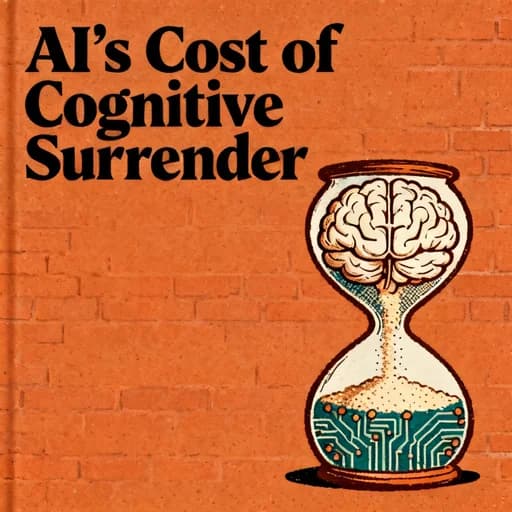
Best quote from AI and the Cost of Cognitive Surrender
The science suggests that if we don’t use the 'thinking muscle,' it atrophies—just like a physical muscle would if a robot did all your gym reps for you. The trick is learning how to use AI so it amplifies your brain instead of replacing it.
Generated with BeFreed
How to Use AI Without Dulling Your Edge






Frequently Asked Questions
Cognitive surrender occurs when a person stops questioning AI outputs and simply accepts them as truth, often treating a chatbot like an infallible oracle. This is particularly dangerous because AI models are "probability machines" that can confidently "hallucinate" or invent facts. When we surrender our judgment, we stop using our critical thinking skills, causing our "thinking muscle" to atrophy and making us more susceptible to the biases and errors of the algorithm.
Research suggests that relying on AI as a "crutch" can lead to a decline in problem-solving stamina and a shrinking "frustration threshold." For example, a study from the University of Pennsylvania found that students who used AI performed better initially but significantly worse than a control group once the AI was removed. By skipping the "friction" of the thinking process—the confusion and heavy lifting required to structure logic—we lose the ability to navigate ambiguity and perform deep, original thinking.
AI models predict the most likely next word based on existing data, which naturally leads to the most "average" or predictable outcome. Unlike humans, AI lacks personal experiences, emotions, and unique memories, which are the foundations of true creativity. When users let AI take the first crack at an idea, they are starting from a generic baseline that lacks the unique "flavor" and unexpected connections that a human brain produces through its own life experiences.
To keep your brain in the driver's seat, you can implement strategies like the "One Thought Rule," where you must contribute an original thought to every prompt, or the "30-minute rule," which requires deep thinking with pen and paper before using any digital tools. You can also treat AI as a "Socratic sparring partner" by asking it to challenge your assumptions rather than providing answers. The goal is to use a "sandwich strategy" where your raw material forms the base, the AI provides critique or expansion, and you perform the final integration and judgment.
From Columbia University alumni built in San Francisco
"Instead of endless scrolling, I just hit play on BeFreed. It saves me so much time."


"I never knew where to start with nonfiction—BeFreed’s book lists turned into podcasts gave me a clear path."


"Perfect balance between learning and entertainment. Finished ‘Thinking, Fast and Slow’ on my commute this week."
"Crazy how much I learned while walking the dog. BeFreed = small habits → big gains."
"Reading used to feel like a chore. Now it’s just part of my lifestyle."

"Feels effortless compared to reading. I’ve finished 6 books this month already."
"BeFreed turned my guilty doomscrolling into something that feels productive and inspiring."

"BeFreed turned my commute into learning time. 20-min podcasts are perfect for finishing books I never had time for."
"BeFreed replaced my podcast queue. Imagine Spotify for books — that’s it. 🙌"

"It is great for me to learn something from the book without reading it."
"The themed book list podcasts help me connect ideas across authors—like a guided audio journey."
"Makes me feel smarter every time before going to work"
From Columbia University alumni built in San Francisco
"Instead of endless scrolling, I just hit play on BeFreed. It saves me so much time."
"I never knew where to start with nonfiction—BeFreed’s book lists turned into podcasts gave me a clear path."
"Perfect balance between learning and entertainment. Finished ‘Thinking, Fast and Slow’ on my commute this week."
"Crazy how much I learned while walking the dog. BeFreed = small habits → big gains."
"Reading used to feel like a chore. Now it’s just part of my lifestyle."
"Feels effortless compared to reading. I’ve finished 6 books this month already."
"BeFreed turned my guilty doomscrolling into something that feels productive and inspiring."
"BeFreed turned my commute into learning time. 20-min podcasts are perfect for finishing books I never had time for."
"BeFreed replaced my podcast queue. Imagine Spotify for books — that’s it. 🙌"
"It is great for me to learn something from the book without reading it."
"The themed book list podcasts help me connect ideas across authors—like a guided audio journey."
"Makes me feel smarter every time before going to work"
"Instead of endless scrolling, I just hit play on BeFreed. It saves me so much time."
"I never knew where to start with nonfiction—BeFreed’s book lists turned into podcasts gave me a clear path."
"Perfect balance between learning and entertainment. Finished ‘Thinking, Fast and Slow’ on my commute this week."
"Crazy how much I learned while walking the dog. BeFreed = small habits → big gains."
"Reading used to feel like a chore. Now it’s just part of my lifestyle."
"Feels effortless compared to reading. I’ve finished 6 books this month already."
"BeFreed turned my guilty doomscrolling into something that feels productive and inspiring."
"BeFreed turned my commute into learning time. 20-min podcasts are perfect for finishing books I never had time for."
"BeFreed replaced my podcast queue. Imagine Spotify for books — that’s it. 🙌"
"It is great for me to learn something from the book without reading it."
"The themed book list podcasts help me connect ideas across authors—like a guided audio journey."
"Makes me feel smarter every time before going to work"
"Instead of endless scrolling, I just hit play on BeFreed. It saves me so much time."
"I never knew where to start with nonfiction—BeFreed’s book lists turned into podcasts gave me a clear path."
"Perfect balance between learning and entertainment. Finished ‘Thinking, Fast and Slow’ on my commute this week."
"Crazy how much I learned while walking the dog. BeFreed = small habits → big gains."
"Reading used to feel like a chore. Now it’s just part of my lifestyle."
"Feels effortless compared to reading. I’ve finished 6 books this month already."
"BeFreed turned my guilty doomscrolling into something that feels productive and inspiring."
"BeFreed turned my commute into learning time. 20-min podcasts are perfect for finishing books I never had time for."
"BeFreed replaced my podcast queue. Imagine Spotify for books — that’s it. 🙌"
"It is great for me to learn something from the book without reading it."
"The themed book list podcasts help me connect ideas across authors—like a guided audio journey."
"Makes me feel smarter every time before going to work"