BeFreed
    Categories>Biography>Timothy Leary: The Harvard Professor and the Origins of Psychedelics

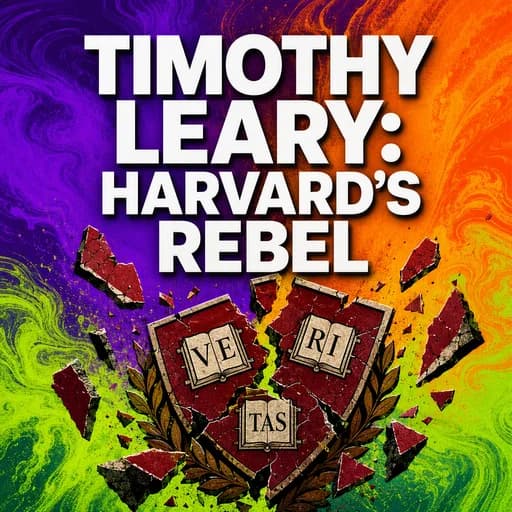
    Timothy Leary: The Harvard Professor and the Origins of Psychedelics

    19분
    |
    |
    2026년 8월 21일
    • Biography
    • Psychology
    • Philosophy & Spirituality

    Explore Timothy Leary's journey from a respected Harvard clinical psychology professor to a counterculture icon who challenged the foundations of psychotherapy.

    Timothy Leary: The Harvard Professor and the Origins of Psychedelics
    0:00 / 0:00
    전달 방식을 선택하세요

    하나의 에피소드, 다양한 청취 방식.

    Timothy Leary: The Harvard Professor and the Origins of Psychedelics의 같은 아이디어를 나에게 맞는 목소리, 깊이, 속도로 만나보세요. 언제든 바꿀 수 있습니다.

    전체 대본 및 챕터

    챕터 1

    The Professor Who Dreamed of Change

    Ethan: Imagine you’re a graduate student at Harvard in 1960. You’re sitting in a wood—paneled office, surrounded by the heavy weight of tradition, and your professor—a rising star in clinical psychology—hands you a small, synthesized pill. He tells you it’s a key to unlocking the deepest parts of your mind, a way to reach what he calls "a marked broadening of awareness". This isn’t a scene from a movie—it was the actual work of Timothy Leary. Before he was a counterculture icon or the man Richard Nixon called "the most dangerous man in America," Leary was a serious, highly respected academic who believed he had found a chemical solution for the emotional problems of the Western world.

    Iris: It’s such a sharp contrast, isn’t it? You have this man with a PhD from Berkeley, a director of psychiatric research who literally wrote the book on personality diagnosis—a book called The Interpersonal Diagnosis of Personality that was hailed as the most important work in psychotherapy the year it came out. He was the quintessential "organization man," as he later put it—driving to work in a line of commuter cars, drinking martinis, feeling like a middle—class robot. But then, a single experience with magic mushrooms in Mexico in August 1960 changed everything. He claimed he learned more about his brain and its possibilities in five hours than he had in fifteen years of research.

    Ethan: That moment in Cuernavaca, Mexico, is really the pivot point for his entire life. He goes from studying behavior in a lab to wanting to "bring about a fundamental shift in human consciousness". It’s fascinating because it raises this huge question: how does a brilliant scientist lose his footing—or maybe find a new one—so completely that he ends up as an international fugitive?

    Iris: And that’s exactly what we’re going to trace. We’ll look at the famous Harvard experiments that started with high hopes and ended in a massive scandal, his descent into the underground, and his eventual reinvention as a digital philosopher. It’s a story about the tension between institutional rigor and the messy, unpredictable nature of personal discovery. Let’s start with how he brought that "mushroom wisdom" back to the hallowed halls of Harvard.
    챕터 2

    Science or Spiritual Crusade

    Ethan: When Leary returned to Harvard after that Mexico trip, he didn't just want to talk about his experience—he wanted to prove its value through the Harvard Psilocybin Project. He teamed up with Richard Alpert, another assistant professor, and they started ordering psilocybin from Sandoz, the Swiss company that also produced LSD. But right from the start, the way they ran these experiments was... well, it was unconventional, to say the least.

    Iris: "Unconventional" is putting it mildly. In their first study in 1960, they had 38 people, and here’s the kicker: the lead researchers, Leary and Alpert, took the drugs along with the participants. Leary argued that you had to be in the same state of mind as the subject to actually understand what they were going through in the moment. But to the rest of the faculty at the Harvard Center for Research in Personality, that looked like a total abandonment of scientific objectivity. You can’t be the observer if you’re part of the phenomenon, right?

    Ethan: Exactly. And they weren't just doing this in sterile labs. They chose "soothing environments" and let the subjects control their own dosages. They found that 95% of the participants felt the experience "changed their lives for the better". But while the participants were happy, the Harvard administration was getting nervous. There were rumors of private "psilocybin parties," and two students actually ended up in a mental hospital after using the drug.

    Iris: The ethical lines were blurring fast. Other professors were worried that Leary and Alpert were abusing their power—essentially pressuring graduate students in their required classes to participate in the research. They also started giving the drugs to undergraduates, which was a huge violation of university policy. It wasn't just a disagreement over data—it was a full—blown institutional crisis.

    Ethan: It really feels like Leary was transitioning from a scientist to a "performing philosopher" even then. He and Alpert felt that denying someone the right to explore their inner self was a step toward totalitarianism. They weren't just testing a chemical—they were advocating for a new way of being. This tension eventually led to a massive internal meeting in March 1962 that basically turned into a trial of their methods.

    Iris: And that trial was just the beginning of the end for their time at Harvard. But before the final split, Leary conducted two of his most famous—and controversial—experiments: one in a prison and one in a chapel. These studies were supposed to be the "proof" that psychedelics could solve society's deepest problems.
    이 에피소드로 더 깊이 배우기

    이 에피소드의 아이디어를 BeFreed의 가이드 학습 경험으로 더 깊이 탐구해 보세요.

    챕터 3

    The Prison and the Chapel

    Ethan: Leary really believed psilocybin could be a tool for social good. In 1961, he launched the Concord Prison Experiment, where he gave the drug to 36 inmates during group psychotherapy. The idea was to see if the experience could reduce recidivism—the rate at which people return to prison after being released. Leary reported a massive success, claiming the rate dropped from 60% to 20%. He described the inmates as finally being able to see themselves outside the "cops—and—robbers game" they’d been stuck in.

    Iris: It sounds like a miracle, but when you look closer at the data, the story changes. A follow—up study later suggested that the improvement was actually very slight and that Leary might have fallen prey to the "halo effect," essentially skewing the results because he wanted them to be true. There was also criticism that his study lacked a control group—he didn't have a group of prisoners who got the same level of attention and support without the drugs.

    Ethan: Then you have the Marsh Chapel Experiment in 1962, often called the "Good Friday Experiment." This one was designed by a divinity student under Leary’s supervision to see if psilocybin could facilitate a "profound religious state". They gave the drug to ten divinity students in a chapel at Boston University. All ten of them reported having a mystical experience.

    Iris: It was a "mysticism in the lab" moment that got national attention, even in Time magazine. But even here, Leary was pushing against the scientific method. The principal investigator, Walter Pahnke, had to fight Leary to keep the study double—blind and placebo—controlled. Leary later joked that a double—blind study with psychedelics was foolish because "after five minutes, no one’s fooling anyone".

    Ethan: That’s the core of the problem. For Leary, the "inner truth" of the person tripping was more important than the "outer truth" of the data. He was moving away from being a lecturer and toward being a "high priest," which is exactly how the public started to see him.

    Iris: And the Harvard administration had seen enough. In May 1963, both Leary and Alpert were fired. Interestingly, they weren't officially fired for the drugs—at least not initially. Leary was dismissed for failing to attend his scheduled lectures, and Alpert was fired for giving psilocybin to an undergraduate off—campus. But the message was clear: the academic experiment was over. The counterculture era was about to begin.

    챕터 4

    The Millbrook Years and the Birth of a Slogan

    Ethan: After Harvard, Leary didn't just disappear—he leveled up. He and his group moved into a massive 64—room mansion on an estate in Millbrook, New York, provided by heirs to the Mellon fortune. This became the headquarters for his new organization, the Castalia Foundation. They saw themselves as "anthropologists from the 21st century" living in the "dark ages of the 1960s".

    Iris: It sounds like a strange mix of a research colony and a perpetual party. They were doing LSD sessions, practicing yoga, and trying to create a "new dedication to life as art". This is also when Leary co—authored The Psychedelic Experience, which was based on the Tibetan Book of the Dead. He wanted to give people a manual for navigating what he called "ego death".

    Ethan: That book had a massive impact. John Lennon actually used it as the inspiration for the Beatles' song "Tomorrow Never Knows". And it was during this time that Leary coined—or at least popularized—his most famous phrase: "Turn on, tune in, drop out". He actually said he got the idea from the media theorist Marshall McLuhan while they were having lunch in New York.

    Iris: People often forget that he actually had a specific definition for those words. "Drop Out" meant detaching from the "external social drama." "Turn On" was about finding a sacrament to return to the "temple of God," which he said was your own body. And "Tune In" meant being reborn and starting a new sequence of behavior that reflected your vision. It wasn't just a call to be lazy—it was a call to a completely different life.

    Ethan: But the authorities weren't buying the "spiritual discovery" angle. Millbrook was constantly being raided, often by a local assistant district attorney named G. Gordon Liddy—the same guy who would later be famous for the Watergate scandal. Liddy would literally enter Leary’s bedroom at midnight during these raids.

    Iris: It’s a wild collision of historical figures. You have Leary trying to start a new religion—the League for Spiritual Discovery—using LSD as a sacrament to gain legal protection under "freedom of religion". But while he was preaching harmony and "questioning authority," the legal net was tightening. In 1965, a routine trip to Mexico with his children and his girlfriend, Rosemary Woodruff, turned into the beginning of a decades—long legal nightmare.

    이 에피소드로 더 깊이 배우기

    이 에피소드의 아이디어를 BeFreed의 가이드 학습 경험으로 더 깊이 탐구해 보세요.

    챕터 5

    The Fugitive King and the Great Escape

    Ethan: The legal trouble started at the US—Mexico border. Leary’s daughter, Susan, was found with a small amount of marijuana in a silver snuffbox. Leary took responsibility for it and was initially sentenced to thirty years in prison. He fought it all the way to the Supreme Court and actually won in 1969, getting the Marihuana Tax Act declared unconstitutional. But that victory was short—lived.

    Iris: Right, because he was arrested again in California for having just two marijuana "roaches" in his car. Leary claimed they were planted, but he was convicted and sentenced to twenty years. This is where the story turns into a Hollywood thriller. In September 1970, Leary pulled off an audacious prison escape.

    Ethan: He was forty-nine years old at the time! He used his own psychological tests to convince the prison staff that he was a harmless, conventional person who just wanted to garden in a low—security facility. Then, one night, he climbed a telephone wire, scaled a twelve—foot fence, and escaped. The Weather Underground—a radical militant group—smuggled him out of the country in a pickup truck.

    Iris: He and his wife Rosemary ended up in Algeria as "guests" of Eldridge Cleaver and the Black Panthers. But that didn't go well. Cleaver eventually put the Learys under "house arrest" because he was fed up with their "socialite lifestyle". The Algerians also realized that Leary wasn't a political revolutionary in the way they expected—they were stunned to find out he was a "white man" and a "drug advocate".

    Ethan: So they flee again—this time to Switzerland, then Austria, Lebanon, and finally Afghanistan. It’s an incredible journey. He’s being protected by arms dealers and socialites, all while the Nixon administration is pressuring governments around the world to extradite him.

    Iris: He was finally captured at the airport in Kabul in 1973 by American federal agents. When he got back to the US, his bail was set at five million dollars. The judge said that if he were allowed to travel freely, he would "speak publicly and spread his ideas". He was sent back to Folsom Prison, where he ended up in a cell right next to Charles Manson. Apparently, Manson couldn't understand why Leary gave people LSD without trying to control them.

    챕터 6

    The Informant and the Eight Circuits

    Ethan: Leary’s time in prison after his capture is one of the most controversial parts of his life. He eventually became an FBI informant to shorten his sentence, which led many of his old friends—including Allen Ginsberg and his own son—to denounce him as a "cop informant". Leary claimed he was just "feigning cooperation" and giving them information they already had, but the damage to his reputation in the counterculture was huge.

    Iris: While he was in prison, though, he wasn't just sitting idle. He was writing Neurologic, which described an early seven-circuit model of consciousness This is a super complex theory where he argued the human brain has eight levels of consciousness. The first four are "terrestrial"—things like survival and social status. But the last four are "extra—terrestrial," designed for when humans eventually evolve to live in space.

    Ethan: He actually wrote a book called Neurologic while he was in solitary confinement, using a tiny pencil stub on the back of legal documents. He believed he was receiving "inspired clear—channel transmissions" about the future of human evolution. He even claimed that higher intelligences had encoded a "UFO message" in human DNA to help us move into space.

    Iris: It sounds like science fiction, but for Leary, this was the natural progression of his work. He moved away from just talking about drugs to what he called "SMI²LE"—an acronym for Space Migration, Intelligence Increase, and Life Extension. He really thought the purpose of the higher circuits was to prepare us for zero gravity and interstellar travel.

    Ethan: It’s a far cry from his days as a Harvard psychologist, but you can see the thread. He was still trying to map the human mind, just on a much more cosmic scale. And once he was released from prison in 1976—thanks to Governor Jerry Brown—he took this "futurist" message to a whole new audience.

    Iris: He became a "stand—up philosopher," touring with his old nemesis, G. Gordon Liddy, to debate politics and the future. He was reinventing himself once again, this time as a techno—prophet. He famously said that "the PC is the LSD of the 1990s".

    이 에피소드로 더 깊이 배우기

    이 에피소드의 아이디어를 BeFreed의 가이드 학습 경험으로 더 깊이 탐구해 보세요.

    챕터 7

    From Psychedelics to Cybernetics

    Ethan: By the 1980s and 90s, Leary had fully embraced the digital revolution. He told people to "turn on, boot up, jack in". He saw computers and virtual reality as the new tools for expanding consciousness, much like he had seen mushrooms and LSD decades earlier. He even became a promoter of virtual reality systems and used the Mattel Power Glove in his lectures.

    Iris: It’s so interesting how he saw technology as a continuation of the psychedelic experience. He befriended pioneers in the field like Jaron Lanier and served as a consultant for Billy Idol’s Cyberpunk album. He was still the "high priest," just for a different kind of temple. He even started re—connecting with Neo—Pagan movements, declaring himself a "Pagan" and talking about "digital polytheism".

    Ethan: And he never lost his flair for the dramatic. When he was diagnosed with inoperable prostate cancer in 1995, he decided to turn his own death into a media event he called "designer dying". He had a website team that gave daily updates on his health and his drug intake—everything from nitrous oxide to what he called "Leary Biscuits," which were crackers with cheese and a marijuana bud.

    Iris: He even initially signed up to have his head frozen with a cryonics company, though he changed his mind three weeks before he died. He finally passed away on May 31, 1996, and his last words were reportedly a sequence of "Why?" and "Why not?" before finally saying "beautiful".

    Ethan: Even his burial was cosmic. Seven grams of his ashes were launched into space aboard a rocket—sharing the ride with the creator of Star Trek, Gene Roddenberry. They stayed in orbit for six years before burning up in the atmosphere. It was the ultimate "space migration" for him.

    Iris: Looking back at his whole life, from the Harvard labs to the Algerian exile to the digital prophet phase, it’s such a strange, singular path. But it leaves you with a lot to think about—especially regarding how we handle people who challenge the status quo from the inside.

    챕터 8

    A Playbook for the Questioner

    Ethan: So, if you’re looking at Leary’s life, what are the actual takeaways? I think the first one is his famous mantra: "drop out, turn on, tune in". Whether you agree with his methods or not, he was a massive advocate for personal autonomy. He believed that no institution—not even Harvard or the US government—should have the right to tell you what you can do with your own consciousness.

    Iris: Another key concept is "set and setting." This is actually a fundamental principle in modern psychedelic research. "Set" is your internal state—your expectations and mood—and "setting" is the physical and social environment you’re in. Leary and his coauthors popularized the idea that safe and secure "set and setting" were essential elements in determining the outcome of an experience.

    Ethan: And then there’s the "reality tunnel." This was a term he coined to explain how we all filter the world through our own subconscious beliefs and experiences. He taught that "truth is in the eye of the beholder," and that by changing your mental filters, you can literally change the world you live in.

    Iris: But there's also a cautionary tale here about "the halo effect" and the dangers of abandoning rigor for advocacy. Modern researchers like Roland Griffiths at Johns Hopkins note that Leary actually played a very significant role in the backlash because he didn't pursue a systematic and cautious approach. He made the subject "untouchable" for serious academia for a long time.

    Ethan: It’s a reminder that if you want to change a system, you have to find a balance between the "bold oracle" and the "scientist". If you go too far one way, you lose your legitimacy; go too far the other, and you might lose your vision. Leary chose the vision, and he paid a high price for it—thirty—six arrests and years of exile.

    Iris: But today, we’re seeing a "psychedelic renaissance" in universities like Johns Hopkins and NYU, using the very substances Leary championed to treat things like PTSD and addiction. It’s almost like the world is finally catching up to some of the questions he was asking, even if it’s taking a more cautious path to get there.

    이 에피소드로 더 깊이 배우기

    이 에피소드의 아이디어를 BeFreed의 가이드 학습 경험으로 더 깊이 탐구해 보세요.

    챕터 9

    The Beautiful Why Not

    Ethan: As we bring this to a close, it’s worth reflecting on that final exchange of his: "Why?" and "Why not?". It really sums up the tension of his whole life. Why follow the rules? Why stick to the commuter line and the martinis? And when he found an alternative, he asked, "Why not?" Why not try to change the world? Why not explore the furthest reaches of the mind?

    Iris: He was a man who refused to be just "another cog in society," as his old Berkeley colleague put it. Whether you see him as a "hero of American consciousness" or a "treacherous creep," you can’t deny his influence on how we think about the mind, technology, and personal freedom.

    Ethan: He’s finally made it back to Harvard in a way—many items from his archive are housed in Harvard Library’s Ludlow-Santo Domingo Library. It’s a perfect irony for a man who was once "shamed" by the university only to become one of its most famous historical figures. It makes you wonder: what are the "reality tunnels" we’re living in today that might be challenged in the next generation?

    Iris: That’s a great question to leave you with. Next time you encounter a boundary—whether it’s a social rule or a mental limit—maybe ask yourself the Leary question: "Why not?" Thank you for diving into this wild story with us. It’s been a fascinating trip.

    Ethan: Definitely. Take some time to think about your own "set and setting" this week. We’ll be thinking about ours. Thanks for listening.

    ★★★★★

    Timothy Leary: The Harvard Professor and the Origins of Psychedelics의 끝까지 도달했어요

    “23일째 매일 사용하고 있어요. 이제 제 일상의 한 부분이 되었습니다.”

    jayallen

    Timothy Leary: The Harvard Professor and the Origins of Psychedelics 베스트 인용

    “

    He claimed he learned more about his brain and its possibilities in five hours than he had in fifteen years of research.

    ”
    S

    Generated by Stephen

    질문 입력

    Timothy Leary: from Harvard psychologist and psychedelic researcher to counterculture icon, activist, and international fugitive.

    호스트 음성
    Lenaplay
    Lenaplay
    지식 출처
    Harvard Psilocybin Project
    link
    https://en.wikipedia.org/wiki/Harvard_Psilocybin_Project
    Timothy Leary
    link
    https://en.wikipedia.org/wiki/Timothy_Leary
    Timothy Leary’s legacy and the rebirth of psychedelic research
    link
    https://dash.harvard.edu/server/api/core/bitstreams/d9dd2883-fcfe-40f6-9506-f2796cc19ea4/content
    Inside Timothy Leary's Audacious Prison Escape - Rolling Stone
    link
    https://www.rollingstone.com/culture/culture-features/inside-timothy-prison-escape-acid-queen-excerpt-1235303212/
    When the LSD King Timothy Leary Hid in Africa with the Black Panthers
    link
    https://www.thedailybeast.com/lsd-king-timothy-learys-weirdest-trip-took-him-to-the-black-panthers/
    Neurologic (book)
    link
    https://en.wikipedia.org/wiki/Neurologic_(book)

    자주 묻는 질문

    Before becoming a counterculture figure, Timothy Leary was a highly respected academic and a rising star in clinical psychology. He held a PhD from Berkeley and served as a director of psychiatric research. At Harvard University, he was known for his serious academic work, including his influential book, The Interpersonal Diagnosis of Personality, which was once hailed as the most important work in psychotherapy.

    At Harvard, Timothy Leary was a professor who conducted research into the human mind and personality. In 1960, he began exploring the potential of synthesized substances and magic mushrooms as tools for clinical psychology. He believed these substances could provide a chemical solution for emotional problems, offering what he described as a marked broadening of awareness for his graduate students and research subjects.

    A single experience with magic mushrooms in Mexico in August 1960 fundamentally altered Leary's professional path. He claimed that this five-hour experience taught him more about the brain's possibilities than his previous fifteen years of research. This realization led him to shift away from his life as a traditional academic and 'organization man' to focus on the origins of psychedelics and their impact on the mind.

    While Leary started as a serious Harvard professor, his radical shift toward promoting psychedelics and challenging social norms eventually drew the attention of the highest levels of government. His transition from a clinical psychologist to a leader of a movement led Richard Nixon to label him the most dangerous man in America, reflecting the perceived threat his ideas posed to the traditional Western world.

    컬럼비아 대학교 동문들이 제작 | 샌프란시스코에서 개발

    BeFreed는 호기심 넘치는 글로벌 커뮤니티를 하나로 연결합니다

    4.7

    평균 평점

    앱 평가 7.84천 개 이상

    BeFreed 커뮤니티

    정말이지 아직 앱을 다 써 보지도 않았는데, 며칠 써 본 것만으로도 깊은 인상을 받았어요… BeFreed는 제가 써 본 어떤 학습 앱과도 차원이 달라요. 몰입감이 엄청나고 집중력도 실제로 좋아져서, 스마트폰을 하염없이 스크롤하는 분들께 딱이에요!

    @ladyInfinity

    정확히 23일 전에 BeFreed를 구입했는데, 그날부터 하루도 빠짐없이 쓰고 있어요. 제 일상 업무 흐름과 학습 습관에 완전히 자리 잡았어요.

    @jayallen

    솔직히 이 앱은 제 기대를 전부 뛰어넘었어요. 어떤 주제든 오디오로 만들어 달라고 할 수 있고, 결과물이 놀라워요. 제 전문 분야는 심리치료 쪽이고 여러 학문이 얽혀 있는데도 답변이 아주 정확해요.

    @Raguipa

    제일 고마운 건 스크롤하는 시간이 확 줄었다는 거예요. 검색하는 시간은 줄고 흡수하는 시간은 늘었어요. 오디오북 전권, 팟캐스트, 학습 플랜의 조합이 정말 훌륭해요.

    @colonyofcreatorsNGO

    저는 24년째 PhotoReading 속진 학습 강사로 일하고 있어요… 책과 독서, 배움이 제 전문인데, BeFreed는 정보를 소화하기 쉽게 전달하는 혁신적인 방식을 정말 잘 구현했어요.

    @BeFreed user

    단순한 책 요약 앱이 아니에요. '재미' 스타일을 써 봤는데, 전통적인 방식보다 훨씬 나은 요약이고 아이디어를 이해하기도 쉬워요. 이것만으로도 값어치를 해요.

    @austinakon

    이 앱이 정말 좋아요. 며칠 써 봤는데 듣는 걸 멈출 수가 없어요. 시작하기에 이보다 좋을 수 없어요.

    @jcrules328

    정말 마음에 들어요. 한 달 정도 써 봤는데 숨은 보석을 찾은 기분이에요. BeFreed로 제가 원하는 주제를 직접 만들 수 있어서 좋고, 목소리도 훌륭한 데다 내레이션 선택지가 무궁무진해요.

    @DanielCZ

    정말이지 아직 앱을 다 써 보지도 않았는데, 며칠 써 본 것만으로도 깊은 인상을 받았어요… BeFreed는 제가 써 본 어떤 학습 앱과도 차원이 달라요. 몰입감이 엄청나고 집중력도 실제로 좋아져서, 스마트폰을 하염없이 스크롤하는 분들께 딱이에요!

    @ladyInfinity

    정확히 23일 전에 BeFreed를 구입했는데, 그날부터 하루도 빠짐없이 쓰고 있어요. 제 일상 업무 흐름과 학습 습관에 완전히 자리 잡았어요.

    @jayallen

    솔직히 이 앱은 제 기대를 전부 뛰어넘었어요. 어떤 주제든 오디오로 만들어 달라고 할 수 있고, 결과물이 놀라워요. 제 전문 분야는 심리치료 쪽이고 여러 학문이 얽혀 있는데도 답변이 아주 정확해요.

    @Raguipa

    제일 고마운 건 스크롤하는 시간이 확 줄었다는 거예요. 검색하는 시간은 줄고 흡수하는 시간은 늘었어요. 오디오북 전권, 팟캐스트, 학습 플랜의 조합이 정말 훌륭해요.

    @colonyofcreatorsNGO

    저는 24년째 PhotoReading 속진 학습 강사로 일하고 있어요… 책과 독서, 배움이 제 전문인데, BeFreed는 정보를 소화하기 쉽게 전달하는 혁신적인 방식을 정말 잘 구현했어요.

    @BeFreed user

    단순한 책 요약 앱이 아니에요. '재미' 스타일을 써 봤는데, 전통적인 방식보다 훨씬 나은 요약이고 아이디어를 이해하기도 쉬워요. 이것만으로도 값어치를 해요.

    @austinakon

    이 앱이 정말 좋아요. 며칠 써 봤는데 듣는 걸 멈출 수가 없어요. 시작하기에 이보다 좋을 수 없어요.

    @jcrules328

    정말 마음에 들어요. 한 달 정도 써 봤는데 숨은 보석을 찾은 기분이에요. BeFreed로 제가 원하는 주제를 직접 만들 수 있어서 좋고, 목소리도 훌륭한 데다 내레이션 선택지가 무궁무진해요.

    @DanielCZ

    유용한 정보와 아이디어를 8~15분짜리 팟캐스트 스타일 오디오로 압축해서 들을 수 있다는 게 정말 좋아요. 원래 팟캐스트는 군더더기가 많아서 안 좋아했는데, 여기는 그걸 싹 걷어냈어요.

    @BeFreed user

    박사 과정을 마무리하는 중이라 낯선 자료를 많이 읽어야 해요… BeFreed에서는 프롬프트만 입력하면 앱이 자료를 찾아서 오디오 팟캐스트로 만들어 줘요. BeFreed의 과정이 NotebookLM보다 더 매끄럽게 느껴져요.

    @Brad

    아침을 준비하거나 산책하거나 출퇴근할 때 들을 것을 YouTube에서 자주 찾곤 했는데, BeFreed는 광고도 군더더기도 없이 훨씬 더 딱 맞는 걸 들려줘요!

    @BeFreed user

    이 플랫폼의 가장 큰 장점은 활용도예요. 다루지 못하는 주제가 말 그대로 하나도 없어요. 무엇을 던져도 다 소화해요… 제한이 전혀 없으면서 약속을 실제로 지키는 학습 도구는 정말 드물어요.

    @jayallen

    BeFreed는 환상적이에요. 디자인이 편해서 헤매는 시간은 줄고 배우는 시간은 늘었어요. 오디오북, 팟캐스트, 학습 플랜의 조합은 천재적이에요. 제 하루가 완전히 달라졌어요.

    @BeFreed user

    처음엔 이탈리아어로 팟캐스트를 만드는 방법을 이해하는 데 시간이 좀 걸렸는데, 알고 나니까 — 와! 정말 대단해요! 어떤 주제든 설명해 달라고 하면 정말 똑똑하게 잘 설명해 줘요!

    @matteo77

    BeFreed는 제가 매일 쓰는 오디오북 앱이 됐어요… 제일 마음에 드는 건 텍스트를 넣으면 이동 중에도 들을 수 있는 오디오로 만들어 준다는 점이에요.

    @kotanzu1

    유용한 정보와 아이디어를 8~15분짜리 팟캐스트 스타일 오디오로 압축해서 들을 수 있다는 게 정말 좋아요. 원래 팟캐스트는 군더더기가 많아서 안 좋아했는데, 여기는 그걸 싹 걷어냈어요.

    @BeFreed user

    박사 과정을 마무리하는 중이라 낯선 자료를 많이 읽어야 해요… BeFreed에서는 프롬프트만 입력하면 앱이 자료를 찾아서 오디오 팟캐스트로 만들어 줘요. BeFreed의 과정이 NotebookLM보다 더 매끄럽게 느껴져요.

    @Brad

    아침을 준비하거나 산책하거나 출퇴근할 때 들을 것을 YouTube에서 자주 찾곤 했는데, BeFreed는 광고도 군더더기도 없이 훨씬 더 딱 맞는 걸 들려줘요!

    @BeFreed user

    이 플랫폼의 가장 큰 장점은 활용도예요. 다루지 못하는 주제가 말 그대로 하나도 없어요. 무엇을 던져도 다 소화해요… 제한이 전혀 없으면서 약속을 실제로 지키는 학습 도구는 정말 드물어요.

    @jayallen

    BeFreed는 환상적이에요. 디자인이 편해서 헤매는 시간은 줄고 배우는 시간은 늘었어요. 오디오북, 팟캐스트, 학습 플랜의 조합은 천재적이에요. 제 하루가 완전히 달라졌어요.

    @BeFreed user

    처음엔 이탈리아어로 팟캐스트를 만드는 방법을 이해하는 데 시간이 좀 걸렸는데, 알고 나니까 — 와! 정말 대단해요! 어떤 주제든 설명해 달라고 하면 정말 똑똑하게 잘 설명해 줘요!

    @matteo77

    BeFreed는 제가 매일 쓰는 오디오북 앱이 됐어요… 제일 마음에 드는 건 텍스트를 넣으면 이동 중에도 들을 수 있는 오디오로 만들어 준다는 점이에요.

    @kotanzu1

    웹에서 BeFreed가 어떻게 논의되고 있는지 더 보기
    129.7K19.5K
    55.2K19.2K
    154.2K10827355
    48.1K2.5K
    81.2K6.6K
    82.3K1.8K
    지금 바로 학습 여정을 시작하세요
    BeFreed 앱
    BeFreed

    무엇이든 개인화된 학습

    DiscordLinkedIn
    추천 도서 요약
    Crucial ConversationsThe Perfect MarriageInto the WildNever Split the DifferenceAttachedGood to GreatSay Nothing
    인기 카테고리
    Self HelpCommunication SkillRelationshipMindfulnessPhilosophyInspirationProductivity
    유명인 추천 도서
    Elon MuskCharlie KirkBill GatesSteve JobsAndrew HubermanJoe RoganJordan Peterson
    수상작 컬렉션
    Pulitzer PrizeNational Book AwardGoodreads Choice AwardsNobel Prize in LiteratureNew York TimesCaldecott MedalNebula Award
    추천 주제
    ManagementAmerican HistoryWarTradingStoicismAnxietySex
    연도별 베스트 도서
    2025 Best Non Fiction Books2024 Best Non Fiction Books2023 Best Non Fiction Books
    추천 저자
    Chimamanda Ngozi AdichieGeorge OrwellO. J. SimpsonBarbara O'NeillWinston ChurchillCharlie Kirk
    BeFreed vs 다른 앱
    BeFreed vs. Other Book Summary AppsBeFreed vs. ElevenReaderBeFreed vs. ReadwiseBeFreed vs. Anki
    학습 도구
    Knowledge VisualizerAI Podcast Generator
    정보
    회사 소개arrow
    가격arrow
    FAQarrow
    블로그arrow
    채용arrow
    파트너십arrow
    앰배서더 프로그램arrow
    디렉토리arrow
    BeFreed
    Try now
    © 2026 BeFreed
    이용 약관개인정보 처리방침
    BeFreed

    무엇이든 개인화된 학습

    DiscordLinkedIn
    추천 도서 요약
    Crucial ConversationsThe Perfect MarriageInto the WildNever Split the DifferenceAttachedGood to GreatSay Nothing
    인기 카테고리
    Self HelpCommunication SkillRelationshipMindfulnessPhilosophyInspirationProductivity
    유명인 추천 도서
    Elon MuskCharlie KirkBill GatesSteve JobsAndrew HubermanJoe RoganJordan Peterson
    수상작 컬렉션
    Pulitzer PrizeNational Book AwardGoodreads Choice AwardsNobel Prize in LiteratureNew York TimesCaldecott MedalNebula Award
    추천 주제
    ManagementAmerican HistoryWarTradingStoicismAnxietySex
    연도별 베스트 도서
    2025 Best Non Fiction Books2024 Best Non Fiction Books2023 Best Non Fiction Books
    학습 도구
    Knowledge VisualizerAI Podcast Generator
    추천 저자
    Chimamanda Ngozi AdichieGeorge OrwellO. J. SimpsonBarbara O'NeillWinston ChurchillCharlie Kirk
    BeFreed vs 다른 앱
    BeFreed vs. Other Book Summary AppsBeFreed vs. ElevenReaderBeFreed vs. ReadwiseBeFreed vs. Anki
    정보
    회사 소개arrow
    가격arrow
    FAQarrow
    블로그arrow
    채용arrow
    파트너십arrow
    앰배서더 프로그램arrow
    디렉토리arrow
    BeFreed
    Try now
    © 2026 BeFreed
    이용 약관개인정보 처리방침

    비슷한 콘텐츠

    The Harvard Psychedelic Club 책 표지
    The Harvard Psychedelic Club
    Don Lattin
    Explores how four Harvard scholars sparked a cultural revolution through psychedelic drug research in the 1960s.
    27 min
    LSD and Liberation in the Castro 책 표지
    Drugs in the Gay Scene - FoundSF
    7 sources
    LSD and Liberation in the Castro
    In the 1970s, San Francisco’s gay community used psychedelics to dismantle social inhibitions. Explore how this radical experiment fueled a new world.
    22 min
    The psychedelic explorer's guide 책 표지
    The psychedelic explorer's guide
    James Fadiman
    A comprehensive guide to safe and transformative psychedelic journeys for health and self-discovery.
    26 min
    Thomas Merton: From Restless Wanderer to Mystic Prophet 책 표지
    The Silent LifeLife’s Amazing SecretsThe Varieties of Religious ExperienceThe Naked Now
    27 sources
    Thomas Merton: From Restless Wanderer to Mystic Prophet
    Explore how a party-loving Cambridge student became one of the 20th century's most influential spiritual voices, discovering that true contemplation deepens rather than escapes our connection to the world.
    26 min
    Psychedelic Apes and Fringe Science 책 표지
    NUTS4R2: Psychedelic Apes
    2 sources
    Psychedelic Apes and Fringe Science
    We often mistake popular guesses for solid facts. Explore the wild, logical theories that challenge our history and show how thin the evidence really is.
    21 min
    Psychedelics and Psychotherapy 책 표지
    Psychedelics and Psychotherapy
    Tim Read & Maria Papaspyrou
    29 min
    Altered States: The Psychology of Substance Use 책 표지
    Major life changes following psychedelic use: A retrospective survey among people using psychedelics naturalisticallySubjective and neurocognitive profiling of clinical doses of 3,4-methylenedioxymethamphetamine (MDMA) in healthy volunteers: implications for therapeutic use - Molecular PsychiatryJohns Hopkins Study Finds Cannabis Use May Pose Greater Mental Health Risks in Adolescents than AdultsTypes of psychoactive drugs and their effects - Medical News Today
    8 sources
    Altered States: The Psychology of Substance Use
    Stuck in a mental fog? Explore how substances from caffeine to psychedelics rewire our brains, the risks for young minds, and the path to safer choices.
    16 min
    Trippy 책 표지
    Trippy
    Ernesto Londoño
    28 min