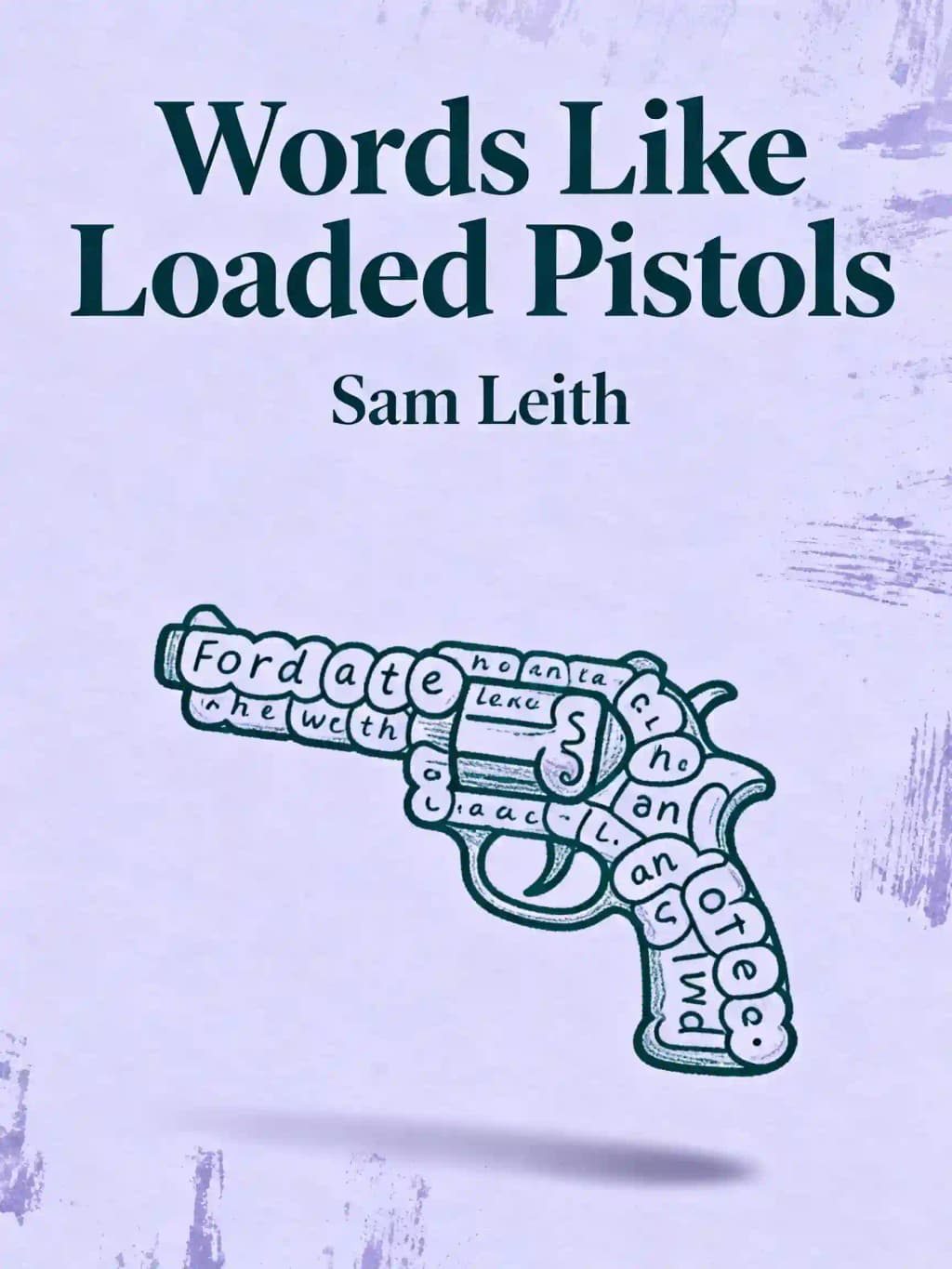
Words Like Loaded Pistols
The Power of Rhetoric from the Iron Age to the Information Age
Words Like Loaded Pistols 개요
From Aristotle to Obama, Sam Leith's "Words Like Loaded Pistols" reveals how rhetoric shapes our world. Used in university courses, this witty guide unpacks persuasion's timeless power. Why do some arguments convince while others fail? Discover the ancient art still ruling today's political battlegrounds.

Words Like Loaded Pistols의 핵심 주제
- classical rhetoric
- art of persuasion
- political oratory
- rhetorical devices
- public speaking history
Words Like Loaded Pistols의 명언
We're all practicing rhetoricians without realizing it.
Persuasive communication became increasingly valuable.
Modern audiences claim to prefer 'plain speaking' to high oratory.
Rhetoric deals with likelihood rather than certainty.
Rhetoric gives the plausible ignoramus power over the good and wise.
Words Like Loaded Pistols의 등장인물
- Sam LeithAuthor and guide to the history of rhetoric
- CoraxDeveloper of the first systematic approach to rhetoric
- Gorgias of LeontiniSophist who brought rhetoric from Sicily to Athens
저자 소개
Words Like Loaded Pistols의 저자 소개
Sam Leith, author of Words Like Loaded Pistols: Rhetoric From Aristotle to Obama, is a celebrated British author, journalist, and literary critic renowned for his expertise in language, rhetoric, and communication.
A graduate of Magdalen College, Oxford, where he earned a first in English Literature, Leith combines academic rigor with accessible prose, dissecting how language shapes politics, culture, and identity.
As literary editor of The Spectator and a contributor to major publications like The Guardian and Financial Times, he bridges literary analysis and contemporary discourse. His other works, including You Talkin’ to Me? and Write to the Point, further cement his authority in exploring the power of words.
Leith’s insights are frequently showcased on platforms like Monocle’s Meet the Writers podcast, and his books are acclaimed for blending historical depth with modern relevance. A sought-after speaker and media commentator, his analyses of rhetoric have influenced both academic and public debates, with his works consistently praised for their wit and scholarly precision.
Words Like Loaded Pistols 요약 다운로드
Words Like Loaded Pistols 요약을 무료 PDF 또는 EPUB으로 받으세요. 인쇄하거나 오프라인에서 언제든 읽을 수 있습니다.
이 책에 대한 FAQ
Words Like Loaded Pistols by Sam Leith explores the art of rhetoric, tracing its history from ancient Greece to modern politics. It breaks down persuasive techniques like ethos, pathos, and logos, illustrating their use by figures such as Cicero, Martin Luther King Jr., and Adolf Hitler. The book demystifies rhetorical tools, showing how language shapes opinions and actions.
This book is ideal for writers, public speakers, and anyone interested in mastering persuasive communication. It’s also valuable for history buffs analyzing speeches or voters dissecting political rhetoric. Leith’s accessible style makes complex concepts engaging for general readers seeking to understand how language influences society.
Yes, for its blend of historical insight and practical advice. Leith balances academic depth with wit, offering actionable tips like constructing a “memory palace” or using chiasmus. It’s praised for making rhetoric relevant to modern debates, careers, and everyday conversations.
Leith’s “Three Musketeers” are ethos (credibility), pathos (emotion), and logos (logic)—the core pillars of persuasion. He shows how leaders like Churchill combined these to motivate masses, while demagogues like Hitler manipulated them for harm. Examples include MLK’s moral authority and scientific arguments in policy debates.
The title compares words to weapons: loaded pistols can defend or destroy. Leith argues rhetoric is a neutral tool—its impact depends on the user’s intent. He contrasts Hitler’s destructive propaganda with FDR’s unifying fireside chats, emphasizing ethical responsibility.
Cicero’s courtroom strategies, Shakespeare’s poetic persuasion, and Churchill’s wartime speeches are highlighted. Leith also examines controversial figures like Nixon’s “Checkers speech” and Hitler’s propaganda, showing how rhetorical mastery can serve both noble and malicious goals.
Absolutely. Leith provides frameworks like occultation (strategic omission) and anaphora (repetition for emphasis). He dissects TED Talks and political debates, offering templates to structure arguments, engage audiences, and counter opposition. Practical exercises include constructing analogies and refining tone.
While celebrating rhetoric’s power, Leith warns against manipulation—citing how loaded terms like “fake news” distort truth. He advocates transparency, urging readers to “disarm bad faith arguments” by exposing fallacies like straw men or false binaries.
Some reviewers note limited focus on digital-age rhetoric (e.g., social media algorithms). However, the core principles remain applicable. A few argue Leith’s humorous tone occasionally oversimplifies complex philosophical debates about language.
Both explore classical rhetoric, but Leith emphasizes historical case studies, while Heinrichs focuses on modern scenarios like parenting or email negotiations. Words Like Loaded Pistols offers deeper analysis of infamous speeches, making it ideal for students of history.
Leith advises using antithesis (contrasting ideas) in job interviews, metaphors to simplify complex data, and humor to defuse tension. He also recommends analyzing political debates to identify logical fallacies and rhetorical tricks.
Fans of Leith’s The Haunted Wood (on childhood reading) will recognize his engaging narrative style. His journalism background enriches both books with real-world examples, though Words is more instructional versus Haunted Wood’s cultural analysis.