1장
The Art of Persuasion: Where Truth Meets Beauty
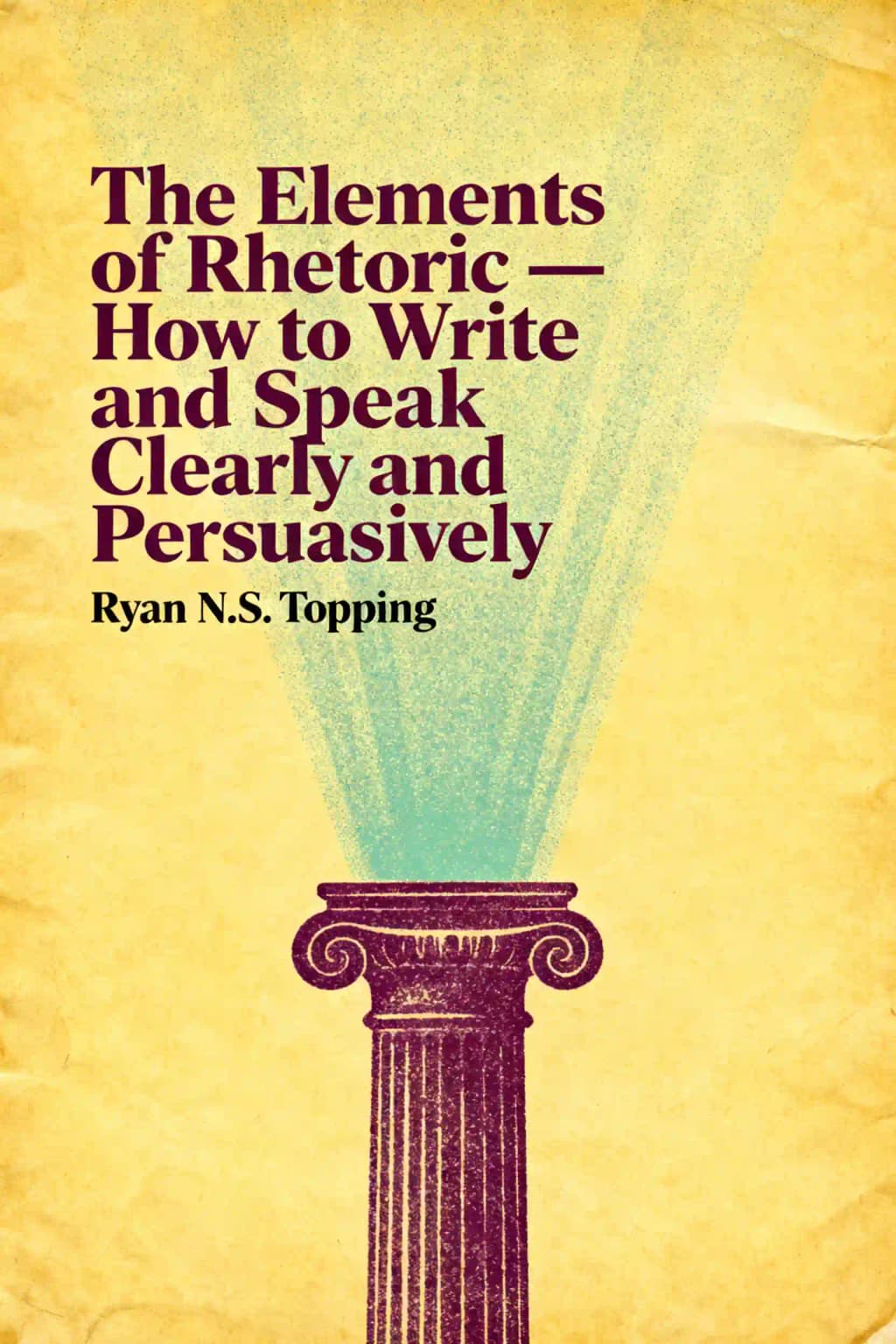
When Winston Churchill addressed the British people during their darkest hour, he didn't just speak-he wielded language as a weapon against despair. His rhetoric wasn't merely effective; it altered the course of history. Ryan N.S. Topping's "The Elements of Rhetoric" resurrects this ancient art for modern readers, revealing how persuasive communication can arm the virtuous against the manipulative. Since its publication, this book has become required reading in classical schools across America and has been translated into multiple languages, with renowned public speakers citing it as their secret weapon. What makes this work particularly remarkable is how it bridges classical wisdom with contemporary needs-showing that Aristotle's principles remain as relevant in boardrooms and social media as they were in the Athenian assembly. In a world where communication increasingly happens through screens rather than faces, Topping's work reminds us that the ability to speak well isn't just a professional skill but a moral imperative.
2장
The Foundation: Logos and the Rational Mind
Clear thinking precedes clear speaking. Logos-articulate, rational speech-forms the foundation of all persuasive communication. Without clarity, listeners cannot even offer the courtesy of disagreement. As Alice discovered in Wonderland during her conversations with the King, even nonsense depends on understanding the rules of language first.
Grammar mastery isn't merely academic pedantry-it's essential for credibility. When employers consistently cite poor reading comprehension as their top complaint about new hires, the practical value of grammar becomes evident. A misplaced comma or incorrect word choice can completely transform meaning, undermining your entire message.
Three fundamental precepts should guide your writing. First, omit needless words. Expect to write at least three drafts, each time eliminating unnecessary verbiage or replacing weak words with precise ones. A phrase like "She is a woman who enjoys reading" becomes simply "She enjoys reading." Think of your paragraph as a finely tuned bicycle-every part should contribute to your end goal.
Second, prefer active voice. While passive constructions have their place in creating a sense of objectivity (as in "Patrons are requested to remain quiet"), active voice generally creates clearer meaning with fewer words. Rather than hiding behind phrases like "it will be discussed," own your work with "I will discuss."
Third, use parallel structure to express similar ideas in similar form. This creates pleasing, memorable language that helps readers grasp connections between related concepts. Buddha demonstrated this principle beautifully: "All that we are is defined by our thoughts: it begins where our thoughts begin, it moves where our thoughts move, and it rests where our thoughts rest." When making lists or using correlative expressions (both/and, either/or), maintain consistent grammatical patterns.
Logic-the language of God-underlies all rational thinking. Until relatively recently, most university students learned about "the three acts of the mind": understanding, judging, and reasoning. Understanding grasps essences through definitions, judging evaluates propositions as true or false, and reasoning connects judgments through syllogisms to expand knowledge. Like building a house, arguments require solid premises (walls) to support conclusions (upper floors). Without common ground at the foundational level, you'll never share the view from the top.
When arguments fail, fallacies often lurk beneath the surface. These logical errors include Amphiboly (ambiguous phrasing), Equivocation (using the same word in different senses), False Cause (mistaking correlation for causation), Ad Hominem (attacking the person instead of their argument), and Ad Populum (appealing to popular opinion rather than evidence). Recognizing these fallacies strengthens your own thinking and immunizes you against manipulation.
3장
The Heart's Appeal: Pathos and Emotional Connection
Logic alone rarely persuades. Pathos-the emotional quality of your presentation-determines whether your message resonates or falls flat. Your task is twofold: understand what emotions naturally correspond to your message, then communicate these convincingly to your audience.
The principle of proportio-harmonious relation between parts-governs effective emotional appeal. Just as medieval cities feel welcoming because they're built to human scale, your emotional expression must match your message and occasion. Emotions are neither good nor bad in themselves; they're like keys on a keyboard that must be played according to the appropriate score. The wrong emotion makes you look as out of place as a skyscraper in a historic piazza.
Demosthenes, despite his impressive intellect, initially failed as an orator because his style was overly academic and lacked emotional connection. Only when his actor friend Satyrus demonstrated how to embody the emotions behind the words did Demosthenes grasp the essential lesson: to convince your listener of what you think, you must first feel what you say.
Yet balance is crucial. Too little pathos causes you to be ignored; too much emotion causes you to be despised. The art lies in appealing to both intellect and emotion in proper proportion.
Vivid language brings clarity and delight to speech. Rather than telling, effective speakers show through concrete details. Arthur Koestler's novel "Darkness at Noon" demonstrates this through its evocative prison description-clean blankets, solid brick walls, and "freshly disinfected" trash cans-conveying the Soviet prison's clinical brutality without explicitly stating it. Similarly, Farley Mowat's description of prairie drought makes readers "want to spit the dirt out of your mouth" through sensory details of blackened sky and barren fields.
Concrete language moves the affections more effectively than abstractions. Shakespeare's "The quality of mercy is not strain'd, It droppeth as the gentle rain from heaven" creates vivid imagery that speaks directly to the senses. This concrete approach carries more meaning with less scaffolding, creating an emotional resonance that abstract explanations cannot match. When we compare the 1970s Catholic Mass translation ("receive you") to the 2010 revision ("enter under my roof"), we see how concrete, image-rich language preserves Biblical allusions and historical connections that abstract paraphrasing loses.
4장
The Speaker's Authority: Ethos and Character
Style is "character embodied in speech"-an extension of personality through space and time. The ancient Romans understood that character produces conviction, with Quintilian defining the good orator simply as "vir bonus dicendi peritus"-a good man, expert in speech. For listeners to believe you, they must first like you, or at least not find you odious. The more you expect from your listener, the more they will require of your character.
Character directly affects credibility. As Pope Francis noted, "There is a difference between a professor and a teacher... The teacher involves others; it is profoundly testimonial." We need witnesses, not mere transmitters of information. To build character, start with basic morals everyone agrees on, then develop the cardinal virtues: Wisdom (reason), Courage (will), Moderation (desire), and Justice (harmony of all parts).
Sound judgment manifests in avoiding rash claims. Recognize whether a topic admits of certain, probable, or doubtful judgments. Different subjects require different standards of proof-mathematics demands certainty, while history and statecraft often rely on probability. The madman, as Chesterton put it, "is not the man who has lost his reason. The madman is the man who has lost everything except his reason."
Credible ethos shines through both ordered speech and bodily communication. As Oscar Wilde quipped, "Only a shallow person does not judge by appearances." Dress with dignity-if you're the speaker or leader, dress as well as or better than your peers. This isn't about stifling authenticity but showing courtesy and signaling respect for your audience's time.
When communication channels contradict, people trust the body over tone, and tone over words. The body reveals truth-as Sherlock Holmes noted, everything from fingernails to expressions reveals a person. Women often excel at reading these nonverbal cues-one Harvard study found 87% of women correctly interpreted silent scenes compared to only 42% of men.
For effective bodily communication, understand three basic types of motion: position (where you stand), motion (facial expressions and gestures), and velocity (speed of movement). Your eyes should follow either a Sweep pattern (side to side) or Horseshoe pattern (front-back-front), making personal connections with individuals. Hand gestures communicate more than you realize-as evidenced by the FBI agent who caught a criminal's lie through contradictory hand movements.
Your voice is an instrument requiring practice to match your emotions. Master three basic alterations: tempo (slow to fast), pitch (high to low), and projection (soft to loud). Maintain conversational speech as your baseline, using variations for emphasis. Don't be discouraged by natural limitations-history's great speakers like Demosthenes, Churchill, and James Earl Jones all overcame vocal impediments.
5장
Purposeful Communication: The Speaker's Aims
When organizing your thoughts, begin with your purpose and work backward. Three possible aims exist for any speaker: to teach (inform), to please (delight), or to move (incite action). Teaching forms the foundation - without understanding, listeners can't even disagree effectively. Yet humans aren't merely rational beings; truth unadorned is often ignored or forgotten. Even the most logical argument requires strategic presentation to resonate with an audience.
Consider your audience's circumstances with careful empathy - they may arrive tired after a long workday, distracted by personal concerns, or irritated by external factors. To serve them well, be pleasant in demeanor, thoroughly prepared with your material, and punctual in your timing. Jokes, relevant anecdotes, and intentional brevity add necessary delight. The more you wish to please, the more you must engage the senses through vivid, concrete language that creates mental pictures. When describing a scene, include specific details about colors, sounds, and textures. For moving audiences to action, speak directly and explicitly about what you want them to do - whether it's changing a belief, adopting a new practice, or taking specific steps.
Use simple, memorable language - not simplistic, but concise and clear. Lincoln's Gettysburg Address accomplished remarkable objectives in just ten sentences through powerful simplicity, employing straightforward words like "dedicated," "conceived," and "endure" rather than more ornate alternatives. Modern speakers can learn from this example by crafting messages that balance accessibility with dignity.
To determine your rhetorical approach, carefully consider the "communication triangle" - the dynamic relationship between speaker, subject, and hearers. Your authority as speaker (including credentials, experience, and reputation), the nature of your subject (technical, inspirational, or practical), and your audience's expectations (formal or casual, expert or general) all shape your presentation. Presidential speeches and war orations demand the "grand style" with formal elements like parallel structure, measured rhythm, and elevated diction. Context matters profoundly - the same words delivered by a street preacher versus from a pulpit carry vastly different weight due to setting, perceived authority, and audience expectations.
Match your rhetorical style precisely to your purpose: the "restrained style" for academic topics among peers (emphasizing clarity and precision), the "mixed style" for theoretical matters in semi-public settings (balancing complexity with accessibility), and the "grand style" for practical matters requiring immediate action (employing emotional appeal and urgent tone). Always submit your personality to the purpose of your talk - you're there to serve the audience's needs, not to showcase yourself. This requires careful self-awareness and the ability to adapt your natural speaking tendencies to the demands of the situation.
6장
Architectural Excellence: Structuring Your Message
Having established persuasive motives, identified your audience, and clarified your aims, you must now organize your thoughts effectively. The essay provides the fundamental structure for clear communication. As Aldous Huxley noted, it is "a literary device for saying almost everything about almost anything." Like good glasses, it aims not to be seen but to make clear - functioning as an invisible framework that supports and enhances your message without drawing attention to itself.
An expository essay revolves around one central theme, with every element methodically preparing the reader for the final destination. Think of it as a well-planned journey where each step builds upon the previous one, creating a coherent path to understanding. This journey consists of three essential phases: introduction, body, and conclusion - each serving a distinct yet interconnected purpose in your communication strategy.
The introduction's primary purpose is to convince your reader to continue reading - a crucial task that can make or break your entire communication effort. This happens through three carefully crafted elements: hook, line, and sinker. Each component must flow naturally into the next, creating a seamless entry point for your audience.
The hook grabs attention by demonstrating your topic's value and relevance. Effective hooks include surprising statistics (like "94% of executives believe delivery is as important as content"), thought-provoking questions ("What if everything you knew about productivity was wrong?"), or apt stories that illustrate your point. In formal writing, directly stating your topic and its importance can serve as a powerful hook, as demonstrated by John Stuart Mill's introduction to "On Liberty," where he immediately establishes the gravity of individual freedom. Sometimes, beginning in media res - dropping readers directly into the action without formal introduction - can be remarkably effective, as Julius Caesar demonstrated in "Gallic War" with his famous opening "Gaul is divided into three parts."
The line leads readers to a definite point - ideally a thesis statement that governs the entire work like a symphony's theme, providing coherence and direction to everything that follows. This thesis should be clear, specific, and compelling enough to sustain interest throughout your piece. The sinker tells readers exactly what to expect, giving them confidence you're a trustworthy guide who will make their time investment worthwhile. A good introduction deserves significant effort - perhaps one-fifth of your total writing time - as it sets the tone and expectations for everything that follows.
Transitions serve as the logical bridges in your argument, both within paragraphs and between them. Within paragraphs, follow the CERC pattern: claim, example, reason, claim - a structure used by effective communicators since Aristotle's time. For instance, you might claim that remote work increases productivity, provide an example from a specific company, explain the psychological reasons behind this effect, then reinforce your initial claim with new insight.
Between paragraphs, transitions signal shifts in your argument's direction and maintain momentum. These can take various forms: numerical sequences ("First... Second... Finally"), questions and answers, brief summaries connecting previous points to new ones, extended metaphors that carry through multiple paragraphs, temporal markers ("Subsequently," "Meanwhile"), or memorable acronyms that organize your main points.
For conclusions, the classical approach includes three essential elements: summing-up (restating thesis and key reasons without mere repetition), amplification (drawing broader implications and connecting to larger contexts), and appeal (calling for specific action or warning of consequences). The key is to deliver what you promised in your introduction, then stop writing - leaving readers satisfied but still thinking about your message.
7장
Eloquence in Action: The Garden of Rhetorical Devices
To speak well and persuasively, one must build upon tradition rather than striving merely for originality. As Newton acknowledged, innovation proceeds from standing on the "shoulders of giants." The truly eloquent speaker studies the masters - Cicero, Churchill, Martin Luther King Jr., and accomplished preachers - to develop their rhetorical abilities. This apprenticeship to greatness involves not just reading great speeches, but understanding how they achieve their effects through careful construction and deliberate technique.
Four traditional speech patterns serve as foundations for effective rhetoric. The Pleasant Conversation (or Fireside) uses a simple question-answer format that mimics casual speech - tell a story, draw a moral. This approach, exemplified by FDR's intimate fireside chats, creates an atmosphere of trust and familiarity. The Plain Style Speech (or Stroll) follows the CREC pattern: Claim, Reason, Example, Claim. This straightforward structure works particularly well for informative presentations and technical explanations, as demonstrated in TED talks and academic lectures.
The Classical Sermon (or Pitch) builds on these foundations with a formal structure: opening/exordium to capture attention, story/narratio to set context, argument/confirmatio to present evidence, and conclusion/peroratio to drive home the message. Martin Luther King Jr.'s "I Have a Dream" speech masterfully employs this structure. The Scholastic Dispute (or Duel) pursues truth through opposition, presenting a question, considering objections, citing authorities, giving positive reasons, and replying to initial objections - as exemplified in Thomas Aquinas's structured theological inquiries and modern debate formats.
To avoid boring your audience - the cardinal sin of rhetoric - you must vary your speech patterns and delivery. Erasmus demonstrated this principle in his groundbreaking work Copia, showing over 80 variations of the simple sentence "Your letter pleased me greatly." These variations include rearranging word order ("Greatly did your letter please me"), changing active to passive voice ("I was greatly pleased by your letter"), and employing synonyms and equivalent constructions ("Your correspondence brought me considerable joy"). Such variation reflects the natural world's rich diversity and prevents the plague of monotony that dulls even the worthiest content.
Literary figures - defined by Quintilian as "a form of speech artfully varied" - create memorable, pleasurable patterns in language. Though not guaranteeing good style, they provide essential tools for effective communication. Key figures include repetition and word play (anaphora: "I have a dream," alliteration: "purple passionate prose," epistrophe: "of the people, by the people, for the people"); structural devices (parallel structure: "to have and to hold," antithesis: "ask not what your country can do for you - ask what you can do for your country," chiasmus: "when the going gets tough, the tough get going"); and dramatic touches (adages, similes, metaphors). Each figure creates intelligent disruptions in cadence that please the ear and elevate worthy ideas, as in Churchill's "We shape our buildings, and afterwards our buildings shape us" or Kennedy's "Those who make peaceful revolution impossible will make violent revolution inevitable."
8장
From Preparation to Performance: The Complete Rhetorical Process
Contrary to the common prejudice that spontaneous speaking is more authentic, effective rhetoric requires preparation-specifically, writing. While short talks might need only a mental checklist, most speeches demand advance planning. As J.K. Rowling advises aspiring writers, "You have to plan," even when people prefer "just writing and seeing where it takes me." Michelangelo similarly noted that "infinite pains" are required "to make something that looks effortless." Authenticity isn't innate but developed through study and practice.
Before speaking, clarify your disposition by reviewing your purpose and your role in the event. For delivery, eliminate verbal tics (have a friend ring a bell when you say "um" during practice). Arrive early to check room arrangements-ensure proper lighting, microphone function, and especially seating proximity. The closer you are to your audience, the stronger your emotional connection; never allow a "dead man's divide" between you and listeners. Adapt the space to your numbers, and assess your audience's mood and demographics before beginning.
Preparation doesn't end with your talk-it continues with review. Immediately afterward, jot notes while impressions remain fresh, considering questions like: Did I achieve my purpose? Did I read the audience accurately? Did I anticipate questions? Did I avoid fillers? Did I control my emotions? Even when things go wrong-as with my disastrous radio interview about a book where the interviewer asked about Medieval Guilds I knew nothing about-learn and move on.
When facing hecklers, try limited banter to reestablish authority, incorporate their concerns briefly, then return to your text. If disruption escalates, either rally supportive audience members or gracefully conclude. Sometimes a speaker's moderate indignation can defuse tension better than security intervention; other times, a dignified retreat may serve your cause better than confrontation.
After mastering the rules, what remains is developing a habit of composition. My advice echoes the ancient proverb: nihil nimius-nothing too much. Writers typically fall into two camps: "romantics" who write in fevered bursts of inspiration, and "reliables" who keep to schedules. Though each approach has merit, research shows the reliables prove more productive, happier, and better balanced. Keep pen and paper always near to capture ideas, but establish regular writing habits. Fifteen minutes daily yields better results than sporadic two-hour sessions.
9장
The Marriage of Truth and Beauty
Modern society maintains a peculiar relationship with rhetoric - no longer teaching it to our young, we've abandoned what Athens considered essential for free citizens, consigning it to hucksters and car salesmen. This educational mistake coincided with our desperate need to navigate increasingly complex global crises, from climate change to technological disruption. The fruits of self-expression without discipline have disappointed, producing graduates who can barely comprehend complex texts or compose coherent arguments after years of what educators euphemistically call "student-centered learning" and "self-esteem building."
Classical rhetoric encompassed not just persuasive speaking but systematic thinking, careful analysis, and ethical consideration. The ancient Greeks understood that rhetoric serves as the bridge between raw knowledge and effective action. In the Athenian assembly, citizens were expected to articulate their positions clearly and defend them vigorously - skills that required years of dedicated study and practice. This tradition recognized that democracy depends not just on having the right to speak but on speaking well.
Yet ours is a time of reconstruction, where old certainties have crumbled but new foundations remain unbuilt. The fundamental political problem endures: reconciling wisdom and power, preserving humanity from increasingly destructive technologies while harnessing their benefits. This is where rhetoric, properly wedded to philosophy and faith, offers hope - that even in our fractured world, truth might marry beauty, producing discourse that is both profound and compelling. It's a lesson the well-intentioned often forget, assuming that truth alone will triumph without the aid of skillful expression.
The revival of classical rhetoric offers practical solutions to contemporary challenges. When citizens cannot articulate their views persuasively, they become vulnerable to manipulation by those who master the dark arts of propaganda and emotional manipulation. By reclaiming the classical tradition, we recover not just techniques of expression but essential civic virtues - the ability to reason clearly, argue fairly, and present truth in ways that engage both mind and heart. This marriage of substance and style, of logos and pathos, becomes increasingly crucial in a digital age where information overwhelms but wisdom remains scarce.
Modern education must therefore rediscover rhetoric's central role in developing capable citizens. This means moving beyond both pure technical training and unfocused self-expression to embrace rigorous study of how language shapes thought and action. The goal isn't merely to produce more eloquent speakers but to cultivate individuals who can think critically, argue ethically, and lead effectively in a world desperately needing all three capabilities.