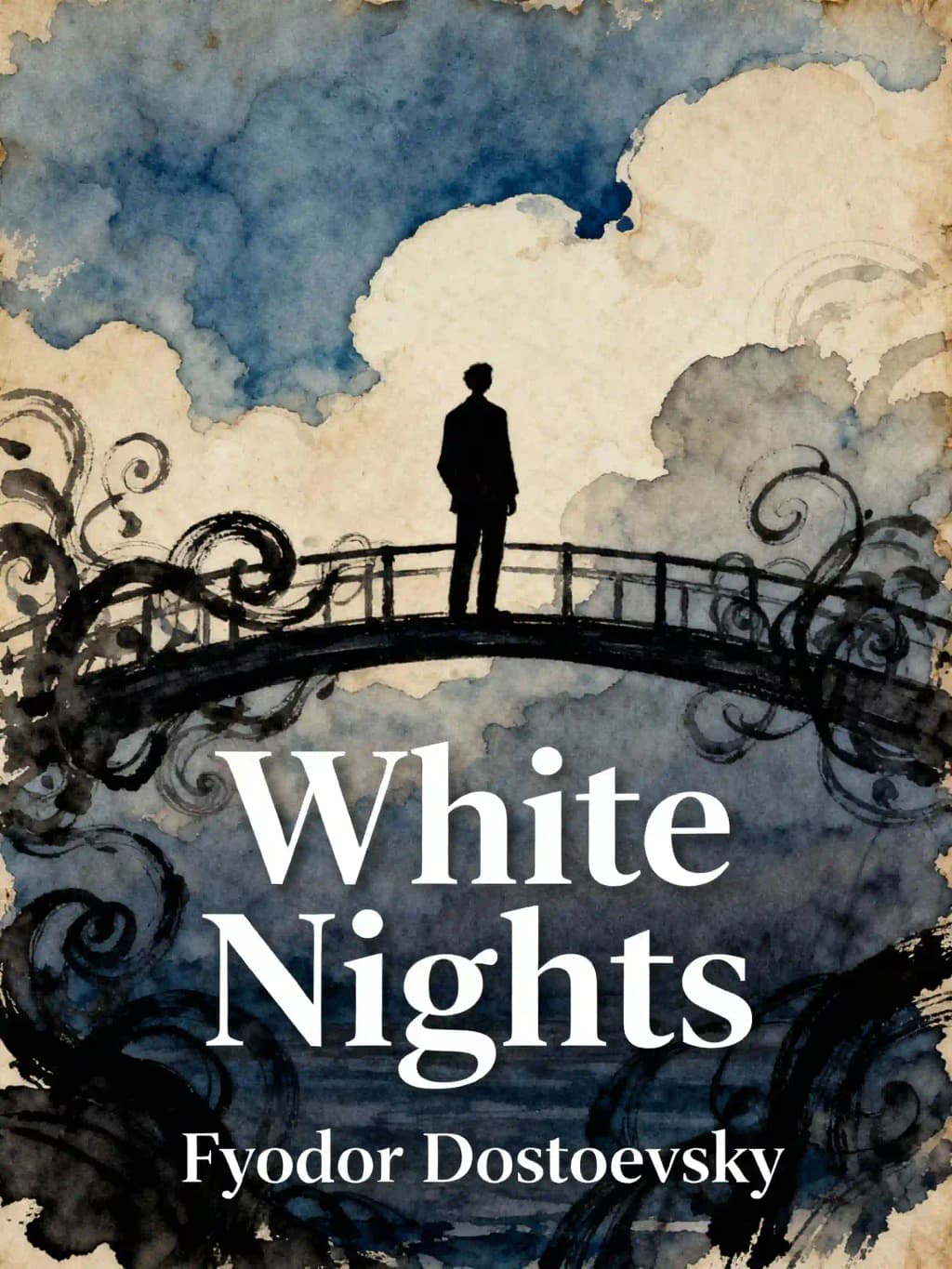
In Dostoevsky's "White Nights," a lonely dreamer's four-night romance unfolds during St. Petersburg's ethereal summer twilights. Capturing the uniquely Russian concept of "toska" - melancholic longing - this haunting tale of unrequited love prefigures the psychological depth that would define literary modernism.
Fyodor Mikhailovich Dostoevsky (1821–1881) is celebrated as one of Russia’s greatest literary figures and a pioneer of psychological fiction, renowned for his penetrating explorations of the human condition.
His 1848 novella White Nights—a poignant study of loneliness, transient love, and the interplay between imagination and reality—exemplifies his mastery of existential themes. Dostoevsky’s own experiences, including a traumatic mock execution, Siberian imprisonment, and lifelong financial struggles, deeply informed his works’ psychological depth and philosophical urgency.
Among his seminal novels are Crime and Punishment (1866), The Idiot (1869), and The Brothers Karamazov (1880), all widely studied for their insights into morality, free will, and the complexity of human desire. His writings profoundly influenced existential philosophy and modern psychology, with thinkers like Nietzsche and Sartre citing his impact.
Dostoevsky’s works have been translated into over 170 languages, and White Nights remains a timeless reflection on the fragility of human connection, adapted into numerous films and theatrical productions.
White Nights explores the tragic story of a lonely dreamer in 19th-century St. Petersburg who forms a fleeting connection with Nastenka, a young woman awaiting her lover’s return. Over four nights, their bond deepens until her lover reappears, leaving the protagonist isolated again. The novella examines themes of loneliness, transient happiness, and the tension between fantasy and reality through poetic prose and psychological depth.
Fans of classic Russian literature, existential themes, and character-driven narratives will appreciate this work. It appeals to readers interested in psychological introspection, Dostoevsky’s exploration of human connection, and stories that blend emotional vulnerability with philosophical inquiry.
Yes—its concise length (a novella) and profound emotional resonance make it accessible yet deeply impactful. Dostoevsky’s portrayal of unrequited love and societal alienation remains timeless, offering insights into the human condition that resonate with modern audiences.
Key themes include:
The “white nights” (summer nights with extended twilight) symbolize the dreamer’s liminal state between hope and despair. St. Petersburg’s canals and bridges represent emotional crossroads, while Nastenka’s lover embodies the irrationality of desire that disrupts rational plans.
Unlike Crime and Punishment’s criminal psychology or The Brothers Karamazov’s moral debates, White Nights focuses on emotional vulnerability and lyrical introspection. Its brevity and lack of overt tragedy make it unique in his oeuvre.
Nastenka’s abrupt departure with her lover underscores the fragility of human connections. The Dreamer’s return to solitude—symbolized by his aging maid and empty room—emphasizes the inevitability of loneliness despite fleeting hope.
The novella interrogates:
Its themes of digital-age isolation and the search for authentic relationships mirror modern struggles. The protagonist’s escapism parallels today’s reliance on virtual interactions over real-world bonds.
Some critics argue its sentimental tone and lack of plot action make it less compelling than Dostoevsky’s longer works. Others note Nastenka’s underdeveloped agency compared to the Dreamer’s introspection.
저자의 목소리로 책을 느껴보세요
지식을 흥미롭고 예시가 풍부한 인사이트로 전환
핵심 아이디어를 빠르게 캡처하여 신속하게 학습
재미있고 매력적인 방식으로 책을 즐기세요
Petersburg in summer becomes a ghost town.
He exists in a perpetual twilight of human experience.
Every closed shutter and darkened window seems to mock his solitude.
Their connection develops with an intensity that seems almost supernatural.
The dreamer, who has lived so long in his fantasies, suddenly finds himself navigating real human connection.
White nights의 핵심 아이디어를 이해하기 쉬운 포인트로 분해하여 혁신적인 팀이 어떻게 창조하고, 협력하고, 성장하는지 이해합니다.
White nights을 빠른 기억 단서로 압축하여 솔직함, 팀워크, 창의적 회복력의 핵심 원칙을 강조합니다.

생생한 스토리텔링을 통해 White nights을 경험하고, 혁신 교훈을 기억에 남고 적용할 수 있는 순간으로 바꿉니다.
무엇이든 물어보고, 목소리를 선택하고, 진정으로 공감되는 인사이트를 함께 만들어보세요.

샌프란시스코에서 컬럼비아 대학교 동문들이 만들었습니다
"Instead of endless scrolling, I just hit play on BeFreed. It saves me so much time."
"I never knew where to start with nonfiction—BeFreed’s book lists turned into podcasts gave me a clear path."
"Perfect balance between learning and entertainment. Finished ‘Thinking, Fast and Slow’ on my commute this week."
"Crazy how much I learned while walking the dog. BeFreed = small habits → big gains."
"Reading used to feel like a chore. Now it’s just part of my lifestyle."
"Feels effortless compared to reading. I’ve finished 6 books this month already."
"BeFreed turned my guilty doomscrolling into something that feels productive and inspiring."
"BeFreed turned my commute into learning time. 20-min podcasts are perfect for finishing books I never had time for."
"BeFreed replaced my podcast queue. Imagine Spotify for books — that’s it. 🙌"
"It is great for me to learn something from the book without reading it."
"The themed book list podcasts help me connect ideas across authors—like a guided audio journey."
"Makes me feel smarter every time before going to work"
샌프란시스코에서 컬럼비아 대학교 동문들이 만들었습니다

White nights 요약을 무료 PDF 또는 EPUB으로 받으세요. 인쇄하거나 오프라인에서 언제든 읽을 수 있습니다.
Petersburg in summer becomes a ghost town as wealthy families retreat to country dachas, leaving behind empty streets and silent facades. Against this backdrop of abandoned grandeur walks our unnamed narrator-a man who knows every crack in the city's granite embankments but hardly a single soul within it. For eight years, he has wandered these magnificent boulevards, forming intimate relationships with buildings while remaining a stranger to people. He can describe the exact date when yellow paint began peeling from the Anichkov Palace or when railings were last repaired along the Fontanka River. His isolation has become so complete that he holds silent conversations with stone lions and marble columns, attributing personalities to different streets and squares. The white nights-that ethereal period near summer solstice when twilight extends almost until dawn-mirror his existence between observation and participation. He lives in perpetual twilight, seeing everything but touching nothing, a ghost haunting the margins of society. When we meet him, his isolation has reached an unbearable intensity as the city empties for summer, every closed shutter and darkened window mocking his solitude.