1장
The Paradox of Human Consciousness: Dostoevsky's Darkest Revelation
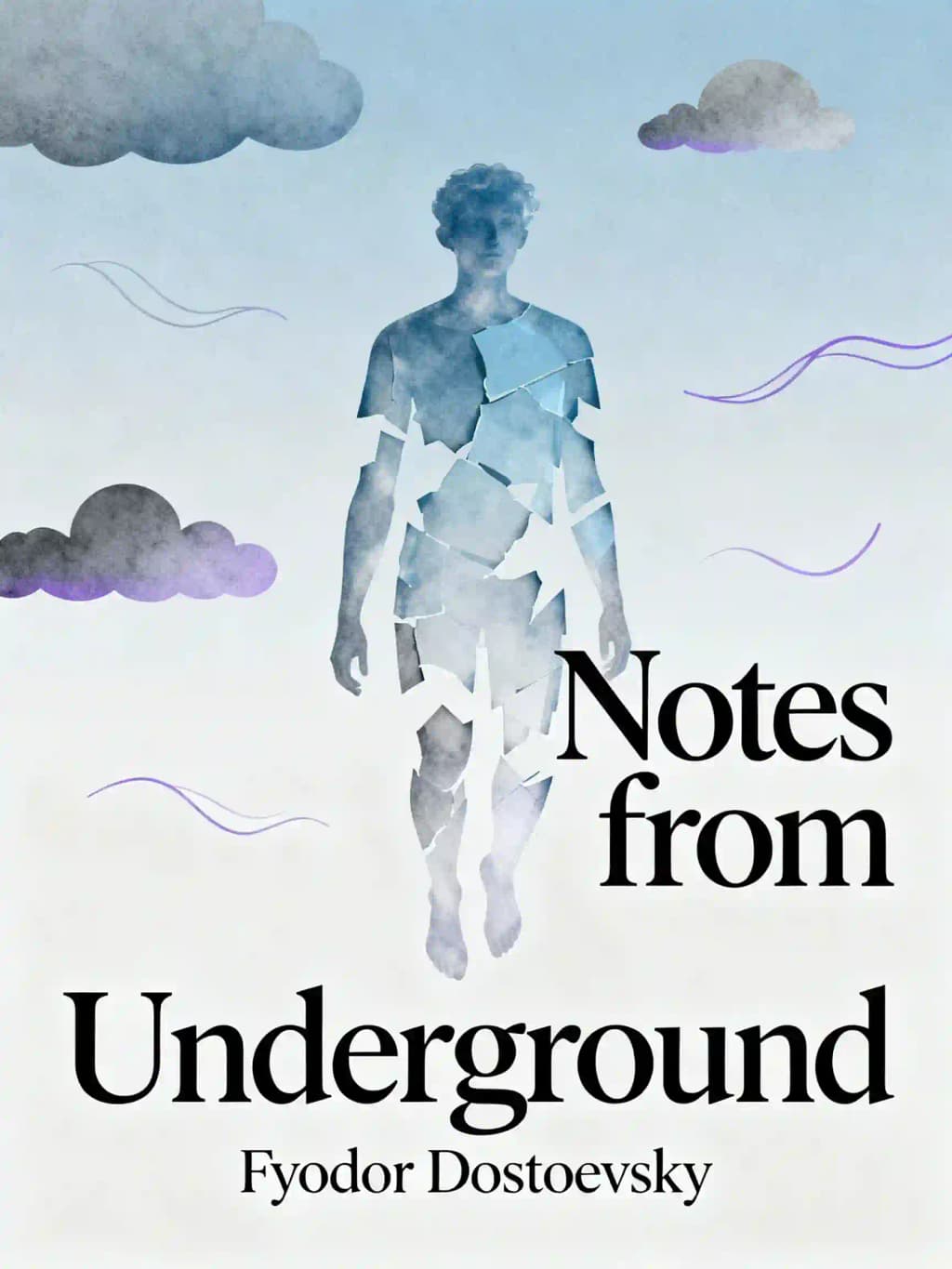
In the damp, gray streets of 19th century St. Petersburg walks a man unlike any other in literature-a character so profoundly contradictory and painfully self-aware that he has become the archetype of modern alienation. "Notes from Underground" stands as Dostoevsky's most penetrating psychological study, a work that philosopher Friedrich Nietzsche called "the only psychological work I cannot do without." This revolutionary novella, published in 1864, has influenced existentialist thought from Sartre to Camus and remains startlingly relevant in our age of anxiety and digital isolation. Even David Foster Wallace cited it as a primary influence, noting that Dostoevsky "diagnosed the paradoxes of consciousness a century before we had the vocabulary to articulate them."
2장
The Underground Man: Portrait of Spite and Self-Loathing
"I am a sick man... I am a spiteful man. I am an unattractive man." With these unforgettable words, we meet our narrator-a retired civil servant living in self-imposed isolation in St. Petersburg. He is forty years old, supported by a modest inheritance, and consumed by a consciousness so acute it has become a disease. Unlike the "men of action" he despises yet envies, the underground man cannot act decisively because he sees too many possibilities, too many contradictions in every situation. He analyzes each potential action until paralysis sets in, turning even simple decisions into philosophical crises.
His spite isn't genuine-it's performative, a way to amuse himself and assert some control over his meaningless existence. During his twenty years as a government official, he took perverse pleasure in being rude to petitioners, watching their discomfort as he wielded his tiny measure of bureaucratic power. He would deliberately keep them waiting, speak to them dismissively, or demand unnecessary documentation, finding satisfaction in their frustration. Now, in retirement, he refuses medical treatment for his liver disease out of spite, though he respects medicine enough to fear it. This contradiction exemplifies his character: he understands the irrationality of his actions yet persists in them, finding a peculiar satisfaction in his own self-destructive behavior.
What makes the underground man so compelling is his brutal self-awareness combined with his inability to change. He recognizes his contradictions-he cannot become definitively anything, neither kind nor cruel, neither honest nor dishonest. He understands that his excessive consciousness prevents him from becoming a "man of character," yet he clings to this consciousness as his only distinction, his claim to superiority over the "normal" people he both despises and envies. When he commits reprehensible acts, he does so with full awareness they are wrong, deriving a "shameful sweetness" from his own degradation. His pleasure comes not from the acts themselves but from the intense awareness of his own baseness-a psychological insight that anticipates Freud's theories by decades.
The underground man represents what happens when consciousness becomes untethered from action, when thinking becomes an end in itself rather than a means to living. His paralysis is the modern condition taken to its extreme-analysis without synthesis, criticism without creation. He embodies the crisis of the modern intellectual: trapped between the desire for rational certainty and the recognition that such certainty is impossible. His diary becomes both confession and justification, an attempt to explain himself while simultaneously demonstrating the impossibility of explanation. In his tortured self-analysis, we see the seeds of existentialism, modernist alienation, and the psychological complexity that would come to dominate 20th-century literature.
Through this character, Dostoevsky presents a devastating critique of rational egoism and the enlightenment belief in reason as the path to human happiness. The underground man's hyper-rationality leads not to clarity but to paralysis, not to self-improvement but to self-destruction, suggesting that human nature cannot be reduced to rational calculation alone.
3장
The Stone Wall: Rationality vs. Human Nature
The underground man's most profound rebellion is against rationality itself. He rails against the "stone wall" of natural laws and mathematical certainty that the rational men of his age worship. "What do I care for the laws of nature and arithmetic," he cries, "when, for some reason, I dislike those laws?" This defiance isn't merely petulant-it's an assertion of human dignity against determinism.
In the 19th century, when Dostoevsky was writing, positivism and utilitarianism were ascendant. Thinkers like John Stuart Mill believed human behavior could be scientifically analyzed and optimized for maximum utility. The underground man savagely attacks this worldview: "Who was it first announced that man only does nasty things because he does not know his own interests?" He insists that throughout history, humans have deliberately acted against their rational self-interest, choosing suffering over comfort, chaos over order.
The crystal palace-a reference to the famous structure at the 1851 Great Exhibition in London-becomes his symbol for rational utopia. While others see it as humanity's glorious future, the underground man sees it as a prison where one "cannot even stick out one's tongue" in defiance. He would rather live in a ramshackle "henhouse" than accept such perfect, stifling rationality.
His most radical claim is that the highest human advantage isn't advantage at all-it's free will itself, even when exercised irrationally. "What man wants is simply independent choice, whatever that independence may cost and wherever it may lead." This insight anticipates existentialism's emphasis on choice as the essence of human dignity. Even if a formula could be discovered that perfectly predicted all human desires, the underground man insists we would deliberately violate it, if only to prove we aren't "organ-stops" in a mechanical universe.
The underground man's rebellion isn't merely theoretical-it's visceral. He feels suffocated by the equation "twice two makes four," seeing it as "insolent" in its certainty. Mathematical truth represents death to him; life requires uncertainty, possibility, even suffering.
4장
The Pleasure of Suffering: Consciousness as Curse and Blessing
Perhaps the underground man's most disturbing insight is that humans don't simply endure suffering-they sometimes actively seek it. "Man loves suffering," he declares. "Suffering is the sole origin of consciousness." This paradox lies at the heart of the novel: consciousness itself, our defining human trait, emerges from our capacity to suffer. The underground man suggests that without pain, we would remain in a state of blissful but mindless contentment, never questioning our existence or developing deeper understanding.
The underground man's own life demonstrates this principle in vivid detail. He derives a peculiar pleasure from his humiliations, nursing grudges for decades, inventing new insults against himself, and analyzing every slight with excruciating precision. When slighted by an officer who moves him aside without acknowledgment, he obsesses over this trivial incident for years, even writing a satirical novel about the man. He walks the same streets hoping to encounter the officer again, rehearsing confrontations that never materialize. His suffering becomes a form of self-definition-if he cannot be respected, he will at least be memorably despised. This self-imposed martyrdom becomes his primary mode of existence.
This masochistic tendency isn't presented as admirable but as tragically human. The underground man recognizes that "normal" people-those with "strong nerves"-cannot understand such "refinements of enjoyment." They accept life's limitations, the stone walls of necessity, finding contentment in simple pleasures and straightforward goals. But he refuses reconciliation with such walls, seeing them as artificial constructs that imprison human potential. If he lacks the strength to break through them, he will at least refuse to accept them, finding a perverse pleasure in his futile rebellion. His resistance becomes a testament to human freedom, even if that freedom only manifests as the ability to choose suffering.
His inertia-his inability to act decisively-stems from this excessive consciousness. While others act because they mistake secondary causes for primary ones, he sees each cause leading to another infinitely, paralyzing him with possibilities. Every potential action spawns countless hypothetical consequences, each demanding analysis. Even in revenge, where others find justice and thus rest, he finds only spite that dissolves through further reflection. The very act of contemplating revenge becomes more satisfying than its execution, as the imagination offers unlimited possibilities that reality can never match.
The underground man's suffering is inseparable from his lucidity. He sees through social conventions, through his own self-deceptions, through the comforting lies that make life bearable. His heightened awareness extends to every social interaction, every moral choice, every human motivation. His tragedy is that he cannot unsee what he has seen-he cannot return to the unexamined life that might allow him happiness. This creates a cruel irony: his superior consciousness, which he values above all else, becomes the very source of his isolation and misery. Yet he clings to this suffering as proof of his humanity, preferring conscious torment to unconscious contentment.
5장
Dreams vs. Reality: The Escape into Fantasy
To escape his sordid reality, the underground man retreats into elaborate fantasies that become increasingly complex and detached from his actual existence. After periods of debauchery, which often involve drinking and wandering St. Petersburg's seedier districts, his dreams become especially vivid-filled with remorse, tears, and visions of redemption. In these dreams, he imagines himself in heroic roles, crowned with laurel, receiving universal admiration from both peers and superiors. He envisions speeches that move crowds to tears and acts of courage that earn him eternal glory.
The contrast between his grandiose fantasies and his squalid reality creates a devastating psychological portrait of a man trapped between two irreconcilable worlds. He can only imagine himself in extremes-either triumphant or utterly debased-with nothing in between. This binary thinking prevents him from finding modest satisfactions in everyday life, such as friendly conversations, small achievements at work, or simple pleasures. Every minor slight becomes a crushing defeat; every small victory must be transformed into an epic triumph in his mind.
His dreams have a distinctly literary quality, borrowed heavily from romantic novels and poetry of the era, particularly Byron and Pushkin. He imagines dramatic confrontations where he triumphs through eloquence, reducing opponents to tears with his wit and wisdom, or scenes of noble self-sacrifice followed by universal recognition of his superiority. When he later faces actual social situations, such as the awkward dinner with former schoolmates or encounters with his servant, the gap between his romantic expectations and awkward reality becomes painfully apparent, leading to humiliation and further retreat into fantasy.
These fantasies aren't merely escapist-they're compensatory mechanisms that serve a crucial psychological function. They allow him to preserve his sense of superiority despite his actual social failures and professional mediocrity. In his imagination, he is always the hero of the story, the misunderstood genius, even when in reality he is at best a minor character, at worst an object of contempt. His fantasies become more elaborate as his real-life failures mount, creating a self-reinforcing cycle of alienation.
The underground man's fantasies reveal Dostoevsky's deeper critique of romantic individualism and its impact on Russian society. The narrator has thoroughly absorbed the romantic notion that he is exceptional, destined for greatness, yet his actual life as a minor civil servant offers no outlet for these grandiose aspirations. His dreams become increasingly divorced from reality, creating a destructive cycle where fantasy makes reality even more unbearable, driving him further into isolation. This pattern reflects the broader social crisis of educated Russians in the 1860s, caught between Western romantic ideals and the constraints of their society.
6장
The Dinner Party: Humiliation and Social Alienation
The dinner party episode brilliantly dramatizes the underground man's social alienation, serving as a microcosm of his broader inability to function in society. When he learns that his former schoolmates are organizing a farewell dinner for Zverkov-a successful military officer he has always despised for his superficial charm and unearned social success-he impulsively invites himself, despite knowing he will be unwelcome. This self-destructive decision exemplifies his pattern of deliberately seeking out situations that will confirm his worst fears about himself and society.
The dinner becomes an excruciating study in social humiliation, unfolding in precise psychological detail. Arriving at the Hotel de Paris, he discovers they've changed the time without informing him, leaving him to wait alone for an hour in the restaurant's corner. This deliberate slight perfectly encapsulates his social position - technically included but fundamentally excluded. When they finally arrive, they barely acknowledge his wait, treating it as beneath their notice. Zverkov, embodying everything the underground man despises - social grace, military success, and unthinking confidence - treats him with condescending courtesy, while the others make little effort to hide their contempt, exchanging meaningful glances and barely suppressed smirks.
Throughout the dinner, the underground man oscillates between desperate attempts to assert his superiority and painful awareness of his social failure. His behavior becomes increasingly erratic as he drinks heavily, shifting between aggressive confrontation and pathetic attempts at camaraderie. He makes pointed literary references that fall flat, attempts sophisticated jokes that no one understands, and tries to engage in intellectual discourse with men interested only in shallow pleasantries. When they toast Zverkov, he delivers a rambling, insulting speech that provokes only laughter and contempt, transforming what should have been a moment of social connection into yet another demonstration of his alienation.
For three hours afterward, he paces the hotel corridor while they continue their celebration inside, caught in a psychological trap of his own making. This physical movement mirrors his mental state - unable to leave yet unable to truly participate, wanting their acknowledgment while pretending indifference. He imagines elaborate scenarios of revenge and reconciliation, all while knowing he lacks the social capability to execute either.
This scene reveals the underground man's fundamental social dilemma with devastating clarity. His acute self-consciousness makes natural interaction impossible, transforming every social encounter into an elaborate psychological drama. He overthinks every gesture, every word, transforming social situations into battlegrounds where he inevitably loses. His intellectual superiority-the one quality he prides himself on-becomes worse than useless in social contexts where ease and charm are valued, serving only to highlight his isolation.
The dinner party episode also demonstrates how the underground man's theoretical insights fail him in practice. Despite his penetrating critique of social conventions and his intellectual understanding of human behavior, he remains desperately dependent on others' approval. His rebellion against society masks a deeper desire for acceptance-a contradiction he cannot resolve and barely acknowledges. This paradox - of seeking connection through alienation - defines not just this scene but his entire character.
7장
Liza: The Possibility of Redemption
The Liza episode forms the emotional heart of the novel. After the disastrous dinner party, the underground man follows his schoolmates to a brothel, hoping to confront Zverkov. Finding they've already separated, he encounters Liza-a young prostitute with "grave, wondering eyes" and an unusual seriousness.
Their interaction begins with the underground man's cruel lecture about her inevitable decline-vividly describing how she will age quickly, fall deeper into debt, be discarded when no longer useful, and die alone in some filthy cellar. Yet beneath this cruelty lies a genuine desire to save her, mixed with his need to assert intellectual dominance.
When his graphic descriptions of her potential future reduce Liza to sobbing, he panics, feeling he's gone too far. Before leaving, he gives her his address, setting up the novel's most powerful scene-her later visit to his squalid apartment.
Liza's visit catches him at his worst moment-in the middle of a humiliating confrontation with his servant Apollon. Mortified by her witnessing his degradation, he lashes out with extraordinary cruelty, confessing that he visited her only to avenge an earlier humiliation, not to save her.
The novel's most profound moment comes when, instead of responding with anger to his cruelty, Liza embraces him with compassion. She sees through his vicious words to his underlying unhappiness. For a brief moment, genuine human connection seems possible.
Yet the underground man cannot accept this compassion. His shame at being understood transforms into a desire to dominate her again. After a loveless physical encounter, he spitefully thrusts money into her hand as she leaves-the ultimate insult to her genuine feelings. When he discovers she has left the money behind, he runs after her into the snowy night but stops, wondering if her resentment might actually prove more purifying than his toxic love.
This episode reveals the tragedy at the core of the underground man's existence. Given a genuine opportunity for human connection-for the redemption he claims to seek in his fantasies-he sabotages it. His consciousness has become so twisted that he cannot recognize love without seeing it as a power struggle. His need to maintain intellectual superiority prevents him from accepting the emotional authenticity Liza offers.
8장
The Underground as Metaphor: Modern Alienation
The "underground" of the title functions as a powerful metaphor for the narrator's psychological state. He has retreated from normal social life into a subterranean existence-not just physically in his "corner" of Petersburg, but mentally in his obsessive self-analysis and fantasies. This withdrawal manifests in his peculiar habits: writing endless notes to himself, spying on others from his window, and constructing elaborate scenarios of revenge and triumph that never materialize.
This underground existence represents modern alienation-the condition of individuals cut off from traditional communities and values, forced to create meaning in an increasingly rationalized world. The underground man's isolation isn't merely personal but symptomatic of modernity itself, where individuals must construct identities without the guidance of tradition. His struggle reflects the broader nineteenth-century crisis of faith and meaning, as urbanization and industrialization disrupted traditional social bonds and belief systems.
Dostoevsky presents the underground as both refuge and prison. It protects the narrator from the humiliations of social life but traps him in sterile self-analysis. His consciousness becomes a closed circuit, feeding on itself without the corrective of genuine human interaction. This paradox is evident in his relationship with Liza, where his inability to maintain genuine human connection leads him to destroy the very intimacy he craves. The underground becomes a self-perpetuating cycle: the more he retreats from society, the less capable he becomes of meaningful engagement.
The underground also represents resistance to the dominant ideologies of Dostoevsky's time-the rationalism, utilitarianism, and materialism he saw corrupting Russian society. The underground man's refusal to be defined by these systems, despite his inability to offer a coherent alternative, represents a stubborn assertion of human complexity against reductive theories. His rejection of the Crystal Palace-the symbol of rational progress-and his insistence on the importance of individual will, even when self-destructive, challenge the prevailing faith in reason and progress.
Dostoevsky's genius lies in making this underground perspective simultaneously repulsive and compelling. We recognize the underground man's distortions while acknowledging the partial truths in his critique. His voice anticipates the alienated narrators of modern literature-from Kafka's isolated protagonists to the anti-heroes of existentialist fiction. The underground man's psychological complexity and his articulation of modern alienation influenced writers like Sartre, Camus, and Ralph Ellison, who similarly explored themes of isolation and authenticity in modern society.
The metaphor of the underground extends beyond individual psychology to represent a broader critique of modern civilization. It suggests that beneath the rational surface of society lies a darker, irrational realm that cannot be eliminated by social progress or scientific advancement. This underground realm represents both the threat to human dignity posed by rationalistic systems and the potential for authentic, if painful, self-awareness.
9장
The Legacy of Notes from Underground: Existentialism Before Its Time
"Notes from Underground" stands as a remarkable philosophical achievement-articulating existentialist themes before existentialism itself was formally developed. The underground man's insistence on free will as humanity's defining characteristic, his rejection of deterministic systems, his emphasis on individual choice even when irrational-all anticipate key existentialist principles.
Dostoevsky challenges the optimistic rationalism of his era with a darker vision of human nature. While thinkers like Chernyshevsky (whose utopian novel "What Is to Be Done?" Dostoevsky was directly responding to) believed humans would naturally choose rational self-interest if properly educated, Dostoevsky insists that humans are fundamentally irrational beings who sometimes deliberately choose suffering over happiness.
This critique wasn't merely philosophical but political. Dostoevsky saw the rational utopias promised by socialism as fundamentally misunderstanding human nature. The underground man's rejection of the crystal palace represents Dostoevsky's rejection of socialist utopianism-not because he opposed social improvement, but because he believed any system that ignored humanity's irrational dimensions would become tyrannical.
The novella's influence extends far beyond philosophy. Its stream-of-consciousness narrative technique, with its digressions, contradictions, and direct addresses to the reader, revolutionized literary form. Its unflinching psychological realism-showing thoughts most authors would conceal-opened new possibilities for literary exploration of consciousness.
Most importantly, "Notes from Underground" gave voice to a modern condition-the alienation of individuals in an increasingly rationalized, bureaucratic world. The underground man's desperate assertion of individuality against systems that would reduce him to a predictable formula resonates powerfully in our algorithmic age, where human behavior is increasingly quantified and predicted.
In the end, the underground man's paradoxical legacy endures: consciousness is both our curse and our blessing, the source of our suffering and our dignity. In giving voice to this paradox, Dostoevsky created not just a character but a mode of being that continues to haunt and illuminate our understanding of what it means to be human in the modern world.