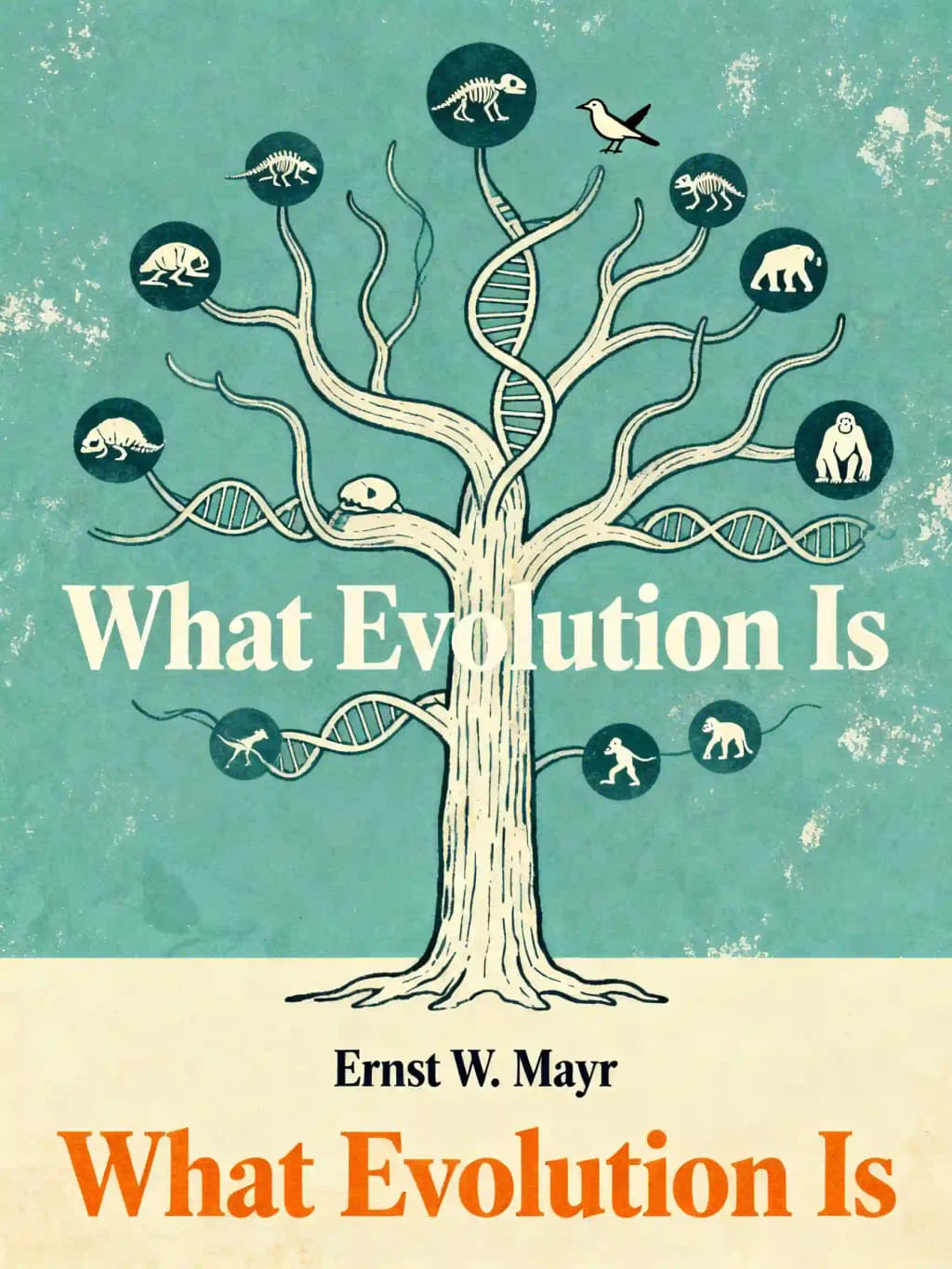
Ernst Mayr, "Darwin of the 20th century," demystifies evolution beyond theory into undeniable fact. This scientific masterpiece challenges creationist arguments while making complex concepts accessible. What surprising evidence convinced Mayr that evolution is more than just theory?
Ernst Walter Mayr (1904–2005), author of What Evolution Is, was a pioneering evolutionary biologist and architect of the modern evolutionary synthesis, bridging Darwinian natural selection with Mendelian genetics. A German-American ornithologist and taxonomist, Mayr’s groundbreaking expeditions to New Guinea and the Solomon Islands informed his revolutionary biological species concept—defining species as reproductively isolated populations—and his theory of allopatric speciation, which explains how geographic isolation drives evolutionary divergence.
His seminal works, including Systematics and the Origin of Species (1942) and Animal Species and Evolution (1963), reshaped 20th-century biology by integrating fieldwork, genetics, and theoretical rigor.
As a professor at Harvard University and curator at the American Museum of Natural History, Mayr championed evolutionary biology as a historical science, emphasizing the role of chance, adaptation, and biogeography. His writings, known for their clarity and interdisciplinary depth, remain foundational in genetics, ecology, and conservation studies.
What Evolution Is distills his lifelong exploration of evolutionary mechanisms, from punctuated equilibrium to population genetics, into an authoritative yet accessible primer. Translated into over 20 languages, Mayr’s works are required reading in evolutionary biology courses worldwide, cementing his legacy as “Darwin’s apostle” and one of the most influential biologists of the modern era.
What Evolution Is provides a comprehensive exploration of evolutionary theory, detailing mechanisms like natural selection, genetic drift, and mutations. Ernst Mayr synthesizes decades of research to argue evolution is a scientific fact, not mere theory, while addressing misconceptions and controversies like punctuated equilibrium. The book bridges historical context with modern genetics, offering insights into biodiversity and human evolution.
This book is ideal for biology students, educators, and general readers seeking a rigorous yet accessible primer on evolutionary biology. Mayr’s clear explanations cater to those unfamiliar with technical jargon, while his critiques of competing theories (e.g., selfish-gene hypotheses) provide value for seasoned scientists.
Yes. Mayr’s authoritative voice and ability to distill complex concepts make this a cornerstone text. It clarifies evolution’s mechanisms, debunks myths, and contextualizes human origins. Readers praise its balance of depth and readability, calling it “essential for understanding life’s diversity”.
Mayr argues evolution is driven by natural selection acting on phenotypes, not genes, emphasizing that genes’ selective value depends on their genetic context. He dismantles reductionist views (e.g., gene-centric selection) and underscores speciation through geographic isolation and genetic reorganization.
Mayr defines species as populations that interbreed exclusively among themselves, excluding others. Isolated groups (e.g., on islands) diverge via genetic drift and selection, leading to new species—a concept foundational to his theory of peripatric speciation.
The book traces human ancestry through fossil and genetic evidence, highlighting adaptive traits like bipedalism and brain development. Mayr stresses that humans are subject to the same evolutionary forces as other species, rejecting anthropocentric narratives.
While acknowledging rapid speciation in small populations, Mayr challenges the idea of long evolutionary stasis. He argues the fossil record’s gaps explain apparent discontinuities, reaffirming gradualist principles central to Darwinian evolution.
Key concepts include:
Mayr’s work modernizes Darwin’s ideas with 20th-century genetics, addressing gaps like speciation mechanisms. While Darwin laid the foundation, Mayr integrates molecular biology and population genetics, offering a nuanced, evidence-rich update.
As debates about creationism and intelligent design persist, Mayr’s rigorous defense of evolutionary science remains vital. The book also provides frameworks for understanding modern issues like antibiotic resistance and climate-driven adaptation.
Some critics argue Mayr overemphasizes geographic speciation and underestimates sympatric mechanisms. Others note his dismissive tone toward competing theories like evolutionary psychology, which limits interdisciplinary dialogue.
For deeper dives, pair with Richard Dawkins’ The Selfish Gene (contrasting gene-centric views) or Stephen Jay Gould’s The Structure of Evolutionary Theory (exploring punctuated equilibrium). Mayr’s Systematics and the Origin of Species offers further speciation insights.
저자의 목소리로 책을 느껴보세요
지식을 흥미롭고 예시가 풍부한 인사이트로 전환
핵심 아이디어를 빠르게 캡처하여 신속하게 학습
재미있고 매력적인 방식으로 책을 즐기세요
Evolution represents a radical departure from both.
Darwin triggered mankind's greatest intellectual revolution.
Evolution is fact, not theory.
Molecular biology has provided the strongest confirmation of evolution.
What Evolution Is의 핵심 아이디어를 이해하기 쉬운 포인트로 분해하여 혁신적인 팀이 어떻게 창조하고, 협력하고, 성장하는지 이해합니다.
What Evolution Is을 빠른 기억 단서로 압축하여 솔직함, 팀워크, 창의적 회복력의 핵심 원칙을 강조합니다.

생생한 스토리텔링을 통해 What Evolution Is을 경험하고, 혁신 교훈을 기억에 남고 적용할 수 있는 순간으로 바꿉니다.
무엇이든 물어보고, 목소리를 선택하고, 진정으로 공감되는 인사이트를 함께 만들어보세요.

샌프란시스코에서 컬럼비아 대학교 동문들이 만들었습니다
"Instead of endless scrolling, I just hit play on BeFreed. It saves me so much time."
"I never knew where to start with nonfiction—BeFreed’s book lists turned into podcasts gave me a clear path."
"Perfect balance between learning and entertainment. Finished ‘Thinking, Fast and Slow’ on my commute this week."
"Crazy how much I learned while walking the dog. BeFreed = small habits → big gains."
"Reading used to feel like a chore. Now it’s just part of my lifestyle."
"Feels effortless compared to reading. I’ve finished 6 books this month already."
"BeFreed turned my guilty doomscrolling into something that feels productive and inspiring."
"BeFreed turned my commute into learning time. 20-min podcasts are perfect for finishing books I never had time for."
"BeFreed replaced my podcast queue. Imagine Spotify for books — that’s it. 🙌"
"It is great for me to learn something from the book without reading it."
"The themed book list podcasts help me connect ideas across authors—like a guided audio journey."
"Makes me feel smarter every time before going to work"
샌프란시스코에서 컬럼비아 대학교 동문들이 만들었습니다

What Evolution Is 요약을 무료 PDF 또는 EPUB으로 받으세요. 인쇄하거나 오프라인에서 언제든 읽을 수 있습니다.
What if I told you that everything you see in nature - from the tiniest bacteria to blue whales, from desert cacti to rainforest orchids, and yes, even you - shares a common ancestry? Ernst Mayr's masterpiece "What Evolution Is" unveils this remarkable story with the wisdom of a scientist who dedicated 97 years to understanding life's most fundamental process. Evolution isn't just another scientific theory - it's the single most important concept in all of biology, the thread that connects every living thing on Earth. For millennia, Western thought was dominated by the idea that species were fixed, unchanging entities - perfect types created at the beginning of time. This "typological thinking" made evolution literally unthinkable. Darwin's genius was recognizing that species aren't fixed types but fluid populations of unique individuals. No two tigers, oak trees, or humans are genetically identical - variation is the rule, not the exception. This shift from thinking about fixed types to variable populations was revolutionary. Darwin faced fierce opposition not just from religious quarters but from the scientific establishment itself. The idea that complex structures like eyes or wings could develop naturally, without divine guidance, seemed absurd to many. Yet Darwin showed how natural processes working over vast timescales could produce extraordinary complexity. He introduced four revolutionary concepts: population thinking (focusing on variation), natural selection (differential survival driving adaptation), chance (random variation providing raw material), and historical contingency (recognizing that past events shape current forms). The most profound insight? Evolution has no direction, no predetermined goal. It's not a ladder of progress leading inevitably to humans - it's a branching bush of diversity, with each species adapted to its own particular circumstances. This perspective fundamentally changed how we understand our place in nature.