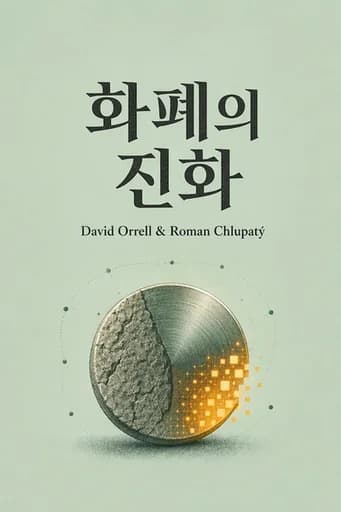
Money isn't what you think. "The Evolution of Money" shatters economic myths, comparing currency to quantum physics - both particle and wave. Praised by top economists, it traces money's journey from Mesopotamian tablets to Bitcoin, revealing how it's always been about power, not barter.
David Orrell and Roman Chlupatý, authors of The Evolution of Money, combine expertise in mathematics, economics, and systems theory to dissect the complex history and future of currency. Orrell, a Canadian mathematician and Oxford Ph.D. holder, is renowned for critiquing traditional economic models in works like Economyths (a National Business Book Award finalist) and the bestselling Apollo’s Arrow. His research on prediction and complex systems, featured in The Economist and BBC Radio, informs the book’s analysis of money’s dual physical-virtual nature.
Chlupatý, an economist, collaborates to trace monetary systems from ancient barter to modern cryptocurrencies, emphasizing their societal impact. Their interdisciplinary approach, endorsed by thought leaders like Parag Khanna and Jan Muehlfeit, challenges assumptions about rational markets and monetary value.
Orrell’s prior books, translated into over 10 languages, establish his authority in decoding technical subjects for broad audiences. The Evolution of Money reflects his signature blend of historical narrative and systems thinking, offering a framework to understand money’s role in an era of digital transformation. The work has been cited in platforms like Evonomics and praised for bridging economics, philosophy, and physics.
The Evolution of Money analyzes money’s dual nature as both a physical object and abstract concept, critiques neoclassical economics’ shortcomings, and explores how monetary systems shape societal structures—particularly in the digital age. Orrell argues that money acts as a dynamic social technology influenced by cultural norms and technological shifts.
Economists, students of monetary policy, and readers interested in socioeconomic systems will benefit from Orrell’s interdisciplinary approach. The book appeals to those questioning traditional economic theories or seeking insights into cryptocurrency, digital finance, and money’s societal impact.
Yes—it offers a fresh critique of economic orthodoxy and examines money’s evolving role in driving social change. Orrell’s analysis of digital currencies and historical monetary shifts provides actionable frameworks for understanding modern financial challenges.
Orrell critiques economists for neglecting money’s role in models and failing to establish a unified scientific theory. He highlights their oversight of money’s social dimensions, such as its impact on gender equality and community dynamics.
Money exists on a spectrum between tangible (coins, notes) and abstract (digital transactions, credit). Orrell shows how societies toggle between these poles, influencing economic stability and power structures—e.g., material-heavy systems often correlate with higher gender equality.
Digital tech disrupts traditional monetary rules, enabling decentralized systems like cryptocurrencies. Orrell argues this shift creates unprecedented economic interactions, requiring new models to address volatility, trust, and governance in finance.
Orrell observes that material-based currencies (e.g., physical cash) often coincide with improved women’s societal status, while abstract systems may obscure financial disparities. This link underscores money’s role in shaping social hierarchies.
Orrell frames money as a “social technology” shaped by cultural values and innovation. He emphasizes its fluidity between physical and abstract forms, advocating for models that account for complexity and human behavior.
The book discusses emerging trends like blockchain and decentralized finance, urging adaptive frameworks to manage risks like inequality and instability. Orrell highlights the need for systems balancing innovation with social equity.
It blends history, sociology, and systems theory to challenge mainstream economics. Unlike purely technical analyses, Orrell prioritizes money’s cultural impact and critiques idealized academic models.
His expertise in nonlinear systems informs the book’s focus on complexity and unpredictability in economics. Orrell applies these principles to debunk deterministic financial models and highlight systemic risks.
저자의 목소리로 책을 느껴보세요
지식을 흥미롭고 예시가 풍부한 인사이트로 전환
핵심 아이디어를 빠르게 캡처하여 신속하게 학습
재미있고 매력적인 방식으로 책을 즐기세요
Money is everywhere yet nowhere.
Money was imposed at swordpoint.
Money's history has alternated between virtual and metal phases.
Society valued land and power over money.
The Evolution of Money의 핵심 아이디어를 이해하기 쉬운 포인트로 분해하여 혁신적인 팀이 어떻게 창조하고, 협력하고, 성장하는지 이해합니다.
생생한 스토리텔링을 통해 The Evolution of Money을 경험하고, 혁신 교훈을 기억에 남고 적용할 수 있는 순간으로 바꿉니다.
무엇이든 묻고, 학습 스타일을 선택하고, 나에게 맞는 인사이트를 함께 만들어보세요.

샌프란시스코에서 컬럼비아 대학교 동문들이 만들었습니다
"Instead of endless scrolling, I just hit play on BeFreed. It saves me so much time."
"I never knew where to start with nonfiction—BeFreed’s book lists turned into podcasts gave me a clear path."
"Perfect balance between learning and entertainment. Finished ‘Thinking, Fast and Slow’ on my commute this week."
"Crazy how much I learned while walking the dog. BeFreed = small habits → big gains."
"Reading used to feel like a chore. Now it’s just part of my lifestyle."
"Feels effortless compared to reading. I’ve finished 6 books this month already."
"BeFreed turned my guilty doomscrolling into something that feels productive and inspiring."
"BeFreed turned my commute into learning time. 20-min podcasts are perfect for finishing books I never had time for."
"BeFreed replaced my podcast queue. Imagine Spotify for books — that’s it. 🙌"
"It is great for me to learn something from the book without reading it."
"The themed book list podcasts help me connect ideas across authors—like a guided audio journey."
"Makes me feel smarter every time before going to work"
샌프란시스코에서 컬럼비아 대학교 동문들이 만들었습니다

The Evolution of Money 요약을 무료 PDF 또는 EPUB으로 받으세요. 인쇄하거나 오프라인에서 언제든 읽을 수 있습니다.
What if everything you thought you knew about money was backward? For thousands of years, we've been told a simple story: people bartered goods, then invented coins for convenience, and eventually developed banking. It's neat, logical, and completely false. Money didn't emerge from barter-it was imposed through conquest and maintained through force. It began not as metal coins but as virtual accounting systems in ancient temples. And today, despite our obsession with physical cash, we've come full circle: over 90% of money exists only as digital entries in bank computers, created not by governments but by private institutions with a few keystrokes. This isn't some conspiracy theory-it's the reality acknowledged by central banks themselves, yet it fundamentally contradicts everything we learned in Economics 101. Understanding money's true nature reveals why our financial system lurches from crisis to crisis, why inequality keeps widening, and why we feel increasingly trapped by an economic system that seems to serve everyone except us.
Money possesses a strange duality philosophers have puzzled over since ancient Greece - simultaneously real and imaginary, a thing you can hold and a number that exists nowhere. A five-dollar bill is just paper and ink, worth pennies in materials. Yet we treat it as genuinely valuable because it represents an abstract number - five - that everyone agrees means something. It exists in a quantum-like state, collapsing into concrete value only when spent. This numerical aspect transforms how we see the world. When everything becomes reducible to a number, we stop seeing qualities and start seeing quantities. A forest becomes board-feet of lumber worth $X. A person becomes a worker worth $Y per hour. The first coins appeared in Miletus, the same Greek city that produced the first Western philosophers. While Thales tried reducing physical reality to water, Pythagoreans believed numbers were ultimate reality. Money and philosophy emerged together, both seeking universal principles beneath surface diversity. This split - neither purely material nor purely abstract, but both simultaneously - creates the tension that drives money's behavior.
The standard origin story - that money emerged from barter - is completely backward. Anthropologists have found zero examples of pure barter economies that later adopted money. Money began around 3000 BCE in Mesopotamia as elaborate credit systems, not coins. Temple accountants used the silver shekel as a virtual accounting unit, recording transactions on clay tablets. Payments were often made in barley or other goods valued in shekels. Debts were recorded and sometimes traded - a sophisticated financial system without physical currency. Interest rates were standardized at one-sixtieth per month (roughly 20% annually). Unpayable debts could lead to slavery, requiring periodic debt cancellations called "Jubilees." Physical coins appeared much later, in seventh-century BCE Lydia. These stamped pieces spread through war, not merchant convenience. Alexander the Great's conquests required paying enormous armies - about half a ton of silver daily - using coins minted from Persian mines worked by war captives. He systematically wiped out existing credit systems and demanded taxes in his coins. The Romans industrialized this system, creating a massive currency network supporting imperial spending of 225 million denarii annually, mostly for military purposes. Money's history has alternated between virtual and metal phases. Today, we've completed another millennial-long cycle back to money's virtual roots.
After Rome's collapse, scarce precious metals pushed money toward abstraction. The Islamic world pioneered credit instruments like sakk (origin of "check"), where reputation rivaled wealth in importance. Mathematical breakthroughs enabled this shift. Indian mathematician Brahmagupta conceptualized positive numbers as "fortunes" and negative numbers as "debts" in 628 CE. These concepts spread through Islam to Europe, where double-entry bookkeeping - codified by Luca Pacioli in 1494 - formalized the balance between debits and credits as a mathematical equation. The Crusades accelerated innovation. The Knights Templar created early travelers checks, letting pilgrims deposit valuables at one castle and withdraw funds at another. Italian cities became financial hubs, pioneering bills of exchange that eliminated coin transport by instructing distant bankers to make payments. These bills expanded money supply while boosting circulation. When the pope arranged for English church collections to fund Italian purchases of English wool, no physical cash crossed borders. The system worked because bankers formed an exclusive network in a shadow economy resistant to competition and government interference - a power shift from state to private sector persisting today. Yet modern economic lenses distort the Middle Ages. Medieval economy functioned more as a gift economy where charity defined relationships and usury bans reflected a worldview where everything occupied its divinely appointed place.
When Hernan Cortes encountered the Aztecs, their gold gifts triggered what he called "a disease of the heart which can only be cured by gold." The subsequent conquest extracted massive precious metals, transforming Europe's economy and triggering the "price revolution" - sustained inflation that reshaped commerce. Paradoxically, Spain's treasure flowed to other European powers through trade while Spain defaulted fourteen times between 1550-1700, growing "poor because she is rich." This birthed mercantilism: accumulate treasure to build military power. England compensated for lacking mines through trade and colonization, with the British East India Company ruling India with private armies. By the seventeenth century, goldsmiths evolved into bankers, issuing receipts for deposits and lending against them. The Bank of England (1694) pioneered public-private partnership, providing government loans in exchange for interest-bearing notes that circulated as money. Isaac Newton inadvertently established the gold standard in 1717 by setting exchange rates favoring gold - a "Newtonian accident" lasting 200 years. Yet financial innovations magnified both opportunity and risk. Dutch tulip mania and England's South Sea Bubble demonstrated market irrationality. Even Newton lost fortunes, lamenting: "I can calculate the motions of heavenly bodies, but not the madness of people."
The international gold standard collapsed during World War I. Britain's 1925 return to gold triggered strikes, while gold adherence worsened the Great Depression by preventing monetary expansion. In 1933, Roosevelt ordered citizens to surrender gold coins-revealing gold's limitations as monetary foundation. The 1944 Bretton Woods conference made the dollar redeemable for gold at $35 per ounce. This worked until the 1960s when America printed money to fund Vietnam, the Cold War, and the space program-more dollars than gold could support. On August 15, 1971, Nixon halted the dollar's convertibility to gold, transforming it into pure fiat money backed only by government decree. What backed the world's reserve currency? Collective belief alone. Simultaneously, electronic money emerged-credit cards, ATMs, online banking. Money returned to its virtual roots as digital ledger entries. By 2009, Fed Chairman Ben Bernanke revealed the Fed simply uses "the computer to mark up the size of the account" when creating money. The 2008 financial crisis exposed this system's flaws when banks needed massive public bailouts-a delayed aftershock from the Nixon shock, revealing both fiat currency's problems and the economic theories that failed to account for monetary instability.
Money and power are inseparable, yet mainstream economics ignores this reality, serving those who benefit from the status quo. The greatest economic power-money creation-belongs largely to private banks, not governments or communities. Nobel Prize-winning chemist Frederick Soddy identified the confusion between real wealth (tangible assets) and virtual wealth (bank money representing debt) as the source of economic instability. Under fractional reserve banking, virtual wealth eventually exceeds real wealth, triggering crises when people simultaneously try to convert virtual to real assets. Financial institutions spent $5 billion on political influence from 1998-2008, ensuring regulations serve their interests through a revolving door between Wall Street and government. Yet cracks are appearing-China's yuan joined the IMF's reserve currencies in 2015, while the euro demonstrates alternatives to dollar dominance. Since the 1970s, local currencies have gained popularity through community activism and digital technology. The 2008 crisis accelerated this trend-Greece saw local currencies resurge when euros became scarce. Today, thousands of alternative currencies operate worldwide, from corporate loyalty programs to mobile phone airtime in Africa to Bitcoin, which appeals to migrant workers, citizens facing hyperinflation, and the 2.5 billion unbanked adults worldwide. The emerging monetary paradigm will likely feature overlapping currencies at multiple scales and digital wallets holding multiple types. Despite enormous economic growth, many work longer hours than ever. We've drifted from having market economies to becoming market societies where nearly everything is for sale. Like McLuhan's observation that "the medium is the message," our money systems determine what civilization we build. By understanding money as a human creation rather than a natural force, we can redesign it to serve human and planetary well-being.