1장
The Climate Crisis We Can No Longer Ignore
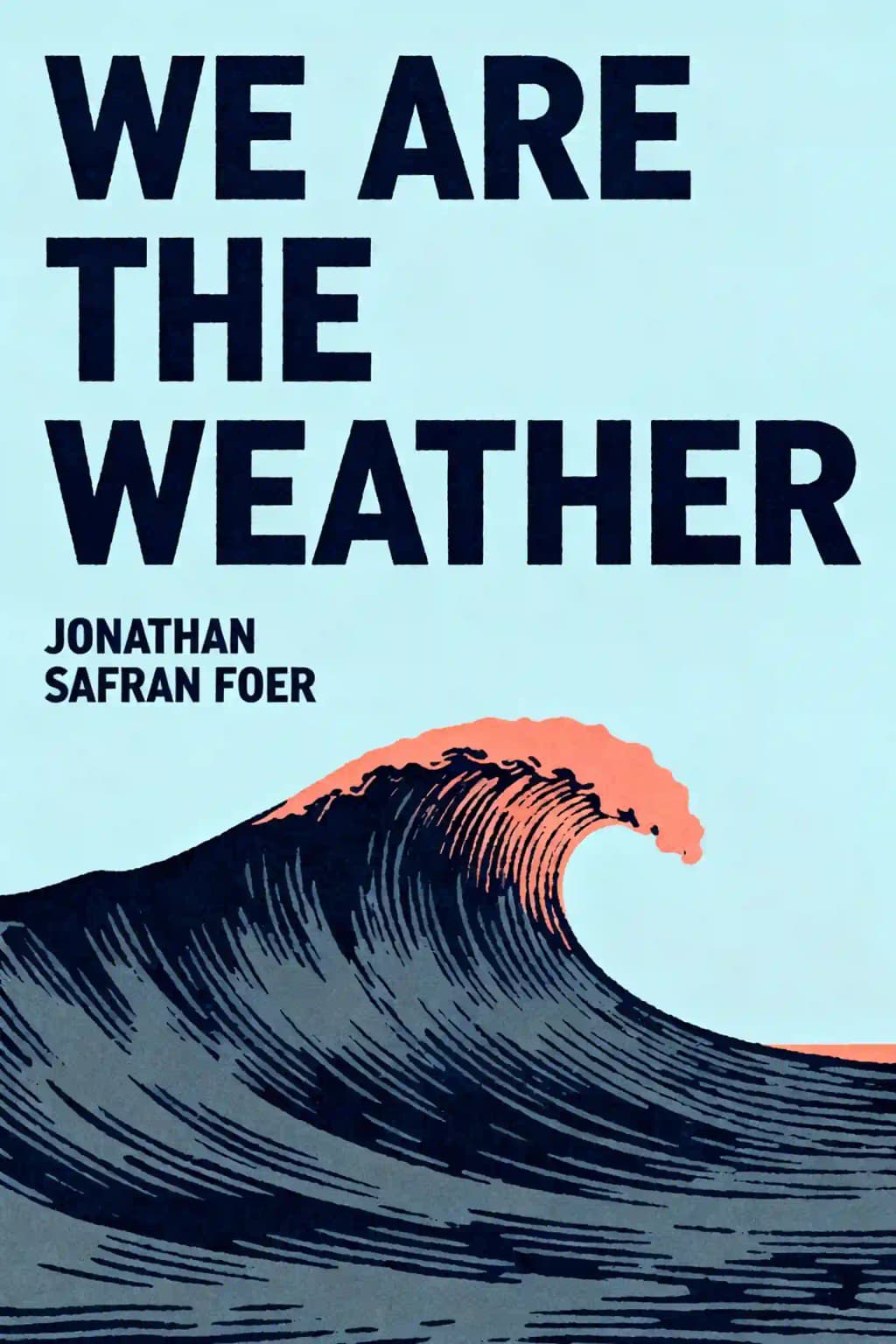
In September 2018, Jonathan Safran Foer published "We Are the Weather," a book that would quickly become a cultural touchstone in environmental literature. Endorsed by figures ranging from Al Gore to Yuval Noah Harari, the book arrived at a critical moment when climate anxiety was reaching unprecedented levels. Unlike typical climate books filled with technical jargon, Foer's work stands apart through its deeply personal approach, weaving family history with environmental science. What makes this book particularly compelling is how it frames climate action not as a scientific problem but as a psychological and moral one. The question at its heart isn't whether climate change is real-it's why we fail to act despite knowing the facts. As Greta Thunberg noted in her endorsement, "This book explains how we can save our planet without losing our humanity." In a cultural landscape saturated with apocalyptic climate narratives, Foer offers something different: a pathway to meaningful action that begins with our next meal.
2장
The Paradox of Knowing But Not Believing
We all contain molecules from Caesar's final breath - a scientific fact that illustrates our profound interconnection across time and space. This molecular legacy creates a vast web of human experience where endings become beginnings, linking ancient Rome to modern civilization. Every breath we take contains atoms that have cycled through countless lives before us. Yet despite this deep connection to history and each other, this understanding doesn't translate into meaningful action on climate change-our most pressing existential threat that threatens to unravel these connections.
During World War II, Americans demonstrated remarkable capacity for collective action and sacrifice. Industries transformed overnight - auto plants became tank factories, silk producers shifted to parachutes, and toy companies manufactured gun parts. Personal sacrifice reached unprecedented levels as taxes soared to 94%, rationing became routine, and 20 million citizens planted victory gardens that produced 40% of America's vegetables. Roosevelt masterfully framed these actions not as burdens but as privileges, declaring: "When we shall have saved our free way of life, we shall have made no 'sacrifice.'" This historical example raises a powerful question that haunts our present crisis: if flipping a light switch or changing simple daily habits could prevent catastrophe, would we really consider it too much to ask?
Climate change struggles as a narrative because it lacks the essential elements that typically drive human action. Unlike a war with visible enemies and immediate danger, climate change feels distant rather than immediate, complex rather than simple, and lacks clear villains and heroes. While bombs overhead demand instant response, climate catastrophe remains abstract - something happening "over there" in our imagination, creating a dangerous gap between intellectual awareness and emotional feeling. Even as wildfires rage and storms intensify, we struggle to connect these events to our daily choices.
The psychological barrier to action is illustrated by a powerful historical parallel. In 1943, Jan Karski brought eyewitness accounts of the Holocaust to America, meeting with leaders including Supreme Court Justice Felix Frankfurter. After hearing Karski's detailed testimony, Frankfurter made a revealing confession: "I didn't say this young man is lying. I said I am unable to believe him." This crystallizes our human predicament: knowing something intellectually doesn't mean we truly believe it enough to act. Our minds evolved to respond to immediate threats - predators, rival tribes, visible danger - while remaining remarkably indifferent to slow-moving, distant ones.
Those who stayed in Europe before WWII weren't less intelligent or brave than those who fled; they simply couldn't believe the coming horror would be fundamentally different from previous hardships they'd survived. Their normalcy bias - the tendency to believe things will continue as they have - proved fatal. As filmmaker Claude Lanzmann noted about Holocaust witnesses: "I knew, but I didn't believe it, and because I didn't believe it, I didn't know." We face the same psychological pattern with climate change - intellectually knowing our lifestyle destroys the planet while being emotionally and practically incapable of the deep belief that would move us to meaningful action. This cognitive dissonance between knowledge and belief may be our greatest obstacle to survival.
3장
The Hidden Power of Collective Action
When eighteen-year-old Kyle Holtrust was pinned under a 3,300-pound Camaro, witness Thomas Boyle Jr. lifted the vehicle to free him-an example of "hysterical strength" that far exceeds normal human capability. While this extraordinary act saved a life, so did the ordinary acts of drivers pulling aside for the ambulance. We follow social norms like making way for emergency vehicles not because we imagine loved ones inside, but because "it is what we do."
Hysterical strength has never been demonstrated in controlled settings, but evidence suggests it's real-from electrical muscle stimulation to athletic performance at high-stakes competitions. Athletes perform better at home games partly because fans create powerful emotional incentives. Similarly, to address the climate crisis, we need to feel Earth as our only home "not idiomatically, and not intellectually, but viscerally."
Facts alone won't mobilize us. As psychologist Daniel Kahneman noted, "To mobilize people, this has to become an emotional issue." Yet even terrifying climate reporting fails to permanently change behavior. The question remains whether our emotional limits can be exceeded, noting how Thomas Boyle's connection to the accident victim enabled his extraordinary strength, while wondering if such emotional connections can extend to distant or abstract threats.
Honeybees perform a collective "shimmering" wave to ward off predators-something no individual bee could accomplish alone. Similarly, groups of people lifting cars together accomplish what single individuals rarely can. Bee populations are collapsing globally due to climate change and other factors, leading to desperate measures like hand-pollination by workers using "pollen sticks" in some regions. This represents our planetary crisis-what happens when collective action fails.
Thanksgiving represents America's broadest collective action, with 96% participation-higher than daily tooth-brushing. This participation isn't driven by incentives or spontaneous emotion but by cultural structure. Studies show that action often begets motivation rather than the reverse-pilgrims reported increased religious identity after festivals; couples who cuddled longer reported greater relationship satisfaction. Environmental nudges (green arrows in grocery stores, organ donation opt-out policies) dramatically change behavior without requiring emotional commitment first.
4장
The Uncomfortable Truth About Our Food Choices
After sixty-three pages of evasion, I finally name what I've been avoiding: we cannot save the planet without significantly reducing consumption of animal products. My own hypocrisy is evident-having eaten meat occasionally despite writing passionately against factory farming. My cravings sometimes overpowered my convictions, revealing the complexity of eating-which satisfies not just hunger but identity, community, and personal history.
Climate change isn't a puzzle we can return to when convenient; it's a house on fire. Unlike moral progress of the past, which could unfold over generations, we face a tipping point of "runaway climate change" beyond which we cannot save ourselves. Future generations will ask where we were in the biblical sense-where was our selfhood when this crisis demanded decisions?
A few degrees of temperature change can transform our planet completely. During the ice age (100,000-10,000 years ago), Earth was 4-7C colder, supporting mastodons and dire wolves. Fifty million years ago, Earth was 5-8C warmer, with tropical rainforests in the Arctic and no polar ice caps. Like body temperature, these small differences determine whether our planet thrives or faces crisis.
Of Earth's five mass extinctions, climate change caused all but the dinosaurs' demise. The worst was the Great Dying 250 million years ago, when volcanic CO2 emissions warmed oceans by 10C, killing 96% of marine life and 70% of land species. We're now in the sixth extinction-the Anthropocene extinction-the first caused by an animal rather than natural events. Human activity is responsible for 100% of global warming since the Industrial Revolution.
The scale of animal agriculture is staggering: 59% of all cropland grows food for livestock; one-third of human-used freshwater goes to livestock (versus one-thirtieth for homes); 70% of global antibiotics are used for animals; 60% of all mammals on Earth are farmed animals; and there are roughly thirty farmed animals for every human on the planet.
5장
The Climate Math We Can't Ignore
Greenhouse gases trap heat like a blanket, making Earth habitable (without them, average temperature would be near 0F instead of 59F). CO2 comprises 82% of human-caused greenhouse emissions, with concentrations increasing 40% since the Industrial Revolution. Animal agriculture produces 37% of anthropogenic methane and 65% of nitrous oxide emissions. Since factory farming began in the 1960s, nitrous oxide concentrations have grown twice as fast and methane six times faster than any previous 40-year period in two millennia.
Unlike manageable chronic conditions, climate change resembles a cancerous tumor requiring immediate intervention before positive feedback loops create "runaway climate change." One such loop is the albedo effect: as white ice melts, dark oceans absorb more sunlight, further accelerating warming.
Methane traps 34 times more heat than CO2 over a century and 86 times more over two decades. Nitrous oxide is 310 times more potent than CO2. When calculating emissions, these gases are converted to carbon dioxide equivalents (CO2e), usually on a 100-year scale. Since methane and nitrous oxide create significantly larger short-term warming and are primarily from food choices, they're both the most urgent and easiest greenhouse gases to reduce.
Trees function as carbon sinks, absorbing CO2, with vegetation currently storing about 25% of human emissions. The bathtub analogy is apt-destroying forests is like plugging the drain while the water keeps running. Forests contain more carbon than all exploitable fossil fuel reserves, and their destruction causes at least 15% of global greenhouse emissions annually. Alarmingly, about 80% of deforestation occurs to clear land for livestock. Allowing tropical land currently used for livestock to return to forest could mitigate over half of all human-caused greenhouse gases.
Estimates of animal agriculture's contribution to climate change vary dramatically. The UN's Food and Agriculture Organization calculates 14.5% of global emissions, but this excludes critical factors like the CO2 forests can no longer absorb after being cleared. When Worldwatch Institute researchers included overlooked emissions, they estimated livestock responsible for 51% of global emissions-exceeding all cars, planes, buildings, and industry combined.
6장
Seeing Our Planet With New Eyes
To see Earth as a complete globe requires at least twenty thousand miles of distance - a perspective that remained impossible for humans until the space age. "The Blue Marble," the first photograph of the fully illuminated Earth, was taken somewhat illicitly by Apollo 17 astronauts in December 1972 and became one of history's most reproduced images. The crew, defying their flight plan, rotated the spacecraft to capture this unprecedented view. These early Earth photographs catalyzed the environmental movement by revealing our planet's striking isolation and vulnerability - a delicate blue sphere suspended in the infinite blackness of space, protected only by a paper-thin atmosphere.
Astronauts consistently report experiencing the transformative "overview effect" when viewing Earth from space - a profound cognitive shift that induces a deep sense of awe and connection to humanity. This perspective has led many space travelers to dramatic life changes: Edgar Mitchell founded an institute for noetic sciences, Russell Schweickart became a meditation practitioner, and numerous others devoted themselves to humanitarian and environmental causes. Since Yuri Gagarin's first flight in 1961, only 567 people have witnessed our home planet with naked eyes from space. However, companies like SpaceVR and Space Perspective are working to democratize this perspective through virtual reality and high-altitude balloon flights, potentially creating what they call "a revolution in how the planet thinks of the Earth." Research shows the overview effect reliably helps people "feel more connected" to the planet and "reframe troubles" in a broader context.
Just as space travel allowed us to see Earth anew, the invention of clear glass mirrors around 1290 in Venice enabled humans to truly see themselves for the first time. This technological breakthrough in self-reflection transformed society and art - by 1400, wealthy patrons began inserting their own likenesses into religious paintings, and self-portraiture emerged as a distinct genre. Mirror recognition has become a crucial marker of self-consciousness in human development, typically emerging in babies around 18 months old. This capacity also distinguishes particularly intelligent species like dolphins, great apes, elephants, and surprisingly, the tiny cleaner wrasse fish, which demonstrates self-awareness by attempting to remove marks visible only in its reflection. These remarkable fish, which inhabit coral reefs increasingly threatened by climate change, challenge our assumptions about consciousness in simpler organisms.
In 1988, when NASA scientist James Hansen testified before Congress that global warming was definitively human-caused, there was a brief window of bipartisan support for environmental action. George H.W. Bush even campaigned as the "environmental president," declaring that environmental issues "know no ideology." However, despite internal research by fossil fuel companies documenting climate dangers since the 1950s, major corporations like Exxon subsequently slashed their climate research programs and launched sophisticated disinformation campaigns to manufacture doubt about established science.
The most dangerous form of science denial isn't found in presidential tweets or corporate propaganda, but in our own collective inaction despite knowing better. By failing to address climate change with the urgency it demands, we are effectively mortgaging our children's future against short-term convenience and profit, betraying both scientific truth and intergenerational ethics.
7장
The Debt We Owe to Future Generations
Stephen Hawking's stark warning about humanity's need to leave Earth stems from our unprecedented consumption of finite resources. The Global Footprint Network's detailed analysis shows that since the late 1980s, humanity has been living in ecological debt, with Earth Overshoot Day - the date when humanity's resource consumption exceeds Earth's capacity to regenerate those resources - arriving earlier each year. While countries like Bangladesh maintain sustainable ecological footprints of 0.8 Earths, the average American lifestyle requires the resources of four entire planets. The contrast is even more striking in cities like Dubai, where the per-capita footprint approaches six Earths.
This resource consumption disparity manifests in startling statistics: the average American uses 300 liters of water daily, while many Africans survive on less than 20. By the 2030s, global resource demands will require a second Earth - a planet we don't have. The ecological debt accumulates in various forms: depleted aquifers, deforested landscapes, collapsed fisheries, and rising atmospheric CO2 levels.
We're operating at a devastating debt-to-income ratio of 150% - consuming resources at 1.5 times Earth's replenishment rate. This intergenerational theft has spurred unprecedented legal action, with twenty-one youth plaintiffs filing Juliana v. United States, arguing that government inaction on climate change violates their constitutional rights. Similar lawsuits have emerged in countries from Pakistan to the Netherlands, representing a growing recognition of environmental rights.
The American dream's promise of perpetual growth contradicts basic physical limits. My grandmother's generation practiced resource conservation born of necessity - repairing clothes, growing food, and saving every penny. My great-grandparents lived without electricity or indoor plumbing, while today's average home contains thousands of consumer items. The contrast between past frugality and present excess raises uncomfortable questions about intergenerational equity. My great-grandchildren will inherit not just warming temperatures but collapsed ecosystems, depleted resources, and potentially uninhabitable regions.
Space exploration offers a seductive escape route, as advocated by visionaries like Stephen Hawking and Elon Musk. The rapid progression from the Wright brothers' 12-second flight to Neil Armstrong's moon landing - just 66 years - demonstrates humanity's innovative potential. SpaceX's reusable rockets and NASA's Mars plans suggest similar technological leaps ahead. However, space colonization remains a distant solution to immediate problems.
The urgency of our situation demands comprehensive action across multiple fronts. We need a portfolio of solutions including: rapid transition to renewable energy, implementation of carbon pricing, dramatic reduction in transportation emissions, massive reforestation efforts, and fundamental changes to food systems. Project Drawdown's research identifies surprising priorities: reducing food waste (which could prevent 87 gigatons of CO2 emissions), educating girls (which naturally leads to lower population growth), expanding access to family planning, and shifting toward plant-based diets. These solutions often offer multiple benefits - for example, reducing meat consumption addresses both emissions and deforestation while improving public health.
8장
The Personal Choice That Makes a Global Difference
The carbon footprint of foods varies dramatically across different food groups, with animal products generally having the most significant environmental impact. Beef tops the list at 6.61 pounds of CO2 equivalent per serving, creating over 200 times more emissions than potatoes at just 0.03 pounds. The hierarchy of food emissions reveals a clear pattern: cheese (2.45), pork (1.72), poultry (1.26), eggs (0.89), and milk (0.72) all substantially exceed plant-based alternatives. Common plant foods like rice (0.16), legumes (0.11), and carrots (0.07) demonstrate remarkably lower environmental impacts. Even fish, often considered environmentally friendly, produces 1.15 pounds of CO2 per serving.
The Paris Climate Accord sets ambitious targets requiring significant lifestyle changes. To meet the two-degree warming limit, each person's annual carbon footprint must not exceed 2.1 metric tons by 2050. Current global emissions paint a stark picture of inequality: the average global citizen produces 4.5 metric tons yearly, while Americans generate 19.8 metric tons, Europeans like the French 6.6 metric tons, and citizens of developing nations like Bangladesh just 0.29 metric tons. A simple dietary change - avoiding animal products for just breakfast and lunch - can save 1.3 metric tons annually, equivalent to driving 3,000 fewer miles in a typical car.
The author's internal struggle reflects a common dilemma faced by climate-conscious individuals. Through honest self-reflection, he confronts his own contradictions: delivering passionate speeches about reducing animal product consumption while secretly indulging in burgers after climate conferences. This internal conflict mirrors broader societal challenges in addressing climate change - the gap between knowledge and action, between public advocacy and private behavior.
Historical parallels provide context for contemporary climate inaction. The author draws a powerful comparison to Supreme Court Justice Felix Frankfurter's inability to believe Jan Karski's firsthand accounts of the Holocaust, despite Karski's credibility and direct experience. Similarly, the author reflects on his grandmother's heart-wrenching decision to flee her shtetl while leaving family behind - a choice between immediate action and paralysis in the face of overwhelming circumstances.
The soul's wisdom emerges through practical advice: progress matters more than perfection. Rather than viewing dietary change as an all-or-nothing proposition, the focus shifts to incremental improvements. The solution isn't necessarily becoming vegan, but rather becoming more conscious of consumption patterns. Instead of being overwhelmed by the prospect of thousands of future meals requiring sacrifice, the soul advocates for a simpler approach: focus on the next meal choice. This manageable framework - "Just order something different this one time" - transforms an overwhelming lifestyle change into achievable daily decisions.
9장
We Are Both the Flood and the Ark
Beginning with the mass suicide at Masada, the author contrasts this with the Warsaw Ghetto Jews who fought and documented their resistance through the Ringelblum Archive. He examines modern efforts like the Svalbard Global Seed Vault and DNA preservation projects as contemporary "arks" against catastrophe, noting how even these supposedly secure facilities are threatened by climate change.
The author draws parallels to Noah, who spent a century building his ark despite ridicule, noting that we have far less time-perhaps a decade-to construct our own ark against climate disaster. Unlike Noah, we lack divine instruction and must choose what kind of ark to build: a spacecraft for Mars colonization, seed banks, or collective action.
After the biblical flood, God placed a rainbow as a reminder of His covenant never to destroy Earth again. The rainbow serves as both promise and warning-it can be a lifeline or a noose. The section concludes with the sobering recognition that "We are the flood, and we are the ark."
The author opens with the story of civil rights attorney David Buckel who committed suicide by self-immolation in Brooklyn's Prospect Park-a place familiar to the author. Buckel, who was not depressed according to loved ones, left multiple notes explaining his act as a protest against environmental destruction. His final message declared: "Pollution ravages our planet, oozing inhabitability via air, soil, water and weather. Our present grows more desperate, our future needs more than we've been doing."
Climate change presents a crisis requiring decision-whether to sacrifice convenience for survival. The author compares our situation to World War II's home-front efforts, suggesting future generations might view our inaction as "an atrocity commensurate with the war itself." Humans are "killing ourselves because choosing death is more convenient than choosing life," waiting for someone else to act first.
With each breath, we inhale molecules from all who came before-heroes, villains, and ordinary people. The author wonders if we're worthy of this inheritance and whether future inhabitants of Earth might someday study human artifacts, hypothesizing about our strange behaviors and limitations: "Doing nothing to save their kind required the participation of everyone."
In a letter to his sons, the author reflects on mortality and human existence while connecting personal loss to larger environmental concerns. He describes how Neil Armstrong's famous moon landing quote accidentally omitted the word "a" from "one small step for a man," transforming its meaning to suggest that no human stands alone. "In order to contribute to the creation of the world, rather than its destruction, an individual must act on behalf of the collective. Humankind takes leaps when individuals take steps."
The author concludes by recalling a family boat trip where his sons jumped into water, connecting this memory to ancient Egyptian writing about clinging to life. "It is not enough to say that we want more life; we must refuse to stop saying it... And we must do this together: everyone's hand wrapped around the same pen, every breath of everyone exhaling the shared prayer."