1장
The Eloquence of Hope: Obama's Vision for America
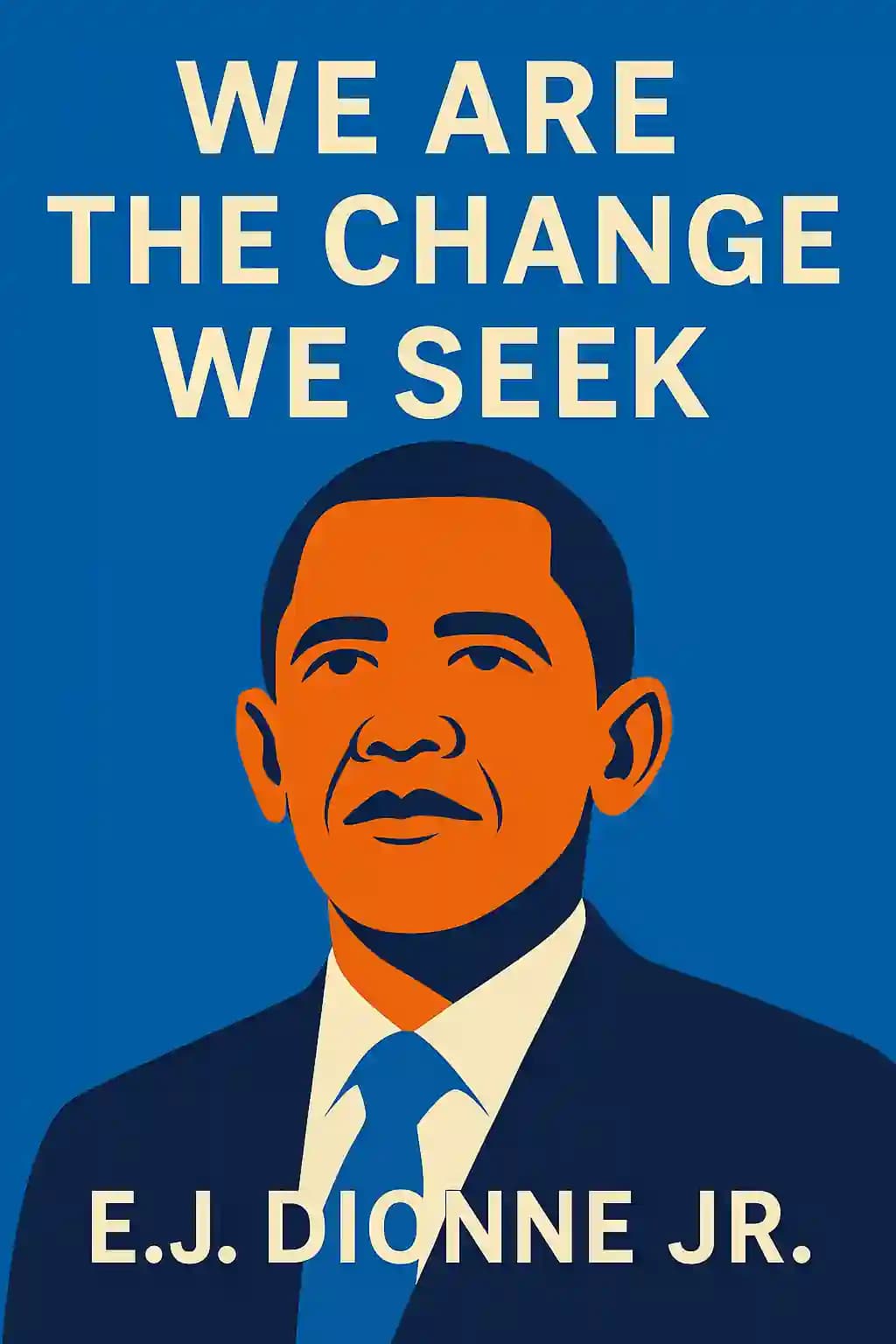
In the midst of a deeply polarized nation, Barack Obama's words continue to resonate as a testament to the power of rhetoric in American politics. "We Are the Change We Seek" presents a carefully curated collection of Obama's most significant speeches, capturing his evolution from state senator to two-term president. What makes this collection particularly compelling is how it reveals Obama's rare rhetorical genius-placing him alongside FDR, JFK, and Reagan in the pantheon of presidential orators. The book has become required reading in university political science courses nationwide and was famously cited by Lin-Manuel Miranda as inspiration for his approach to political rhetoric in "Hamilton." Beyond academic circles, these speeches offer a blueprint for how leaders can inspire action through words during times of national crisis. As we navigate an increasingly fractured political landscape, Obama's consistent appeal to our better angels provides both historical context and a potential path forward.
2장
The Power of Principled Opposition
Obama's political identity was forged in his October 2002 speech opposing the Iraq War. Standing before a Chicago anti-war rally on the same day Congress introduced the war authorization, state senator Obama made a crucial distinction that would define his approach to foreign policy: "I am not opposed to all wars. What I am opposed to is a dumb war." This wasn't mere political calculation but a demonstration of moral clarity that would later distinguish him from primary opponents like Hillary Clinton and John Edwards, who had voted to authorize the war.
The speech revealed Obama's ability to acknowledge complexity while maintaining moral conviction. He recognized Saddam Hussein as "a brutal man" who "butchers his own people" while still arguing that invasion without clear rationale or international support would inflame the Middle East and strengthen al Qaeda. "I know that even a successful war against Iraq will require a U.S. occupation of undetermined length, at undetermined cost, with undetermined consequences," he warned with remarkable prescience. This nuanced position stood in stark contrast to both the hawkish certainty of the Bush administration and the absolute pacifism of some war opponents.
What's particularly striking is how Obama framed the alternative to war not as pacifism but as strategic focus: "You want a fight? Let's finish the fight with bin Laden and al Qaeda." He advocated for intelligence operations, financial controls on terrorist organizations, and diplomatic pressure on Middle Eastern allies-approaches he would later implement as president. This framework would eventually guide his administration's successful targeting of bin Laden in 2011 and his broader counterterrorism strategy, which emphasized precision over large-scale military intervention.
The Iraq War speech also demonstrated Obama's ability to connect immediate policy decisions to broader American values. He didn't just oppose the war on practical grounds but framed it as a distraction from America's true battles "against ignorance and intolerance, corruption and greed, poverty and despair." This connection between policy and values would become a hallmark of his presidential rhetoric, evident in major speeches from his 2004 Democratic Convention keynote to his Nobel Peace Prize acceptance.
The speech's impact extended beyond its immediate context, establishing core principles that would guide Obama's future decisions: the importance of international coalitions, the preference for targeted intervention over regime change, and the need to weigh moral imperatives against practical limitations. These principles would later influence his approaches to Libya, Syria, and Iran, where he consistently sought to balance idealistic goals with pragmatic constraints.
Obama's stance also demonstrated his willingness to take politically risky positions when guided by principle. At a time when supporting the war was seen as politically expedient, especially for someone harboring national ambitions, Obama chose to voice his opposition publicly. This decision would later prove politically advantageous during the 2008 campaign, but at the time, it represented a significant political risk, particularly in a post-9/11 environment where questioning military action was often equated with lack of patriotism.
3장
Bridging America's Divides
Obama burst onto the national stage with his electrifying 2004 Democratic National Convention keynote address, a seventeen-minute speech that would fundamentally reshape American political discourse. Beginning with his personal narrative as the son of a Kenyan father and Kansas mother whose "improbable love" embodied American possibility, Obama crafted a speech that transcended typical partisan rhetoric. His mixed-race heritage and diverse upbringing spanning Hawaii, Indonesia, and the mainland United States positioned him uniquely to speak about American unity and diversity.
The address masterfully wove together personal storytelling with broader themes of national identity. Obama spoke of his grandfather who served in Patton's army, his grandmother who worked on a bomber assembly line, and his father who came to America seeking education - each story carefully chosen to resonate with different segments of American society. What made this address revolutionary wasn't just its eloquence but its explicit rejection of America's cultural and political divisions at a time when the country was deeply polarized over the Iraq War and social issues.
"There's not a liberal America and a conservative America; there's the United States of America," Obama declared in what became the speech's defining line. He dismantled the red state/blue state divide with memorable examples: "We worship an awesome God in the blue states, and we don't like federal agents poking around in our libraries in the red states." He added other powerful parallels: "We coach Little League in the blue states and have gay friends in the red states." These weren't just clever rhetorical flourishes but reflected Obama's genuine belief that beneath partisan conflict, Americans shared common values and aspirations.
The speech's structure built toward an emotional crescendo, culminating in Obama's meditation on hope - not as blind optimism but as the substantial hope that drove slaves to seek freedom on the Underground Railroad, immigrants to cross oceans for a better life, workers to organize for fair wages, and "a skinny kid with a funny name who believes that America has a place for him too." This "audacity of hope" became the title of his second book and a defining theme of his political career, representing both personal ambition and national possibility.
What's remarkable about this speech is how it established Obama's political identity while transcending traditional political boundaries. He presented himself not as a Democratic partisan but as someone who could speak to all Americans, drawing on universal themes of family, faith, and patriotism. The address revealed Obama's unique ability to acknowledge real differences while emphasizing shared values - a skill that would help him navigate the treacherous waters of American politics and eventually win the presidency. His emphasis on unity and common purpose, rather than division and partisan advantage, offered a template for a different kind of political discourse that still resonates today.
4장
Faith in the Public Square
Throughout his political career, Obama demonstrated a nuanced understanding of religion's role in American public life. In his landmark 2006 Call to Renewal address, he argued that progressives make a critical mistake by failing to acknowledge faith's profound power in people's lives. "If we scrub language of all religious content, we forfeit the imagery and terminology through which millions of Americans understand both their personal morality and social justice," he explained, highlighting how religious language has historically animated movements for social change, from abolition to civil rights.
Obama's personal journey from skepticism to faith emerged through his community organizing work with Chicago's Black churches, where he witnessed faith as "an active, palpable agent in the world" and "a source of hope." Working alongside religious leaders in addressing poverty, housing, and education, he saw how faith communities could mobilize people for social justice. This firsthand experience allowed him to speak authentically about religion while maintaining his progressive values, bridging what many saw as an unbridgeable divide between faith and liberal politics.
What distinguished Obama's approach to religion was his emphasis on proportion and context. He rejected both rigid separation of church and state and attempts to impose religious views through government policy. "Children saying 'under God' in the Pledge isn't oppression," he argued, while acknowledging that certain faith-based programs might uniquely solve social problems. He advocated for "fair-minded words" in religious discourse, demonstrating how religious and secular Americans could engage respectfully across deep differences.
A pivotal moment came when Obama received an email from a Christian doctor who challenged his website's characterization of abortion opponents as "right-wing ideologues." The doctor's respectful request for more measured language led Obama to not only change his website but to reflect deeply on how political discourse often demonizes those with differing views. This experience became a touchstone for his approach to religious dialogue in public life, emphasizing mutual respect and understanding.
This thoughtful engagement with faith informed Obama's controversial 2009 Notre Dame commencement address. Rather than sidestepping tensions over his pro-choice stance at the Catholic university, he directly addressed them, emphasizing the possibility of finding common ground despite fundamental disagreements. He proposed practical steps to reduce abortions while protecting conscience rights, connecting this approach to Notre Dame's dual role as "lighthouse and crossroads" - maintaining clear principles while fostering meaningful dialogue across differences.
Obama's framework for faith in public life ultimately suggested a new way forward: acknowledging religion's vital role in American life while maintaining secular governance, respecting deeply held beliefs while seeking practical common ground, and using religious language thoughtfully to bridge divides rather than deepen them. This approach recognized both the power of faith to inspire social change and the importance of maintaining inclusive democratic discourse.
5장
Confronting America's Racial Legacy
As the first Black president, Obama carried unique responsibilities interpreting racial crises. His 2008 "A More Perfect Union" speech, delivered amid controversy surrounding his former pastor Jeremiah Wright, remains one of the most profound meditations on race in American political history.
Obama refused simplistic solutions, acknowledging both Black anger and white resentment as real but often counterproductive forces. He traced today's racial disparities to historical inequalities from slavery through segregation while rejecting Wright's static view of America. Most powerfully, he refused to disown Wright, comparing it to disowning his white grandmother who occasionally expressed racial stereotypes despite her love for him-a deeply personal illustration of America's racial complexity.
Obama's 2013 remarks following Trayvon Martin's death and his killer's acquittal demonstrated his ability to speak from personal experience while maintaining presidential perspective. "Trayvon Martin could have been me thirty-five years ago," he stated, sharing his own experiences with racial profiling while calling for nonviolent response and concrete solutions like better police training and programs supporting African American boys.
His 2015 speech commemorating the fiftieth anniversary of Bloody Sunday in Selma represented the culmination of Obama's racial rhetoric. Standing on the Edmund Pettus Bridge, he placed Selma among America's defining historic sites, declaring it "not some outlier in the American experience" but the embodiment of our founding ideals. Obama celebrated progress while acknowledging unfinished work, defining American exceptionalism through our diverse, dynamic character: "We are Lewis and Clark... Sojourner Truth... immigrants who stowed away... slaves who built the White House."
Perhaps most movingly, Obama's eulogy for Reverend Clementa Pinckney following the Charleston church massacre demonstrated how faith could inform racial reconciliation. After reflecting on the AME church's historical significance and the killer's failed attempt to inspire hatred, Obama concluded by singing "Amazing Grace"-a moment that transcended political rhetoric to become a profound expression of healing.
6장
Economic Justice in the 21st Century
Obama's economic vision emerged most clearly in his 2011 Osawatomie speech, delivered in the same location where Theodore Roosevelt gave his famous "New Nationalism" address a century earlier. Speaking amid 9% unemployment, widespread foreclosures, and fierce Tea Party opposition, Obama embraced progressive commitments while adapting Roosevelt's ideas for a new century marked by globalization, technological change, and rising inequality.
He diagnosed America's fundamental economic challenge with stark statistics: "For decades, American middle-class families have been squeezed, with wages flat or declining while the cost of everything from health care to education to gas keeps going up, while those at the very top have seen their incomes rise like never before." The top 1% now owned 40% of the nation's wealth, while median household income had fallen by $2,000 in the previous decade. This wasn't just an economic problem but threatened America's foundational promise that hard work leads to success - the core of the American Dream.
Obama rejected both unfettered free-market capitalism and heavy-handed government overreach, arguing instead that markets work best with proper rules ensuring fair competition - just as Roosevelt had understood despite being "a wealthy Republican who praised industry titans." He systematically dismantled trickle-down economics as a failed theory, citing how it delivered "the slowest job growth in half a century" during the 2000s while concentrating wealth at the top. The Bush tax cuts, he noted, had added $2 trillion to the deficit while median wages stagnated.
What made Obama's economic vision distinctive was his emphasis on shared prosperity as both morally right and economically sound. Inequality hurts everyone, he argued, not just the poor: "When middle-class families can't afford to buy goods and services, when they're cutting back on spending, it drags down the entire economy from top to bottom." He connected economic policy to democratic principles, noting how inequality "distorts our democracy" by giving outsized voice to wealthy interests through super PACs and lobbying. The average CEO now made 273 times more than their typical worker, compared to 20 times more in 1965.
Obama's economic vision culminated in his 2013 State of the Union address, where he proposed specific policies to rebuild the middle class: fifteen manufacturing innovation hubs to spark high-tech jobs, $50 billion in infrastructure investment targeting 70,000 deficient bridges, universal pre-K education, comprehensive immigration reform to attract skilled workers, and raising the minimum wage to $9 per hour indexed to inflation. He rejected false choices between deficit reduction and growth, arguing that "deficit reduction alone is not an economic plan" and that broad-based growth must be the "North Star" guiding all economic efforts. This required both fiscal responsibility and strategic investments in America's future competitiveness.
7장
Global Leadership in a Changing World
Obama's foreign policy vision emerged from his recognition that global integration created both unprecedented opportunities and complex challenges. His landmark 2009 Cairo address sought "a new beginning" with the Muslim world based on mutual interest and respect, acknowledging deep historical tensions while emphasizing shared universal principles of justice, progress, tolerance, and human dignity. This speech represented a deliberate departure from post-9/11 rhetoric, offering instead a framework for cross-cultural dialogue and cooperation.
His 2009 Nobel Peace Prize acceptance speech demonstrated remarkable intellectual honesty and nuance, acknowledging the apparent contradiction of receiving a peace prize while commanding a nation engaged in two wars. Obama articulated a sophisticated vision of "just war" that balanced moral idealism with pragmatic realism, drawing on philosophers from Augustine to Niebuhr. While maintaining that military force sometimes remains necessary in an imperfect world, he argued that nations must adhere to clear standards governing its use - explaining why America cannot credibly insist others follow international rules that we ourselves ignore or circumvent.
Obama's approach to climate change exemplified his conviction that contemporary global challenges require coordinated collective action. In his pivotal 2015 Paris Climate Conference address, he strategically framed climate action as both a practical response to terrorism and a fundamental moral imperative. Drawing on his personal observations of melting glaciers and eroding coastlines in Alaska, Obama painted a vivid picture of potential futures: "submerged countries," "abandoned cities," and "fields that no longer grow" unless decisive action was taken "right here, right now." He emphasized that environmental degradation threatens to create resource conflicts and refugee crises that could destabilize entire regions.
His final UN address in 2016 presented humanity with a stark choice between continued international cooperation or dangerous retreat into division along "age-old lines of nation and tribe and race and religion." Obama forcefully rejected isolationism, declaring that "a nation ringed by walls would only imprison itself" - a clear rebuke to rising nationalist movements. He argued for making globalization work for everyone, not just economic elites, through inclusive trade agreements, shared technology, and coordinated responses to transnational threats. While defending the liberal international order and its institutions, he acknowledged its imperfections and need for reform, arguing that powerful nations must accept certain constraints on their sovereignty because "giving up some freedom of action enhances security and prosperity over the long term." This vision of enlightened self-interest in an interconnected world became a defining feature of his foreign policy legacy.
8장
The Fierce Urgency of Now
Throughout his presidency, Obama consistently drew upon civil rights Christianity, emphasizing hope, struggle, and "the fierce urgency of now" - a phrase borrowed from Martin Luther King Jr. This rhetorical approach skillfully connected contemporary challenges to America's ongoing journey toward justice, weaving together historical struggles with present-day imperatives. His speeches often emphasized that progress comes through sustained effort and collective action, not just moments of inspiration.
His 2012 remarks following the Sandy Hook massacre powerfully demonstrated how moral urgency could inform policy debates. After offering comfort to grieving families and honoring the heroism of teachers who sacrificed their lives protecting students, Obama challenged Americans to honestly assess whether we're doing enough to keep children safe. "We can't tolerate this anymore," he declared with visible emotion, pledging to engage citizens in preventing future tragedies. He specifically called for universal background checks, assault weapons restrictions, and mental health reforms, framing gun violence as both a moral and policy challenge requiring immediate action.
Obama's second inaugural address masterfully connected immediate policy challenges to America's founding principles and historical evolution. He traced the nation's journey through pivotal moments-from ending slavery to building transcontinental railroads, establishing fair market rules, and creating social safety nets-while emphasizing that preserving individual freedoms requires collective action and shared sacrifice. On climate change, he insisted that despite persistent denials from some quarters, "raging fires and crippling drought and more powerful storms" demanded immediate action as a moral obligation to future generations. He connected environmental stewardship to both scientific reality and American values of responsibility and foresight.
His 2016 Howard University commencement address offered detailed strategic guidance for creating lasting social change. While celebrating historical progress in civil rights and opportunities for African Americans, Obama emphasized that passion must be paired with practical strategy: "Not just hashtags, but votes." He specifically criticized low voter turnout, especially among youth, noting that in the 2014 midterms less than 20% of young people voted. He stressed that democracy demands both compromise and coalition-building across racial and ideological lines. "Better is good," he insisted, explaining that incremental progress allows advocates to "consolidate your gains and then move on to the next fight from a stronger position." This pragmatic approach emphasized that sustainable change requires both moral conviction and political sophistication.
Throughout these speeches, Obama consistently balanced idealism with pragmatism, moral urgency with strategic patience, and individual responsibility with collective action. His oratory connected contemporary challenges to America's historical struggles while providing practical guidance for continued progress.
9장
The Audacity of Hope Remains
Obama's speeches reveal a leader who never abandoned his belief that beneath political conflict, America wasn't as divided as it appeared. Even as circumstances forced him to become an effective partisan fighter, he maintained his faith in America's capacity for positive change. This optimism wasn't merely rhetorical flourish but a core philosophical conviction that shaped his presidency from his earliest days in office through his final address.
At Selma, commemorating the 50th anniversary of Bloody Sunday, Obama delivered one of his most powerful articulations of this vision: "What greater expression of faith in the American experiment than this, what greater form of patriotism is there than the belief that America is not yet finished, that we are strong enough to be self-critical, that each successive generation can look upon our imperfections and decide that it is in our power to remake this nation to more closely align with our highest ideals?"
This vision of America as an unfinished project distinguished Obama from those who believed national greatness was something to be regained. For Obama, America's greatness lay ahead if citizens embraced the task of perfecting the union. Whether addressing healthcare reform, climate change, or racial justice, he consistently framed challenges as opportunities for collective progress. His message took many forms, but he regularly returned to the idea that through collective action and shared sacrifice, Americans could build a more just, prosperous, and inclusive society.
Throughout his presidency, Obama drew inspiration from historical figures who embodied this spirit of hope and progress. He frequently invoked Abraham Lincoln's "better angels of our nature," Martin Luther King Jr.'s "arc of the moral universe," and the countless unnamed citizens who fought for civil rights, workers' rights, and social justice. Even in the face of fierce opposition and gridlock, he maintained that democratic dialogue and civic engagement could bridge seemingly insurmountable divides.
While Obama couldn't unite the country as he hoped, his speeches remain powerful testaments to the enduring power of hope in American political life. In moments of national tragedy, like the Charleston church shooting, he demonstrated how hope could coexist with grief and anger. During policy debates, he showed how hope could fuel practical progress. As he concluded in his final State of the Union address: "That's the America I know. That's the country we love. Clear-eyed. Big-hearted. Optimistic that unarmed truth and unconditional love will have the final word."
This persistent optimism wasn't naive idealism but rather a calculated choice to believe in and work toward positive change, even when faced with significant obstacles. It reflected his understanding that progress in American history has never been linear but has always required sustained faith in the possibility of a better future.