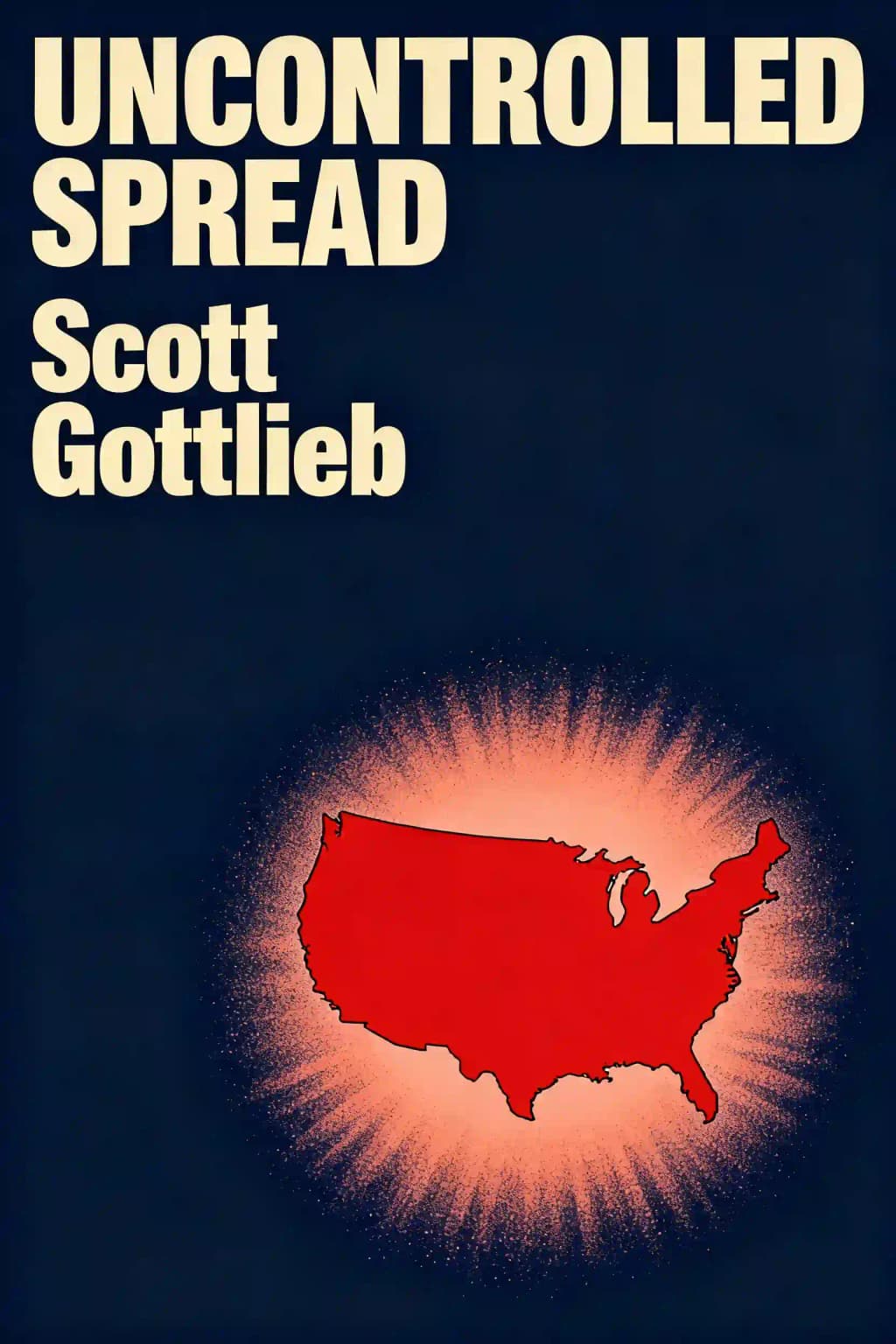
Former FDA commissioner Scott Gottlieb delivers a chilling insider account of America's COVID-19 failures. Praised by CNN's Dr. Sanjay Gupta as "sprinkled with true wisdom," this NYT bestseller reveals why our public health infrastructure collapsed - and how we prevent the next catastrophe.
Scott Gottlieb, former FDA Commissioner and New York Times bestselling author of Uncontrolled Spread: Why COVID-19 Crushed Us and How We Can Defeat the Next Pandemic, is a leading voice in public health policy and pandemic preparedness.
A physician and regulatory expert, Gottlieb draws on his tenure as the 23rd FDA Commissioner (2017–2019) to dissect systemic failures during the COVID-19 crisis in this nonfiction exposé. His background includes roles as a senior fellow at the American Enterprise Institute and partner at venture firm New Enterprise Associates, as well as board positions at Pfizer and Illumina.
Gottlieb regularly contributes to CNBC and CBS’s Face the Nation, leveraging his platform to advocate for healthcare innovation and evidence-based policymaking. His forthcoming book, The Miracle Century: Making Sense of the Cell Therapy Revolution, explores breakthroughs in medical science.
Elected to the National Academy of Medicine, Gottlieb’s work combines frontline regulatory experience with actionable insights for global health security. Uncontrolled Spread became an instant bestseller, solidifying his reputation as a critical thinker in crisis management.
Uncontrolled Spread analyzes systemic U.S. failures during COVID-19, including inadequate pandemic preparedness, flawed testing strategies, and bureaucratic breakdowns. Former FDA Commissioner Scott Gottlieb offers solutions like improved disease surveillance and global health integration into national security frameworks, drawing on insider accounts of government missteps.
Public health professionals, policymakers, and readers interested in pandemic preparedness will find this book essential. It’s also valuable for those seeking insights into U.S. institutional weaknesses and strategies to combat future outbreaks.
Yes. Gottlieb’s blend of policy expertise, firsthand experience, and detailed pandemic chronology provides a sobering yet actionable critique of America’s COVID-19 response. The book is praised for its depth and relevance to future public health crises.
Gottlieb argues the U.S. underestimated asymptomatic spread, relied on ineffective containment measures, and suffered from fragmented leadership. He highlights the CDC’s outdated protocols and the need to modernize disease-tracking systems.
Key lessons include decentralizing disease surveillance, accelerating diagnostic testing, and integrating real-time data sharing across agencies. Gottlieb emphasizes treating pandemics as national security threats to prioritize resource allocation.
The book criticizes China’s early suppression of viral data and refusal to share initial SARS-CoV-2 strains, which hindered global containment efforts. Gottlieb warns against over-reliance on foreign governments for timely outbreak intelligence.
He identifies poor coordination between federal agencies, politicization of public health guidance, and underfunded emergency stockpiles. The FDA’s slow emergency use authorizations and CDC’s rigid protocols exacerbated delays.
He argues that pandemics destabilize economies and societies like traditional threats. The book proposes embedding epidemiologists in intelligence agencies and creating a dedicated health security budget to preempt outbreaks.
Gottlieb notes that dismissing asymptomatic spread early on led to inadequate masking and testing policies. This oversight allowed silent community transmission to fuel the pandemic’s uncontrolled phase.
The CDC’s rigid adherence to outdated protocols, slow data sharing, and resistance to decentralized testing are criticized. Gottlieb advocates modernizing its mandate to prioritize rapid response over academic perfection.
“When people hear ‘no need to panic,’ many ask: ‘Should I panic?’” reflects Gottlieb’s critique of mixed messaging. Another warns: “COVID was enabled by the intentional quashing of information”
Unlike retrospective analyses, Gottlieb’s FDA experience and focus on systemic fixes provide a unique blueprint for reform. It contrasts with broader societal critiques by prioritizing actionable policy changes.
저자의 목소리로 책을 느껴보세요
지식을 흥미롭고 예시가 풍부한 인사이트로 전환
핵심 아이디어를 빠르게 캡처하여 신속하게 학습
재미있고 매력적인 방식으로 책을 즐기세요
Testing would become our most visible failure.
China's refusal to share critical information severely hampered global preparation.
Travel bans weren't what America truly needed.
The virus found its way in, exposing the fundamental flaw.
This created a false sense of security.
Uncontrolled Spread의 핵심 아이디어를 이해하기 쉬운 포인트로 분해하여 혁신적인 팀이 어떻게 창조하고, 협력하고, 성장하는지 이해합니다.
Uncontrolled Spread을 빠른 기억 단서로 압축하여 솔직함, 팀워크, 창의적 회복력의 핵심 원칙을 강조합니다.

생생한 스토리텔링을 통해 Uncontrolled Spread을 경험하고, 혁신 교훈을 기억에 남고 적용할 수 있는 순간으로 바꿉니다.
무엇이든 물어보고, 목소리를 선택하고, 진정으로 공감되는 인사이트를 함께 만들어보세요.

샌프란시스코에서 컬럼비아 대학교 동문들이 만들었습니다
"Instead of endless scrolling, I just hit play on BeFreed. It saves me so much time."
"I never knew where to start with nonfiction—BeFreed’s book lists turned into podcasts gave me a clear path."
"Perfect balance between learning and entertainment. Finished ‘Thinking, Fast and Slow’ on my commute this week."
"Crazy how much I learned while walking the dog. BeFreed = small habits → big gains."
"Reading used to feel like a chore. Now it’s just part of my lifestyle."
"Feels effortless compared to reading. I’ve finished 6 books this month already."
"BeFreed turned my guilty doomscrolling into something that feels productive and inspiring."
"BeFreed turned my commute into learning time. 20-min podcasts are perfect for finishing books I never had time for."
"BeFreed replaced my podcast queue. Imagine Spotify for books — that’s it. 🙌"
"It is great for me to learn something from the book without reading it."
"The themed book list podcasts help me connect ideas across authors—like a guided audio journey."
"Makes me feel smarter every time before going to work"
샌프란시스코에서 컬럼비아 대학교 동문들이 만들었습니다

Uncontrolled Spread 요약을 무료 PDF 또는 EPUB으로 받으세요. 인쇄하거나 오프라인에서 언제든 읽을 수 있습니다.
When a routine White House ceremony for Amy Coney Barrett became a superspreader event infecting President Trump and dozens of others despite rigorous testing protocols, it perfectly encapsulated America's failed COVID-19 response. How did the nation ranked best-prepared for a pandemic suffer one of the world's worst outcomes? Former FDA Commissioner Scott Gottlieb's insider perspective reveals a cascade of institutional failures that left America vulnerable when it mattered most. By January 2020, the warning signs were unmistakable-a mysterious pneumonia in Wuhan was spreading with alarming velocity. Despite China's initial claims of just a dozen cases linked to a market, the numbers quadrupled overnight. Videos showing medics in hazmat suits screening airline passengers contradicted official denials of human-to-human transmission. When China locked down Wuhan on January 23-a city of 11 million people-it should have triggered immediate action beyond mere travel restrictions. What America truly needed was diagnostic testing capacity, medical supplies, vaccine development, and expanded local health capabilities. Instead, we watched the crisis unfold in slow motion, unable to see what was already here.
