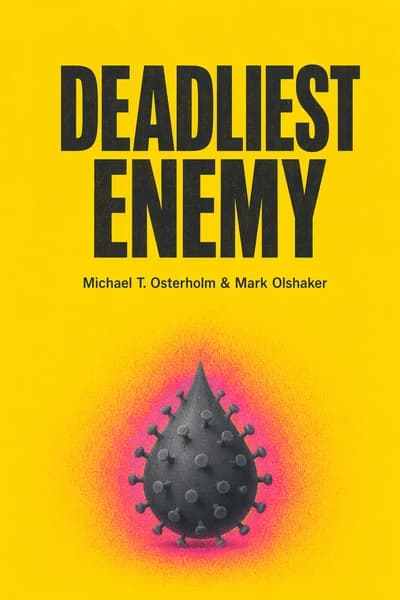
Before COVID-19 struck, Osterholm's "Deadliest Enemy" chillingly predicted our pandemic reality. Praised by Anthony Fauci and dubbed the "Paul Revere of pandemics," this Johns Hopkins-acclaimed blueprint reveals how unprepared we remain for the next inevitable outbreak - and what must change.
Michael Thomas Osterholm, PhD, MPH, and Mark Olshaker are the acclaimed authors of Deadliest Enemy: Our War Against Killer Germs, a New York Times bestselling exploration of pandemic threats and public health strategy. Osterholm, a world-renowned epidemiologist and director of the Center for Infectious Disease Research and Policy (CIDRAP) at the University of Minnesota, brings decades of frontline experience combating outbreaks like Ebola and advising institutions such as the World Health Organization. Olshaker, an Emmy-winning documentary filmmaker and bestselling coauthor of Mindhunter, lends his narrative expertise to translate complex science into gripping prose.
Their collaboration merges Osterholm’s authoritative analysis of bioterrorism, antimicrobial resistance, and emerging pathogens with Olshaker’s skill in crafting investigative narratives. The book builds on their prior work, including Living Terrors: What America Needs to Know to Survive the Coming Bioterrorist Catastrophe, cementing their reputation as essential voices in global health discourse.
Deadliest Enemy has been translated into 12 languages, endorsed by Pulitzer Prize-winning historians, and featured in Wired and Johns Hopkins Bloomberg School of Public Health’s best books list. Osterholm’s TED Talks and frequent appearances on CNN and NPR amplify the book’s urgent message about pandemic preparedness.
Deadliest Enemy examines infectious diseases as humanity’s greatest threat, blending epidemiology, historical outbreaks like AIDS and Ebola, and policy critiques. Coauthored with Mark Olshaker, it argues for proactive global health strategies to combat emerging pathogens, antibiotic resistance, and bioterrorism. The book uses real-world case studies, such as the toxic shock syndrome and raw milk outbreaks, to highlight systemic vulnerabilities.
Public health professionals, policymakers, and general readers interested in pandemic preparedness will find this book essential. It offers actionable insights for managing outbreaks and critiques bureaucratic failures, making it valuable for those studying epidemiology or global security. The accessible storytelling also appeals to fans of nonfiction like The Hot Zone.
Dr. Osterholm is a renowned epidemiologist, Regents Professor at the University of Minnesota, and director of CIDRAP. With over 40 years of experience, he advised the Biden administration on COVID-19 and authored bestselling books on bioterrorism and infectious diseases. His fieldwork includes investigating AIDS, Ebola, and foodborne outbreaks.
The threat matrix refers to diseases prioritized by their potential to cause societal disruption, not just mortality rates. Osterholm argues that novel pathogens (e.g., pandemic influenza) and antibiotic-resistant superbugs pose greater risks than familiar threats like heart disease, yet receive less public attention due to misaligned fear responses.
The book warns that overuse of antibiotics in medicine and agriculture accelerates resistance, creating “superbugs” immune to treatments. Osterholm cites MRSA and untreatable gonorrhea as examples, urging stricter regulations and reduced nonessential antibiotic use to avert a post-antibiotic era.
This analogy references John Snow’s 1854 cholera response, where removing a contaminated water pump halted the outbreak. Osterholm applies it to modern epidemiology, advocating for immediate action even without perfect data, as seen in his raw milk outbreak investigation.
Unlike The Hot Zone’s narrative focus, Deadliest Enemy combines scientific analysis with policy roadmaps. It parallels Spillover in exploring zoonotic diseases but emphasizes preparedness over storytelling, offering specific strategies for mitigating biological threats.
Osterholm’s warnings about pandemic unpreparedness, published in 2017, proved prescient during COVID-19. The book critiques fragmented global responses and underfunded health systems, providing a framework to address gaps exposed by recent crises.
Some reviewers note the book’s dense policy discussions may overwhelm casual readers. Others argue it underestimates non-infectious health threats like chronic diseases, though Osterholm counters that pandemics uniquely risk collapsing societal infrastructure.
Key strategies include:
Each chapter opens with a thematic quote (e.g., from Sherlock Holmes or Bob Dylan), framing epidemiology as detective work. Case studies, like the AIDS crisis and Minnesota measles outbreaks, illustrate concepts without relying on chronological narrative.
These lines underscore the book’s urgent, action-oriented tone.
저자의 목소리로 책을 느껴보세요
지식을 흥미롭고 예시가 풍부한 인사이트로 전환
핵심 아이디어를 빠르게 캡처하여 신속하게 학습
재미있고 매력적인 방식으로 책을 즐기세요
Evidence, knowledge, and logic weren't always enough to change human behavior.
The AIDS epidemic serves as a dire warning about what's possible.
The public health agenda isn't preventing death—which remains 100% inevitable.
When you know how to relieve torment and don't, then you become the tormentor.
Data can be easily misinterpreted without proper context.
Deadliest Enemy의 핵심 아이디어를 이해하기 쉬운 포인트로 분해하여 혁신적인 팀이 어떻게 창조하고, 협력하고, 성장하는지 이해합니다.
Deadliest Enemy을 빠른 기억 단서로 압축하여 솔직함, 팀워크, 창의적 회복력의 핵심 원칙을 강조합니다.

생생한 스토리텔링을 통해 Deadliest Enemy을 경험하고, 혁신 교훈을 기억에 남고 적용할 수 있는 순간으로 바꿉니다.
무엇이든 물어보고, 목소리를 선택하고, 진정으로 공감되는 인사이트를 함께 만들어보세요.

샌프란시스코에서 컬럼비아 대학교 동문들이 만들었습니다
"Instead of endless scrolling, I just hit play on BeFreed. It saves me so much time."
"I never knew where to start with nonfiction—BeFreed’s book lists turned into podcasts gave me a clear path."
"Perfect balance between learning and entertainment. Finished ‘Thinking, Fast and Slow’ on my commute this week."
"Crazy how much I learned while walking the dog. BeFreed = small habits → big gains."
"Reading used to feel like a chore. Now it’s just part of my lifestyle."
"Feels effortless compared to reading. I’ve finished 6 books this month already."
"BeFreed turned my guilty doomscrolling into something that feels productive and inspiring."
"BeFreed turned my commute into learning time. 20-min podcasts are perfect for finishing books I never had time for."
"BeFreed replaced my podcast queue. Imagine Spotify for books — that’s it. 🙌"
"It is great for me to learn something from the book without reading it."
"The themed book list podcasts help me connect ideas across authors—like a guided audio journey."
"Makes me feel smarter every time before going to work"
샌프란시스코에서 컬럼비아 대학교 동문들이 만들었습니다

Deadliest Enemy 요약을 무료 PDF 또는 EPUB으로 받으세요. 인쇄하거나 오프라인에서 언제든 읽을 수 있습니다.
What if I told you that the greatest threat to human civilization isn't nuclear war, climate change, or artificial intelligence-but something invisible to the naked eye? Throughout history, infectious diseases have toppled empires, reshaped demographics, and killed more people than all wars combined. Yet we remain dangerously unprepared for the next pandemic, despite clear warnings that it's not a matter of if, but when. This reality check comes from decades of frontline experience in epidemiology, where connecting dots between isolated cases can mean the difference between containing an outbreak and watching it engulf the world. The nickname "Bad News Mike" wasn't earned by being pessimistic-it came from delivering uncomfortable truths that officials didn't want to hear. But here's the thing: infectious diseases represent the only health threat capable of simultaneously disrupting society's functioning, halting global travel and trade, and destabilizing governments worldwide. Unlike chronic conditions that develop slowly or injuries that affect individuals, pandemics can transform our world overnight. Despite a stark 2005 warning in Foreign Affairs that time was running out to prepare, little meaningful action followed. This isn't about spreading fear-it's about understanding what we're up against and why our current approach falls dangerously short.