1장
When Contagion Goes Beyond Disease
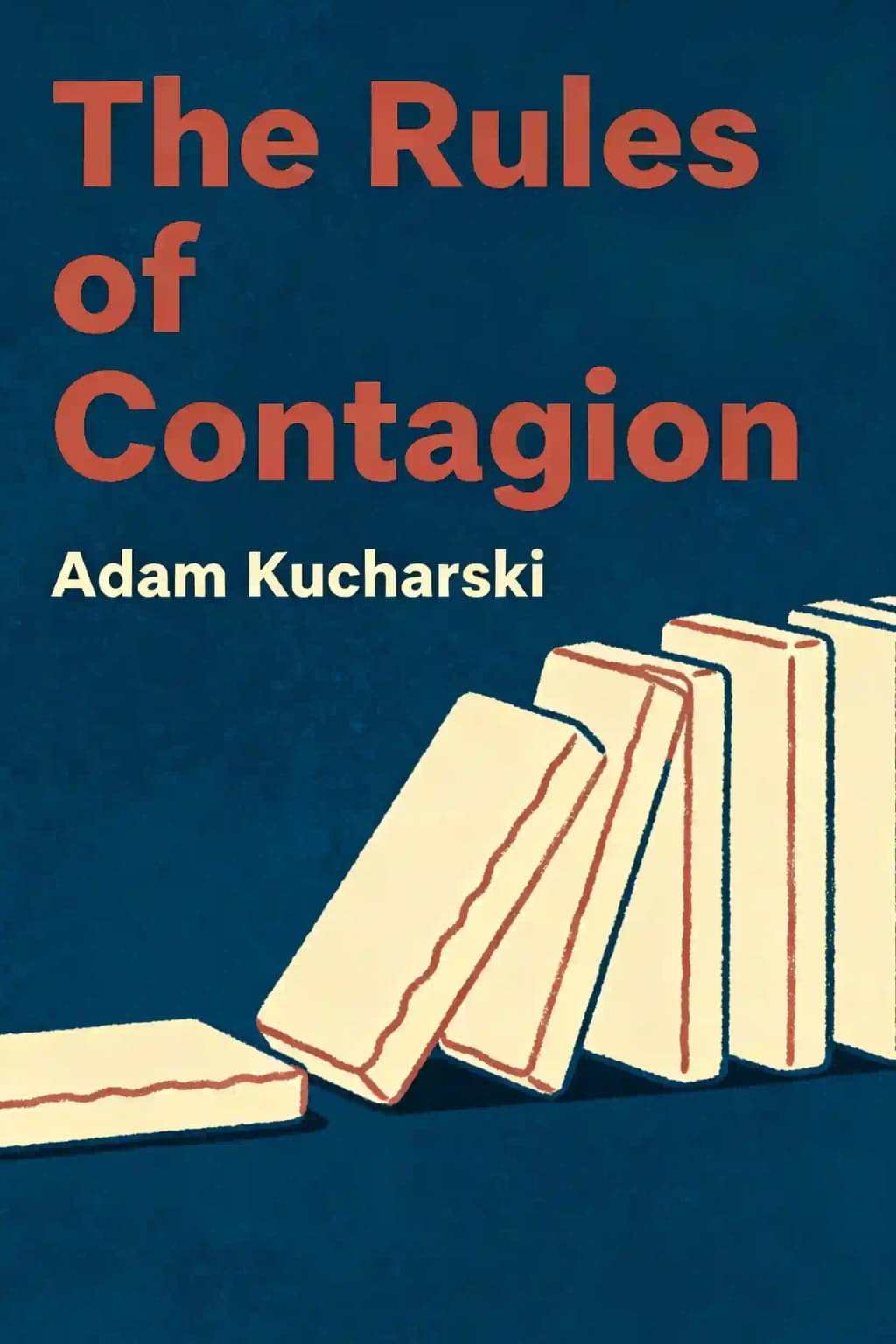
What do gun violence, financial crises, viral videos, and infectious diseases have in common? They all spread through networks, following remarkably similar patterns of contagion. This insight forms the core of Adam Kucharski's "The Rules of Contagion," a book that arrived with eerie timing just before the COVID-19 pandemic. As a mathematician and epidemiologist at the London School of Hygiene and Tropical Medicine, Kucharski has become a trusted voice during global health crises, appearing regularly on BBC and writing for publications like Scientific American and The Guardian. The book has been praised by Bill Gates as "a compelling read with powerful insights," while The Economist called it "excellent and timely." Beyond exploring how diseases spread, Kucharski reveals the universal principles governing everything from market crashes to social media trends, showing how the mathematics of contagion can help us understand-and potentially control-the outbreaks that shape our world.
2장
The Mathematical Foundation of Contagion
The story of modern outbreak science begins with Ronald Ross, a British doctor stationed in India who discovered the mosquito-malaria connection in the late 1800s. After years of meticulous research examining mosquito breeding patterns and infection rates, Ross became frustrated by widespread skepticism about mosquito control measures. To combat this resistance, he turned to mathematics, developing sophisticated models that would revolutionize epidemiology. His groundbreaking conceptual model demonstrated that complete mosquito elimination wasn't necessary-there existed a critical threshold below which malaria would naturally fade away. This "mosquito theorem" showed that once mosquito populations fell below this threshold, recoveries would outpace new infections, leading to disease extinction without requiring total vector elimination.
Ross pioneered what we now call a "mechanistic" approach to disease analysis, marking a fundamental shift in epidemiological thinking. While statisticians like William Farr focused on identifying patterns in existing outbreak data through careful observation and statistical analysis, Ross started by modeling the fundamental processes of transmission-how people became infected, infected others, and recovered. This approach allowed him to make forward-looking predictions and ask "what if" questions about control measures without requiring real-world experiments. His mathematical framework could simulate various intervention scenarios, providing crucial insights for public health planning.
Building on Ross's foundation, William Kermack and Anderson McKendrick developed the SIR model (Susceptible-Infected-Recovered) in the 1920s. This elegant mathematical framework divided populations into three distinct groups and tracked their interactions over time. Their work revealed that epidemics peak when enough people become immune that the disease can no longer spread effectively-what we now call "herd immunity." This concept has become central to public health, demonstrating that diseases can be controlled without vaccinating everyone, as immune individuals create protective barriers within communities. For example, measles requires about 95% immunity for herd protection, while polio can be controlled with around 80% coverage.
The reproduction number (R)-how many new infections a typical infectious person generates-emerged as the cornerstone of modern epidemic analysis. When R is below one, infections decline; above one, they grow exponentially. This value varies dramatically between diseases-from 1-2 for pandemic flu and Ebola to over 20 for measles in susceptible populations. The reproduction number depends on four key factors, known as DOTS: Duration of infectiousness, Opportunities for transmission, Transmission probability during each opportunity, and Susceptibility of the population. Understanding these components helps public health officials target interventions effectively-for instance, reducing opportunities for transmission through social distancing or decreasing susceptibility through vaccination campaigns.
These mathematical principles have proven remarkably versatile across different contexts and scales. During the 2013-14 Zika outbreak in French Polynesia, models helped health officials prepare for Guillain-Barre syndrome cases requiring ventilators, accurately predicting that existing resources would be sufficient. The same mathematical framework has been successfully applied to analyze financial contagion in global markets, the spread of violence in conflict zones, and even the viral transmission of social media content. This broad applicability demonstrates how Ross's mathematical insights have become fundamental to understanding and controlling outbreaks of all kinds, from infectious diseases to social phenomena.
3장
Financial Contagion: When Markets Catch a Fever
Financial markets demonstrate how contagion principles apply beyond disease. Even brilliant minds like Isaac Newton lost fortunes in market bubbles, and Nobel Prize-winning economists at Long Term Capital Management saw their fund collapse in 1998, requiring a $3.6 billion bailout to prevent financial contagion from spreading through the banking system.
The 2008 financial crisis revealed how correlation-how much things move together-proves crucial to understanding both financial markets and disease outbreaks. Banks had borrowed mathematical models from the life insurance industry to bundle mortgages into collateralized debt obligations (CDOs), but these models had fatal flaws. They assumed housing markets weren't correlated nationally, with Ben Bernanke claiming a nationwide housing decline was "pretty unlikely." When housing prices fell simultaneously across the country, the mathematical illusion making high-risk loans appear safe shattered.
Financial bubbles follow a pattern remarkably similar to disease outbreaks. Economist Jean-Paul Rodrigue identified four distinct phases: the stealth phase (where specialists invest in new ideas), the awareness phase (attracting wider investment), the mania phase (when media and public join, sending prices soaring), and finally the "blow off" phase of decline. Bitcoin represents perhaps the greatest recent bubble, reaching nearly $20,000 in December 2017 before losing 80% of its value a year later. Each Bitcoin bubble involved progressively larger groups of susceptible people-mimicking how an outbreak spreads from village to town to city.
The pre-2008 banking system exhibited nearly every network feature that could amplify contagion. Like disease networks with superspreaders, the financial system was dominated by a handful of institutions-in 2006, just 66 banks handled 75% of the $1.3 trillion daily transfers in the US Fedwire payment network. When Lehman Brothers collapsed, it had trading relationships with over one million counterparties, with no clear picture of who owed what to whom. Warren Buffett warned about this "frightening web of mutual dependence," noting that financial risk, like sexually transmitted diseases, depends not just on whom you interact with directly, but whom they interact with too.
Following insights from epidemic theory, regulators have implemented measures to reduce financial contagion. Banks now must hold more capital if they're central to the network. In 2011, the Vickers Commission recommended "ring-fencing" British banks' riskier trading activities from retail operations, creating barriers to contagion. Another approach requires large derivatives contracts to go through central hubs rather than direct bank-to-bank trading, simplifying the network structure.
4장
The Architecture of Social Networks
Understanding how people interact-whether for spreading innovations or infections-requires measuring contact patterns, a surprisingly difficult task. Companies like Pixar deliberately design workspaces to create "small-world encounters" between different network parts, with central atriums containing mailboxes and cafeterias to maximize "inadvertent encounters." The Francis Crick Institute similarly engineered its 650 million building to foster "gentle anarchy" through interactions.
For respiratory infections, contact patterns vary by location and demographic. The POLYMOD study tracked over 7,000 participants across eight European countries, measuring both physical contacts and conversations. Similar studies worldwide have revealed consistent patterns: people mix with similar-aged individuals, children have the most contacts, and school/home interactions typically involve physical contact. School terms significantly influence disease spread-during the 2009 influenza pandemic in the UK, the gap between spring and autumn peaks coincided with school holidays, when children have 40% fewer daily contacts.
Infection risk depends not just on direct contacts but on extended networks-your contacts' contacts and beyond. During the 2009 Hong Kong flu pandemic, children's high social contact rates drove transmission, with risk dropping after childhood but rising again at parenthood age. US studies show people without children spend weeks yearly with viral infections, those with one child are infected about a third of the year, while those with two children carry viruses more than half the time.
Disease spread doesn't follow geographic distance but human movement patterns. In 2009, flu reached distant China before nearby Barbados because airline passenger flows, not map distance, determine transmission. Once established within countries, diseases spread more locally-the 2009 flu pandemic moved across the US at just under 1 km/h, following "gravity model" patterns where people are drawn to locations based on proximity and population size.
Beyond infectious diseases, researchers debate whether behaviors and conditions like obesity, smoking, happiness, divorce and loneliness can spread through social networks. When people share characteristics with friends, three explanations exist: social contagion (friends influencing each other), homophily ("birds of a feather flock together"), or shared environment (like opening umbrellas when it rains). Distinguishing between these explanations presents what sociologists call "the reflection problem"-correlations between friendships and behaviors exist, but proving causation through contagion remains challenging.
5장
Violence as a Contagious Disease
When Gary Slutkin returned to Chicago in 1994 after working on disease epidemics in Africa, he was shocked by the city's violence epidemic that claimed over 800 lives the previous year. Examining maps and patterns, he noticed striking similarities between violence clusters and infectious disease outbreaks like cholera.
While medicine has moved beyond "miasma" to germ theory, Slutkin argues our approach to violence remains stuck in moralistic thinking about "bad people" rather than treating it as contagious. Violence shows key similarities to infectious disease: incubation periods between exposure and symptoms, clustering in time and location, and dose-response effects. Research reveals suicide can cluster following media coverage of high-profile cases, with studies finding a 10% rise in suicides after Robin Williams' death.
Analysis shows gun violence has a reproduction number of 0.63, with most outbreaks involving a single shooting, though superspreading events drive larger outbreaks. The Cure Violence approach works because violence spreads through identifiable social networks with sufficient time between events for intervention, resulting in significant reductions in shootings across multiple cities.
In Glasgow, once Europe's "murder capital," Karyn McCluskey established the Violence Reduction Unit after discovering hospital records revealed far more violence than police statistics captured. The unit borrowed techniques from American programs, implementing violence interruption through A&E department monitoring, providing employment training for gang members while maintaining consequences for continued violence, and supporting vulnerable children to prevent intergenerational transmission. The approach yielded promising results with significant drops in violent crime.
Public health specialist Carl Bell identified three requirements to stop epidemics: evidence, implementation methods, and political will. Yet gun violence research in the US has been hampered by the 1996 Dickey Amendment, which prevented CDC funds from being "used to advocate or promote gun control." Congressman Jay Dickey, who sponsored the amendment, later changed his position, stating "We need to turn this over to science and take it away from politics."
Following the 2011 London riots, researcher Toby Davies modeled how disorder spreads by examining three decisions: whether to participate, where to riot, and the likelihood of arrest based on "outnumberedess" (the ratio of rioters to police). Mark Granovetter's classic 1978 study proposed that people have different "thresholds" for joining riots-some might participate immediately while others require seeing many others involved first. This explains how small differences in individual thresholds can determine whether an incident remains an isolated "tantrum" or cascades into widespread rioting.
6장
The Viral Internet: How Content Truly Spreads
Jonah Peretti's 2001 viral Nike email exchange about customizing shoes with the word "sweatshop" accidentally launched his career in understanding online contagion. This success led Peretti to establish a "contagious media lab" at Eyebeam, experimenting with what makes content spread online. His insights about news-jacking, polarizing topics, and content sharing mechanisms eventually led to the creation of BuzzFeed.
Duncan Watts and colleagues challenged the popular "influencer" marketing theory that certain everyday people can spark massive social epidemics. While marketers believed they could achieve "Oprah-like impact from small budgets" by targeting well-connected individuals, research revealed this was largely untrue. Watts' replication of Milgram's small-world experiment with 25,000 email chains showed messages didn't flow through consistent influencers. Later Twitter studies confirmed that even users with many followers rarely created large outbreaks.
Social media communities often cluster around similar worldviews, creating "echo chambers" where contradictory opinions rarely penetrate. The anti-vaccination movement exemplifies this phenomenon, congregating around the debunked claim that MMR vaccines cause autism. Andrew Wakefield's discredited paper, amplified by British media, led to decreased vaccination rates and subsequent measles outbreaks. Digital connectivity now enables vaccine myths to cross language barriers, threatening the 95% vaccination coverage needed to prevent measles outbreaks.
Online conflict emerges not just from content but from "context collapse"-when posts intended for one audience are read by another. Unlike real-life interactions where we adjust our communication style based on audience, social media inadvertently combines friends, family, coworkers and strangers in the same conversation. Comments easily lose context, creating misunderstandings.
Most online content never becomes popular. A 2016 study of 620 million Twitter posts found about 95% were never shared by anyone else. Of those that spread, most didn't go beyond one additional share. Even viral content typically spreads through "broadcast" events rather than person-to-person propagation.
For stuttering outbreaks with reproduction number R below 1, mathematicians proved the expected outbreak size equals 1/(1-R). This formula works for both diseases and online content. BuzzFeed's success came from "big seed marketing"-starting with large initial exposure to compensate for modest contagiousness. As Peretti explained, true viral content should exhibit exponential growth rather than decay, unlike most online content which requires mass broadcast events to reach large audiences.
Despite having nearly a billion Twitter cascades to analyze, Microsoft researchers could explain less than half the variability in popularity. A tweet's content provided little predictive power; the user's past success mattered more, but randomness played an enormous role. The "peeking method"-observing initial spread patterns-significantly improved predictions, with large cascades showing broadcast-like early growth.
7장
The Evolution of Digital Threats
When major websites like Netflix, Amazon and Twitter were taken down in 2016, the culprits weren't sophisticated hackers but ordinary household appliances. The "Mirai" malware had infected thousands of smart devices-kettles, fridges, toasters, TVs, and baby monitors-turning them into a massive botnet that overwhelmed Dyn, a crucial domain name system. The attack was devastating precisely because these devices stay powered on continuously, unlike computers that get turned off at night.
Computer infections have evolved dramatically since their humble beginnings. The first "in the wild" computer virus, 1982's "Elk Cloner," was created by 15-year-old Rich Skrenta as a practical joke that occasionally displayed a poem on Apple II computers. It spread slowly through floppy disk exchanges among friends.
The Mirai botnet originated not from sophisticated criminal syndicates but from three young men involved in the competitive Minecraft server market. Twenty-one-year-old Paras Jha and his friends created Mirai to launch distributed denial of service (DDoS) attacks against rival Minecraft servers, hoping to frustrate players into switching to their own servers. The creators published Mirai's source code online to obscure their involvement, but unknown actors repurposed it for the massive Dyn attack that temporarily disabled major websites.
Modern malware spreads with astonishing efficiency. While the 2001 "Code Red" worm infected just 1.8 machines per hour (still faster than measles, which infects 0.1 people per hour), the 2003 "Slammer" worm infected 75,000 machines, doubling in size every 8.5 seconds. The dark web hosts thriving marketplaces for malware services, with DDoS attacks available for as little as $5 for five minutes or $400 for a full day.
Computer viruses display a puzzling characteristic: they persist for long periods despite infecting relatively few machines. This persistence stems from the internet's network structure, which has extreme variation in connectivity. Because there is huge variability in the number of links, even seemingly weak infections can survive since computers are never far from highly connected hubs that can trigger superspreading events.
Like biological viruses, malware evolves over time. After the Mirai botnet code was published online in 2016, dozens of variants emerged with different features. Modern malware increasingly evades detection through evolution. The "Beebone" botnet infected thousands of machines in 2014, changing its appearance several times daily to produce millions of unique variants that could bypass antivirus software. This mirrors how influenza viruses gradually evolve their surface proteins to escape immune recognition, necessitating annual vaccine updates.
8장
Tracking the Origins of Outbreaks
Phylogenetic analysis has become a powerful tool in criminal investigations and outbreak tracking. In the case of Richard Schmidt, a Louisiana doctor who attempted to murder his former lover by injecting her with HIV, it demonstrated that HIV strains between his patient and the victim were exceptionally closely related, undermining defense claims that the infections were unrelated.
Beyond identifying outbreak sources, phylogenetic methods reveal when diseases arrived in particular locations. If viruses circulating in an area show little diversity, the outbreak is likely recent; extensive diversity suggests the virus has been present longer. This approach helped determine that Zika entered Fiji in two separate introductions, and revealed that a 2016 Ebola resurgence in Guinea came from a virus that had persisted in a recovered patient's body for 18 months.
Just as phylogenetic methods track biological evolution, they can also map cultural evolution. Anthropologist Jamie Tehrani applied these techniques to folktales, analyzing nearly sixty versions of "Little Red Riding Hood" and related stories across cultures. By examining seventy-two plot features instead of genetic sequences, Tehrani created a phylogenetic tree that surprisingly revealed "The Wolf and the Kids" and "Little Red Riding Hood" predated "The Tiger Grandmother"-contrary to common belief.
Modern phylogenetic analysis by Tehrani and Sara Graca da Silva found some folktales like "Rumpelstiltskin" may be over 4,000 years old, as ancient as Indo-European languages themselves. Despite national claims on folktales, phylogenetic analysis reveals extensive cultural borrowing, showing oral traditions are "highly globalized."
Cultural transmission occurs in two main ways: "vertical transmission" passes information down through generations, while "horizontal transmission" spreads ideas within a generation. Da Silva and Tehrani found that folktales primarily spread vertically, but computer code often travels horizontally as programmers reuse existing code. This horizontal sharing makes it difficult to draw neat evolutionary trees, creating what biologists call an "unkempt hedge" rather than Darwin's tree of life.
The 21st century's ability to rapidly sequence and analyze genomes promises revolutionary healthcare advances, but raises serious privacy concerns. Our genomes reveal not just our own characteristics but our relatives' too. High-resolution GPS data is particularly revealing-domestic violence shelters report protecting people from GPS stalking, and military personnel have inadvertently exposed base layouts through fitness tracker routes.
9장
The Ethics of Contagion Science
Nuclear physics exemplifies "dual-use technology"-research with enormous benefits but also devastating harmful applications. From nuclear medicine saving lives to atomic weapons causing mass destruction, this duality shapes scientific ethics. Similar patterns emerge with social media, crime analysis algorithms, and GPS tracking. The 2018 Cambridge Analytica scandal, which revealed secret harvesting of Facebook data to profile voters, echoed ethical debates from fields like nuclear physics and medicine. This incident highlighted how seemingly benign data collection could be weaponized for social manipulation.
Technology companies often assume that because they have massive datasets, they must be able to solve important problems. Silicon Valley's "move fast and break things" mentality frequently collides with public health realities. As epidemiologist Caroline Buckee argues, we shouldn't fall for "the seductive idea that young, tech-savvy college grads can single-handedly fix public health on their computers." Many tech approaches fail because they focus on disruption rather than long-term engagement with complex problems. Examples include failed contact tracing apps during COVID-19 and oversimplified disease prediction models that ignore crucial social factors.
The biggest challenges in outbreak analysis are often practical rather than computational. Gathering data is one thing; having resources to respond is another. This is evident in the Ebola outbreaks in some of the world's poorest countries, where sophisticated tracking systems proved useless without basic medical supplies and infrastructure. Research often struggles to keep pace with outbreaks-by the time studies are ready, cases have often stopped, leaving fundamental questions unanswered. The 2014 West African Ebola outbreak particularly demonstrated this challenge, where research protocols couldn't be implemented fast enough to capture crucial early-stage data.
Researchers face similar challenges with messy, imperfect data across fields-from radiation and cancer to obesity, drug use, and social media influence. As Alice Stewart noted, epidemiologists rarely have perfect datasets; they're "looking for a spot of trouble in a very messy situation." Combining multiple imperfect datasets can reveal a more complete picture of contagion. For instance, combining cell phone location data with traditional disease surveillance helped track cholera spread in Haiti and dengue fever in Pakistan.
As infectious diseases decline globally, attention is shifting to other contagious threats like suicide, violence, and misinformation. Methods developed to study disease outbreaks are now being applied to financial crises, violence prevention, and the spread of ideas and culture. This modern "theory of happenings" is helping us analyze everything from diseases to economics, often overturning popular notions of how outbreaks work. For example, social network analysis techniques originally developed for tracking STDs now help understand how extremist ideologies spread online.
In outbreak analysis, the most significant moments aren't when we're right, but when we realize we've been wrong-when patterns catch our eye or exceptions break what we thought were rules. These are the moments that allow us to unravel chains of transmission and change how outbreaks happen in the future. The discovery that H1N1 influenza spread differently than predicted in 2009, for instance, led to fundamental revisions in pandemic planning. Similarly, understanding how misinformation spreads on social media has challenged traditional models of information diffusion.