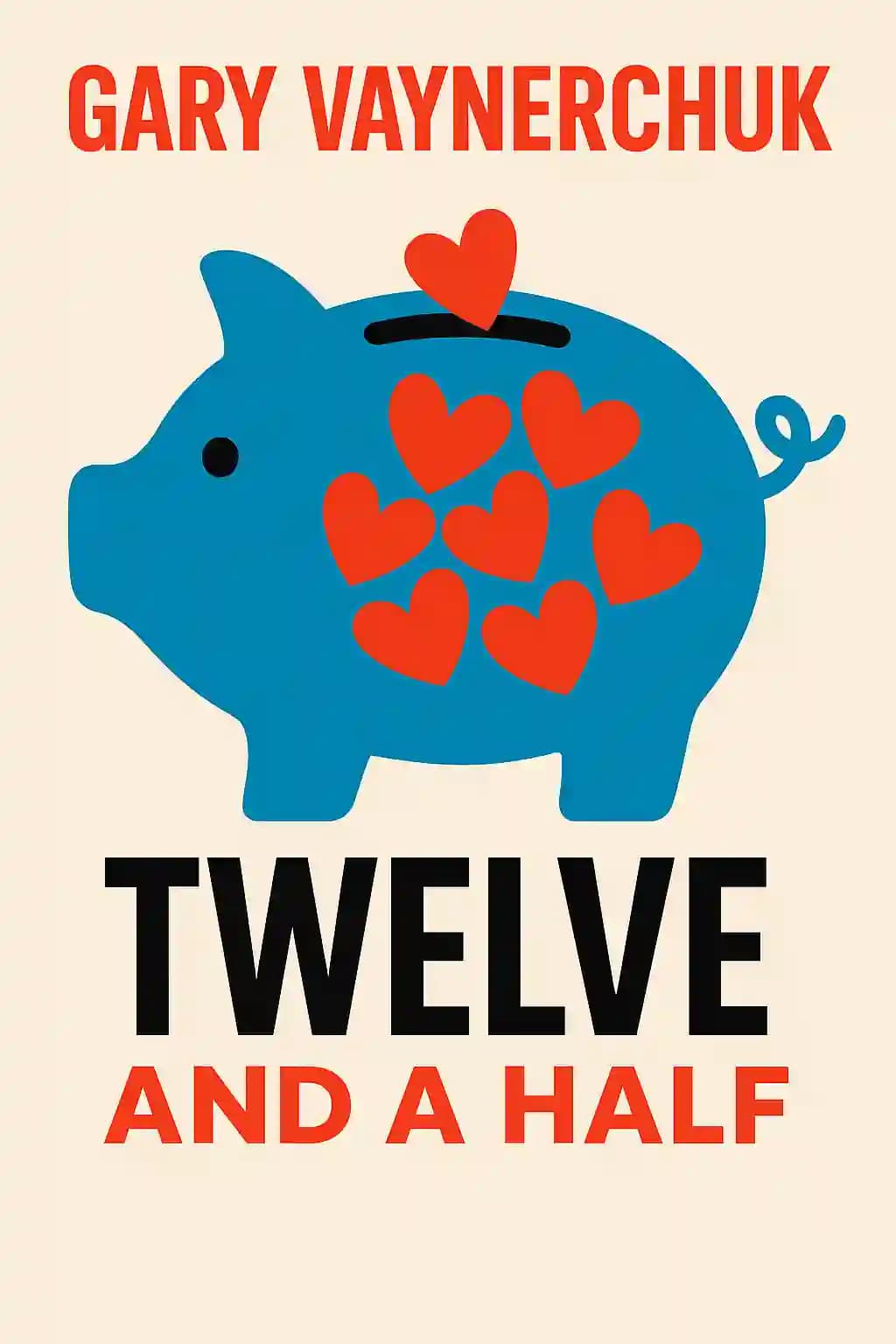
In "Twelve and a Half," Gary Vaynerchuk reveals the emotional ingredients essential for business success. Beyond hard skills, this eye-opening guide challenges traditional leadership with practical scenarios - including his response to an employee stealing $200k. What emotional trait are you missing?
Gary Vaynerchuk, bestselling author of Twelve and a Half and renowned serial entrepreneur, combines decades of digital marketing expertise with sharp insights on emotional intelligence in this business-focused work.
Born in Belarus and raised in New York, Vaynerchuk transformed his family’s $3M wine business into a $60M ecommerce empire through pioneering YouTube content and social media strategies, later founding the award-winning agency VaynerMedia.
His authority stems from early investments in Facebook, Twitter, and Uber, alongside NYT bestsellers like Crush It! and Ask Gary Vee. The book’s themes of leveraging personal strengths and business psychology reflect his daily podcast #AskGaryVee and documentary series DailyVee, which dissect entrepreneurial mindset cultivation.
A frequent speaker at global conferences and guest on Ellen and Conan, Vaynerchuk’s works have shaped modern digital marketing frameworks. Twelve and a Half follows his 2009 debut’s legacy, with his books collectively selling millions worldwide and translated into 35+ languages.
Twelve and a Half explores 12 emotional intelligence traits critical for success, including gratitude, accountability, and curiosity, paired with a personalized "half" ingredient—the skill readers need to develop most. Gary Vaynerchuk blends personal anecdotes with actionable strategies to help individuals and leaders harness these traits for professional growth and healthier workplace dynamics.
Entrepreneurs, managers, and professionals seeking to improve leadership skills or workplace culture will benefit most. The book’s focus on emotional intelligence over traditional "hard skills" makes it ideal for those navigating team dynamics, career transitions, or personal development challenges.
Yes—readers praise its practical exercises, relatable scenarios, and emphasis on self-awareness. Reviews highlight its value for refining leadership styles, improving communication, and building resilience in fast-paced environments.
The core traits are gratitude, self-awareness, accountability, optimism, empathy, kindness, tenacity, curiosity, patience, conviction, humility, and ambition. Each chapter defines a trait, explains its impact on decision-making, and provides exercises to strengthen it.
The "half" refers to the emotional ingredient readers struggle with most, such as Vaynerchuk’s own challenge with balancing kindness and candid feedback. Identifying and improving this "half" is central to achieving balanced leadership and personal growth.
Unlike theory-heavy guides, it prioritizes actionable frameworks over abstract concepts. For example, it replaces generic advice with exercises like "seek feedback weekly" to build self-awareness and "reframe setbacks as experiments" to cultivate optimism.
Balancing opposing traits—like patience with ambition or humility with conviction—is key. Vaynerchuk argues that overemphasizing one trait (e.g., relentless ambition) without its counterbalance (e.g., patience) leads to unsustainable success.
The book advises using empathy to understand colleagues’ perspectives and "kind candor" to address issues directly. For instance, pairing kindness with accountability helps resolve tensions while maintaining trust.
Some note the concepts may feel repetitive for readers familiar with Vaynerchuk’s previous work. Others suggest the emotional focus might undervalue technical skills in certain industries.
Vaynerchuk reframes failure as a necessary step for growth, urging readers to analyze missteps without self-judgment. Exercises like "post-failure debriefs" help extract lessons while maintaining optimism.
Notable lines include:
It emphasizes empathy and accountability to bridge communication gaps in virtual teams. For example, scheduling regular check-ins fosters connection, while clear ownership of tasks reduces ambiguity.
저자의 목소리로 책을 느껴보세요
지식을 흥미롭고 예시가 풍부한 인사이트로 전환
핵심 아이디어를 빠르게 캡처하여 신속하게 학습
재미있고 매력적인 방식으로 책을 즐기세요
Leaning into humanity is what truly helps us survive and flourish.
Gratitude provides sustainable energy unlike negative emotions.
When you fully accept yourself, you're no longer scared of other people's judgments.
When you blame others, you're admitting you're no longer in control.
Optimism means being thrilled about your next opportunity.
TWELVE AND A HALF의 핵심 아이디어를 이해하기 쉬운 포인트로 분해하여 혁신적인 팀이 어떻게 창조하고, 협력하고, 성장하는지 이해합니다.
생생한 스토리텔링을 통해 TWELVE AND A HALF을 경험하고, 혁신 교훈을 기억에 남고 적용할 수 있는 순간으로 바꿉니다.
무엇이든 묻고, 학습 스타일을 선택하고, 나에게 맞는 인사이트를 함께 만들어보세요.

샌프란시스코에서 컬럼비아 대학교 동문들이 만들었습니다
"Instead of endless scrolling, I just hit play on BeFreed. It saves me so much time."
"I never knew where to start with nonfiction—BeFreed’s book lists turned into podcasts gave me a clear path."
"Perfect balance between learning and entertainment. Finished ‘Thinking, Fast and Slow’ on my commute this week."
"Crazy how much I learned while walking the dog. BeFreed = small habits → big gains."
"Reading used to feel like a chore. Now it’s just part of my lifestyle."
"Feels effortless compared to reading. I’ve finished 6 books this month already."
"BeFreed turned my guilty doomscrolling into something that feels productive and inspiring."
"BeFreed turned my commute into learning time. 20-min podcasts are perfect for finishing books I never had time for."
"BeFreed replaced my podcast queue. Imagine Spotify for books — that’s it. 🙌"
"It is great for me to learn something from the book without reading it."
"The themed book list podcasts help me connect ideas across authors—like a guided audio journey."
"Makes me feel smarter every time before going to work"
샌프란시스코에서 컬럼비아 대학교 동문들이 만들었습니다

TWELVE AND A HALF 요약을 무료 PDF 또는 EPUB으로 받으세요. 인쇄하거나 오프라인에서 언제든 읽을 수 있습니다.
Have you ever wondered what truly separates extraordinary achievers from everyone else? In a world obsessed with hard metrics and analytics, the secret ingredients might surprise you. I once faced a defining moment when a client representing 30% of our revenue demanded I fire an entry-level employee over an accidental tweet. It took me a hundredth of a second to refuse. This crystallized my belief that leaning into our humanity - not aggression or intimidation - is what truly helps us flourish. While spreadsheets matter, they're distant seconds to mastering emotional intelligence. Twelve key ingredients - gratitude, self-awareness, accountability, optimism, empathy, kindness, tenacity, curiosity, patience, conviction, humility, and ambition (plus the "half" ingredient of kind candor) - form the foundation of both success and happiness. These aren't just nice-to-haves; they're the transformative elements that turn ordinary careers into extraordinary journeys.
Most people don't recognize their privileged position in the world. With 785 million lacking clean water and over 40 million in modern slavery, simply having internet access makes you fortunate. Many confuse gratitude with complacency, but they're distinct. Gratitude provides sustainable energy while negative emotions are like cheap gas that damages your engine. When you're grateful for fundamentals-health, opportunity, freedom-business setbacks become manageable rather than catastrophic. Lost clients become opportunities to diversify; failed projects become learning experiences. This resilience creates an unshakeable foundation for success. The most successful entrepreneurs maintain drive while practicing gratitude, achieving more lasting success than their constantly dissatisfied peers. Optimism isn't delusion-it's hopefulness about the future while remaining aware of potential downsides. Choosing optimism is practical since you control your perspective more than external variables. It means being excited about opportunities while acknowledging success isn't guaranteed. Your response to setbacks reveals your relationship with optimism. Do you blame others and shield your ego? Or do you take responsibility, deploy gratitude, and maintain perspective? Optimism naturally pairs with tenacity-how can you persist without believing in possible success? The optimist's advantage is seeing opportunities where others see only obstacles.
When you fully accept yourself, you're no longer scared of others' judgments. People fixated on job titles often worry about others' opinions. Even as a sixth-grader selling baseball cards, I recognized my entrepreneurial nature. Confidence enhances self-awareness - I can acknowledge weaknesses because I separate who I am from who I wish to be. The power in acknowledging weaknesses is navigating around them. I lack the work ethic for hanging paintings but will work fifteen hours on my business because I love it. I focus on elevating strengths from great to supernova rather than merely improving weaknesses. The outcome is greater when you triple down on strengths due to time-impact arbitrage. Self-awareness extends beyond weaknesses to understanding your natural tendencies and preferences. Do you excel in the morning or evening? Does collaboration energize you or solo work? These insights help structure your work for maximum effectiveness. The most self-aware people can precisely identify their strengths, weaknesses, and what energizes versus drains them. They've abandoned being well-rounded to focus on becoming exceptional in their areas of strength.
People often deflect blame, thinking it leads to happiness, but this makes them victims by surrendering control. Accountability acts like brakes, stopping the pain momentum from blaming others. I find comfort knowing every issue in my life is 100% my fault - if I created it, I can fix it. Even with circumstantial problems, I can choose how I respond. This ingredient challenges those whose self-esteem depends on outcomes. They fear others' opinions and develop ego-defense mechanisms against mistakes. When you don't overvalue your own opinion, you won't overvalue others' either, freeing you to be accountable. Accountability isn't self-punishment - it's empowerment. Taking ownership of problems means taking ownership of solutions, transforming you from a passive recipient to an active creator. Successful people take responsibility even when they could reasonably blame others, understanding that blame disempowers while accountability enables improvement.
Empathy is my superpower - the ability to understand and share others' feelings. It's why I invested early in Facebook and Twitter, why I'm bullish on NFTs, and how I knew certain artists would succeed. I have an uncanny sense of human behavior. Empathy works both one-on-one and at scale. I can sense what individuals across from me are feeling, but also what masses of people with different perspectives are experiencing collectively. This helps me communicate contextually and understand behaviors. When people leave hateful comments, I respond with compassion rather than anger. I know their negativity reflects their own pain. Similarly, with toxic people in corporate settings, I recognize they must be suffering to behave that way. Empathy gives you the answers to the test of human interaction. You can use it destructively or constructively - I choose to uplift. It's not just about understanding emotions but understanding context. Why is someone behaving a certain way? What might they be experiencing that I can't see? This contextual understanding prevents knee-jerk judgments and enables more productive interactions.
True kindness means showing compassion even under pressure or after being wronged. When an employee stole $250,000 of wine from my company, I responded with empathy after learning about their addiction struggle. Many confuse kindness with being a pushover, but they're distinct. You can be kind, candid, and firm simultaneously. Kindness creates safety for difficult conversations and encourages others to open up. Without balancing empathy with candor, resentment develops. That's why I developed "kind candor" - how you deliver the message matters. It's like choosing a doctor with good bedside manner over one without. Society often mistakes kindness for weakness. As a business strategy, kindness creates unparalleled loyalty. When employees, customers, and partners feel genuinely cared for, they become advocates rather than mere participants. This creates a competitive advantage that's hard to replicate because it stems from authentic values, not tactics.
When these emotional ingredients reach their full potential, you work with minimal friction. Colleagues feel safe around you, speeding up execution. Organizations that embrace these qualities eliminate unnecessary politics, allowing teams to move projects forward faster. By taking accountability, you avoid the spiral of blame. Self-awareness helps you focus on strengths rather than weaknesses. Gratitude limits dwelling on mistakes. Empathy, kindness, and humility shield you from insecurity, while optimism, curiosity, and patience foster trust. Kind candor enables timely feedback before resentment develops. You might still work late - not from pressure but because you're enjoying yourself. These emotional ingredients create speed in business and life by removing fear from your steps. All attributes are essential and interdependent. This journey could be distilled to one question: "Are you insecure?" The ultimate privilege isn't wealth, status, or achievement, but the internal calm from emotional intelligence. When you develop these ingredients, you gain something far more valuable than business success: the ability to be truly present and at peace regardless of circumstances. Isn't that the real definition of success?