1장
When Your Brain Dances: The Neuroscience of Musical Experience
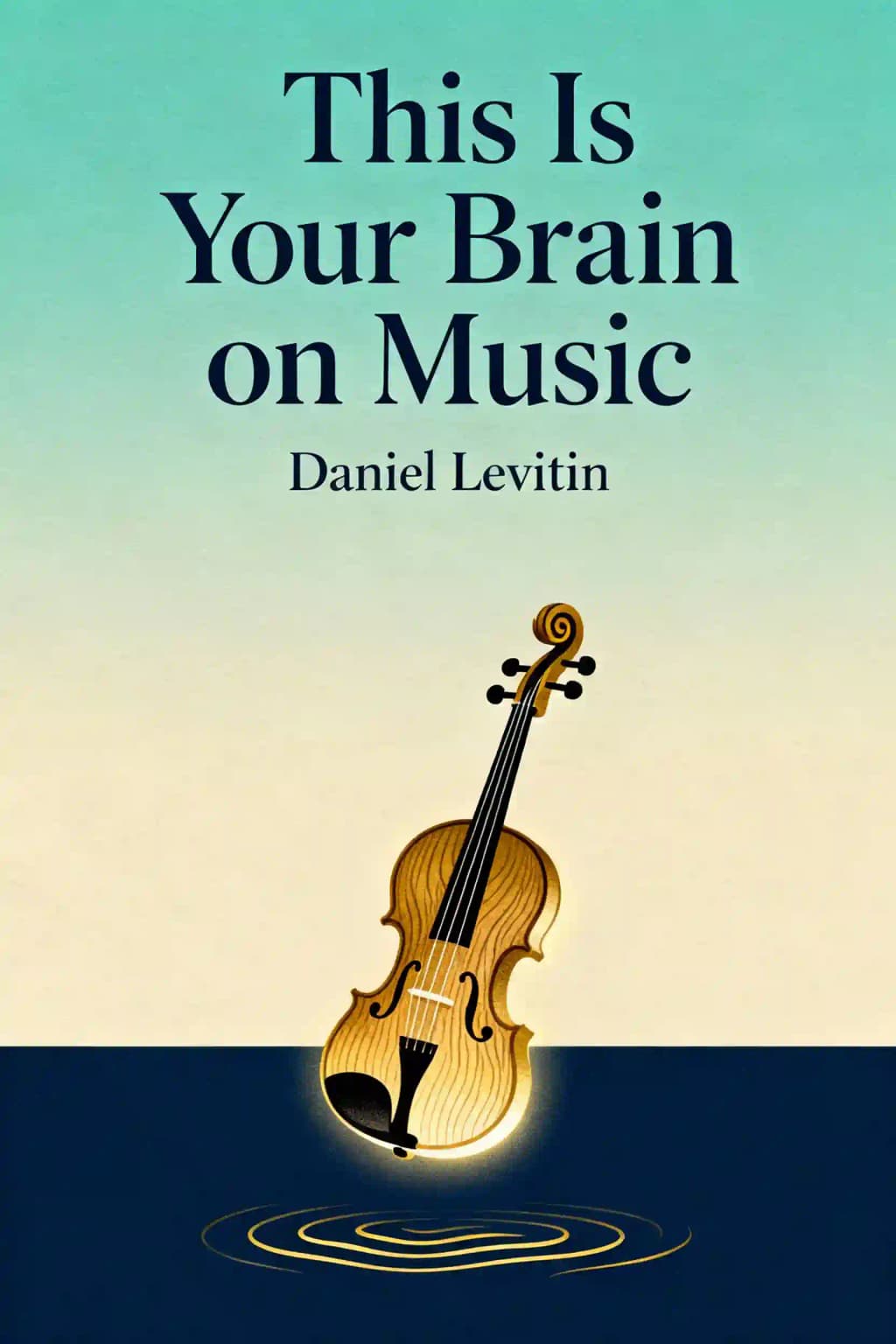
Ever wondered why certain songs transport you back to specific moments in time? Or why a simple melody can evoke powerful emotions that words alone cannot express? In "This Is Your Brain on Music," neuroscientist and former music producer Daniel Levitin unveils the fascinating relationship between our brains and the music we love. Since its publication in 2006, this groundbreaking work has become required reading in university courses across disciplines from neuroscience to music theory. Even celebrities like Sting and Stevie Wonder have praised its insights, with Wonder noting that it "finally explains why a simple song can trigger such powerful emotions." The book's cultural impact extends beyond academia - it has fundamentally changed how we understand music's role in human evolution and development, suggesting that our musical abilities may be as central to our humanity as language itself. Through Levitin's expert blend of scientific research and musical appreciation, we discover that when we listen to music, we're engaging in one of the most complex cognitive activities humans perform.
2장
The Musical Brain: How Sound Becomes Meaning
Music isn't just sound - it's organized sound that engages nearly every region of our brain. When we listen to music, our auditory cortex processes pitch and timbre, while our cerebellum tracks rhythm and our frontal lobes predict what comes next. This widespread neural activation explains why music can affect us so profoundly - it's literally lighting up our entire brain.
What exactly constitutes music? The question has sparked heated debates throughout history. When Bob Dylan switched from acoustic to electric guitar in 1965, fans felt betrayed, believing he had abandoned "real" music. These reactions reveal how personally we define music, often based on cultural and emotional attachments rather than objective criteria.
Composer Edgard Varese offered a more inclusive definition: music is simply "organized sound." This organization involves manipulating basic elements - loudness, pitch, contour, rhythm, tempo, timbre, spatial location, and reverberation - into structures like meter, harmony, and melody. These elements work together to create what we experience as music.
The relationships between these elements matter more than the elements themselves. Miles Davis understood this when he famously noted that music isn't just about the notes you play - it's about the spaces between them. This concept parallels Picasso's approach to visual art, where negative space carries as much meaning as the painted areas. In music, silence and anticipation create tension and release, engaging our brains in a constant dance of expectation and surprise.
Our perception of music begins with pitch - the psychological interpretation of sound frequency. While we can technically hear frequencies from 20 to 20,000 Hz, not all register as distinct pitches. The brain organizes these frequencies along a tonotopic map in both our inner ear and auditory cortex, creating a precise neural representation of the sounds we hear. This remarkable mapping allows scientists to identify exactly which frequencies we're hearing by observing which parts of our brain activate - a level of precision unmatched in other sensory systems.
3장
The Architecture of Sound: From Physics to Feeling
When we hear a note played on a violin versus the same note on a piano, how do we instantly recognize the difference? The answer lies in timbre - the unique tonal quality that distinguishes one sound source from another. Timbre results from the specific pattern of overtones produced by an instrument, creating a sonic fingerprint as distinctive as a human voice.
The physics behind this is fascinating. When an instrument plays a note, it doesn't produce just one frequency but a complex mixture of the fundamental tone plus higher frequencies called overtones or harmonics. These harmonics occur in specific mathematical relationships to the fundamental - usually as integer multiples (2x, 3x, 4x the fundamental frequency). The specific blend of these harmonics creates each instrument's characteristic sound.
Our brains are remarkably adept at processing these harmonic relationships. Even if the fundamental frequency is missing from a sound, our auditory system will "fill in" the missing fundamental based on the pattern of overtones - a phenomenon known as the missing fundamental illusion. This demonstrates how actively our brains construct our perception of sound rather than passively receiving it.
The importance of timbre extends beyond music. It's how we recognize a loved one's voice in a crowded room or distinguish between different environmental sounds. In fact, timbre processing may be our most ecologically important auditory skill, essential for survival long before humans created music.
In the 1950s, composer Pierre Schaeffer conducted fascinating experiments with timbre. He discovered that removing the initial attack phase of an instrument's sound - the first few milliseconds - made instruments nearly indistinguishable from one another. This revealed that much of an instrument's identity resides in how the sound begins rather than how it sustains. These insights led to new techniques for electronic music composition and sound synthesis.
Modern synthesizers like the revolutionary Yamaha DX7 of the 1980s use techniques like FM synthesis to manipulate harmonic relationships, creating both realistic instrument simulations and entirely new timbres. This technology transformed popular music, giving us the distinctive sound of '80s hits and expanding the palette of sounds available to composers and producers.
4장
Rhythm, Meter, and the Body's Response
Why do certain songs make us want to move? The answer lies in rhythm - the pattern of durations that forms music's temporal backbone. Rhythm isn't just an abstract concept; it connects directly to our bodies, triggering automatic responses that can be difficult to suppress.
Consider Sonny Rollins' saxophone solos - their rhythmic intensity creates an almost irresistible urge to move. This physical response to rhythm appears universal across cultures and likely has deep evolutionary roots. Our ancestors may have used rhythmic synchronization for social bonding and coordination long before language developed.
Rhythm works alongside meter and tempo to create music's temporal structure. While rhythm deals with patterns of note durations, meter organizes beats into recurring groups (like the familiar 4/4 time of most pop music), and tempo determines the overall speed. Together, these elements create what musicians call "groove" - that compelling sense of forward motion that draws listeners in.
But true groove isn't about mechanical precision. It emerges from subtle variations in timing that reflect human expression. When musicians play slightly ahead of or behind the beat, they create tension and release that communicates emotion. This is why computer-generated rhythms often feel sterile - they lack the human variations that give music its emotional power.
The emotional impact of rhythm extends to other musical elements as well. Fast tempos generally convey happiness or excitement, while slow tempos suggest sadness or solemnity. Major scales typically sound cheerful, while minor scales evoke melancholy. These associations aren't arbitrary but reflect deep connections between music and emotional expression.
Our brains are constantly extracting patterns from music, building expectations about what will come next. When composers play with these expectations - delaying resolutions or introducing surprising changes - they create emotional responses ranging from mild pleasure to profound catharsis. This interplay between expectation and surprise forms the basis of music's emotional power.
5장
The Mind's Ear: How We Process Musical Information
Have you ever wondered how you can instantly recognize a familiar song, even when it's played in a different key or on different instruments? This remarkable ability highlights the sophisticated processing our brains perform when encountering music.
When we hear music, our brains don't simply record the sounds like a tape recorder. Instead, they actively construct a mental representation, extracting invariant features - the essential characteristics that remain constant despite variations in performance. This allows us to recognize "Yesterday" whether it's played by The Beatles, a string quartet, or hummed by a friend.
This process involves both absolute and relational encoding. While we primarily recognize melodies through the relationships between notes (their intervals and contours), research shows we also retain some absolute information about pitch and tempo. This explains why we often remember songs in their original keys, even without formal musical training.
Our musical memory operates through multiple systems. Episodic memory connects music to personal experiences and emotions - why certain songs transport you back to specific moments in your life. Semantic memory stores factual information about music, like artist names or release dates. Procedural memory enables musicians to play instruments without conscious thought about each movement.
How we categorize music reveals fascinating insights about human cognition. Rather than using strict definitions with clear boundaries, we organize music into genres through what philosopher Ludwig Wittgenstein called "family resemblance" - overlapping sets of features without any single defining characteristic. This explains why genre boundaries are often fuzzy and contested.
Psychologist Eleanor Rosch's prototype theory further illuminates this process. We organize categories around central examples (prototypes) with other members showing varying degrees of similarity. This is why some songs are considered "better examples" of rock or jazz than others, even though we struggle to precisely define these genres.
This flexible categorization system reflects how our brains naturally organize information - not through rigid definitions but through networks of associations and similarities. It allows us to recognize patterns while accommodating the rich diversity of musical expression across cultures and eras.
6장
The Emotional Power of Musical Anticipation
Why does music move us emotionally? The answer lies largely in how composers manipulate our expectations. When we listen to music, our brains constantly form predictions about what will happen next based on our previous musical experiences. The fulfillment, delay, or violation of these expectations creates emotional responses ranging from satisfaction to surprise or even profound emotional release.
Consider what happens when you hear the opening chord progression of "Hotel California." Even before the vocals begin, you likely recognize the song because your brain has stored this particular sequence of chords as a distinctive pattern. The familiarity creates a sense of pleasure and anticipation for what comes next.
Composers throughout history have exploited this predictive processing to create emotional effects. A deceptive cadence - where a chord progression sets up the expectation for resolution but then takes an unexpected turn - creates tension that demands release. This tension-and-release pattern mirrors emotional experiences in everyday life, which may explain why music can feel so emotionally authentic.
Our expectations aren't just about which notes come next but also about timing, dynamics, and timbre. A sudden loud chord after a quiet passage (like in Haydn's "Surprise Symphony") startles us precisely because it violates our expectations about how the music should continue. These violations activate emotional centers in the brain, particularly when they occur against a backdrop of otherwise predictable patterns.
Different musical traditions establish different sets of expectations. When we listen to unfamiliar musical styles, we may initially struggle to appreciate them because we lack the appropriate schemas - mental frameworks that help us predict and interpret patterns. With repeated exposure, we develop these schemas, allowing us to recognize and enjoy the distinctive features of new musical styles.
This explains why musical tastes can evolve over time. As we build more sophisticated schemas through exposure to diverse music, pieces that once seemed too complex or strange may become favorites. The "sweet spot" for musical enjoyment typically balances familiarity with novelty - enough predictability to create a sense of orientation, but enough surprise to maintain interest.
7장
The Neural Symphony: How Music Engages the Brain
When you listen to music, your brain performs a remarkable feat of parallel processing. Unlike a computer that processes information sequentially, your brain simultaneously analyzes multiple aspects of music - rhythm, melody, harmony, timbre - across specialized neural networks that communicate with one another.
The auditory cortex, located in the temporal lobes, performs the initial processing of sound, with different regions responding to different frequencies along a tonotopic map. But music processing extends far beyond this primary auditory region. The cerebellum tracks rhythm and timing, motor areas respond to the beat even when you're sitting still, and frontal regions engage in prediction and emotional evaluation.
This widespread activation explains why musical training can have cognitive benefits beyond music itself. When you learn to play an instrument, you're not just developing musical skills but strengthening neural connections across diverse brain regions. This may contribute to the enhanced language abilities, spatial reasoning, and executive function observed in many musicians.
Music's emotional impact stems partly from its activation of ancient brain structures like the cerebellum and limbic system. The cerebellum, traditionally associated with motor coordination, plays a surprising role in emotional responses to music. This "little brain" at the back of your skull contains more neurons than the rest of the brain combined and forms connections with emotional centers that activate when we hear music we enjoy.
Francis Crick, co-discoverer of DNA's structure, became interested in this connection late in his career. During a memorable conversation with the author, Crick suggested that the cerebellum might help synchronize neural activity across different brain regions - potentially contributing to the "binding problem" of how our brains create unified perceptual experiences from diverse sensory inputs.
This synchronization may explain music's unique power to coordinate group activities. When people sing or play music together, their brains literally synchronize, creating a shared experience that strengthens social bonds. This may have provided evolutionary advantages to early human groups, promoting cooperation and cohesion.
The brain's response to music also involves dopamine - the same neurotransmitter associated with pleasure from food or sex. When we hear music we enjoy, dopamine releases in anticipation of the most pleasurable moments, creating a neurochemical reward that reinforces our musical preferences and keeps us coming back for more.
8장
Becoming Musical: Nature, Nurture, and Practice
What makes someone musical? Is it innate talent, dedicated practice, or something else entirely? The evidence suggests it's a complex interplay of all these factors, with both genetic predispositions and environmental influences shaping musical development.
The popular notion that 10,000 hours of practice leads to expertise contains some truth but oversimplifies the reality. While extensive practice is certainly necessary for mastery, the quality of practice matters as much as the quantity. Deliberate practice - focused on specific improvements with immediate feedback - proves far more effective than mindless repetition.
Emotional connection to music plays a crucial role in developing expertise. When we care deeply about music, we pay closer attention, remember more effectively, and remain motivated through the inevitable challenges of learning. This emotional engagement triggers neurochemical changes that enhance memory formation and neural plasticity, creating a virtuous cycle of improvement.
Genetic factors do influence musical ability, but not in the simplistic way often imagined. Rather than a single "music gene," multiple genetic factors affect various components of musicality - from auditory processing to motor coordination to emotional sensitivity. These genetic predispositions interact with environmental exposures throughout development, with early childhood experiences particularly influential.
Critical periods in brain development create windows of opportunity when certain skills are more easily acquired. Children who begin musical training before age seven typically develop more pronounced neural adaptations, including larger corpus callosum (the bridge between brain hemispheres) and greater bilateral processing of music. However, the adult brain remains capable of significant plasticity, allowing meaningful musical development at any age.
What distinguishes truly exceptional musicians goes beyond technical proficiency. The ability to communicate emotion - to move listeners - emerges as the defining characteristic of musical greatness. Yet ironically, most formal music education focuses almost exclusively on technical skills, with little explicit instruction in emotional expression.
Musicians like Joni Mitchell, who lacked formal training but possessed extraordinary emotional expressivity, demonstrate that technical perfection isn't the essence of musical communication. The most compelling performers combine technical control with authentic emotional connection, creating performances that resonate deeply with listeners.
9장
The Development of Musical Taste
Why do you like the music you like? The journey begins earlier than you might imagine - possibly before birth. Research shows that newborns recognize and prefer music they heard while in the womb, suggesting that musical memories form even in prenatal development. These early exposures create the foundation for later preferences, though we remain unaware of these formative influences.
As children develop, their musical preferences reflect both biological maturation and cultural exposure. Young children typically prefer simple, predictable melodies with clear rhythms. As cognitive abilities advance, they gradually appreciate more complex musical structures. This developmental trajectory follows an inverted U-shaped curve of complexity preference - we initially enjoy simple music, then increasingly complex compositions, before eventually settling somewhere in between.
Adolescence marks a critical period for musical taste formation. During these years, when identity development becomes paramount, music often serves as a powerful tool for self-definition and social bonding. The music we love during this formative period tends to remain emotionally significant throughout life, explaining why many people maintain strong attachments to the music of their teenage years.
Exposure plays a crucial role in preference development through the mere exposure effect - we tend to like things simply because they're familiar. This explains why the music of our culture feels "natural" while unfamiliar musical traditions may initially sound strange or even unpleasant. With repeated exposure, however, we develop the cognitive schemas necessary to appreciate diverse musical styles.
The relationship between complexity and enjoyment follows an inverted-U function. Music that's too simple becomes boring through excessive predictability, while music that's too complex overwhelms our processing capacity. The sweet spot lies in between - music complex enough to be interesting but not so complex that we can't find patterns or meaning.
Our personal "complexity window" - the range of complexity we find enjoyable - expands with musical experience and education. This explains why jazz aficionados might appreciate complex improvisations that sound like random noise to untrained listeners. As we develop more sophisticated schemas through exposure and learning, we can extract meaningful patterns from increasingly complex musical structures.
Social and cultural factors further shape our preferences. Music serves as a badge of identity and group membership, influencing choices based on what our social circles value. The emotional associations we form with music - memories of significant life events or relationships - create powerful preference drivers that transcend purely musical qualities.
10장
Music's Evolutionary Origins and Purpose
Why do humans make music at all? This question has sparked debate among evolutionary scientists, with competing theories about music's origins and adaptive value.
Steven Pinker famously described music as "auditory cheesecake" - a pleasant but evolutionarily useless byproduct of cognitive adaptations that evolved for other purposes. In this view, music exploits neural circuits that evolved for language, emotional communication, and environmental sound processing, but serves no direct evolutionary function itself.
Others, following Darwin's lead, argue that music evolved through sexual selection. Geoffrey Miller suggests musical ability may have functioned as a fitness indicator - demonstrating cognitive capacity, motor coordination, and creativity to potential mates. The modern phenomenon of rock stars attracting numerous sexual partners might reflect this ancient dynamic, though in exaggerated form.
A compelling alternative proposes that music evolved primarily for social bonding. Coordinated musical activities - singing, dancing, drumming together - create synchronized experiences that promote group cohesion and cooperation. This synchronization releases endorphins and other neurochemicals that reinforce social bonds, potentially providing survival advantages to early human groups that could coordinate effectively.
Evidence from neurodevelopmental conditions supports this social bonding hypothesis. Individuals with Williams syndrome, characterized by hypersociability and heightened emotional responses to music despite cognitive impairments, contrast with those on the autism spectrum, who often show reduced social motivation alongside diminished emotional responses to music. This pattern suggests shared neural substrates for musical and social processing.
Music may also have facilitated cognitive development more broadly. Learning musical patterns exercises the brain's capacity for complex rule extraction, potentially supporting language acquisition and abstract thinking. Children's musical play might serve as a form of cognitive practice, developing neural circuits that later support other advanced cognitive functions.
Cross-species comparisons provide additional insights. While no other species creates music as humans do, many animals use vocalizations for communication and social coordination. Birdsong, in particular, shares features with human music - learned cultural transmission, regional "dialects," and complex structural organization. These parallels suggest evolutionary continuity in the auditory communication systems that eventually gave rise to human music.
The universal presence of music across human cultures, despite tremendous diversity in specific forms, suggests music addresses fundamental human needs. Whether through facilitating group cohesion, attracting mates, regulating emotions, or supporting cognitive development, music appears deeply intertwined with our evolutionary heritage as social beings.
11장
The Symphony of Mind: Music's Enduring Mystery
Music's power to move us emotionally, to connect us socially, and to engage our brains so comprehensively remains one of the most fascinating aspects of human experience. Through the lens of neuroscience, we've begun to understand the complex neural mechanisms underlying our musical experiences, yet much remains mysterious.
What makes a particular melody beautiful? Why does a specific chord progression bring tears to our eyes? Science provides partial answers - we know that tension and release, expectation and surprise, familiarity and novelty all contribute to music's emotional impact. We understand how different brain regions process rhythm, pitch, and timbre, and how these processes connect to emotion and memory.
Yet the subjective experience of music - what it feels like from the inside to be moved by a piece of music - remains stubbornly resistant to complete scientific explanation. This gap between objective description and subjective experience represents not a failure of science but a reminder of music's profound complexity and its unique place in human life.
Perhaps music's power lies precisely in this integration of the physical and the metaphysical, the concrete and the ineffable. When we listen to music, we simultaneously engage with sound waves vibrating air molecules and with abstract patterns of meaning that exist nowhere but in our minds. We experience both the physics of acoustics and the psychology of emotion, memory, and meaning.
This duality mirrors the relationship between brain and mind that has fascinated philosophers and scientists for centuries. Music provides a unique window into this relationship, allowing us to observe how physical processes in the brain give rise to subjective experiences of beauty, emotion, and meaning.
As we continue to explore the neuroscience of music, we deepen our understanding not just of how music works but of how we work - how our brains construct our experience of the world, how we form emotional connections, and how we create and share meaning. In studying music's effects on the brain, we ultimately study what makes us human.
What's your favorite piece of music? The next time you listen to it, consider the remarkable neural symphony playing inside your head - the millions of neurons firing in precise patterns, the cascade of neurotransmitters, the activation of memories and emotions. Then surrender to the experience itself - the ineffable beauty that emerges from this intricate dance between sound and mind, between physics and feeling, between the notes themselves and the spaces between them.