1장
The Invisible Architecture: How Music Shapes and Is Shaped by Its World
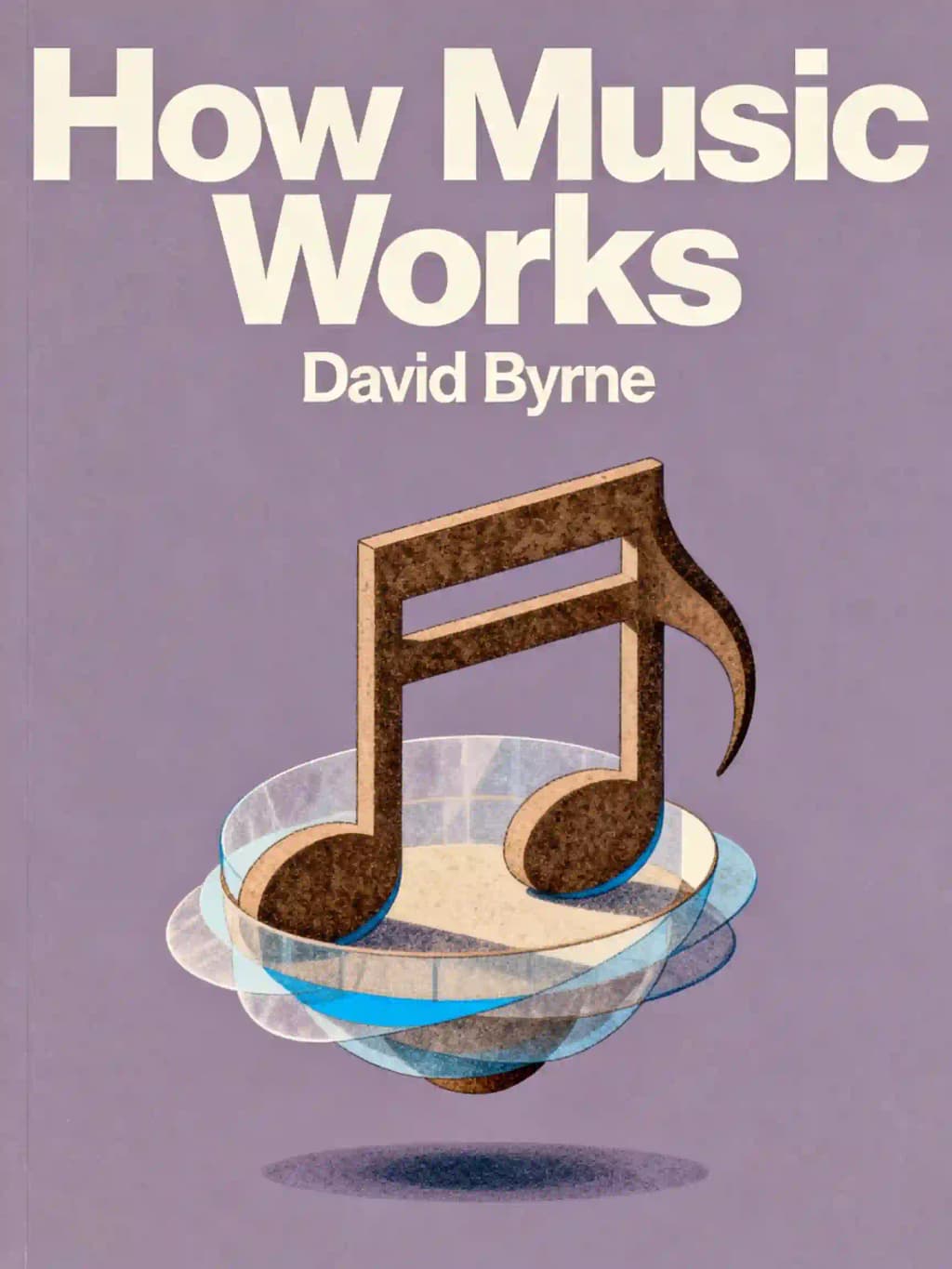
David Byrne's journey through music began as "an unplanned but happy accident," yet this serendipitous path led to profound insights about how music functions in our lives. What makes this exploration particularly fascinating is Byrne's realization that music doesn't exist in isolation-it's profoundly shaped by its environment. The spaces where we perform, the technology we use to record, and the cultural contexts in which we listen all fundamentally alter what music is and how we experience it. This perspective transforms our understanding of musical creation from a purely artistic endeavor to something more akin to evolutionary adaptation. As Byrne discovered through decades of performance and experimentation, music evolves to fit its acoustic and cultural niches just as surely as birds adapt their songs to different environments. The book has garnered praise from figures ranging from Brian Eno to Questlove, who called it "one of the most inspiring things I've ever read." Its influence extends beyond musicians to architects, designers, and anyone interested in how creative expression adapts to its surroundings.
2장
Creation in Reverse: How Context Shapes Music
We tend to think of artistic creation as starting with inspiration-a melody, a feeling, a message-that then gets shaped into a finished piece. But Byrne proposes something radical: we unconsciously create work to fit preexisting formats. The venues, technologies, and social contexts available to us silently dictate what we create, often without our awareness. This doesn't mean passion is absent-emotional content still finds its way in-but the form is largely determined by external constraints.
Throughout history, musical styles have evolved perfectly to suit their acoustic environments. Percussive music thrived outdoors where complex rhythms wouldn't become muddled by echoes. Medieval Western music, with its slowly evolving modal structures, was ideally suited to reverberant cathedrals where overlapping notes would otherwise clash dissonantly. Bach wrote for smaller churches with moderate reverberation, while Mozart composed intricate pieces for intimate palace rooms where fine details could be heard clearly despite the social atmosphere.
The assumption that medieval composers used simpler harmonies because they hadn't "evolved" complex ones is completely backward-they created exactly what worked in their spaces. Similarly, jazz developed in bars and dance venues with little reverberation, where groove could be strong and instruments could cut through crowd noise. The instrumentation itself evolved for these spaces-banjos instead of quieter guitars, loud trumpets that could be heard over dancers.
By the early 20th century, classical audiences were expected to sit in complete silence, allowing composers to write extremely quiet passages knowing every detail would be heard. This separation of body from head seemed intentional-for music to be taken seriously, audiences couldn't be seen moving to it. This cognitive dissonance meant sophisticated but danceable music like mid-century tango arrangements weren't taken seriously by cultural elites.
The advent of recording technology in 1878 created an entirely new "venue"-the phonograph in the parlor. Performers adapted quickly, with singers like Sinatra and Crosby pioneering "crooning," a microphone-dependent style that would have been impossible before. Today, car interiors with massive sound systems influence hip-hop production-bass-heavy with precise high ends. Personal listening devices create an audience of one who can hear minute details impossible to appreciate in live settings.
Even in nature, we see this adaptive process. Birds in dense jungles use repetitive, brief signals within narrow frequencies, while forest floor birds use lower-pitched calls. San Francisco birds have raised their pitch over forty years to be heard above increased traffic noise. The principle is universal: sound adapts to its environment, whether created by humans or other species.
3장
Performance as Language: Finding Voice Through Movement
For Byrne, a self-described introvert who later self-diagnosed with mild Asperger's syndrome, performance became both a language and a social entry point when ordinary conversation felt impossible. As a shy teenager in the late sixties, he began performing rock songs on acoustic guitar at university coffeehouses, bringing energy to folk spaces by contextually shifting songs by the Who and others. This oddball approach-playing Chuck Berry on ukulele or scratching dirges on violin-allowed him to communicate when words failed.
His early musical experiences were filled with both awe and intimidation. Watching virtuosic guitarists like Nils Lofgren made his own rudimentary skills seem hopeless. James Brown's tightly choreographed show at the Providence Civic Center seemed "from another planet," while Rahsaan Roland Kirk's jazz performance revealed that even serious jazz incorporated entertainment elements.
When Byrne formed Talking Heads with Chris Frantz and Tina Weymouth, they developed as a live band first, honing their skills through weekly performances while maintaining day jobs. Byrne's approach was deliberately reductive-stripping away rock cliches, poses, elaborate lighting, and conventional singing styles. Their early performances were "less a band than an outline for a band," intentionally bare-bones and defined by what they wouldn't do rather than what they would.
His stage presence evolved through multiple personas. Initially adopting a "Mr. Man on the Street" look with a cheap polyester suit, he discovered it was impractical under stage lights. The preppy look that followed brought accusations of elitism, teaching him that clothing is never neutral-every outfit carries cultural baggage. Throughout these changes, Byrne maintained that "the most subversive thing was to look totally normal," avoiding leather jackets and safety pins even as punk exploded around them.
As Talking Heads expanded with Jerry Harrison joining, they transformed from a sketch into a fully-realized band. Their songs remained focused on self-examination and alienation, with the groove serving as a "psychological safety net" beneath the angsty foreground. After recording "Remain in Light," they expanded their lineup to create what Byrne saw as a living model of an ideal society-an ephemeral utopia felt by both band and audience. This transformation was psychic as well as musical, allowing him to experience an ecstatic release akin to gospel church experiences or trance states.
In Japan, Byrne studied traditional theater forms-Kabuki, Noh, and Bunraku-which were highly stylized rather than naturalistic. These influences, along with Balinese ritual performances, showed him that theatricality wasn't inauthentic but integrated into daily life in many cultures. This insight led to the revolutionary concept for the "Speaking in Tongues" tour: complete transparency-showing how everything was done. Starting with a bare stage, musicians would appear one by one on rolling platforms, allowing the audience to hear each player's contribution. This approach was inspired by Asian theater traditions like Bunraku puppeteers operating in plain sight.
4장
The Recording Revolution: How Technology Transformed Music
Before recording technology, music was something ephemeral-existing only in memory, subject to the fallibility of recollection. As Walter Murch noted, music was "the main poetic metaphor for that which could not be preserved." This very transience may have enhanced our attention and enjoyment, forcing composers to create memorable experiences.
Recording technology pretends to be an objective acoustic mirror, but it's far from neutral. Edison's first cylinder recorders were purely mechanical devices with limited fidelity, originally intended for dictating speeches rather than music. By 1915, Edison believed his improved Diamond Disc Phonograph achieved perfect reproduction, marketing it through "Tone Tests" where audiences allegedly couldn't distinguish between live singers and recordings. The trick? Singers were trained to imitate the limited range and pinched quality of the recordings.
This illustrates how technology shapes perception-we've developed what sociologist H. Stith Bennett calls "recording consciousness," where our brains filter reality based on recorded sound. Our understanding of certain musical traditions, based solely on recordings, may be completely inaccurate. The battle between amateur and "professional" recordings emerged as companies like Victor and Edison signed artists and removed recording capabilities from home phonographs.
Recording transformed music perception fundamentally: what was originally a simulation of performance-the recording-has now supplanted live performances, which are considered interpretations of recordings. Stokowski embraced technology by choreographing microphone movements during orchestra recordings to capture the subjective experience of listening.
The physical limitations of early recording formats-78s and 45s restricted to under four minutes per side-fundamentally shaped our conception of song length. This arbitrary technological constraint became so internalized that the three-to-four-minute song now seems almost inevitable and natural. Adorno criticized this as "atomized listening," claiming it shortened our musical attention spans.
Recording technology dramatically transformed jazz performance. Musicians who might improvise for thirty-two choruses live had to edit themselves for recordings, creating more concise, composed versions of their work. These tightened solos often became standardized in subsequent performances.
Records democratized music access, allowing cross-pollination between distant traditions. British rockers inspired by American recordings eventually found their own voices while acknowledging their influences. This created loops of influence-African musicians imitated Cuban recordings (themselves mutations of African music) to create something new, which then inspired others.
5장
Digital Revolution: New Tools, New Possibilities
The digital revolution in sound began at Bell Labs, where telephone company researchers sought more efficient ways to transmit conversations. In 1962, they digitized sound by sampling sound waves into ones and zeros, dramatically increasing phone line capacity. This technology eventually transformed music production, introducing harmonizers, digital delays, and vocoders. Though initially prohibitively expensive, these technologies became affordable, leading to samplers that revolutionized hip-hop.
CDs debuted in 1982, jointly developed by Sony and Philips. The disc's 12cm diameter was allegedly determined by Sony president Norio Ohga's insistence that it hold a complete recording of Beethoven's Ninth Symphony (74 minutes). Unlike vinyl's physical limitations, CDs encoded music digitally, offering theoretically unlimited frequency and volume ranges. This freedom led to abuse-the "volume war" where producers made recordings consistently, artificially loud to compete on radio, sacrificing dynamic range.
Throughout recording history, we've consistently chosen convenience over quality. Digital audio's finite slices of sound may fool our ears through psychoacoustic trickery, but they're still steps rather than analog's smooth slope. MP3s represent this trend's culmination-"music in pill form" that delivers the essentials while something ineffable remains missing.
Digital recording fundamentally changed music composition. When sampling others' music, artists often share rights with original composers. Legal limitations eventually pushed many artists away from sampling-the Beastie Boys returned to playing instruments, while others bought custom-made tracks from bedroom producers. This led to a new musical form that floats free of worldly reference-contemporary hip-hop using impossibly fat bass sounds and artificial elements bears no resemblance to live performance.
The iPod, like the Walkman before it, allows us to carry our music everywhere, transforming urban spaces into personal soundtracks. As Michael Bull notes, we "aestheticize urban space" by overlaying our world with music, turning life into a private movie with a changeable score. Philosopher Theodor Adorno critically called this "accompanied solitude," viewing music as an opiate that creates desire for more of itself rather than genuine happiness.
As music becomes less physical and more ephemeral, we're assigning greater value to live performances. After years of hoarding LPs and CDs, Byrne now listens primarily to digital files. Technology has brought us full circle-after a century of innovation, we're returning to valuing music's social function. The irony is that music technology seems to be on a self-destructive trajectory, ultimately increasing the value of what it can't capture or reproduce.
6장
The Curator's Age: Finding Music in an Era of Abundance
In an age of unprecedented musical abundance, the fundamental challenge has shifted from access to discovery. Many music lovers find themselves overwhelmed, retreating to the comfort of familiar songs from their youth rather than venturing into new sonic territories. This "choice paralysis" is a modern phenomenon, yet the potential rewards of discovering resonant music remain profound-it validates our emotional experiences, confirms we're not alone in our feelings, and introduces new ways of thinking through sonic metaphors and musical landscapes.
The economics of music appreciation have undergone a dramatic transformation. Where listeners once invested in physical media-vinyl records, CDs, cassettes-to access music, today's streaming services offer vast libraries for minimal monthly fees. This shift has elevated the value of experiences, particularly live performances, and the art of discovery itself. Concert tickets and festival passes command premium prices while algorithms and curators have become the new gatekeepers of musical exploration. Paradoxically, when faced with millions of songs at our fingertips, many listeners crave careful curation-we want less quantity but higher quality, specifically tailored to our personal tastes.
Pandora's Music Genome Project represents a revolutionary approach to music discovery, analyzing songs through an objective, almost scientific lens. Their experts evaluate each piece across fifty distinct elements, from melodic sophistication to instrumental proficiency, creating detailed "genetic" profiles that connect music across conventional boundaries. A baroque composition might share DNA with a progressive rock track, while a jazz standard could link to contemporary R&B. Founder Tim Westergren argues that social and cultural prejudices often prevent us from enjoying music we might naturally love-whether it's a guilty pleasure pop song or an unfamiliar genre.
The social dimension of musical taste formation cannot be ignored. David Byrne's personal example of his daughter inheriting his love for classic country music through ambient exposure during family moments highlights how context shapes preference. This human element challenges purely algorithmic approaches, yet services like Spotify have found success by combining both-analyzing listening patterns across millions of users while accounting for social connections and shared playlists. Their Discover Weekly feature has become remarkably adept at predicting musical preferences, often surprising users with its accuracy.
Digital democratization has fundamentally altered the music industry's power structure. Traditional gatekeepers-record labels, radio stations, music magazines-have seen their influence wane as direct artist-to-fan connections flourish. Viral sensations like Lana Del Rey's "Video Games" demonstrate how organic audience response can launch careers independently of traditional channels. Platforms like Kickstarter and Patreon have enabled fan-funded projects, though success still requires navigating complex promotional landscapes.
The digital revolution's efficiency came at a cost-the loss of rich contextual information that once enhanced musical appreciation. Physical albums offered artwork, liner notes, credits, and historical context. Online platforms typically display only basic metadata, creating a flattened temporal experience where new releases and historical recordings exist in the same contextual plane. While this democratization enables serendipitous discovery across eras, it often strips away the cultural and historical framework that deepens musical understanding. Digital platforms could easily incorporate this lost context-from production credits to historical significance-enriching the discovery process and creating more meaningful connections between listeners and music.
7장
The Studio as Instrument: From Sacred Space to Bedroom Revolution
The recording studio environment evolved from an intimidating, specialized space into something more accessible. When Byrne entered the music business, multitrack recording was common but required professional studios with massive consoles operated by engineers who relegated musicians to separate rooms. This created a mystique around recording that seemed beyond musicians' abilities to master themselves.
The dominant recording philosophy of the late 1970s was to deconstruct and isolate every sound element. Studios were designed to eliminate all ambient sound and room characteristics, creating pristine but dead recordings. Engineers would then artificially reintroduce reverb and echo during mixing to simulate natural acoustics they had purposefully eliminated. This approach gave producers maximum control but disrupted the organic interplay between musicians who could no longer hear each other naturally.
For the experimental album "My Life in the Bush of Ghosts" with Brian Eno, Byrne created hypnotic beds by playing parts repetitively like human loops, using unconventional instruments like cardboard boxes for kick drums and biscuit tins for snares. They placed found vocals into their music through manual synchronization of two tape machines, "performing" the vocal placement as if conducting a singer. These often low-fidelity recordings from radio sermons or ethnographic records created a disembodied quality that felt like "transmissions from a desperate planet."
After completing Bush of Ghosts, Byrne and Eno brought their experimental techniques to Talking Heads, creating music built around repetitive grooves that often used just one chord. This self-limitation might seem restrictive, but it placed greater emphasis on rhythm and texture, making the tracks feel insistent and trancelike-more akin to African music, gospel or disco.
By the late 1990s, new technology allowed musicians to create professional-quality recordings at home. Byrne purchased a small mixing board and DA-88 machines that recorded eight tracks of digital audio onto Hi-8 videocassettes. Musicians began syncing these recorders with MIDI devices and using computers with sequencing software to trigger samples and synthesizers. This technological shift meant expensive recording studios were becoming increasingly unnecessary for many recording tasks.
Byrne's home studio setup, despite its chaotic appearance-software serial numbers pinned to walls alongside a Tammy Wynette poster-produces professional-quality recordings. He emphasizes that home studios now rival professional facilities while offering lower-pressure, less expensive environments more conducive to creativity. This democratization of recording technology represents a revolutionary shift with far-reaching implications for music creation.
8장
The Business of Music: New Models for a Digital Age
After completing the studio work, mixing and pressing a record, how does music travel from creator to listener? Before recording technology, music was inseparable from its social context-a communal, often utilitarian experience tied to specific times and places. You couldn't take it home, copy it, or replay it. Twentieth-century technology transformed music into a product-something buyable, sellable, and endlessly replayable in any context.
Record companies traditionally provided capital, expertise, contacts and technology that artists couldn't access elsewhere. They funded recording sessions, manufactured and distributed product, marketed music, advanced money for expenses, advised artists, and handled accounting. But since the 1980s, when major labels began merging with each other and non-music businesses, the industry changed dramatically.
The traditional system where successful acts supported less commercially viable ones began to crumble around 2000, as the fundamental assumptions about what labels could offer artists changed dramatically. The $15,000 minimum once needed for studio time is no longer a barrier as albums can now be made on laptops. Digital distribution has eliminated the break-even sales threshold that made marginal music economically unviable.
Artists traditionally lived off advances based on projected record sales, but most never saw royalties beyond these advances as they remained in debt to labels for recording costs, marketing, and advances. This created a cycle where artists needed to keep producing new material to secure new advances, living record-to-record while accumulating debt. Even successful artists like TLC, the Ramones, Michael Jackson, and others went broke.
Where once there was a single model, artists now have multiple options along a spectrum-the more involved the artist is, the larger their slice of revenue. These range from "360 deals" where companies own a piece of everything (merchandise, perfume lines, concert tickets, records) to complete self-distribution where the artist controls everything from creation to distribution.
Radiohead famously used the self-distribution model for "In Rainbows" with their pay-what-you-wish experiment. Amanda Palmer raised over $800,000 on Kickstarter for her orchestral project, while Sufjan Stevens reached Billboard charts through Bandcamp. Byrne and Brian Eno tried DIY for "Everything That Happens Will Happen Today," hiring companies for specific tasks while maintaining control. They recouped their $49,000 recording costs within three weeks-far faster than the six months to a year typical with standard record deals.
Streaming services like Spotify and Pandora, initially touted as music industry saviors, have become major income sources for record labels while offering mere "crumbs" to artists. Despite mediocre sales of recordings, Byrne notes that live experiences are thriving, suggesting we may be returning to a pre-recording era where musicians earn primarily from performances.
9장
Music's Deeper Purpose: From Cosmic Harmony to Neural Connections
Music isn't merely entertainment but an essential part of what makes us human. The Bible tells us "In the beginning was the Word," suggesting sound as the primordial creative force-perhaps a metaphor for the Big Bang itself. Evidence shows humans have been making music for at least 45,000 years. Neanderthals crafted flutes using what appears to be diatonic scales, the same seven-note structure we recognize today.
Pythagoras discovered mathematical congruencies behind pleasant musical intervals after noticing hammers of different weights produced harmonious pings. He found that simple mathematical ratios (like 1:2 for an octave) governed these harmonies, suggesting divine design in music. Pythagoras identified three types of music-instrumental, human, and celestial-believing earthly music merely echoed the divine "Music of the Spheres" produced by planets rotating on crystal spheres.
In ancient Far East traditions, sound was considered fundamental to universe formation. Tantric Buddhism describes the "akasha," a self-generating "sonoriferous" ether producing primordial vibrations. This cosmic sound (Nada-Brahman) emanates from Shiva and Shakti's union-the "Cosmic Orgasm" that formed the material universe.
The fundamental question is why humans gravitate toward specific harmonies and find certain sound sequences emotionally affecting. Duke University's Dale Purves and colleagues discovered that nearly all cultures use selections from the same twelve notes in an octave, though arranged differently. Their research found that the most prominent tones in human speech aligned with the twelve-note chromatic scale, and their harmonics corresponded to pleasing musical intervals. This suggests music's biological basis lies in its similarity to speech-our brains evolved to process the same frequency ranges we produce vocally.
Neurologists Molnar-Szakacs and Overy discovered that mirror neurons fire when we observe others' actions or emotions-our brains literally "mirror" what we see happening. This neurological empathy forms the foundation of human communication through shared representation. When hearing piano music, our brains "feel" the hand movements required to play, even in non-musicians. Music uniquely activates multiple brain regions simultaneously (muscular, auditory, visual, linguistic), explaining why some brain-damaged patients who've lost language can still articulate text when sung.
Music marks nearly every significant social transition across cultures-from birth songs to funeral dirges. As one Sia Indian observed, "without songs you cannot do anything." By the late seventeenth century, the scientific revolution displaced music's cosmic significance. Science now explained music rather than music explaining the universe. Yet humanity's need for ritual persisted, finding expression in secular musical performances. The first public concert occurred in London in 1672, organized by John Banister after his dismissal from the royal band. Modern musical performances-whether in opera halls, cabaret bars, rock clubs, or festivals-serve as rituals with prescribed behaviors that heal and strengthen community bonds, preserving ritual function under different names.