1장
The Great Migration: America's Untold Journey
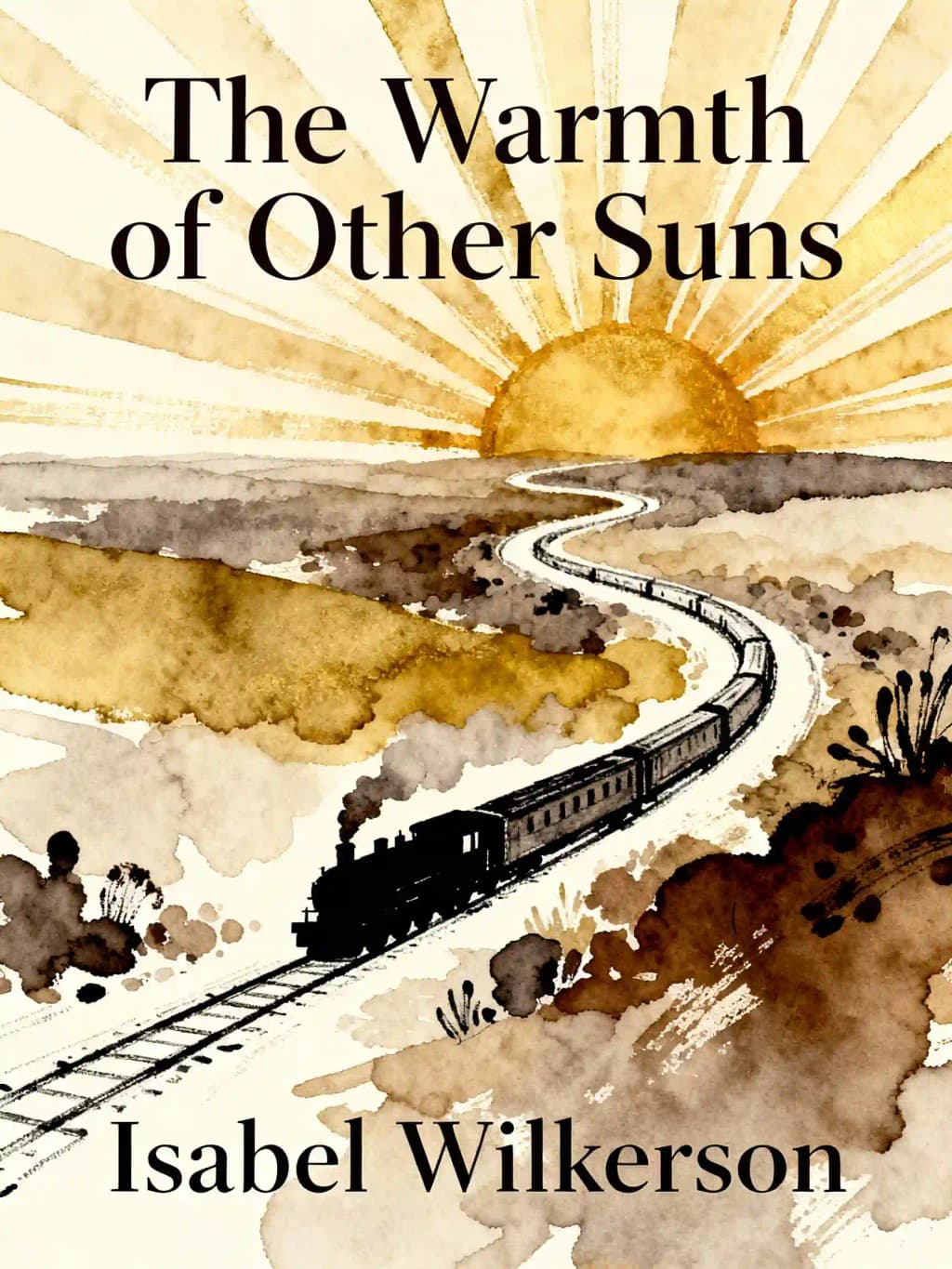
In the sweltering heat of the Jim Crow South, millions of Black Americans made a decision that would forever alter the nation's landscape. Isabel Wilkerson's masterpiece "The Warmth of Other Suns" chronicles this epic migration-a movement so vast it dwarfed both the California Gold Rush and the Dust Bowl exodus combined. This "silent pilgrimage" saw six million Black southerners flee oppression between 1915-1970, transforming every city it touched and ultimately forcing the South to abandon its feudal caste system. The book has become a cultural touchstone, earning a National Book Critics Circle Award and appearing on Barack Obama's summer reading list. Through the intimate journeys of three unforgettable characters, Wilkerson reveals what might be "the biggest underreported story of the twentieth century"-a revolution where America's servant class took their first big step without asking permission.
2장
A Caste System Disguised as Freedom
The South that Ida Mae Brandon Gladney, George Swanson Starling, and Robert Joseph Pershing Foster fled was governed by an invisible but omnipresent racial caste system. Despite emancipation, most Southern Blacks remained economically shackled through sharecropping, perpetually indebted to plantation owners. The brief flowering of opportunity during Reconstruction-when some became physicians, legislators, and business owners-was systematically dismantled when Northern oversight ended in the 1870s.
The Supreme Court's 1896 Plessy v. Ferguson ruling sanctioned "separate but equal" accommodations, unleashing a flood of Jim Crow laws that regulated every aspect of Black life. Politicians rode anti-Black sentiment to power, with Mississippi Governor James K. Vardaman declaring education merely "spoiled a good field hand." Lynchings became public spectacles, with festive crowds watching Black victims tortured and burned alive. Between 1889-1929, someone was lynched every four days for offenses as minor as "trying to act like a white person" or stealing seventy-five cents.
The absurdity of daily life under this system is staggering to contemplate today. Separate amusement parks, elevators, train platforms, ambulances, hearses, waiting rooms, and restrooms. Building segregated facilities often cost businesses 50% more, but few dared complain. There were colored windows at post offices, separate telephone booths, license plate windows, bank tellers, and taxicabs. Black motorists had to yield to white drivers at intersections regardless of right-of-way, could never pass white motorists, and were blamed for any accidents.
In social interactions, Blacks couldn't contradict whites, speak unless spoken to, or offer to shake hands first. The slightest misstep brought swift punishment-a Black tenant farmer in Mississippi was beaten simply for requesting a receipt after paying his water bill. Absurdly specific laws prohibited Blacks and whites from playing checkers together in Birmingham or drinking from the same end of a bar in Atlanta. Even Bibles were segregated in North Carolina courtrooms.
Imagine living in a society where every interaction is governed by such rigid, dehumanizing rules. For those who left, the journey north was defining-most remembered exactly when they departed, which train they took, and who received them. As one migrant put it simply when asked why she left: "To better my conditions."
3장
Three Lives, Three Journeys
Wilkerson masterfully weaves together the stories of three distinct individuals whose lives illuminate different aspects of the Migration. Ida Mae Brandon Gladney, a sharecropper's wife from Mississippi who fled north in 1937 after her husband's cousin was brutally beaten for a theft he didn't commit. George Swanson Starling, an educated fruit picker from Florida who escaped in 1945 when grove owners threatened to lynch him for organizing workers. And Robert Joseph Pershing Foster, a surgeon who drove west from Louisiana in 1953, seeking the right to practice his profession with dignity.
Ida Mae's story reveals the quiet courage of ordinary people. Growing up in Mississippi, she learned early about the invisible boundaries of race. At age six, she was dangled over a well by white children who laughed at her terror. She discovered there were "good ones and bad ones" among white people when a kind employer, Miss Julie McClenna, stopped hiring her after a customer refused to let "that nigger" into her house. Violence was ever-present-she once hid in a barrel of cornmeal to escape bullets from a drunk white farmer who terrorized colored families on weekends.
George Starling's intelligence and ambition were thwarted at every turn. Despite excelling academically and attending two years of college at Florida A&M, his father refused to continue funding his education, claiming "With two years of college, you should be able to be president of the United States." Trapped in the citrus groves, George witnessed the exploitation inherent in the system-packinghouses routinely cheated workers, promising one rate but paying less. When he organized fellow pickers to demand better wages during the wartime labor shortage, grove owners plotted to "take you boys out to Blackwater Creek" for a "necktie party."
Robert Foster's story illuminates how even the most talented and educated Black Americans were constrained. As the son of a respected school principal in Monroe, Louisiana, he attended Morehouse College and became a surgeon. Yet upon completing his military service, he discovered southern hospitals wouldn't allow a colored surgeon in their operating rooms regardless of skill. His journey west represented a quest not just for economic opportunity but for the dignity of practicing his profession at the highest level.
Through these three lives, we see how the Great Migration wasn't just about economics-it was about the fundamental human desire to be treated with dignity and to fulfill one's potential.
4장
The Courage to Leave Everything Behind
What does it take to leave everything you've ever known? The migrants faced this question with remarkable courage, often making life-altering decisions in a matter of days or hours. Ida Mae and George left under cover of darkness, knowing that announcing their departure could bring violent retaliation from local whites who viewed any black departure as a betrayal of the social order. Robert drove alone through the hostile landscape of Texas, where no motel would accept him regardless of his professional status or physical exhaustion. Each departure represented not just a journey, but a profound act of self-determination in a society that denied African Americans basic autonomy.
The journey itself was fraught with danger and indignity at every turn. For George, like thousands of others, the Jim Crow car was deliberately positioned directly behind the coal-fired locomotive, where passengers suffered not only from soot, fumes, and deafening noise, but also faced the greatest danger in case of collision - despite paying the same fare as white passengers in clean, safe cars further back. Children cried from the heat and soot, while adults tried to maintain dignity despite the intentionally degrading conditions. Robert faced the harsh reality of Jim Crow travel across Texas - a thousand-mile gauntlet where every stop carried risk. Unable to stay in any motel regardless of exhaustion, he developed a careful system: pulling over briefly when his eyelids grew heavy, resting at filling stations only after carefully checking for Confederate flags or other warning signs of hostility.
Even after crossing into supposedly "free" territory, the migrants discovered that freedom remained "arbitrary and unpredictable," varying block by block and town by town. When Robert reached Arizona, believing he'd escaped Southern prejudice, he faced rejection after humiliating rejection at motels despite being "free now, like a regular American." At the fourth motel, he was forced to plead his case: "I'm no robber... I'm a medical doctor. I'm a captain that just left Austria." The sympathetic motel owners explained their own trapped position - they couldn't accommodate him for fear of ostracism and retaliation from other motel owners and local residents.
The courage required for this journey is difficult to comprehend from our modern perspective. Imagine leaving behind elderly parents you might never see again, community networks built over generations, and everything familiar to venture into the unknown, carrying only a few possessions and the desperate hope that life might be better somewhere else. Many left with just hours' notice, unable to say proper goodbyes for fear of word spreading. As Richard Wright wrote of his own departure: "I was leaving without a qualm, without a single backward glance... I was now running more away from something than toward something." This sentiment captured the bittersweet reality for millions - their courage born not just of hope, but of the certainty that anything, even complete uncertainty, was better than remaining in the shadow of Jim Crow.
5장
The North: A Kinder Mistress with Sharp Claws
The migrants left behind the "lazy, laughing South with blood on its mouth" as Langston Hughes wrote, seeking the "cold-faced North" which they hoped would be "a kinder mistress." But the reality they encountered was complex. Despite warnings not to act green, they could not "shake off three hundred years of fear in three hours" as Richard Wright observed.
Northern cities offered freedom from Jim Crow laws but presented new challenges. Housing segregation was brutally enforced-not by law but by violence, economic pressure, and social custom. When Harvey Clark and his wife Johnetta tried moving into Cicero, Illinois in 1951, they faced a mob of 4,000 whites who destroyed their apartment while police stood by. In Chicago's "black belt," a quarter-million colored people were packed into dilapidated tenements, paying twice what whites paid for inferior housing.
The migrants also faced unexpected cultural divisions within the Black community. Established northern Blacks, having carved out a tenuous middle-class existence, often resented the flood of southern migrants who threatened their hard-won status. The Chicago Defender published lists of "do's and don'ts" for newcomers: don't hang out windows, don't wear handkerchiefs on your head, don't sit barefoot on porches. The Chicago Urban League conducted "Strangers Meetings" with additional advice: get a job immediately, don't live in crowded rooms, don't be loud in public places.
Employment opportunities remained severely limited. About 40 percent of Black men in 1940s Chicago worked in unskilled or semi-skilled positions, with another 34 percent in service jobs-meaning three-quarters of Black men could only find work nobody else wanted. The situation was even worse for Black women like Ida Mae, with two-thirds working as servants compared to just 17 percent of white women.
Yet despite these challenges, the migrants found meaningful freedoms in the North. For Ida Mae, the ability to vote represented a profound transformation. In November 1940, she joined crowds gathering at a Chicago fire station for her first voting experience. Back in Mississippi, she had never even contemplated voting-colored people there faced insurmountable barriers like poll taxes, impossible literacy tests, and the threat of violence. Her simple act of casting a ballot defied the southern caste system that had defined her early life.
The migrants' experiences reveal how freedom is never absolute but exists on a spectrum. The North offered liberation from the most obvious forms of oppression while maintaining subtler barriers to full equality. As Martin Luther King Jr. would later observe after bringing his civil rights campaign to Chicago: "We are far from the Promised Land, both north and south."
6장
The Transformation of America
The Great Migration fundamentally transformed America in ways that continue to reverberate today. By the time it ended, nearly half of all Black Americans lived outside the South, compared to just ten percent when it began. This demographic shift altered the political landscape, creating influential Black voting blocs in northern cities that helped elect mayors, representatives, and eventually contributed to Barack Obama's historic presidency.
The cultural impact was equally profound. The Harlem Renaissance, Chicago blues, Motown, and countless other artistic movements emerged directly from this migration. The migrants brought their southern sensibilities north, creating new cultural forms that would influence everything from literature to music to cuisine. Without the Great Migration, there would be no Toni Morrison, no Miles Davis, no Aretha Franklin as we know them.
The migrants also challenged northern cities to confront their own forms of racism. When Martin Luther King Jr. brought his campaign to Chicago in 1966, he exposed what he called the "Northern Paradox"-a society where discrimination wasn't codified in law but practiced in daily life through housing segregation, employment barriers, and social isolation. During a march through Marquette Park, King was struck by a rock amid a hostile crowd of 4,000 white residents waving Confederate flags. "I have to do this to expose myself-to bring this hate into the open," he insisted.
The migration created pressure for change in the South as well. As Black labor disappeared, southern businesses and farms were forced to reconsider their practices. The economic impact eventually contributed to the South's grudging acceptance of civil rights reforms. The South that migrants returned to visit decades later had transformed-not completely, but significantly-partly due to the economic and political pressure created by their departure.
Perhaps most importantly, the Great Migration represented a mass act of self-determination. As Wilkerson writes, it was "the first big step the nation's servant class ever took without asking." In exercising their freedom to move, millions of Black Americans forced the nation to confront its contradictions and begin the long process of living up to its ideals.
7장
The Personal Cost of Freedom
Freedom came at a profound personal cost for the migrants. They left behind not just places but people they might never see again. From the moment of departure, family news would arrive through letters and telegrams-births, illnesses, deaths-all experienced from hundreds of miles away. This disruption of family bonds represents perhaps the greatest sacrifice of the Great Migration.
The migrants also faced the challenge of adapting to unfamiliar environments while maintaining their identities. Ida Mae struggled with Chicago's brutal winter-a "supernatural kind of cold" unlike anything she'd experienced in Mississippi. She trudged through snow to take her baby for immunizations, bewildered when nurses instructed her to undress her infant in the freezing clinic.
George found himself caught between worlds, working as a railroad porter on the same routes that had carried migrants north. Though earning more than in his fruit-picking days, he still faced discrimination, being called "boy" while working white cars despite being 27 years old. His formal bearing and educated demeanor irritated southern conductors who considered him acting above his station.
Robert's journey to establish himself in Los Angeles revealed how integration created unexpected challenges. Some colored people, having internalized notions of white superiority, rejected colored doctors when given the choice. During one house call, a colored woman refused his services, declaring "I wasn't going to let no nigger doctor examine me"-a shocking rejection that forced him to swallow his pride.
The migrants' children faced their own struggles, often caught between their parents' southern values and the harsh realities of northern urban life. George watched helplessly as his son Gerard fell into drug addiction in New York, eventually returning to Florida-ironically, the place George had fled. "If I hadn't been born and raised in New York," Gerard told his cousin, "I never would have been on drugs."
These personal costs reveal the complexity of the migrants' experience. Their journeys represented both liberation and loss, opportunity and sacrifice. As one migrant reflected, "It occurred to me that we had lost something in our flight to freedom."
8장
Legacy and Lessons for Today
The Great Migration offers profound lessons for understanding contemporary America. First, it demonstrates how voting with one's feet can drive social change. When millions of Black southerners refused to accept their circumstances and sought better lives elsewhere, they created economic and political pressure that eventually contributed to dismantling Jim Crow. Their individual decisions, multiplied millions of times, became a powerful collective force for transformation. The exodus of Black labor forced Southern businesses to confront the costs of discrimination, while the growing Black populations in Northern cities created new centers of political power and cultural influence.
Second, the migrants' experiences challenge simplistic narratives about racial progress. Their journeys reveal how racism adapts rather than disappears, taking new forms in different contexts. The northern cities that offered escape from Jim Crow laws still maintained racial hierarchies through housing segregation, employment discrimination, and social exclusion. Practices like redlining, restrictive covenants, and workplace discrimination created new barriers to advancement. The formation of urban ghettos, the destruction of thriving Black communities through "urban renewal," and the systematic denial of mortgage loans to Black families helped create and perpetuate wealth disparities that persist generations later. Understanding this history helps explain why the racial wealth gap remains so stark and why many American cities remain deeply segregated today.
Third, the Great Migration illuminates the universal human desire for dignity and self-determination. Despite overwhelming obstacles, the migrants refused to accept limitations on their humanity. Their courage in leaving everything familiar for uncertain prospects elsewhere reflects a fundamental human impulse to seek freedom and opportunity. Like Irish immigrants fleeing famine, Jewish refugees escaping persecution, or modern migrants seeking economic opportunity, the participants in the Great Migration exemplified the human drive to build better lives. Their stories of sacrifice, determination, and resilience connect to broader patterns of human migration throughout history.
The migrants' stories also demonstrate the crucial role of information networks and community support in enabling social change. Through letters, newspapers like the Chicago Defender, and word of mouth, migrants created informal networks that shared crucial information about jobs, housing, and conditions in different cities. These networks, often centered around churches and community organizations, provided practical assistance and emotional support that made migration possible for millions.
Finally, the migrants' stories remind us that history is made not just through dramatic political events but through millions of individual decisions. As Wilkerson writes, the Great Migration was "a leaderless revolution" driven by ordinary people making extraordinary choices. Each family that packed up their lives and headed north contributed to a demographic transformation that reshaped American society, culture, and politics. Their impact can be seen in everything from the geographic distribution of the Black population to the evolution of American music, literature, and art.
In our current moment of political polarization and renewed debates about racial justice, the Great Migration offers a powerful reminder of both how far America has come and how much work remains. The migrants' journeys represent both the painful reality of American racism and the enduring power of hope, courage, and determination to overcome it. Their legacy lives on in ongoing struggles for equality and in the continued importance of migration as a strategy for seeking opportunity and escape from oppression.
9장
The Migration's Continuing Echo
The echoes of the Great Migration continue to reverberate through American society in profound and multifaceted ways. The descendants of those who left the South inhabit a world their ancestors couldn't have imagined - from integrated neighborhoods to positions of political power and cultural influence. Those who remained in the South maintained complex connections with their northern relatives, creating networks that bridged the Mason-Dixon line for generations. The former Confederacy, faced with the economic pressure of losing its labor force and the example of northern opportunities, was forced to gradually improve its treatment of African Americans and reform its most oppressive practices.
The Migration's impact on American culture has been transformative and permanent. In music, the blues traveled north, evolving into urban styles that gave birth to R&B, soul, and rock and roll. Southern food traditions merged with northern ingredients, creating new culinary traditions in cities like Chicago and Detroit. African American vernacular speech patterns influenced northern urban dialects, while fashion and style evolved as migrants adapted southern traditions to city life. These cultural contributions became integral parts of mainstream American identity.
The political impact was equally significant. The Migration created powerful voting blocs in northern cities, leading to the election of Black mayors like Harold Washington in Chicago and David Dinkins in New York. It fostered a politically engaged Black middle class that supported civil rights organizations and inspired independence movements in Africa and civil rights efforts worldwide. Leaders from Malcolm X to Barack Obama emerged from communities shaped by the Migration's legacy.
In a remarkable historical parallel, the three major receiving cities - Chicago, New York, and Los Angeles - had seen Black settlers among their earliest non-native inhabitants. Jean Baptiste Point DuSable, Chicago's first permanent non-indigenous resident, was Black. New York's early colonial period included free Black landowners, while Los Angeles was co-founded by settlers of African descent. The Great Migration thus represented both a return and a renewal of this historical presence.
The Migration fundamentally represented a mass rejection of southern oppression, with individuals and families voting with their feet. Through millions of personal decisions to leave, African Americans transformed themselves from a primarily rural, southern people to an increasingly urban, national presence. They created new opportunities not just for themselves but for subsequent generations, establishing businesses, cultural institutions, and educational legacies that continue to shape American life.
Today, as debates rage over immigration, racial equity, and economic mobility, the Great Migration offers crucial lessons. It demonstrates how systematic oppression can be overcome through collective action, even when that action takes the form of individual choices. The courage of Migration participants - who often left with little more than hope and determination - continues to inspire modern movements for social justice and human rights. Their story resonates beyond racial or national boundaries, embodying the universal human desire for freedom, dignity, and the right to pursue a better life.