1장
When Small Changes Spark Massive Shifts: The Epidemic of Ideas
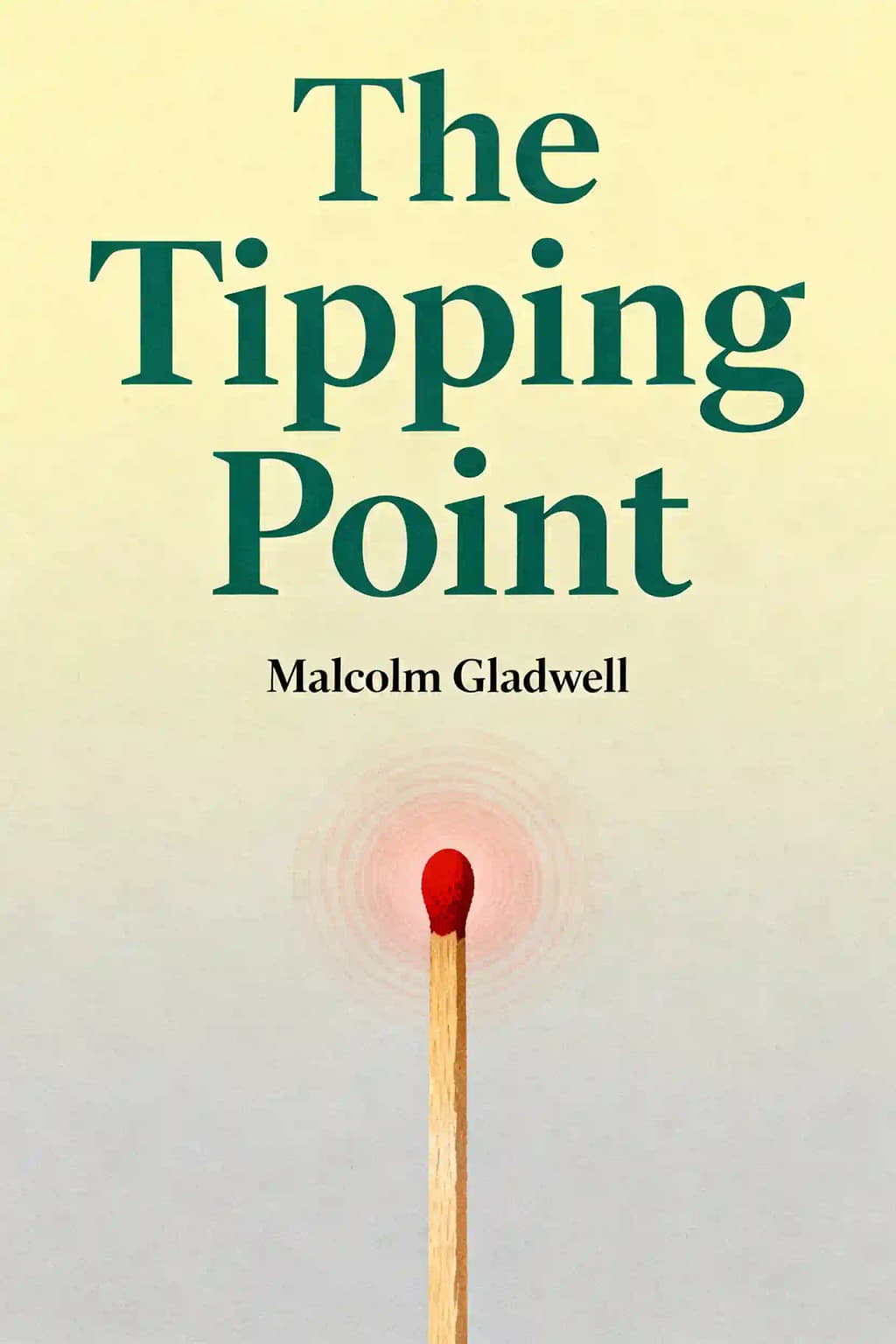
*The Tipping Point* isn't just another business book-it's a cultural phenomenon that has sold over 4 million copies worldwide and spent more than a decade on bestseller lists. Beloved by figures ranging from Bill Clinton to Mark Zuckerberg, this groundbreaking work transformed how we understand social change. Malcolm Gladwell's exploration of how trends, behaviors, and ideas spread like viruses revolutionized marketing strategies across industries and introduced phrases like "tipping point" into everyday conversation. Written with the narrative flair that would later make Gladwell a TED Talk superstar, the book emerged at the perfect moment-just as the internet was beginning to reshape information flow, making its insights about contagious ideas particularly prescient. Whether you're a business leader, social activist, or simply curious about why some ideas take off while others fizzle, this exploration of social epidemics offers timeless wisdom about the mysterious forces that shape our collective behavior.
2장
The Epidemic Nature of Social Change
Have you ever wondered why some trends explode overnight while others never gain traction? The answer lies in understanding social epidemics. Just as a single sick person can trigger a disease outbreak, ideas, products, and behaviors can spread with the same exponential pattern. Consider the curious case of Hush Puppies-a dying brand of casual suede shoes that suddenly skyrocketed to fashion prominence in the mid-1990s after being adopted by a handful of hipsters in Manhattan's East Village. Within two years, sales jumped from 30,000 pairs to 430,000 pairs annually, and the shoes appeared on runways and in Hollywood films. This dramatic turnaround wasn't driven by marketing campaigns but by a small group of trendsetters who unwittingly sparked a nationwide fashion epidemic.
Similarly, New York City's dramatic crime reduction in the 1990s followed epidemic patterns. After decades of escalating violence, felonies plummeted by 50% between 1993 and 1997-a decline so sudden and steep that experts were baffled. Traditional explanations like improved policing strategies or economic factors couldn't fully account for the dramatic shift. Instead, the change behaved like an epidemic in reverse, with small interventions triggering massive social transformation.
These examples illustrate the three principles that govern all epidemics. First, contagiousness-ideas can be as infectious as viruses. Second, little causes can produce big effects-small changes often trigger the most significant outcomes. Third, change happens dramatically, not gradually-there's a moment when everything transforms, the "tipping point" when an idea reaches critical mass and spreads like wildfire.
This epidemic model challenges our conventional thinking about social change. We typically assume major problems require major solutions, but epidemics suggest otherwise. Sometimes the most effective interventions are surprisingly modest-like removing graffiti from subway cars or targeting a handful of influential individuals. By understanding the mechanics of social epidemics, we gain powerful tools for creating positive change with minimal resources.
3장
The Law of the Few: The Power Players Behind Epidemics
Why do some people wield extraordinary influence in spreading ideas? The Law of the Few explains that social epidemics are driven primarily by exceptional individuals with rare social gifts. These influential people fall into three categories: Connectors, Mavens, and Salesmen-each playing a distinct role in tipping ideas into widespread adoption.
Connectors are society's natural networkers-people with an extraordinary knack for knowing everyone. They maintain relationships across diverse social worlds and serve as human bridges between different communities. Think about your own social circle. Do you know someone who seems connected to people in every industry, neighborhood, and interest group? That's a Connector. Their power comes not just from knowing many people but from belonging to many different worlds. When Paul Revere made his famous midnight ride in 1775, he succeeded because he was a classic Connector-active in multiple organizations and known across many communities. His contemporary William Dawes rode the same night with the same message but failed to spark action because he lacked Revere's vast social network.
Mavens are information specialists-the people who accumulate detailed knowledge and love sharing it with others. They're not persuaders but educators who delight in helping others make informed decisions. Mark Alpert exemplifies the Maven personality-he can recite the price history of countless products, knows which stores offer the best deals, and eagerly shares this information with anyone who'll listen. While Connectors spread information widely, Mavens ensure that information is accurate and trustworthy. They're like human Consumer Reports, validating products and ideas through their expertise and integrity.
Salesmen possess the subtle skills of persuasion-the ability to convince us when we're unconvinced. Financial planner Tom Gau demonstrates this talent through his infectious enthusiasm and natural synchrony with clients. Salesmen often persuade through non-verbal cues rather than logical arguments. Studies show that subtle facial expressions, head movements, and rhythmic conversation patterns can influence decisions more effectively than explicit messages. These persuasive individuals create emotional contagion-their moods and convictions spread to others through almost imperceptible social signals.
Together, these three types create the perfect conditions for social epidemics. Mavens gather knowledge, Connectors distribute it widely, and Salesmen persuade the undecided. When an idea reaches all three groups, it gains the credibility, social network, and persuasive backing needed to tip into widespread adoption.
4장
The Stickiness Factor: Making Messages Unforgettable
Why do some ideas persist while others fade? The Stickiness Factor explains how messages become memorable enough to create lasting change. It's not enough for information to spread-it must also stick in people's minds and influence their behavior. Creating stickiness often requires counterintuitive approaches and meticulous attention to presentation details.
Children's television provides a fascinating laboratory for studying stickiness. When Sesame Street debuted in 1969, its creators faced a monumental challenge: how to make educational content captivating enough to compete with commercial entertainment. Through rigorous testing, they discovered surprising insights about children's attention patterns. Using devices like the "Distracter," which measured when children looked away from the screen, researchers identified precisely which elements held children's focus. Contrary to expectations, they found that fantasy segments like talking puppets weren't automatically engaging-children paid attention based on narrative clarity and comprehensibility, not just visual appeal.
These insights led to constant refinement of Sesame Street's format. For instance, when researchers used eye-movement photography to track where children looked during reading segments, they discovered that kids often focused on visually interesting background elements rather than the letters being taught. This prompted redesigns to align visual focus with educational content. The show's success came from this scientific approach to stickiness-systematically identifying and eliminating barriers to engagement.
Years later, Blue's Clues revolutionized children's programming by taking stickiness even further. While Sesame Street used rapid-fire segments to maintain attention, Blue's Clues slowed everything down, focusing on a single storyline with deliberate pacing. The show invited active participation through questions and pauses, allowing children to respond to the host's prompts. Most radically, Blue's Clues aired the same episode five days in a row-a strategy that research showed actually increased rather than decreased engagement. Children loved the repetition because it allowed them to master the content gradually, discovering new layers with each viewing.
The stickiness lessons from children's television apply broadly to all communication. First, small changes in presentation can dramatically increase impact-like the precise ordering of clues in Blue's Clues to build confidence before introducing challenges. Second, conventional wisdom about engagement is often wrong-sometimes simplicity and repetition work better than variety and complexity. Third, creating stickiness requires rigorous testing and refinement-intuition alone rarely identifies the subtle factors that make messages memorable.
Perhaps most importantly, stickiness isn't about dramatic overhauls but precise adjustments. The difference between an idea that sticks and one that disappears often comes down to seemingly minor details in how it's packaged and presented.
5장
The Power of Context: How Environment Shapes Behavior
Can the same person be honest in one situation and dishonest in another? The Power of Context reveals how profoundly our surroundings influence our actions. This principle challenges our tendency to explain behavior through personality traits, suggesting instead that immediate environmental cues often matter more than individual character.
New York City's crime reduction in the 1990s provides a compelling example. While many factors contributed to the decline, a crucial element was the "Broken Windows" theory implemented by transit police chief William Bratton. This approach focused on addressing minor disorders-graffiti, fare evasion, public drinking-based on the insight that visible signs of disorder create an environment that encourages more serious crimes. When subway cars were kept meticulously clean and fare beaters were consistently arrested, it changed the psychological context for potential criminals. The environment no longer signaled that lawlessness was acceptable.
This environmental influence on behavior appears consistently in psychological research. The Stanford Prison Experiment famously demonstrated how quickly normal college students adopted sadistic or submissive behaviors when placed in a prison-like environment with assigned roles as guards or prisoners. Similarly, studies by Hartshorne and May in the 1920s found that children's honesty varied dramatically across situations-the same child might cheat on a test but not when making change, suggesting that honesty is not a stable character trait but a response to specific contexts.
Perhaps most striking was the Good Samaritan experiment conducted by Darley and Batson. Seminary students-training to become ministers-were asked to prepare a talk on the Good Samaritan parable about helping strangers in distress. On their way to deliver the talk, they encountered a person slumped in an alley, clearly needing assistance. Whether these religious students stopped to help depended almost entirely on how rushed they felt. Of those told they were late, only 10% stopped, while 63% of those with time to spare offered assistance. Even people preparing to speak about compassion failed to show it when their immediate context created pressure.
These findings suggest that character traits we consider fundamental-honesty, compassion, law-abidingness-are often overwhelmed by immediate situational factors. This doesn't mean personality is irrelevant, but it does indicate that changing behavior sometimes requires changing contexts rather than changing people. For social epidemics, this principle offers powerful leverage: altering environmental cues can shift collective behavior more effectively than trying to transform individual attitudes or values.
6장
The Rule of 150: Why Group Size Matters
Have you ever noticed how organizations change when they grow beyond a certain size? The Rule of 150 explains why group dynamics transform dramatically at this threshold. Across diverse cultures and contexts, groups larger than about 150 people consistently require different structures to maintain cohesion and effectiveness.
This pattern appears throughout human history. The Hutterites, a communal religious group, deliberately split their communities when they approach 150 members. Military units across different armies and eras organize around companies of 150-200 soldiers. Even modern businesses like Gore Associates (makers of Gore-Tex) maintain facilities with no more than 150 employees and build new buildings when they approach this number.
What makes 150 such a critical threshold? Anthropologist Robin Dunbar discovered that primate brain size-specifically the neocortex ratio-correlates precisely with the size of stable social groups each species maintains. Applying this relationship to humans predicts a natural group size of about 150 individuals. This "Dunbar's Number" represents the cognitive limit of people with whom we can maintain genuine social relationships-knowing who they are and how they relate to everyone else.
Beyond this number, groups require hierarchies, rules, and enforcement mechanisms to function effectively. Below 150, groups can operate through social pressure and personal relationships alone. When everyone knows everyone else, peer influence naturally regulates behavior. People work hard not because of formal incentives but because letting down colleagues feels personally painful. This creates a powerful form of group cohesion that formal structures can never fully replicate.
The Rule of 150 has profound implications for organizations and social movements. Keeping operational units below this threshold allows for the development of close-knit communities where shared values and mutual understanding flourish naturally. Gore Associates' success stems partly from this insight-by maintaining small, interconnected facilities, they preserve the social dynamics that drive innovation and commitment.
For social epidemics, the Rule of 150 suggests that ideas spread most effectively through networks of small, tight-knit groups rather than large, impersonal organizations. When trying to tip a new behavior or idea into widespread adoption, working through multiple small communities may prove more effective than addressing mass audiences directly.
7장
Case Study: Airwalk's Rise and Fall
How did a niche skateboarding shoe transform into a global fashion phenomenon? Airwalk's journey from cult favorite to mainstream success-and subsequent decline-illustrates the principles of social epidemics in action.
Airwalk began as an authentic skateboarding brand with devoted followers in California's skate culture. To expand beyond this niche, they partnered with the advertising agency Lambesis, which developed a brilliant strategy combining all three epidemic principles. First, they identified the Law of the Few by recognizing that youth trends begin with Innovators-creative, cutting-edge individuals who experiment with new styles before anyone else. Lambesis hired cool-hunters to track these trendsetters across major cities, documenting emerging patterns in music, fashion, and language.
Next, they addressed the Stickiness Factor through visually arresting advertisements that captured the irreverent spirit of youth culture. Rather than explicitly promoting shoes, they created surreal, memorable images-a businessman walking up a wall or a teenager mowing snow-that resonated with young audiences. These weren't just ads but cultural statements that sparked conversations.
Finally, they mastered the Power of Context by carefully timing product releases to coincide with emerging trends. When vintage bowling shirts appeared among Innovators, Airwalk quickly produced shoes with similar styling. When space imagery gained popularity, they incorporated cosmic elements into their designs. This approach positioned Airwalk not just as following trends but as an authentic part of the cultural conversation.
The strategy worked brilliantly. Between 1995 and 1997, Airwalk's sales exploded from $16 million to $175 million annually. The shoes appeared everywhere from suburban malls to fashion runways. But this success contained the seeds of failure. As Airwalk expanded distribution to mass-market retailers, they began creating separate product lines-premium versions for specialty shops and basic models for department stores. This strategy backfired by diluting the brand's authenticity. Simultaneously, they shifted advertising to focus on their own imagery rather than connecting to emerging cultural trends.
These changes violated the principles that had created their success. They lost touch with the Innovators who had given the brand its coolness factor. Their message became less sticky as it became more self-referential. And they failed to maintain the cultural context that had made them relevant. By 1998, sales were plummeting, demonstrating how quickly social epidemics can reverse when the underlying dynamics change.
Airwalk's story reveals both the power and the fragility of social epidemics. Creating a tipping point requires aligning multiple factors perfectly-but maintaining success demands continued attention to the same principles that created it initially.
8장
The Contagion of Self-Destruction: Smoking and Suicide
Why do teenagers start smoking despite knowing its dangers? The answer reveals disturbing parallels between cigarette use and another contagious behavior-suicide. Both spread through subtle social cues rather than rational decision-making, challenging our assumptions about how to address self-destructive epidemics.
In the islands of Micronesia, teenage suicide rates skyrocketed in the 1970s and 1980s, reaching levels ten times higher than in the United States. These weren't desperate acts by deeply troubled youth but ritualistic hangings often triggered by minor family disputes. The pattern spread from island to island, with young men adopting specific methods, postures, and even clothing for their suicides. What began as isolated incidents became a cultural script-a recognized way for teenagers to express distress.
Teenage smoking follows remarkably similar patterns. Despite decades of anti-smoking campaigns, adolescent smoking rates have remained stubbornly high. The conventional approach assumes teens smoke because they don't understand the risks, but surveys show they actually overestimate smoking's dangers. Information alone doesn't prevent initiation because smoking, like Micronesian suicide, spreads through social contagion rather than rational choice.
Sociologist David Phillips demonstrated this contagion effect by tracking suicide rates following newspaper stories about self-inflicted deaths. Suicides increased significantly in regions where such stories received prominent coverage, with the largest spikes occurring in areas most similar to the original victim's location. Even more telling, car accident fatalities-particularly single-car crashes that might be disguised suicides-increased following suicide stories. These weren't conscious decisions but subtle permissions granted to vulnerable individuals through cultural cues.
Smoking operates through similar mechanisms. Teens don't simply decide to smoke-they're introduced to it through influential peers who embody specific personality traits: rebelliousness, independence, and nonconformity. These "Salesmen" make smoking appealing not through the act itself but through association with their charismatic personalities. The cigarette becomes a prop in a larger performance of coolness and defiance.
This understanding suggests new approaches to prevention. Rather than focusing on health risks, effective interventions might address the personality associations that make smoking attractive or target the biological mechanisms that make it addictive. Research shows that nicotine affects individuals differently based on genetic factors-some become instantly hooked while others can smoke occasionally without addiction. Studies also reveal strong connections between depression and smoking, with nicotine potentially serving as self-medication for mood disorders.
The most promising approach might be creating "unsticky" cigarettes by reducing nicotine below the threshold needed for addiction. If teens could experiment without becoming dependent, the epidemic might lose its self-perpetuating quality. This strategy acknowledges that social contagion will always attract some experimenters, but aims to prevent that experimentation from becoming lifelong addiction.
9장
Strategic Focus: Finding the Right Levers for Change
How can a small organization with limited resources create massive social change? The story of Georgia's breast cancer screening initiative offers powerful lessons about strategic focus and the leverage points of social epidemics.
In the mid-1990s, Georgia health officials faced a troubling disparity-Black women were far less likely than white women to get mammograms, leading to higher breast cancer mortality. Traditional approaches like public service announcements and pamphlets had failed to change behavior. With limited funds, they needed a more effective strategy.
The solution came from understanding the principles of social epidemics. Rather than trying to reach all women directly, they identified a crucial leverage point: beauty salons. In Black communities, stylists often develop close relationships with clients, engaging in intimate conversations during regular appointments. These stylists were potential Mavens and Connectors who could deliver health messages with credibility and personal connection.
The program trained stylists to discuss mammography with clients, providing them with accurate information and encouraging stories. This approach brilliantly applied all three epidemic principles: The Law of the Few (using influential stylists as messengers), the Stickiness Factor (embedding health information in personal conversations), and the Power of Context (delivering messages in a trusted, comfortable environment).
The results were remarkable. With minimal resources, the program significantly increased mammography rates among Black women. This success demonstrates the counterintuitive nature of tipping points-sometimes the most effective intervention isn't the most obvious or direct approach. By concentrating resources on strategic leverage points rather than spreading them thinly across conventional channels, even modest efforts can trigger substantial change.
This principle extends beyond public health. Whether launching a product, spreading an idea, or changing behavior, success often depends on identifying the right leverage points rather than maximizing reach or volume. A focused message delivered through the right channels to the right people can accomplish more than broad campaigns that lack strategic precision.
The beauty salon initiative also highlights the importance of context in behavior change. Women received mammography information in many settings, but it became actionable when delivered in an environment of trust and personal connection. This suggests that the effectiveness of any message depends not just on its content but on where, when, and how people encounter it.
10장
Digital Immunity and the Return to Human Connection
As we've become increasingly bombarded with digital messages, a curious phenomenon has emerged-people are developing immunity to traditional forms of communication. This growing resistance to digital persuasion has profound implications for how ideas spread in contemporary society.
When email first became widespread, it seemed like the perfect epidemic tool-messages could reach thousands instantly at virtually no cost. The same applied to other digital platforms that followed. But as these channels became saturated, their effectiveness diminished dramatically. Response rates to email campaigns plummeted from 15% to less than 0.5% as people developed filtering mechanisms, both technological and psychological, to manage information overload.
This pattern mirrors biological epidemics, where exposure to a virus eventually produces immunity in the population. The very success of digital communication has created resistance to it. As a result, we're witnessing a counterintuitive return to more personal, face-to-face interactions for truly important exchanges. Studies show that despite having more communication options than ever, people increasingly rely on trusted personal sources for significant decisions.
This shift highlights the enduring importance of Mavens in the digital age. These knowledgeable enthusiasts serve as filters for overwhelming information, helping others navigate complex choices through trusted recommendations. Companies like Lexus have recognized this dynamic, developing strategies to identify and cultivate relationships with Mavens who influence others' purchasing decisions.
When Lexus faced a minor recall issue, they transformed a potential crisis into a reputation-enhancing opportunity by providing extraordinary service-sending mechanics to customers' homes rather than requiring dealership visits. This approach delighted Mavens who spread positive stories about the brand, creating a word-of-mouth epidemic that traditional advertising could never achieve.
The immunity phenomenon suggests that as digital noise increases, the power of genuine human connection grows proportionally. Social epidemics in the contemporary world may depend less on technological reach and more on authentic engagement with key individuals who maintain credibility in an age of information skepticism.
11장
Transforming Ideas into Movements: The Art of the Tipping Point
What makes the difference between ideas that remain interesting theories and those that transform into world-changing movements? The tipping point approach offers a practical framework for turning insights into action, whether you're launching a product, spreading social change, or transforming an organization.
The first step is identifying the right messengers. Rather than trying to reach everyone, focus on finding your Connectors, Mavens, and Salesmen-the individuals whose influence far exceeds their numbers. These people aren't always obvious; they might be middle managers rather than executives, community volunteers rather than elected officials. The key is looking for specific behaviors: Who knows people across diverse groups? Who accumulates and shares specialized knowledge? Who persuades through enthusiasm rather than authority?
Next, make your message stick by focusing on presentation rather than just content. Minor adjustments in how information is structured and delivered can dramatically increase its impact. This often requires challenging conventional wisdom-like Blue's Clues discovering that repetition increases rather than decreases engagement. Testing different approaches with small groups can reveal surprising insights about which versions of your message resonate most effectively.
Finally, shape the context to support your desired change. Environmental factors often influence behavior more powerfully than personal beliefs or intentions. This might mean creating physical spaces that encourage collaboration, establishing social norms that make positive behaviors feel natural, or breaking large organizations into smaller units where peer relationships flourish.
Throughout this process, remember that tipping points often emerge from counterintuitive approaches. The most effective intervention might be indirect rather than direct, focused rather than comprehensive, subtle rather than dramatic. Success comes from understanding the unique dynamics of social epidemics rather than applying conventional wisdom about persuasion or scale.
Perhaps most importantly, creating tipping points requires genuine belief in the possibility of significant change through modest means. When we recognize that major transformations often begin with small adjustments at key leverage points, we approach challenges differently-looking for the precise moment and place where minimal effort can produce maximum impact.
In a world of limited resources and complex problems, this approach offers hope. By understanding the principles that govern how ideas and behaviors spread, we gain the ability to create positive epidemics-tipping problems toward solutions through strategic, focused action rather than brute force.