1장
The Neural Magic Behind Every Great Story
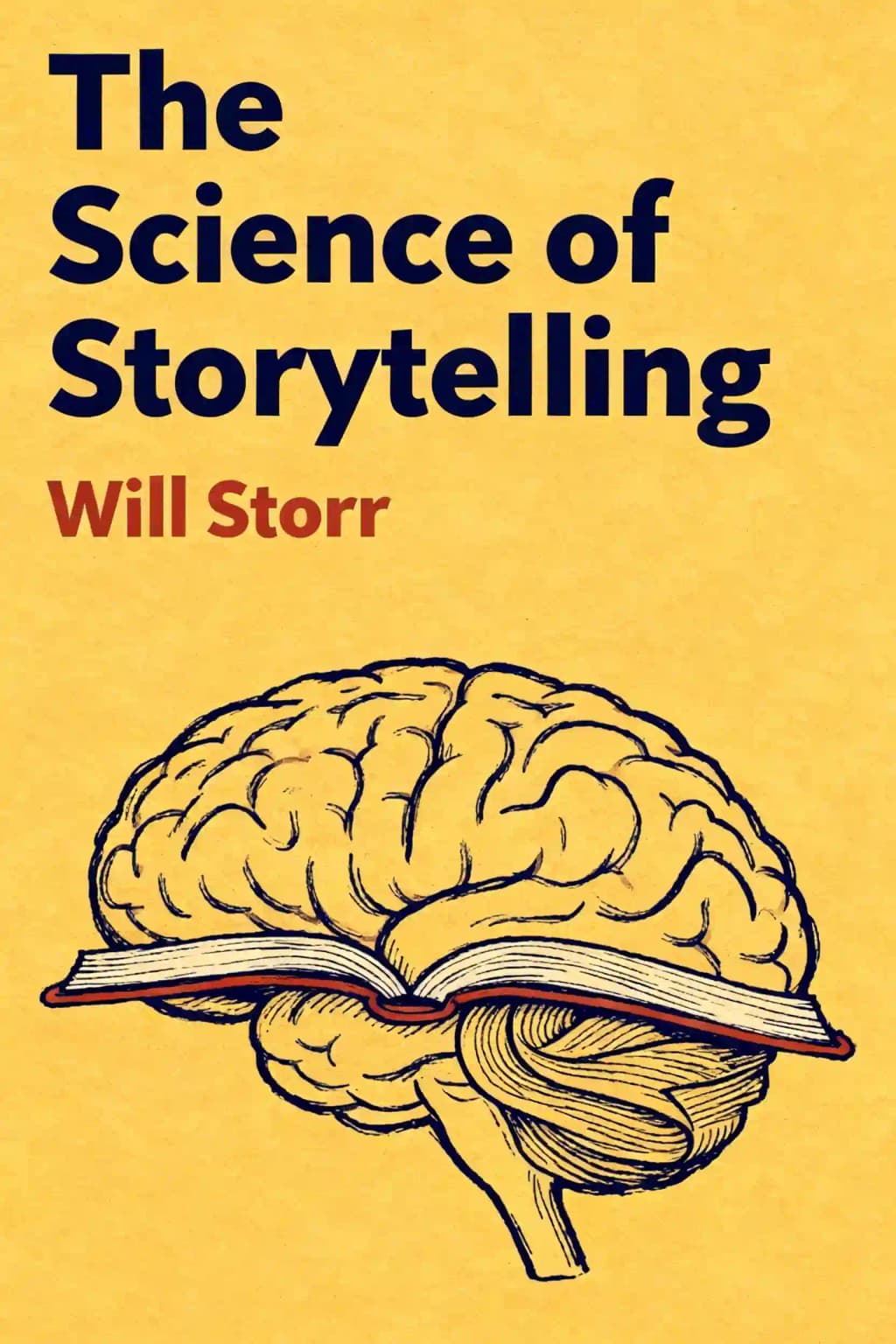
Have you ever found yourself so deeply absorbed in a book that you lost track of time and place? Perhaps you've stayed up until 3 AM, promising "just one more chapter" despite tomorrow's early meeting. This isn't mere entertainment-it's your brain responding to an evolutionary imperative as old as humanity itself. Will Storr's "The Science of Storytelling" has become a modern classic for writers and storytelling enthusiasts, praised by everyone from psychologists to Hollywood screenwriters. Even J.K. Rowling called it "brilliant" for revealing how our brains process narratives. This neuroscience-backed exploration of storytelling has transformed how creative writing is taught at major institutions worldwide, offering a refreshing alternative to formulaic approaches by focusing on what truly captivates the human mind: character psychology.
2장
Our Storytelling Brains: How We Process Reality
We're all going to die. This cosmic meaninglessness threatens to plunge us into despair, but story saves us. Stories aren't merely entertainment-they're the fundamental architecture of human consciousness. Our brains don't process reality directly; they create a "controlled hallucination" that transforms chaos into meaningful narratives with ourselves as the heroes. This neural storytelling mechanism helps us make sense of an otherwise overwhelming world, filtering the constant barrage of sensory information into coherent experiences we can understand and act upon.
This storytelling instinct runs deep in our evolutionary history. Language likely evolved primarily for social storytelling, allowing our ancestors to share moral tales that maintained tribal cohesion. As Professor Jonathan Haidt puts it, we are "story processors, not logic processors." Early humans gathered around fires not just for warmth, but to share tales that transmitted crucial survival information, cultural values, and social bonds. These narrative exchanges helped form the basis of human civilization, enabling complex cooperation and shared understanding across growing communities.
Our brains constantly scan for changes in our environment-not just any changes, but meaningful ones that might represent danger or opportunity. This vigilance shaped our cognitive architecture over millions of years, making us exquisitely sensitive to narrative patterns. Even infants demonstrate an innate ability to recognize and respond to basic story structures, suggesting that narrative comprehension is hardwired into our neural circuitry from birth.
Consider how stories begin. Great openings don't start with biographical data or chronological facts. Instead, they present unexpected change that seizes our attention. Our brains are change-detection machines-86 billion neurons constantly scanning for alterations that might require our control. This explains why compelling first lines often feature disruption: "Mother died today" (Camus) or "Where's Spot?" (children's book). Other powerful examples include Kafka's "Metamorphosis" opening with a man becoming an insect, or Gabriel Garcia Marquez's "One Hundred Years of Solitude" beginning with a colonel facing a firing squad. Change forces characters to act, and that's when story truly begins.
Beyond change, curiosity drives our engagement. Psychologist George Loewenstein discovered that curiosity follows a lowercase "n" shape-weakest when we know nothing or everything, strongest when we think we know something but aren't quite sure. His research identified four ways storytellers trigger curiosity: posing puzzles, creating sequences with unknown resolutions, violating expectations, and revealing that someone else possesses information we lack. These principles explain why detective stories, mysteries, and shows with "mystery boxes" captivate us so completely. Consider how "Lost" kept viewers hooked with its layered mysteries, or how "Gone Girl" masterfully reveals information to create escalating tension. Our brains literally crave answers, sometimes even willing to pay for information that would eventually be free, demonstrating the powerful hold that well-crafted narratives can have over our cognitive processes.
This storytelling mechanism isn't just about entertainment - it's central to how we construct our identities, make decisions, and navigate social relationships. The stories we tell ourselves about who we are and why we do what we do form the foundation of our conscious experience and shape our behavior in profound ways.
3장
The Hallucinated World: How Brains Create Reality
What we perceive as reality is actually a sophisticated hallucination. Though we feel we're observing the world directly, our senses provide only limited information-our high-definition vision covers just thumbnail-width, we have blind spots, and we're blind 10% of the time while blinking. Our brain constructs reality using electrical pulses from our senses, with rapid eye movements checking for unexpected changes.
This explains phenomena like seeing things that aren't there (mistaking a tree stump for a person) or missing obvious things in our visual field (like the famous "invisible gorilla" experiment). When senses are damaged, hallucinations can occur, as with stroke patients who "see" despite blindness. Reality itself differs radically from our perception-there's no sound, color, or pain "out there," just our brain's interpretation of electrical signals.
Effective storytelling exploits the brain's automatic model-making abilities. Fantasy and science fiction writers create immersive worlds through specific naming and technical details that trigger neural processes making fictional places feel real. For young readers encountering Tolkien's maps of "Mount Gundabad" and "Desolation of Smaug," these imaginary places become as tangible as real locations. In Star Wars, when Han Solo mentions making "the Kessel Run in less than twelve parsecs," the specificity creates authenticity despite being nonsensical. The most effective world-building happens not on the page but in readers' minds.
Our brains create specialized hallucinated worlds focused primarily on the social world of other humans. We possess extraordinary abilities to read minds and predict behaviors, skills that have been rapidly enhanced over the last 1,000 generations through a process of "self-domestication." Our fascination with faces begins at birth, and by adulthood, we make instant character assessments in a tenth of a second. Our "theory of mind" ability lets us imagine others' thoughts even when they're absent, giving our species its world-conquering power.
4장
The Flawed Self: Character Is How We're Broken
Consider Mr. B, a psychotic man convinced the FBI secretly films him for "The Mr. B Show." Despite all evidence to the contrary, he remains unshakeable in his delusion. As neuroscientist Michael Gazzaniga explains, one healthy part of Mr. B's brain tries to make sense of abnormalities occurring in another part, creating a distorted reality he cannot recognize as false. This phenomenon, known as confabulation, demonstrates how our brains will create elaborate explanations to maintain coherent narratives, even when those narratives are fundamentally flawed.
Though less extreme, we all resemble Mr. B. Our perception of reality contains distortions we can't recognize. When confronted about our mistakes or irrationality, we instinctively dismiss contradicting evidence, certain we're right. This "blind spot bias" affects everyone from CEOs making crucial business decisions to parents raising children, each convinced of their own objectivity while easily spotting others' biases.
These cognitive distortions make us flawed in unique, individual ways. Our flaws define our character-who we are is how we're broken. In stories, protagonists begin with specific flaws that help readers empathize with them. Consider Hamlet's paralyzing indecision, Elizabeth Bennet's prejudice, or Walter White's pride - these flaws drive their stories forward while making them deeply human. As we learn the causes of their errors, we become emotionally invested in their struggle to overcome or succumb to these inherent weaknesses.
When designing characters, consider their "theory of control"-how they've learned to manipulate their world and respond to chaos. This theory emerges from both their core beliefs and their personality traits. A character who experienced childhood abandonment might develop an excessive need for control, while another raised in chaos might embrace unpredictability. These coping mechanisms become central to their decision-making and relationships.
Personality is partly genetic, developing in the womb and early life. Psychologists measure it across five domains: extraversion (gregariousness, sensation-seeking), neuroticism (anxiety, self-consciousness), openness (curiosity, artistic tendency), agreeableness (modesty, sympathy), and conscientiousness (order, discipline). Each trait exists on a spectrum, creating countless possible combinations that influence behavior, relationships, and life choices.
These traits dramatically influence how characters generate plots. As Professor Keith Oatley notes, "It is from character that flow goals, plans and actions." A disagreeable neurotic sends grumpy causes into the world and receives hostile effects in return, creating a self-reinforcing cycle they can't recognize. An extroverted, open individual might constantly seek new experiences, leading to both opportunities and conflicts. A highly conscientious person might struggle with perfectionism, creating tension in both personal and professional relationships. Even small personality differences compound into vastly different life trajectories, shaping not just individual scenes but entire narrative arcs.
Understanding these personality dynamics helps writers create more authentic characters whose actions flow naturally from their psychological makeup rather than plot convenience. Their flaws become not just obstacles to overcome but essential elements of who they are, driving both internal conflicts and external actions in believable ways.
5장
The Hero-Maker: How We Distort Reality
We are all fictional characters of our own making, protagonists in an elaborate narrative crafted by our consciousness. Our brains function as sophisticated "hero-makers," constantly distorting reality to maintain our sense of moral superiority, personal agency, and control. This psychological mechanism operates continuously, filtering experiences through a self-serving lens that places us at the center of a noble story.
When our neural models encounter contradictory information, we respond with the same physiological intensity as if facing physical danger-entering fight-or-flight mode. The amygdala activates, stress hormones surge, and rational thinking diminishes. We instinctively dismiss opposing viewpoints, often labeling those who disagree as idiots, morally corrupt, or maliciously motivated. This defensive response drives us to seek validation from like-minded individuals, finding profound comfort in shared beliefs and group identity. Echo chambers, both online and offline, reinforce these protective bubbles.
Our brains engage in remarkable feats of selective memory, routinely rewriting or inventing memories to support our self-image. Multiple studies demonstrate how people consistently misremember their own selfish or questionable behaviors, even when offered substantial financial incentives for accurate recall. In one notable experiment, participants who cheated on tests later genuinely believed they had earned their scores honestly. We habitually judge ourselves by our noble intentions while assuming others act from base motives - a cognitive bias known as the fundamental attribution error.
This hero-maker delusion drives much of human suffering and conflict throughout history. Even history's most notorious tyrants, from Stalin to Pol Pot, genuinely believed themselves morally justified. Fascinating research reveals that violence stems primarily not from greed or sadism but from inflated self-esteem and moral idealism-the unshakeable conviction of personal and moral superiority. A chilling example comes from Holocaust perpetrator Franz Stangl, who rationalized killing children at Treblinka by saying: "without its mother the child could not live any longer," revealing how the hero-maker narrative can justify even the most horrific acts.
In literature and media, this phenomenon creates compelling drama. Characters like Amy Elliott Dunne in "Gone Girl" embody pathological self-esteem, methodically framing her husband for murder to preserve her perfect reputation. Greene's murderous police lieutenant in "The Power and Glory" constructs elaborate justifications through memories of corrupt priests exploiting the poor. Contemporary political divisions similarly reflect competing hero-maker narratives, with each side casting themselves as righteous defenders against evil opponents. These neural worlds, locked in mortal combat, demonstrate how our hero-making brains can transform disagreements into existential battles between good and evil.
6장
The Dramatic Question: Who Are We Really?
Charles Foster Kane saw himself as champion of the downtrodden, rejecting wealth to fight for the common man. But after his failed gubernatorial campaign, his drunken friend Jedediah Leland delivers a devastating truth: "You talk about the people as if you owned them... You don't care about anything except you. You just want to persuade people that you love them so much that they ought to love you back."
Who was Kane really? The selfless crusader his hero-making brain portrayed, or the approval-seeking manipulator Leland described?
"Who is this person?" is the fundamental question driving all stories. It emerges at the ignition point when protagonists behave unexpectedly and resurfaces with every choice they make. Wherever this question exists, readers remain engaged; where absent, they become detached.
Most of us don't truly know who we are. The inner voice narrating our lives-generated by speech circuitry in our brain's left hemisphere-cannot be trusted. Though it feels like "us," it's merely observing our neural models and explaining them. It's not lying exactly, but confabulating-telling fictional stories we believe are true.
We are not single selves but multiple competing versions of ourselves. The author describes his own struggle with food cravings, where "Captain Abstemious" dominates Monday mornings with rigid self-discipline, only to be replaced by Wednesday evening by "Billy Pillock Jnr" who believes middle-aged men shouldn't worry about "belly flub" and deserves treats.
Our brains contain different models of self constantly battling for control, with our neural narrator working overtime to stitch together a coherent story about our contradictory behaviors. This multiplicity becomes starkly visible in conditions like Alien Hand Syndrome, where patients' hands act independently-unbuttoning clothes, grabbing phones, or even attempting to strangle their owners while the other hand tries to help.
7장
The Subconscious Battle: Surface Drama vs. Inner Worlds
Stories, like consciousness, operate on two levels. The top level presents the visible drama of plot-actions and events unfolding in sequence - the external conflicts, dialogue, and physical movements that audiences can directly observe. Beneath this lies the subconscious level of neural models, "a stewing night ocean of feelings, urges and broken memories" where competing impulses battle for control. This deeper realm contains characters' fears, repressed desires, childhood wounds, and ingrained beliefs that secretly drive their behavior.
In well-told stories, there's constant interplay between the surface drama and characters' subconscious worlds. As characters' neural models fracture under pressure, previously repressed aspects rise up, creating unexpected behaviors. A normally controlled person might explode in rage, or a coward might suddenly find courage. This is how plots develop organically from character-each new development emerges as characters struggle to reimpose control on their crumbling worldview. The external conflicts serve as catalysts that force buried truths to emerge.
"Lawrence of Arabia" exemplifies this brilliantly. Lawrence's flaw of "vanity that manifests as rebellion" drives him to extraordinary achievements but ultimately leads to horrifying self-discovery when he becomes the very "barbarous" killer he once condemned. The film's power comes from watching Lawrence's dramatic question-"Who am I?"-play out as his theory of control crumbles beneath the weight of experience. His surface actions - leading raids, uniting tribes, defying authority - all stem from deeper psychological needs he doesn't fully understand until it's too late.
Characters often consciously want one thing while subconsciously needing something entirely different. As Robert McKee notes, the most fascinating protagonists contain this inner contradiction-what they believe they want directly opposes what they unwittingly need. A character might pursue wealth and status while actually needing authentic connection, or chase romantic conquests while truly seeking self-acceptance. This tension creates complexity that audiences immediately sense because it mirrors the human experience of being divided against ourselves.
In American Beauty, Lester Burnham's midlife crisis drives him to pursue youth and freedom through a fast car, marijuana, and his infatuation with his daughter's friend Angela. Yet when he finally has the opportunity to sleep with Angela and she confesses it's her first time, his true self emerges. He comforts her instead, revealing that while he wanted to be young again, what he needed was to mature and become truly powerful. His surface pursuit of youth masked a deeper need to reclaim his authentic self and moral center.
Other examples abound in classic literature and film. Michael Corleone in The Godfather believes he wants to stay separate from his family's criminal empire, but subconsciously needs to prove himself worthy of his father's legacy. Rick in Casablanca maintains a cynical facade while harboring deep idealism. These layered characters demonstrate how the dance between surface wants and subconscious needs creates compelling drama that resonates with fundamental human psychology.
8장
Tribal Emotions: The Ancient Power of Story
The emotional power of stories stems from their ancient evolutionary roots. Though we live in the 21st century, we still carry Stone Age brains shaped during our hunter-gatherer tribal existence. These primal forces influence everything from our sleeping habits to our storytelling preferences, from our social bonds to our competitive drives. Our ancestors gathered around fires sharing tales that reinforced group values and warned of dangers, creating neural pathways we still possess today.
Gossip-our earliest form of storytelling-evolved to maintain tribal cooperation and social cohesion. When ancient humans told stories about selfless group members, listeners felt positive emotions; tales of selfish rule-breakers triggered moral outrage and punishment. This mechanism kept tribes functioning without formal laws, creating an informal system of justice and behavioral control. Archaeological evidence suggests that even the earliest human settlements used storytelling as a way to transmit cultural values and maintain social order.
Even babies as young as six months show approval of selfless behavior, turning away from characters who hinder others and gravitating toward helpers. This selfless-selfish moral axis forms the universal basis of human morality, transcending cultural boundaries. Stories exploit these tribal emotions: we crave seeing heroes recognized and villains punished. Whether in Steinbeck's "Grapes of Wrath," where the Joad family's selflessness inspires despite their hardships, Woolf's "Mrs. Dalloway," examining the subtle moral choices of everyday life, or von Trier's "Dancer in the Dark," where sacrifice becomes the ultimate expression of maternal love, storytellers trigger our primal sense of fairness to make us care deeply about fictional characters.
Beyond moral outrage, status competition drives storytelling's emotional power. Humans have two competing instincts: to get along with others and to get ahead of them-the conflict at the heart of our condition. This duality shapes our relationships, career choices, and social interactions. Status-seeking is universal, affecting our well-being, self-esteem and health, with research showing that relative social position influences everything from stress hormones to immune function.
Our obsession with status has deep evolutionary roots-even crickets track victories against rivals, and ravens listen to status gossip from neighboring flocks, adjusting their behavior based on observed social interactions. Unlike many animals, humans (like our chimp cousins) have fluid hierarchies where status constantly shifts, creating narratives of ambition, betrayal, and intrigue. This flexibility in social standing generates the dramatic tension that powers countless stories, from Shakespeare's political dramas to modern workplace narratives. Contemporary research in evolutionary psychology suggests that our fascination with status-driven narratives serves as a way to learn social navigation strategies without risking real-world consequences.
The intersection of moral judgment and status competition creates the perfect storm for compelling storytelling, engaging both our desire for justice and our fascination with social climbing. This combination explains why stories about moral underdogs rising to power, from Cinderella to Rocky, resonate across cultures and generations.
9장
Plot, Purpose, and Transformation
Heroes aren't just selfless, courageous, and status-earning-they're fundamentally goal-directed. This drive to pursue objectives is perhaps our oldest evolutionary impulse, dating back to single-celled organisms. When unexpected change strikes, we don't merely endure; we fight. As nineteenth-century critic Ferdinand Brunetiere observed, drama essentially shows "a will striving towards a goal."
Goal-direction forms the foundation of human motivation. Beyond our basic Darwinian aims of survival and reproduction, we seek tribal connection and status, upon which all our other desires are built-our ambitions, feuds, love affairs, and betrayals.
Humans possess such a powerful need to affect their environment that researchers have found people in sensory deprivation tanks quickly begin creating stimulation-making ripples in water or singing. In one study, participants even administered painful electric shocks to themselves rather than endure a stimulus-free environment.
Our goals organize our perception and give our lives narrative coherence. When psychologists asked people to remember a confusing paragraph, those told beforehand it concerned washing clothes remembered twice as much information, demonstrating how goals transform gibberish into meaningful content.
Plot exists to challenge the protagonist. It creates "story events" that thrust characters into unfamiliar psychological territory where their flawed control theories are tested to breaking point. The standard five-act structure efficiently shows a character's flawed control theory being broken, changed, and rebuilt:
Act I establishes the protagonist's control theory before unexpected change strikes.
Act II tests and breaks down the old theory as new possibilities emerge.
Act III shows transformation as the protagonist counter-attacks with new strategies.
Act IV plunges them into chaos and their darkest moment, questioning their change.
Act V builds to the final battle where they achieve control and definitively answer who they'll become.
10장
The Sacred Connection: Why Stories Matter
We each inhabit uniquely foreign neural worlds, ultimately alone in our "black vault" of consciousness. We laugh at different things, feel moved by different music, and respond to different stories. What we often seek in art is the same connection we crave in friendship and love-storytellers who capture the distinct music of our inner agonies.
Our preference for storytellers with similar backgrounds is natural; their work resonates with shared cultural touchpoints. Yet we shouldn't remain in our silos. Story serves as both tribal propaganda and its antidote. Research shows that exposure to stories portraying "others" positively creates lasting improvements in attitudes toward those groups.
Story's gift is wisdom, passing life lessons from generation to generation. For the author, Julian Barnes' A History of the World in 1012 Chapters provided such wisdom during adolescent romantic turmoil. Barnes' insight that "the heart isn't heart-shaped"-not a neat symmetrical whole but "heavy, squat, bloody, clamped tight like a violent fist"-offered immediate comfort and understanding. These five words became a personal mantra that has helped navigate love's complexities for twenty-six years and counting.
Story's fundamental lesson is humbling: we have no idea how wrong we are. Our most irrational emotional reactions often reveal our most fragile neural models-the places where our perception is most warped and tender. Facing and fixing these flaws becomes life's greatest battle.
Story's ultimate consolation is truth. As hyper-social beings, we're constantly surrounded by people trying to control us through soft lies and half smiles, hiding their sins and failures to appear pleasant and make us pliable. This environment can be numbing and alienating.
Story breaks through this mask, allowing us to enter the flawed mind of another and discover we're not alone in our brokenness, confusion, dark thoughts, and fears. Story connects mind to mind more intimately than even love can achieve, offering hope that we might not be quite so alone in our dark bone vault after all.