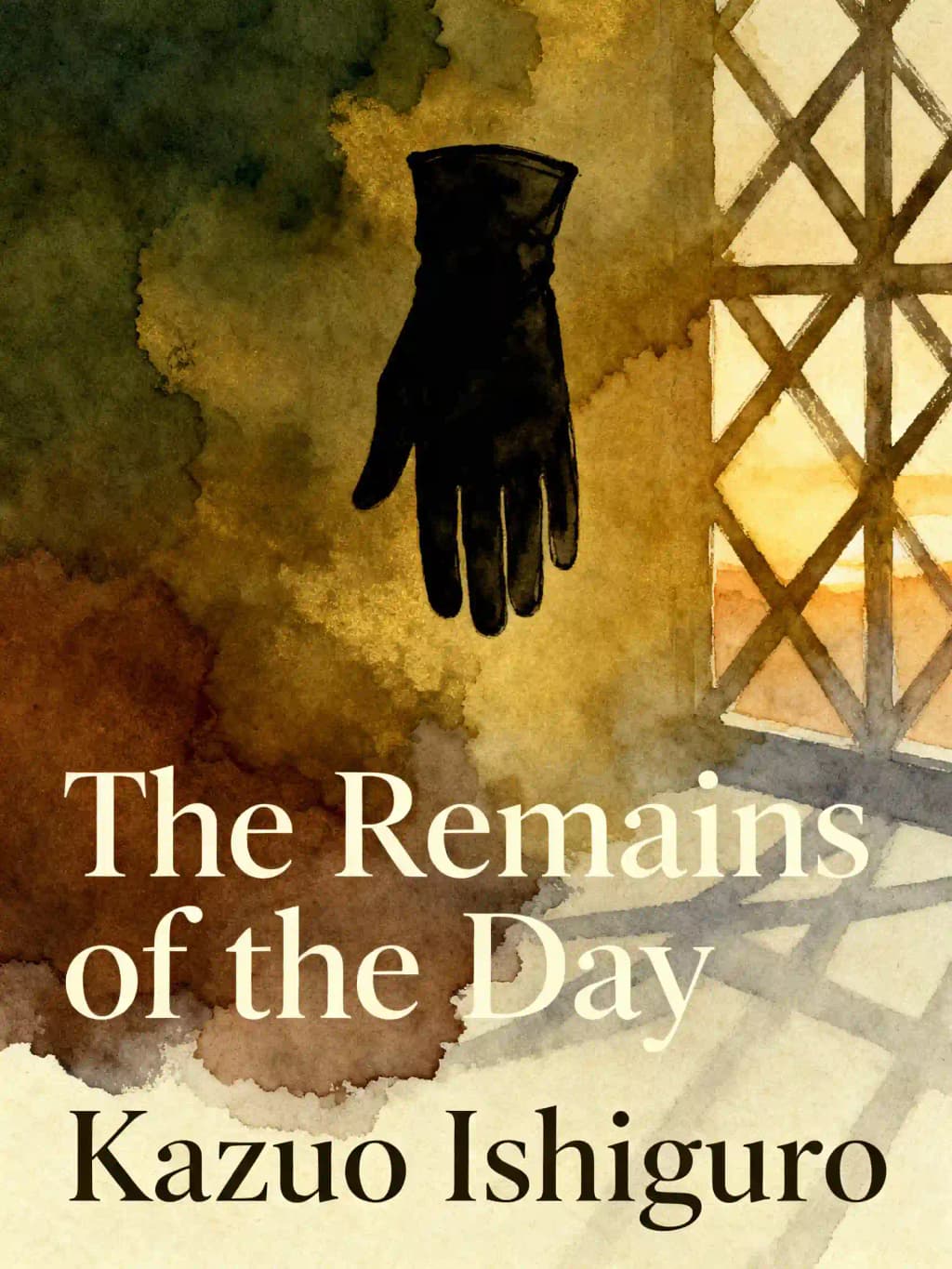
In Ishiguro's Booker Prize-winning masterpiece, a butler's lifetime of perfect service reveals the cost of dignity over desire. Anthony Hopkins brought Stevens to Oscar-nominated life in a film that asks: what remains when duty consumes your days?
Kazuo Ishiguro, Nobel laureate and Booker Prize-winning author of The Remains of the Day, is celebrated for his masterful exploration of memory, identity, and human connection.
Born in Nagasaki, Japan, in 1954, Ishiguro was raised in England from the age of five, blending cross-cultural perspectives in his works.
His iconic novel, a cornerstone of historical fiction, examines themes of duty, regret, and repressed emotions through the reflections of an English butler in post-WWII Britain.
A graduate of the University of Kent and the University of East Anglia’s creative writing program, Ishiguro has penned acclaimed titles like Never Let Me Go and Klara and the Sun, which delve into dystopian futures and ethical dilemmas.
Knighted in 2019 for literary contributions, his works have been translated into over 50 languages. The Remains of the Day was adapted into an Oscar-nominated film, solidifying its status as a modern classic.
The Remains of the Day follows Stevens, an English butler reflecting on his decades of service at Darlington Hall. Through a 1956 road trip, he confronts his unwavering loyalty to a pro-Nazi aristocrat and repressed feelings for housekeeper Miss Kenton, revealing the cost of prioritizing duty over personal connection. The novel explores themes of regret, identity, and the decline of traditional British values.
Readers interested in introspective character studies, post-war British history, or explorations of repressed emotions will find this Booker Prize-winning novel compelling. Its nuanced prose and themes of dignity, self-deception, and unspoken love resonate with fans of literary fiction or psychological dramas.
Yes—Ishiguro’s restrained yet deeply emotional narrative is widely regarded as a masterpiece. It won the 1989 Booker Prize and ranks among the 100 most influential novels (BBC, 2019). The story’s examination of regret, moral ambiguity, and English identity offers timeless insights into human behavior.
Key themes include:
Initially professional, their bond deepens through shared moments—like bantering about books or Stevens’ father’s death. Yet Stevens’ emotional restraint prevents him from acknowledging her affection. Years later, Miss Kenton admits she married to escape loneliness, leaving Stevens to grapple with what might have been.
The phrase alludes to Freud’s concept of “day’s residues”—unprocessed memories that surface in reflection. For Stevens, it signifies reckoning with life’s regrets and the possibility of change in one’s twilight years. The title also mirrors his journey: assessing what “remains” after a lifetime of suppressed emotions.
Lord Darlington symbolizes the pre-WWII British aristocracy’s naivety. He hosts Nazi sympathizers, dismisses Jewish staff, and unwittingly aids fascist agendas. Stevens’ loyalty to him becomes a metaphor for complicity in systemic evil, questioning blind allegiance to authority.
Stevens’ formal, emotionally detached voice underscores his self-deception. His unreliable recollections—downplaying Miss Kenton’s anguish or Darlington’s flaws—force readers to read between the lines, revealing the tragedy of a man clinging to outmoded ideals.
The novel frames Stevens’ “dignity” as a destructive mask. His obsession with composure—ignoring his father’s death to serve guests—exposes the toxicity of prioritizing appearances over authenticity. Ishiguro suggests this cultural trait enabled moral failures in WWII-era Britain.
Memory acts as both sanctuary and prison. Stevens’ journey physically retraces his past, while flashbacks reveal how his devotion to duty eroded relationships. The 1956 setting—post-WWII Britain’s decline—mirrors his personal reckoning.
Some argue Stevens’ emotional repression makes him frustratingly passive. Others note the novel’s focus on elite spaces overlooks broader societal dynamics. However, most praise its subtle critique of complicity and masterful narrative ambiguity.
저자의 목소리로 책을 느껴보세요
지식을 흥미롭고 예시가 풍부한 인사이트로 전환
핵심 아이디어를 빠르게 캡처하여 신속하게 학습
재미있고 매력적인 방식으로 책을 즐기세요
England's countryside possesses a calm, understated beauty that knows no need to shout its virtues.
Dignity can be cultivated through self-discipline and experience.
Is this truly dignity, or is it a form of self-erasure that borders on the tragic?
She represents everything Stevens has suppressed in himself: emotional honesty, spontaneity...
Their interactions crackle with unacknowledged tension...
The remains of the day의 핵심 아이디어를 이해하기 쉬운 포인트로 분해하여 혁신적인 팀이 어떻게 창조하고, 협력하고, 성장하는지 이해합니다.
The remains of the day을 빠른 기억 단서로 압축하여 솔직함, 팀워크, 창의적 회복력의 핵심 원칙을 강조합니다.

생생한 스토리텔링을 통해 The remains of the day을 경험하고, 혁신 교훈을 기억에 남고 적용할 수 있는 순간으로 바꿉니다.
무엇이든 물어보고, 목소리를 선택하고, 진정으로 공감되는 인사이트를 함께 만들어보세요.

샌프란시스코에서 컬럼비아 대학교 동문들이 만들었습니다
"Instead of endless scrolling, I just hit play on BeFreed. It saves me so much time."
"I never knew where to start with nonfiction—BeFreed’s book lists turned into podcasts gave me a clear path."
"Perfect balance between learning and entertainment. Finished ‘Thinking, Fast and Slow’ on my commute this week."
"Crazy how much I learned while walking the dog. BeFreed = small habits → big gains."
"Reading used to feel like a chore. Now it’s just part of my lifestyle."
"Feels effortless compared to reading. I’ve finished 6 books this month already."
"BeFreed turned my guilty doomscrolling into something that feels productive and inspiring."
"BeFreed turned my commute into learning time. 20-min podcasts are perfect for finishing books I never had time for."
"BeFreed replaced my podcast queue. Imagine Spotify for books — that’s it. 🙌"
"It is great for me to learn something from the book without reading it."
"The themed book list podcasts help me connect ideas across authors—like a guided audio journey."
"Makes me feel smarter every time before going to work"
샌프란시스코에서 컬럼비아 대학교 동문들이 만들었습니다

The remains of the day 요약을 무료 PDF 또는 EPUB으로 받으세요. 인쇄하거나 오프라인에서 언제든 읽을 수 있습니다.
A butler stands at the end of his life, looking back across decades of impeccable service, only to discover he may have served the wrong master all along. This is the haunting premise of Kazuo Ishiguro's masterpiece-a novel that asks uncomfortable questions about loyalty, dignity, and the stories we tell ourselves to make our choices bearable. Stevens, our narrator, embarks on a rare motoring trip through 1950s England, ostensibly to visit a former colleague. But what begins as a simple journey becomes something far more profound: a reckoning with a life spent perfecting the art of self-denial. The brilliance lies in how Ishiguro reveals character through what remains unsaid. Stevens describes his devotion to "greatness" in butlering with such earnestness that we barely notice the tragedy underneath-a man who has confused emotional suppression with moral strength, who has mistaken self-erasure for dignity. As the English countryside unfolds before him, so too does the landscape of his past, revealing not the triumph he believes it to be, but a series of devastating choices made in service to an ideal that never truly existed. What makes someone truly great at their profession? Stevens obsesses over this question, convinced that the answer lies in something called "dignity"-the ability to inhabit one's role so completely that personal feelings become irrelevant.