1장
When Life Gives You One More Day
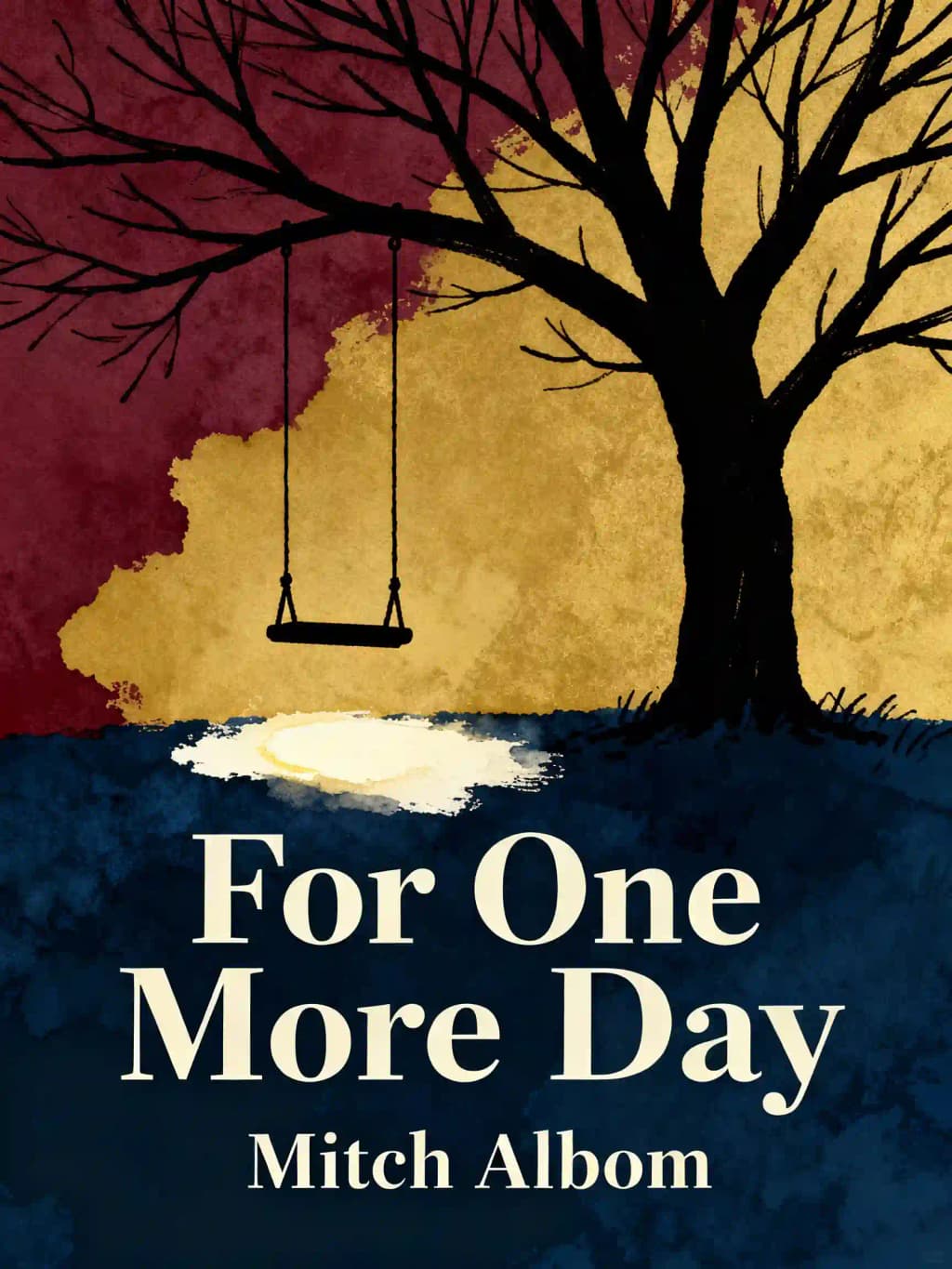
Have you ever wondered what you would do if you could spend one more day with someone you've lost? Mitch Albom's "For One More Day" explores this profound question through the story of Charles "Chick" Benetto, a former baseball player who hits rock bottom and attempts suicide, only to be granted an impossible gift: one more day with his deceased mother. Published in 2006, this poignant novel became an instant New York Times bestseller, selling over 6 million copies worldwide. Oprah Winfrey was so moved by the story that she produced a television movie adaptation starring Michael Imperioli and Ellen Burstyn. The book's universal themes of family, forgiveness, and second chances have made it required reading in many high schools and book clubs across America. Like many of Albom's works, it asks us to consider what truly matters in life before it's too late.
2장
The Breaking Point of a Broken Man
Let me guess. You want to know why I tried to kill myself. The truth is, there's no single moment that pushes someone over the edge. There's only your life, how you mess it up, and who is there to save you-or who isn't.
Chick Benetto's unraveling began when his mother died about ten years earlier. Without her steadying presence, he drifted aimlessly through life, making poor financial decisions, drinking heavily, losing jobs, and watching his marriage collapse. He either left his family or they left him-the distinction hardly matters when the result is the same crushing loneliness.
The final devastating blow came when his daughter Maria married without inviting him. Seeing the wedding photos-joyful moments he'd completely missed-confirmed his total exile from family life. Being unheard is the ground floor of giving up, and giving up is the ground floor of doing yourself in.
After missing his exit for Pepperville Beach one night, Chick recklessly turned around on the highway and sped back toward the ramp. Taking the curve at dangerous speed, he was blinded by two huge lights as a truck horn blasted before a violent crash sent his car flying over an embankment. Miraculously surviving, he shamefully walked away toward his hometown rather than checking on the truck driver.
By dawn, Chick reached the old water tower behind the baseball fields-a place he and his friends used to climb as kids. Determined to end his life, he climbed to the top and hurled himself over the railing. Somehow, he survived the fall, landing among fallen tree pieces and stones. When he opened his eyes, he saw the baseball field of his youth coming into morning light-and his mother, who had been dead for years, standing by the dugout in a lavender jacket, holding her pocketbook.
3장
A Mother's Unconditional Love
"You can be a mama's boy or a daddy's boy. But you can't be both." This was the stark choice Chick's father presented him with early in life, a declaration that would shape his childhood relationships. Naturally, he chose to be a daddy's boy-mimicking his father's walk and laugh, carrying a baseball glove because his father loved baseball, and enduring every hardball his father threw, even when they hurt. He'd practice catching until his hands were red and sore, desperate for his father's approval.
Everything changed one spring morning in fifth grade, a moment forever etched in his memory. Chick entered the kitchen ready for his baseball game, his cleats already on, glove in hand, to find his mother smoking at the kitchen table-something she rarely did before noon-looking upset and distant. When he asked why his father couldn't take him to the game, she simply said, "Daddy's not here." Those three words marked the beginning of a profound shift in his life. From that day forward, he reluctantly became a mama's boy instead, though the transition wasn't immediate or easy.
His mother Pauline ("Posey") possessed a timeless elegance, resembling Audrey Hepburn with her almond-shaped eyes and dark, sweeping hair. She carried herself with a quiet grace that made her stand out in their working-class neighborhood. His father Leonard ("Len") owned a liquor store on the corner of Michigan and Trumbull and cared more about profits than religion, though he insisted Chick be baptized Catholic. They were a clash of cultures-French Protestant and Italian Catholic-who argued constantly about everything from money to child-rearing, with his father's vote always counting twice, a dynamic that created constant tension in their household.
While his father pushed him toward baseball as part of "the plan"-a rigid vision of father-son legacy that included sports scholarships and business success-his mother valued education and books, secretly slipping him novels and encouraging his writing. Chick adored her funny, loving nature, the way she could make him laugh even on his worst days, but like many children, he took her for granted because her love was unconditional and ever-present. As his father said, you chase the love that eludes you-and his was always tucked away "like papers in a briefcase" that Chick kept trying to access, a metaphor that would haunt him well into adulthood.
His mother was always writing him notes, small pieces of paper filled with encouragement and love, slipping them to him whenever she dropped him off somewhere-at school, at practice, at friends' houses-even on his first day of kindergarten when he couldn't yet read. She'd fold them carefully, sometimes drawing little hearts or smiley faces in the corners. These small gestures of love, often unappreciated at the time, would later become precious memories of her devotion, especially after her passing. Years later, he would find some of these notes tucked away in old books and jacket pockets, each one a testament to her constant, unwavering love.
4장
The Impossible Reunion
The morning sun hit Chick like a sidearm pitch between the houses of his old neighborhood as he walked toward his family home with his back hunched like a fugitive, expecting police sirens any moment after the accident he'd fled. Using the hidden key from the flower box, he entered the musty house and was shocked to find fresh food in the refrigerator-Tupperware, lasagna, milk, yogurt. The cabinets held tea, sugar, spices. A dish soaked in the sink.
Then he heard it-his mother's voice calling "Charley?" from upstairs.
He ran out the kitchen door in panic, heart racing, lungs heaving. Then the door opened and his mother stepped outside-his mother who had been dead for years. "What are you doing out here? It's cold," she said, wearing blue slacks and a white sweater, looking no older than on her seventy-ninth birthday. Something melted inside him as the barrier between belief and disbelief snapped. He hugged her as if he'd never let her go.
Now Chick sat at the kitchen table while his mother-or her ghost-tended to his cuts with antiseptic and a washcloth. Despite knowing she had died years ago, he couldn't bring himself to question her presence. The tenderness with which she rolled up his sleeve and cared for his wounds broke through his defenses. When he lacked even the self-respect to stay alive, she still gave a damn. He whispered "Mom?"-that simple word death had stolen from him-and she sighed, "Charley. The trouble you get into."
"So can you stay all day?" his mother asked, standing over the range scrambling eggs as if this were just another day. When she urged him to eat, he finally found his voice and whispered, "Mom, this is impossible." But he surrendered to the moment and ate the eggs his mother placed before him. They carried that certain taste of memory-chives, "the little green things" he called them as a child-and he devoured them like a prisoner. This past-tense breakfast at a past-tense table with his past-tense mother felt strangely familiar.
5장
The Aftermath of Abandonment
After Chick's father left, his mother quickly adapted-putting on lipstick and mascara, cooking fried potatoes, and simply announcing "Dad isn't going to live here anymore." His sister cried, promising to behave better if their father returned, while Chick, feeling the obligation of being the only male, refused to cry. For months they believed it was temporary, listening to their parents' arguments from the staircase about them, work, and Chick's baseball.
The neighborhood changed toward them after the split. Small towns are like metronomes-with the slightest flick, the beat changes. People were kinder to Chick and his sister, offering extra lollipops or larger ice cream scoops, while treating his mother with judgment. Divorce was scandalous then, and his mother bore the blame simply because she remained while his father disappeared.
Her refusal to seek pity, combined with her youth and beauty, made her a threat to women, an opportunity to men, and an oddity to children. Chick grew self-conscious about her dropping them at school in her white nurse's uniform, once sliding away when she tried to kiss him goodbye. He couldn't look at her then, only hearing her sniff as she rubbed his hair before driving away.
Chick discovered a fierce protectiveness when he caught two older boys spying on his mother through binoculars. When he realized they were watching her change clothes through her bedroom window, calling her "the divorcee," he flew into a rage unlike anything he'd felt before, attacking them despite their size advantage, throwing punches at anything that moved.
Throughout his teenage years, Chick pushed his mother away-refusing to sit next to her at movies, squirming from her kisses, embarrassed by her womanly figure and her status as the only divorced woman around. He wanted her to be like other mothers, wearing housedresses and baking brownies. In one painful memory, he cruelly told her she made him sick because of how she dressed for her beauty parlor job. When she slapped him repeatedly, he ran away until dark, only to return and smoke the very cigarettes she'd tried to confiscate.
6장
Lessons from the Elderly
As Chick walked with his mother through the old neighborhood, she explained she had three appointments with homebound elderly women whose hair and makeup she now did. Her first "appointment" was with Rose, an elderly woman with a walker who lived in a small brick home frozen in 1970s decor-royal blue carpet and plastic-covered couches.
When Rose mentioned hearing about "an accident by the highway" where "a car hit a truck and crashed through a big sign," Chick froze, expecting his mother to demand he confess. Instead, she dismissed the news as "depressing" while unpacking her hairdressing supplies.
"It's nice that you spend a day with your mother," Rose told Chick. "Children should do it more often." Then to his mother: "Now, Posey, can you still make me beautiful?"
As they left Rose's house, she mentioned she was "going to see her husband" that night. Walking away, his mother revealed that Rose would die that evening-she was helping her get ready. When Chick questioned how she knew this, she simply smiled.
Later, they visited Miss Thelma, an elderly black woman who once cleaned their house. She called him "Chickadoo," the nickname she inadvertently created, and drove them to her home in the Flats. There, bedridden with cancer, she asked his mother for help looking presentable for her family.
As his mother applied moisturizer and makeup, Miss Thelma reminisced about their Saturdays together, revealing something Chick never knew-after his father left, his mother cleaned houses with Miss Thelma to put them through college. Watching his mother apply makeup to Miss Thelma, Chick struggled with learning she became a cleaning woman after losing her nursing job.
"I did what mattered to me. I was a mother," she explained when he asked why she didn't get money from Dad or return to the hospital. When Chick confessed he hated his job, feeling ashamed when comparing it to their years of physical labor to support their families, his mother questioned what "ordinary" means, and Miss Thelma pointed to her grandchildren's laughter as what keeps her from being forgotten.
7장
The Price of Chasing Dreams
The day Chick left for college was initially one of his mother's happiest. She woke before sunrise to make an enormous breakfast and dressed in her finest purple pantsuit with scarf and high heels while insisting he wear a white shirt and tie. This was the mid-60s, when college campuses were filled with students in sandals, peasant skirts, tank tops, and long hair-making them stand out painfully in their formal attire.
His mother marveled at the university library, exclaiming he could spend all four years there "and never make a dent." Her pride in his "scholarship" overshadowed the fact that half his tuition was being paid because of his baseball skills rather than academics. Despite her enthusiasm, Chick felt embarrassed by her presence, pushing her away when she tried to see his dorm room and rejecting her goodbye embrace when other students appeared-leaving her standing alone in the stairwell, as close as she would ever get to a college education.
At twenty-three, Chick reached the pinnacle of baseball-the World Series with the Pirates. Though he couldn't claim responsibility for their success, he did catch four innings in one playoff game and hit a deep fly ball. They lost to the Orioles in five games, and he never even got to bat. After the final defeat, he watched the Baltimore players celebrate in a pile he would still dream about joining years later.
The following spring, he blew out his knee sliding into third base. Though he healed and played six more years in the minors, he never returned to the majors. He dragged Catherine from city to city, and their daughter Maria was born in Pawtucket just after a rained-out game. He quit baseball soon after, trying various careers but finding nothing that compared to those six glorious weeks when he felt immortal. His father faded from his life along with his baseball career, and they drifted apart like "two boats with the oars pulled in."
8장
The Devastating Truth
As their day together drew to a close, Chick felt an increasing physical and emotional exhaustion overtaking him. The weight of mortality pressed heavily as he directly asked his mother if death was approaching, but she responded with the gentle wisdom of someone who had seen much of life, saying only God held that knowledge. Throughout the afternoon, they made a series of poignant visits to people from her past - former neighbors, old friends, and men who had once courted her. Each encounter revealed a different facet of his mother's life, surprising Chick with the depth of affection these people still held for her decades later. Their eyes would light up at the sight of her, and their stories painted a picture of a vibrant young woman he had never really known.
In a quiet moment between visits, Chick asked about her choice to remain single after so many years alone. Her response was both simple and profound: "The years pass." She spoke with a mixture of resignation and wisdom about how life slips by like water through fingers, emphasizing the foolishness of squandering precious time. Back in the familiar comfort of her kitchen, sharing what would be their final meal together, she became the keeper of their family's memories, sharing stories of grandparents, great-aunts, and long-forgotten relatives. Chick listened with an almost desperate attention, knowing these precious fragments of history would be lost forever if not preserved now.
The day's most dramatic revelation came in an unremarkable setting - a pale yellow brick apartment building in an unfamiliar town. The scene inside seemed almost surreal: an elderly Italian woman, still elegant despite her years, methodically brushing her silver hair before a mirror. His mother's words fell like stones in still water: "She's your father's wife." The story unfolded like a wartime drama - a romance in Italy during the conflict, a secret family established on American soil, and another son - a brother Chick never knew existed.
The details of his mother's discovery were heartbreaking in their simplicity. One ordinary evening, driven by suspicion or instinct, she had driven to Collingswood and witnessed them through a window, sharing a family dinner - a perfect tableau of domestic life that excluded her and her children. Her response to this betrayal became a defining statement about family loyalty: "You have one family. You can't trade them in. You can't run two at once. Sticking with your family is what makes it a family."
For Chick, this revelation was particularly crushing because it exposed the hypocrisy of his father, who had always preached about loyalty and family unity, constantly referring to them as "our team." When confronted, his father's defense seemed weak - claiming ignorance about the son until later and feeling bound by obligation. His mother's response revealed her true character: "I could have forgiven him almost anything against me. But that was a betrayal of you and your sister, too." Her priority had always been protecting her children.
Standing in that apartment, with these two women whose lives had been forever intertwined by one man's choices, his mother leaned close and whispered a truth that would haunt Chick forever: "Secrets, Charley. They'll tear you apart."
9장
The Last Goodbye
Chick now needed to tell about the last time he saw his mother alive. It was at her seventy-ninth birthday party, a sunny spring afternoon lunch at her modest house, attended by family and two dozen people from the old neighborhood, including elderly women whose hair his mother had been styling for decades. Some of these women had been coming to her since before Chick was born, their weekly appointments as much about friendship as hairstyling. His fourteen-year-old daughter Maria, watching her grandmother's practiced movements and gentle way with these women, asked if his mother could do her makeup, something she'd never requested before.
The party had the warmth of old memories and familiar faces, with his mother serving her famous meatballs and telling stories that made everyone laugh. She seemed particularly vibrant that day, moving from guest to guest with the energy of someone much younger, though Chick noticed she occasionally steadied herself against furniture when she thought no one was looking.
After the party, despite his mother's gentle plea for him to stay longer - "Just a little while more, honey?" - Chick left for a baseball exhibition game. At the plate, under the bright stadium lights, his heart was racing despite having done this countless times before. The familiar weight of the bat, the smell of leather and grass, the murmur of the crowd - it all felt suddenly significant. He swung and made contact, thinking he'd hit something fabulous, but it was just a pop-up easily caught by the second baseman-his final offering to this maddening game that had consumed so much of his life.
At that exact moment, his mother was taking her last breaths in Pepperville Beach, collapsed on her bedroom floor from a massive heart attack. The carpet she'd recently cleaned still smelled of shampoo, and the television was softly playing her favorite game show in the background. After the game, Chick packed quickly and found his father outside smoking his third consecutive cigarette, the amber tip glowing in the darkness. Their brief, awkward exchange ended with his father's familiar disgust that he was wasting time talking to him instead of networking with players who could help his career.
When Chick called home from the road, his wife's shaky voice delivered the devastating news: "Your mom... She died." Those words were too big to fit in his ears, a wrecking ball pounding at his head until they finally cracked a hole large enough to split him apart. It was a heart attack; Maria had found her grandmother still clutching her reading glasses, the evening paper spread across her lap. He drove through the night to Pepperville Beach, the highway empty except for long-haul trucks, arriving just before sunrise, with shock, grief, and guilt as his companions. The morning light revealed his mother's garden, where daffodils she'd planted were just beginning to bloom.
10장
The Healing Power of Forgiveness
With his body failing after the suicide attempt, Chick admitted he wanted to die because he'd given up. "Don't give up," his mother whispered, holding him as he confessed his guilt about choosing a baseball game over being with her when she died.
"A child should never have to choose," she responded, revealing she'd known all along. The Italian woman pushed forward two items-a photo of her son and Chick's baseball card-before saying "Perdonare" (forgive). His mother carried him through darkness back to this world, telling him, "You can't lose your mother, Charley. I'm right here." As police officers found him, her final words corrected his grammar: "My mother and I." He felt her kiss his forehead before she vanished.
Chick doesn't expect anyone to believe his story, but he remembers every moment with his mother during that impossible day. Between worlds, she gave him the day he'd wanted so badly. When it's quiet, he can still hear her echo. He's ashamed he tried to take his life-it's too precious. In the two years since, he's remained sober, though some days are harder than others. He believes his mother saved him that night.
Charles "Chick" Benetto died from a sudden stroke five years after his suicide attempt. His funeral was small-attended by family, childhood friends, and his ex-wife, but no one from his baseball days. His father stood in the back wearing sunglasses and left quickly.
In his final years, Chick found contentment-selling his mother's home and giving proceeds to his daughter, moving near her to rebuild their relationship, making peace with Catherine, and working part-time at parks and recreation where "Everyone gets to play." A week before his stroke, he said, "Remember me for these days, not the old ones."
Parents, if they love you, hold you safely above their swirling waters, and sometimes that means you'll never know what they endured. Behind all your stories is always your mother's story, because hers is where yours begins.