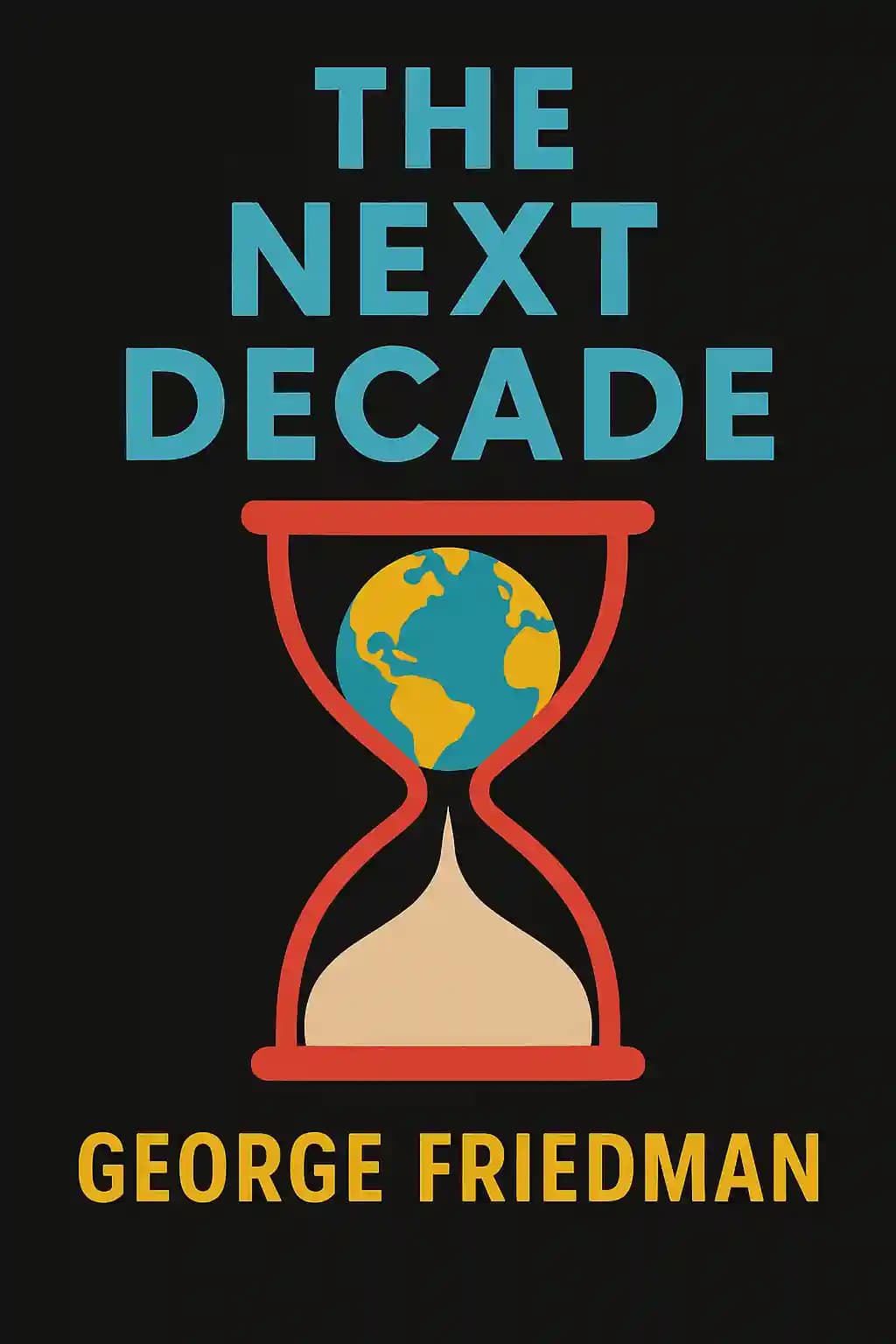
In "The Next Decade," NYT bestseller George Friedman reveals America's imperial challenges while preserving democracy. This Machiavellian geopolitical forecast, praised for its provocative analysis, asks: Can a president balance global dominance with republican ideals? Business strategists and policymakers can't look away.
George Friedman is the New York Times bestselling author of The Next Decade and an internationally recognized geopolitical strategist, renowned for his forecasts on global affairs. As founder of Geopolitical Futures and former CEO of Stratfor, his work blends historical analysis with forward-looking insights.
His expertise includes American foreign policy, international power shifts, and geopolitical risk. The Next Decade—a sequel to his widely cited The Next 100 Years—explores how U.S. leadership can navigate complex global dynamics, drawing from Friedman’s doctoral training in government at Cornell University and decades advising military and government entities.
Friedman's other influential works include Flashpoints: The Emerging Crisis in Europe and The Storm Before the Calm, which analyze systemic crises and national reinvention. His perspectives are frequently featured in major media outlets, and his books have been translated into more than 20 languages, solidifying his status as a leading voice in strategic forecasting.
The Next Decade analyzes global geopolitical shifts from 2010-2020, focusing on U.S. leadership challenges as an unintended superpower. Friedman argues America must balance republican values with imperial responsibilities, navigating crises like China’s rise, Middle East conflicts, and economic transitions. The book applies Machiavelli’s The Prince to modern statecraft, urging presidents to strategically manage rivalries (e.g., Iran vs. Israel) while avoiding overextension.
This book suits readers interested in geopolitics, U.S. foreign policy, and leadership strategy. Policymakers, historians, and business leaders will value Friedman’s forecasts about energy shifts, labor shortages, and post-financial-crisis trends. Critics note its provocative U.S.-centric lens, making it ideal for those debating America’s global role.
Friedman criticizes post-9/11 “war on terror” overreach, arguing the U.S. should revert to offshore balancing—using regional rivals (e.g., Sunni vs. Shia states) to prevent dominance by any single power. Withdrawal from Iraq without countering Iran’s influence is framed as a critical misstep.
China faces a 2020s inflection point due to an aging population, income inequality, and unsustainable growth. Friedman anticipates internal instability, forcing Beijing to prioritize domestic control over global ambitions—a shift with ripple effects for trade and Asian security.
The book highlights a transition from financial crises to labor shortages, driven by retiring Baby Boomers. This will spur wage inflation, migration policy debates, and competition for skilled workers—reshaping economic nationalism and corporate strategies.
Critics dispute Friedman’s “American empire” thesis as hyperbolic, arguing it oversimplifies soft power and multilateral institutions. Others note his realist approach underestimates ethical leadership’s role in diplomacy.
While The Next 100 Years explores century-long trends (e.g., space militarization), The Next Decade focuses on immediate 2010-2020 challenges like Iran’s nuclear ambitions and U.S. presidential decision-making. Both emphasize historical cycles and U.S. resilience.
Its analysis of U.S.-China tensions, Middle East volatility, and economic nationalism remains pertinent. The 2020s labor shortage predictions align with current debates about automation and immigration—validating Friedman’s macroeconomic foresight.
Friedman advises leaders to:
A successful president, per Friedman, balances republican ideals with imperial pragmatism—avoiding moral crusades, managing peripheral conflicts, and delegating regional power to allies. This minimizes overextension and preserves domestic priorities.
Friedman argues terrorism is a persistent but manageable threat. Overreacting (e.g., nation-building in Afghanistan) distracts from core strategic goals. Instead, he advocates covert intelligence and local proxy alliances to contain groups.
저자의 목소리로 책을 느껴보세요
지식을 흥미롭고 예시가 풍부한 인사이트로 전환
핵심 아이디어를 빠르게 캡처하여 신속하게 학습
재미있고 매력적인 방식으로 책을 즐기세요
America has become an empire not by choice but by historical accident.
The president's task...is transforming this undocumented disorder into an orderly system - not by choice but by necessity.
Presidents attempting direct virtue (Carter, Bush) failed spectacularly.
The coming decade requires less passion and more meticulous adjustment of relationships.
Next Decade의 핵심 아이디어를 이해하기 쉬운 포인트로 분해하여 혁신적인 팀이 어떻게 창조하고, 협력하고, 성장하는지 이해합니다.
Next Decade을 빠른 기억 단서로 압축하여 솔직함, 팀워크, 창의적 회복력의 핵심 원칙을 강조합니다.

생생한 스토리텔링을 통해 Next Decade을 경험하고, 혁신 교훈을 기억에 남고 적용할 수 있는 순간으로 바꿉니다.
무엇이든 물어보고, 목소리를 선택하고, 진정으로 공감되는 인사이트를 함께 만들어보세요.

샌프란시스코에서 컬럼비아 대학교 동문들이 만들었습니다
"Instead of endless scrolling, I just hit play on BeFreed. It saves me so much time."
"I never knew where to start with nonfiction—BeFreed’s book lists turned into podcasts gave me a clear path."
"Perfect balance between learning and entertainment. Finished ‘Thinking, Fast and Slow’ on my commute this week."
"Crazy how much I learned while walking the dog. BeFreed = small habits → big gains."
"Reading used to feel like a chore. Now it’s just part of my lifestyle."
"Feels effortless compared to reading. I’ve finished 6 books this month already."
"BeFreed turned my guilty doomscrolling into something that feels productive and inspiring."
"BeFreed turned my commute into learning time. 20-min podcasts are perfect for finishing books I never had time for."
"BeFreed replaced my podcast queue. Imagine Spotify for books — that’s it. 🙌"
"It is great for me to learn something from the book without reading it."
"The themed book list podcasts help me connect ideas across authors—like a guided audio journey."
"Makes me feel smarter every time before going to work"
샌프란시스코에서 컬럼비아 대학교 동문들이 만들었습니다

Next Decade 요약을 무료 PDF 또는 EPUB으로 받으세요. 인쇄하거나 오프라인에서 언제든 읽을 수 있습니다.
America has become an empire not by choice but by historical accident. With an economy three times larger than its nearest competitor and military bases spanning the globe, the United States functions as a de facto global emperor. This reality creates a profound tension with America's founding principles. Unlike traditional empires, America's dominance manifests through economic interdependence and military presence. Countries worldwide depend on the American market for significant portions of their GDP, creating a gravitational pull more powerful than formal imperial structures. Even minor American economic decisions ripple globally-from shrimp consumption affecting Mekong Delta farmers to Dell's facility relocations impacting entire national economies. What truly makes America an empire is the combination of economic dominance with unmatched military power. American forces maintain global presence not primarily to conquer territory but to preemptively disrupt emerging powers before they become threatening. This system binds countries more tightly than formal imperial structures ever could. The challenge lies in systematically managing global dominance rather than merely reacting to events, while never using the word "empire" despite its reality. This requires reconciling moral principles with power realities, understanding that pursuing noble ends often requires uncomfortable compromises.