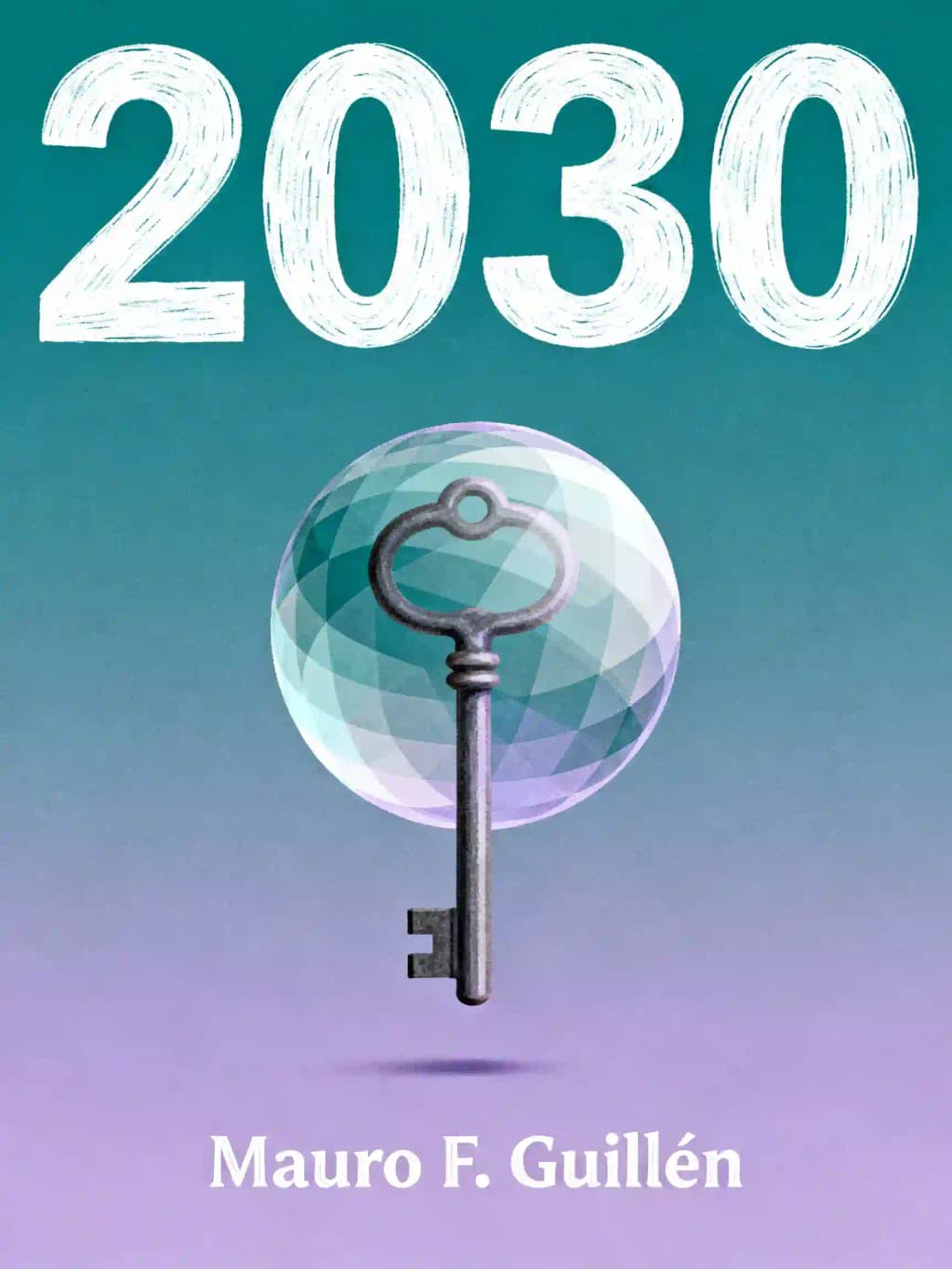
By 2030, women will control over half of global wealth, while people over 60 will outnumber children under 10. Wall Street Journal bestseller that Adam Grant calls essential reading for navigating our rapidly transforming world - where Asia's middle class will reshape everything.
Mauro F. Guillén, author of the Wall Street Journal bestseller 2030: How Today's Biggest Trends Will Collide and Reshape the Future of Everything, is a Spanish-American sociologist and political economist renowned for analyzing global macroeconomic trends.
As the William H. Wurster Professor of Multinational Management at the Wharton School and former Dean of Cambridge Judge Business School, Guillén combines academic rigor with real-world insights into demographic shifts, technological disruption, and economic globalization—core themes explored in 2030.
His other works include The Perennials and the award-winning academic text Models of Management, establishing him as a leading voice on organizational strategy and future studies. Guillén’s expertise has been featured in the Financial Times, The Economist, and major speaking engagements worldwide, including the World Economic Forum.
A trustee of Spain’s Fundación Princesa de Asturias, he bridges academic research and global policy. 2030 has been translated into 15 languages and named a Financial Times Book of the Year, solidifying its status as a critical resource for understanding 21st-century transformations.
2030 explores how demographic shifts, technological advancements, and global economic trends will collide to reshape society by the next decade. Key themes include declining birth rates, aging populations, women’s rising financial influence, and innovations like AI and blockchain. Guillén analyzes how these forces will redefine industries, urban living, and climate resilience, offering actionable insights for businesses and individuals.
This book is ideal for business leaders, policymakers, and futurists seeking to understand global trends. Entrepreneurs will gain insights into emerging markets, while individuals interested in demographic changes, technology’s societal impact, or climate adaptation strategies will find actionable forecasts. Students of economics and sociology also benefit from Guillén’s interdisciplinary approach.
Yes—Guillén combines rigorous research with accessible analysis to map transformative trends. A Wall Street Journal bestseller and Financial Times Book of the Year, it’s praised for its relevance to post-pandemic challenges and its balanced examination of opportunities vs. risks in industries like healthcare and finance.
Guillén forecasts a population decline in developed nations, an African economic boom driven by youth demographics, and women controlling over half of global wealth. He also predicts widespread adoption of 3D printing, blockchain-based currencies, and AI-driven workplace automation, alongside intensified climate-related urban challenges.
The book highlights a “silver economy” where tech-savvy seniors drive demand for age-friendly innovations, from healthcare robotics to flexible retirement models. Guillén argues businesses must adapt to older consumers’ purchasing power, while governments face pressure to overhaul pension systems amid longer lifespans.
Technologies like AI, decentralized finance, and renewable energy systems are central. Guillén discusses ethical dilemmas in autonomous AI, the decline of traditional banking due to cryptocurrencies, and 3D printing’s disruption of manufacturing. He emphasizes tech’s dual role in solving crises (e.g., climate) and creating new inequalities.
By 2030, women will hold most global wealth and leadership roles, reshaping consumer markets and corporate policies. Guillén links this to higher education rates, delayed childbirth, and inheritance shifts. He cites examples like female-led sustainability initiatives and “pink capitalism” targeting gender-specific products.
Some critics note its optimistic assumptions about tech solving climate issues and underplaying geopolitical risks. Others argue regional disparities (e.g., Africa’s growth potential) lack granularity. However, Guillén’s integration of COVID-19’s impact in later editions strengthens its real-world relevance.
Unlike singular-focus tech analyses, 2030 interweaves demographics, economics, and culture, akin to Hans Rosling’s Factfulness but with a business lens. It avoids dystopian tones common in climate-focused works, instead offering pragmatic strategies for adaptation—a balance praised by The Economist and Financial Times.
He advises investing in lifelong learning, diversifying income via the gig economy, and prioritizing sustainability. Businesses should target aging populations and emerging markets, while policymakers must reform immigration and green infrastructure policies. Individuals are urged to embrace financial literacy and tech adaptability.
As a Wharton sociologist-economist, Guillén blends data-driven trends (e.g., birth rates, GDP shifts) with cultural analysis. His work with the World Economic Forum and Fortune 500 companies informs real-world examples, from China’s middle-class boom to European aging crises, lending credibility to his forecasts.
“Follow the babies and follow the money” underscores demography and capital as trend drivers. Another standout: “The future belongs to those who see the invisible”—a call to anticipate shifts like digital currencies or urban climate resilience before they dominate headlines.
저자의 목소리로 책을 느껴보세요
지식을 흥미롭고 예시가 풍부한 인사이트로 전환
핵심 아이디어를 빠르게 캡처하여 신속하게 학습
재미있고 매력적인 방식으로 책을 즐기세요
The world's focus on millennials is misguided.
Puffery is wasted on them.
Immigrants are economic powerhouses.
Follow the babies.
Gray is the New Black.
2030의 핵심 아이디어를 이해하기 쉬운 포인트로 분해하여 혁신적인 팀이 어떻게 창조하고, 협력하고, 성장하는지 이해합니다.
2030을 빠른 기억 단서로 압축하여 솔직함, 팀워크, 창의적 회복력의 핵심 원칙을 강조합니다.

생생한 스토리텔링을 통해 2030을 경험하고, 혁신 교훈을 기억에 남고 적용할 수 있는 순간으로 바꿉니다.
무엇이든 물어보고, 목소리를 선택하고, 진정으로 공감되는 인사이트를 함께 만들어보세요.

샌프란시스코에서 컬럼비아 대학교 동문들이 만들었습니다
"Instead of endless scrolling, I just hit play on BeFreed. It saves me so much time."
"I never knew where to start with nonfiction—BeFreed’s book lists turned into podcasts gave me a clear path."
"Perfect balance between learning and entertainment. Finished ‘Thinking, Fast and Slow’ on my commute this week."
"Crazy how much I learned while walking the dog. BeFreed = small habits → big gains."
"Reading used to feel like a chore. Now it’s just part of my lifestyle."
"Feels effortless compared to reading. I’ve finished 6 books this month already."
"BeFreed turned my guilty doomscrolling into something that feels productive and inspiring."
"BeFreed turned my commute into learning time. 20-min podcasts are perfect for finishing books I never had time for."
"BeFreed replaced my podcast queue. Imagine Spotify for books — that’s it. 🙌"
"It is great for me to learn something from the book without reading it."
"The themed book list podcasts help me connect ideas across authors—like a guided audio journey."
"Makes me feel smarter every time before going to work"
샌프란시스코에서 컬럼비아 대학교 동문들이 만들었습니다

2030 요약을 무료 PDF 또는 EPUB으로 받으세요. 인쇄하거나 오프라인에서 언제든 읽을 수 있습니다.
Imagine waking up in 2030. The world's economic center has shifted to Asia, women control most global wealth, your city grows food in vertical farms, and you rarely own anything outright. This isn't science fiction - it's the meticulously researched forecast of our near future. By 2030, we'll witness a convergence of revolutionary changes already underway: dramatic demographic shifts, climate challenges, technological disruption, and economic power redistribution. These transformations will fundamentally alter how we live, work, and relate to one another. What makes this vision particularly compelling is how seemingly unrelated trends - Africa's baby boom, the rise of the elderly, women's wealth accumulation, and digital currencies - are weaving together to create a world that will feel utterly transformed. The question isn't whether these changes will happen, but how we'll navigate them. Are we prepared for a future that's arriving faster than most realize?