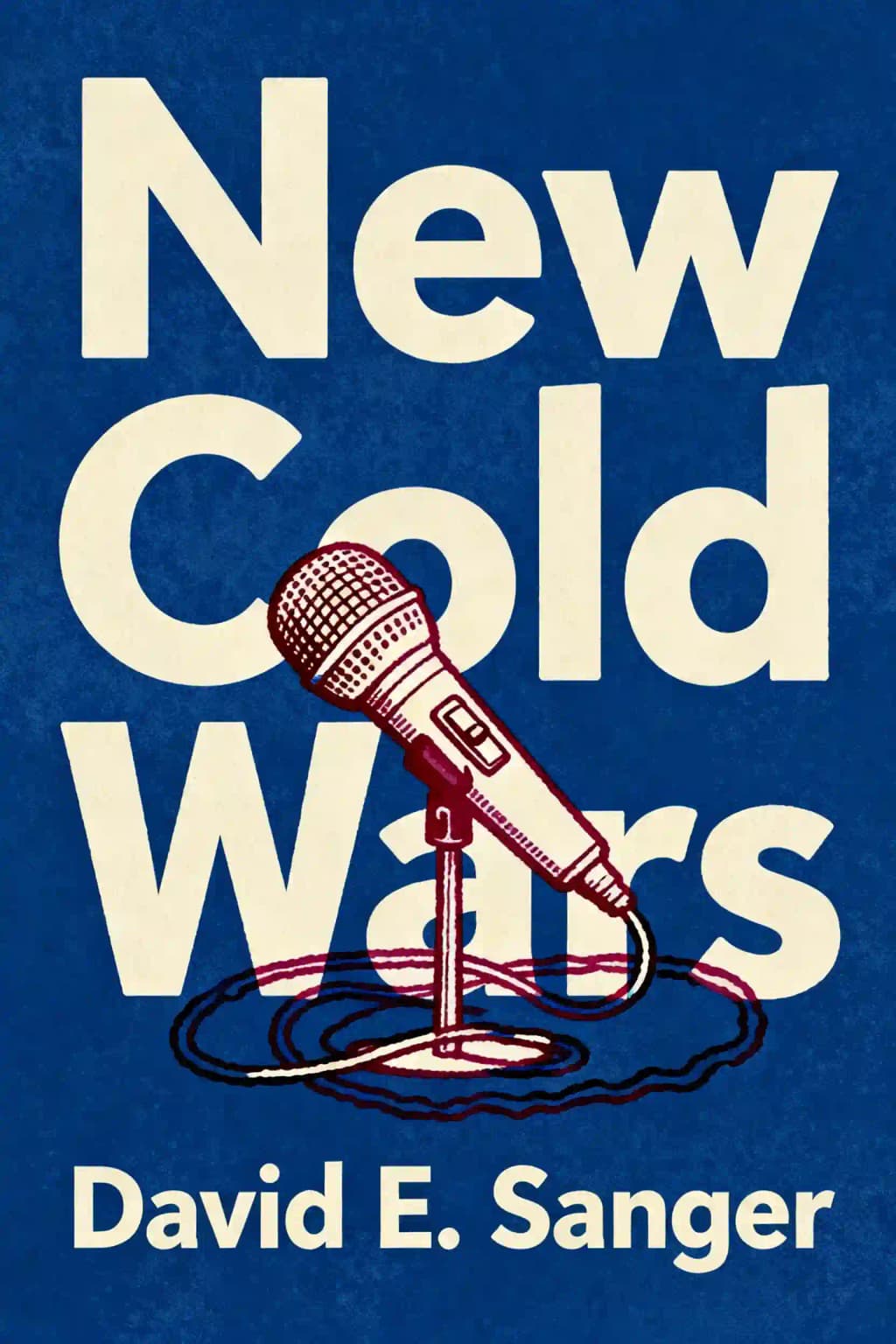
Pulitzer winner David Sanger's bestselling "New Cold Wars" reveals how America navigates China's rise and Russia's aggression. Drawing from five presidential administrations, it exposes the high-stakes struggle for global supremacy that's reshaping our world. What miscalculations led us here?
David E. Sanger, Pulitzer Prize-winning journalist and bestselling author of New Cold Wars: China’s Rise, Russia’s Invasion and the Struggle to Defend the West, is a leading authority on national security and geopolitical strategy. A White House and national security correspondent for The New York Times, Sanger draws on decades of frontline reporting to analyze modern superpower rivalries, cyberwarfare, and diplomatic crises. His expertise stems from roles spanning Tokyo bureau chief, Washington correspondent, and adjunct lecturer at Harvard Kennedy School, where he co-teaches national security policy.
Sanger’s prior works, including The Perfect Weapon: War, Sabotage and Fear in the Cyber Age (adapted into an HBO documentary) and Confront and Conceal: Obama’s Secret Wars, established him as a definitive voice on covert conflicts and presidential decision-making.
A three-time Pulitzer recipient, including for revelations about Russian election interference, he regularly contributes to CNN and major policy forums. New Cold Wars merges his investigative rigor with insights from global leaders, offering a timely examination of America’s strategic challenges. The book expands on themes from his earlier bestsellers, resonating amid escalating US-China tensions and renewed focus on authoritarian threats.
New Cold Wars analyzes the resurgence of geopolitical tensions between the U.S., China, and Russia, framing today’s conflicts as a multidirectional Cold War. Sanger argues that America’s post-Cold War assumptions about economic interdependence curbing authoritarianism failed, leading to unpreparedness for Xi Jinping’s assertiveness and Putin’s invasion of Ukraine. The book blends historical context, policy critiques, and interviews with global leaders.
This book is essential for policymakers, students of international relations, and readers interested in U.S. foreign policy challenges. It offers insights for those seeking to understand modern power dynamics, nuclear proliferation risks, and the erosion of globalization. Sanger’s journalistic style also appeals to general audiences navigating today’s complex geopolitical headlines.
Yes—Sanger’s Pulitzer-winning expertise and access to senior officials provide a gripping, timely analysis of global crises. The book’s examination of U.S. missteps in managing China’s rise and Russia’s aggression makes it critical for understanding 2020s geopolitics. However, critics note its Cold War analogy may oversimplify nuanced rivalries.
Key arguments include:
Sanger highlights differences: today’s conflicts involve three nuclear powers (U.S., China, Russia), not two, and are shaped by technology rivalry. Unlike the 20th-century ideological clash, current tensions stem from territorial disputes, resource competition, and autocratic consolidation. However, proxy wars and alliance-building tactics remain central.
Some scholars argue the Cold War metaphor oversimplifies China’s unique ambitions and Russia’s regional focus. Critics also note Sanger’s focus on U.S. perspectives may downplay Global South agency. However, his warnings about nuclear escalation and cyber threats are widely endorsed.
As a New York Times national security correspondent and Harvard lecturer, Sanger leverages decades of access to intelligence officials and global leaders. His prior books on cyber conflict (The Perfect Weapon) and presidential decision-making (Confront and Conceal) inform the analysis.
The book highlights tech as a battleground: China’s dominance in semiconductors, Russia’s cyber sabotage, and U.S. struggles to secure AI infrastructure. Sanger warns that losing the tech race could undermine military and economic superiority.
It details NATO’s delayed response to Putin’s 2014-2022 escalations, arguing Western overconfidence in deterrence allowed the invasion. Sanger praises Ukraine’s resilience but criticizes fragmented sanctions and energy policy missteps.
Key moments include:
With ongoing tensions in Taiwan, Ukraine, and AI regulation debates, Sanger’s warnings about simultaneous crises remain urgent. The book’s policy prescriptions align with 2025 U.S. debates over semiconductor investment and NATO expansion.
저자의 목소리로 책을 느껴보세요
지식을 흥미롭고 예시가 풍부한 인사이트로 전환
핵심 아이디어를 빠르게 캡처하여 신속하게 학습
재미있고 매력적인 방식으로 책을 즐기세요
Putin's Russia seemed too feeble to worry about.
Like trying to nail Jell-O to the wall.
China's changing intentions.
Insatiable desire to dominate.
Great power competition had already arrived.
New Cold Wars의 핵심 아이디어를 이해하기 쉬운 포인트로 분해하여 혁신적인 팀이 어떻게 창조하고, 협력하고, 성장하는지 이해합니다.
New Cold Wars을 빠른 기억 단서로 압축하여 솔직함, 팀워크, 창의적 회복력의 핵심 원칙을 강조합니다.

생생한 스토리텔링을 통해 New Cold Wars을 경험하고, 혁신 교훈을 기억에 남고 적용할 수 있는 순간으로 바꿉니다.
무엇이든 물어보고, 목소리를 선택하고, 진정으로 공감되는 인사이트를 함께 만들어보세요.

샌프란시스코에서 컬럼비아 대학교 동문들이 만들었습니다
"Instead of endless scrolling, I just hit play on BeFreed. It saves me so much time."
"I never knew where to start with nonfiction—BeFreed’s book lists turned into podcasts gave me a clear path."
"Perfect balance between learning and entertainment. Finished ‘Thinking, Fast and Slow’ on my commute this week."
"Crazy how much I learned while walking the dog. BeFreed = small habits → big gains."
"Reading used to feel like a chore. Now it’s just part of my lifestyle."
"Feels effortless compared to reading. I’ve finished 6 books this month already."
"BeFreed turned my guilty doomscrolling into something that feels productive and inspiring."
"BeFreed turned my commute into learning time. 20-min podcasts are perfect for finishing books I never had time for."
"BeFreed replaced my podcast queue. Imagine Spotify for books — that’s it. 🙌"
"It is great for me to learn something from the book without reading it."
"The themed book list podcasts help me connect ideas across authors—like a guided audio journey."
"Makes me feel smarter every time before going to work"
샌프란시스코에서 컬럼비아 대학교 동문들이 만들었습니다

New Cold Wars 요약을 무료 PDF 또는 EPUB으로 받으세요. 인쇄하거나 오프라인에서 언제든 읽을 수 있습니다.
Picture a winter morning in 2021. Intelligence analysts slide a folder across the desk to President Biden-inside lies irrefutable proof that Russian tanks will soon roll into Ukraine. Halfway around the globe, Xi Jinping oversees China's most aggressive military expansion in generations, while semiconductor factories in Taiwan hum with production of the chips that power everything from your iPhone to America's most advanced fighter jets. The post-Cold War dream-that democracy and free markets would inevitably triumph-has collided with a harsh reality: authoritarian powers are back, and they're playing for keeps. We're no longer living in the stable, predictable world we thought we'd built after the Berlin Wall fell. Instead, we've stumbled into something far more dangerous-a world where America faces not one, but multiple adversaries simultaneously, each armed with nuclear weapons and twenty-first-century technology.