1장
Awakening to the Unimaginable
What if you woke up one morning to find yourself transformed into a monstrous insect? This is the haunting premise of Franz Kafka's masterpiece "The Metamorphosis," a work that has captivated readers since its publication in 1915. The novella's surreal opening line has become one of literature's most famous beginnings, immediately plunging us into an absurd yet eerily relatable nightmare. Kafka's tale of alienation has influenced countless artists, from filmmaker David Lynch to musician David Bowie, who cited it as inspiration for his Berlin-era work. Beyond its literary significance, the book has permeated popular culture, with references appearing in everything from The Simpsons to Japanese manga. Psychologists regularly use the text to explore themes of identity crisis and family dynamics, while business schools analyze it as a commentary on dehumanizing work environments. What makes this century-old story continue to resonate so powerfully? Perhaps because, at its core, it speaks to our deepest fears about rejection, isolation, and the fragility of human connection.
2장
The Transformation and Its Immediate Aftermath
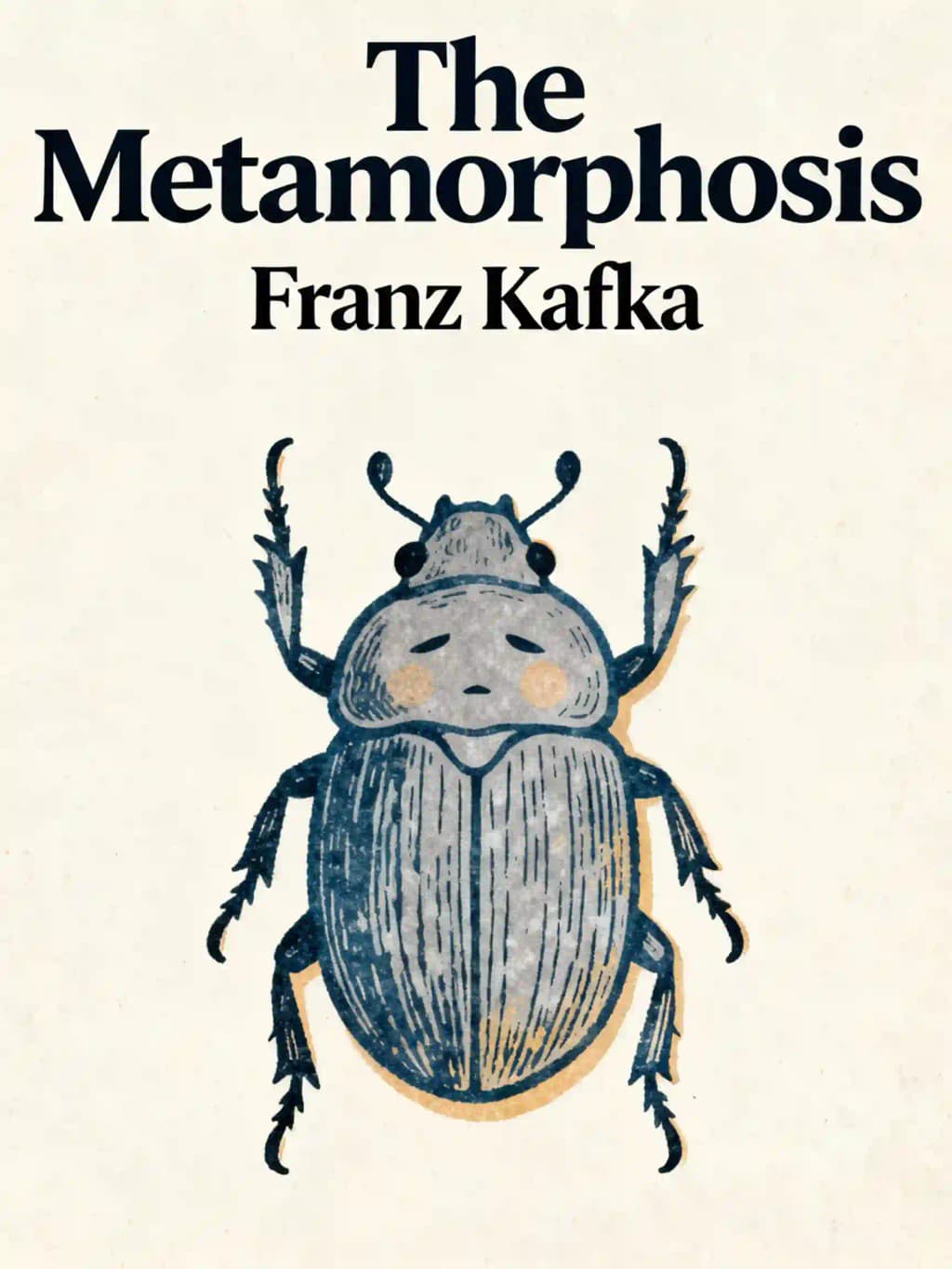
Gregor Samsa's morning begins with a shocking discovery - he has metamorphosed into a giant insect-like creature. Lying on his hard, shell-like back, his thin legs waving helplessly before him, Gregor initially treats this biological impossibility with surprising calm. His first concerns aren't existential but practical: How will he get to work? What will his boss say? Will he make the next train? This juxtaposition of the fantastical with mundane worries creates the distinctive Kafkaesque atmosphere that permeates the entire story. The matter-of-fact narration of this impossible event sets the tone for the surreal narrative that follows.
The transformation immediately highlights Gregor's oppressive work life and the dehumanizing nature of his profession. As a traveling salesman, he endures constant travel on pre-dawn trains, irregular meals in strange towns, and superficial relationships with clients and innkeepers - a life that has already dehumanized him before his physical transformation. His cramped bedroom, filled with fabric samples and commercial catalogs, reflects the way his identity has been consumed by his occupation. His job is not a calling but a burden he bears to pay off his parents' substantial debt to his employer, a obligation that weighs on him like the new shell he now bears on his back. The five-to-six-year timeline he's calculated for this repayment has become the horizon of his existence, trapping him in a cycle of obligation and servitude that mirrors his new physical imprisonment.
When Gregor realizes he's missed his 5 a.m. train, his panic reveals how deeply he's internalized his role as provider and company man. Despite his grotesque transformation, his thoughts fixate on his perfect attendance record - five years without a single sick day, even during minor illnesses and challenging weather. He fears his boss, who already visits employees' homes at the slightest infractions, will send the company doctor who would declare him "perfectly healthy but lazy," showing how thoroughly his identity has been colonized by capitalist values of productivity and reliability. The chief clerk's rapid appearance at his home demonstrates the suffocating surveillance under which Gregor lives.
As his family begins knocking on his door with increasing urgency - first his sister Grete, then his mother with her gentle entreaties, and finally his father with authoritarian demands - Gregor attempts to respond normally, but his voice emerges as an unrecognizable squeaking. This communication barrier becomes the first of many that will isolate him from his family, marking the beginning of his exile within his own home. His locked bedroom door - a habit developed from his traveling days to protect his privacy - becomes a physical boundary that mirrors the emotional distance growing between them, transforming from a symbol of his independence to one of his imprisonment.
Gregor's struggle to control his new body is described with painful precision and mounting frustration. Each attempt to rise from bed proves increasingly difficult, his many small legs moving chaotically beyond his control, scratching helplessly at the air. His efforts to roll onto his side result only in rocking motions that leave him exactly where he started. This physical helplessness foreshadows his growing powerlessness within the family structure he once dominated as breadwinner. His transformation has not only changed his body but will fundamentally alter his place in the household's hierarchy, reducing him from provider to burden, from son to creature, from human to other.
3장
The Confrontation and Rejection
When Gregor's manager arrives to investigate his absence, the scene escalates from domestic concern to professional crisis. The manager's immediate suspicion - wondering if Gregor has mishandled cash collections - reveals the fundamentally distrustful nature of his workplace. Even after five years of perfect service, Gregor remains under constant scrutiny, treated as potentially dishonest until proven otherwise.
The family dynamics quickly shift as Gregor's parents begin making excuses for their son's unusual behavior. His mother insists he must be ill despite his earlier denial, while his father impatiently suggests the manager enter Gregor's room. Their different approaches - mother protecting, father enforcing - establish a pattern that will continue throughout the story. Meanwhile, Gregor's sister sobs in the next room, already sensing the family tragedy unfolding.
When Gregor finally manages to open his door, revealing his transformed state, the reactions are visceral and defining. The manager recoils in horror, his mother faints, and his father begins to cry. These initial responses - fear, unconsciousness, and grief - represent the three primary ways humans react to the unimaginable. Gregor desperately tries to reason with the fleeing manager, still believing he can salvage his job and normal life, but his animal sounds only intensify their horror.
The father's transformation is particularly striking. His initial tears quickly give way to rage as he uses a cane and newspaper to force Gregor back into his room. This violent rejection establishes a new relationship between father and son - one where the previously dependent father now asserts dominance through physical force. The painful scene culminates with Gregor's body becoming stuck in the doorway, his wide insect form unable to pass through this human-sized opening. His father's impatient shove forces him through, scraping his body painfully against the doorframe and leaving "ugly blotches" - physical markers of his rejection from human space.
This brutal reentry into his room, bleeding and disoriented, completes Gregor's first day as an insect. The slamming door behind him symbolizes his expulsion from family life and human society. In just hours, he has moved from valued provider to repulsive creature, from family member to hidden shame.
4장
Adaptation and New Routines
As days pass, Gregor begins adapting to his new existence. His physical wounds heal surprisingly quickly, suggesting his body possesses resilience his spirit may lack. He discovers new abilities - crawling across walls and ceiling brings him particular satisfaction, and he develops a different relationship with his transformed body. These small pleasures represent his attempts to find meaning within his radically altered circumstances.
His sister Grete emerges as his primary caretaker, bringing food twice daily while their parents sleep. Her initial compassion manifests in thoughtful gestures - positioning a chair by the window for him, leaving the inner casement open. Yet her care comes with emotional distance; she rushes to throw open the window as if suffocating in his presence and cannot bear to witness his eating habits. When she arrives earlier than usual one day and sees him at the window, her retreat confirms to Gregor that his appearance remains intolerable even to his most sympathetic family member.
Gregor's response to her distress reveals his enduring humanity. He spends four exhausting hours dragging a sheet onto the couch to conceal himself completely when she enters, a gesture she seems to appreciate. This act of self-erasure - hiding his insect form to spare his sister discomfort - shows how Gregor continues to prioritize his family's feelings above his own, maintaining his human capacity for empathy despite his transformation.
His parents' reaction proves more complex. For two weeks, they cannot bring themselves to visit him, though they acknowledge their daughter's newfound usefulness in caring for him. They wait outside while she cleans, demanding detailed reports about his condition. His mother soon wants to visit, crying out for her "unlucky son," but his father and sister initially restrain her. Gregor, overhearing these conversations, thinks perhaps weekly visits from his mother might be good, as she understands things better than his "childlike" sister - showing his continued desire for parental connection despite his alienation.
Throughout this period, Gregor maintains his human consciousness and understanding of language, allowing him to eavesdrop on family conversations. He learns that contrary to his belief, some money remained from his father's failed business, supplemented by interest and Gregor's earnings. This revelation forces him to reconsider his role as sole provider and the narrative he had constructed around his sacrifice for the family.
5장
The Shifting Family Dynamic
As weeks pass, the family's initial shock gives way to a new reality. Gregor's transformation has catalyzed profound changes in the household's economic and emotional landscape. His father, previously retired and dependent, must return to work as a bank messenger at an advanced age. His mother, suffering from asthma, begins sewing undergarments for a fashion shop. His seventeen-year-old sister Grete, once enjoying a comfortable life of nice clothes and violin practice, now works as a salesgirl while studying stenography and French in the evenings.
This reversal of fortunes carries psychological consequences. Gregor's father undergoes a striking metamorphosis of his own - from a frail, dependent old man to an upright bank employee in a tight blue uniform who stubbornly wears his servant's uniform even at home. This transformation mirrors Gregor's in reverse: as Gregor loses his human form and dignity, his father regains his. The power dynamic that once defined their relationship - provider son and dependent father - has completely inverted.
Gregor observes these changes through his partially open door, watching evening family gatherings with a mixture of longing and guilt. These quiet scenes reveal their diminished circumstances: his mother sewing by lamplight, his sister studying after her sales job, his father often falling asleep in his chair, still in uniform. The family's financial decline is marked by tangible losses - they've dismissed their servant girl, replacing her with a bony cleaning woman who comes only for the heaviest work, and family jewelry has been sold.
Gregor's physical condition deteriorates alongside the family's circumstances. The apple embedded in his back from his father's attack remains a painful reminder of violence and rejection. His mobility decreases, and he barely eats anymore, occasionally taking food into his mouth before spitting it out. His room has become a storage area for unwanted household items, forcing him to navigate through piles of junk - a physical manifestation of his reduced status in the family.
The cleaning woman, unlike the family members, shows curiosity rather than revulsion toward Gregor, regularly opening his door to peek at him and calling him "old dung beetle." Her lack of fear when he turns toward her in anger - merely lifting a chair as if to strike him - demonstrates how thoroughly unthreatening he has become. Once the family's powerful provider, Gregor now cannot even intimidate the household help.
6장
The Intruders and the Violin
The family's financial pressures force them to rent a room to three bearded, meticulously tidy gentlemen. These lodgers represent yet another intrusion into what was once Gregor's domain - the home he provided through his labor. Their presence pushes more household items into Gregor's room, further crowding his already diminished space and symbolizing his continued marginalization.
The family's relationship with these lodgers reveals their desperation. They eat in the kitchen while the lodgers dine in the living room, served by Gregor's mother and sister. The father bows to them deferentially, a humiliating posture for a man who once ran his own business. Watching them eat, Gregor laments, "I really do have an appetite, but not for these things. How these lodgers stuff themselves, and I am dying" - a statement that captures his physical decline and emotional starvation.
When Gregor's sister begins playing violin in the kitchen one evening, the lodgers invite her to perform in the living room. This moment represents a potential turning point - Grete's musical talent, which Gregor had once hoped to nurture by sending her to the conservatory, might now become a source of income and respect for the family. The parents, overly polite to their renters, arrange everything for this impromptu concert.
Drawn by the music, Gregor ventures into the living room despite being filthy with dust and debris. This is his most daring transgression of boundaries since his transformation, motivated not by hunger or physical need but by emotional longing. The music awakens memories of his human aspirations and familial love. As he listens, he fantasizes about confessing to his sister his intentions to send her to the conservatory, imagining her staying with him voluntarily, sitting beside him as he reveals his plans.
This poignant fantasy reveals Gregor's deepest desire - not to regain his human form but to be acknowledged for his human heart, to have his sacrifices and intentions recognized. The music momentarily bridges the gap between his insect body and human consciousness, allowing him to reconnect with his pre-transformation identity as a loving brother with dreams for his sister's future.
However, the lodgers soon lose interest in the performance and retreat to the window, signaling that Grete's talent will not save the family after all. This rejection foreshadows the final rejection Gregor himself is about to face.
7장
The Final Rejection and Death
The discovery of Gregor in the living room becomes the catalyst for his sister's definitive rejection. Previously his most sympathetic caretaker, Grete now declares to their parents: "We must try to get rid of it." Her use of "it" rather than "him" marks the complete dehumanization of her brother in her eyes. She argues that if this creature were really Gregor, it would have understood that humans cannot live with such an animal and would have left voluntarily.
This cruel logic - that the real Gregor would have sacrificed himself for the family's sake - perversely acknowledges his pre-transformation selflessness while using it as justification for abandoning him now. When she cries, "I won't pronounce the name of my brother in front of this monster," she completes his exile from the family by denying him even his name.
Gregor, overhearing this conversation, recognizes the truth in his sister's words. He has become a burden, and his continued presence prevents the family from moving forward. With immense effort, he turns himself around and begins crawling back to his room, astonishingly weak after months of neglect and starvation. No one urges him on; no word interrupts his journey. This final, painful return to his room mirrors his earlier forced retreat but is now undertaken voluntarily - his last act of sacrifice for his family.
Once in his room, Gregor discovers he can no longer move at all, yet feels "strangely content" as his pains gradually weaken. He remembers his family with "deep feeling and love," accepting that he must disappear. As the tower clock strikes three in the morning, his head sinks down, and his last breath flows weakly from his nostrils - a gentle end to his monstrous existence.
The cleaning woman discovers his motionless body the next morning, announcing bluntly, "It's kicked the bucket!" The family's reaction to his death combines relief with ritualized mourning. Father crosses himself in thanks to God, and the women follow his example. Grete remarks on how thin he's become, noting that he hadn't eaten for so long - a belated recognition of his suffering that comes too late to help him.
8장
Rebirth and Moving Forward
The morning of Gregor's death brings more than just an end - it marks a beginning for the family. The cleaning woman opens the window wide to the fresh March air, symbolizing renewal and the literal airing out of the apartment after months of confinement. When the three lodgers emerge from their room looking for breakfast, Father appears in his uniform with Mother and Grete on either arm, presenting a united family front for the first time since Gregor's transformation.
"Get out of my apartment immediately," Father demands of the lodgers, who leave in humiliated haste. This assertion of authority - calling it "my apartment" rather than "our apartment" - signals his reclamation of the patriarchal role Gregor once held. The family watches them descend the staircase, feeling increasingly relieved as they disappear from view, suggesting that these outsiders, like Gregor, had become unwelcome intrusions in their home.
The family's swift transition from Gregor's death to planning their future carries an unsettling callousness. They decide to rest and take a stroll, having "earned a break from work." They write letters of apology to their employers and dismiss the cleaning woman when she attempts to describe how she disposed of "that rubbish from the next room" - refusing to acknowledge even Gregor's remains with dignity.
Their outing becomes a symbolic rebirth. Father, Mother, and Grete leave the apartment together for the first time in months, taking the electric tram outside the city. Sitting in the warm sun, they discuss their promising future prospects and plans to find a smaller, better-situated apartment. The parents notice how their daughter has "blossomed into a beautiful young woman despite recent troubles," and silently agree it's time to find her a good husband.
As their journey ends, Grete stretches her young body, seemingly confirming their new dreams and intentions. This final image - the sister's stretching body, full of youth and potential - contrasts sharply with the rigid corpse of Gregor left behind. The family has completed its own metamorphosis, shedding Gregor like an outgrown exoskeleton to emerge into a new life.
This ending forces us to confront uncomfortable questions: Was Gregor's sacrifice necessary for the family's growth? Did his transformation and death ultimately serve a purpose by forcing his dependent family to become self-sufficient? Or does the ease with which they move on suggest that human connections are fundamentally conditional, lasting only as long as mutual benefit exists?
9장
The Enduring Power of Kafka's Vision
Kafka's genius lies in creating a narrative that functions simultaneously as family drama, existential parable, and social critique. The story's premise - a man transformed into a monstrous insect - seems fantastical, yet the emotional and psychological dynamics it explores feel disturbingly familiar. We recognize the family's initial shock giving way to routine accommodation of horror, their gradual withdrawal of affection as Gregor ceases to be useful, and their eventual rationalization of abandonment.
The transformation itself remains deliberately unexplained. No cause is given, no cure suggested, no moral lesson explicitly drawn. This absence of explanation forces readers to supply their own interpretations. Is Gregor's metamorphosis a manifestation of depression or burnout? A metaphor for serious illness or disability? A representation of how capitalism reduces workers to disposable functions? All these readings find support in the text, making it endlessly interpretable across different cultural and historical contexts.
Perhaps most disturbing is how quickly the extraordinary becomes ordinary. The family's adjustment to Gregor's condition mirrors our own capacity to normalize the unthinkable. They develop routines around his care, then routines around his neglect, and finally routines that exclude him entirely. This progression illustrates how humans can adapt to almost anything, finding ways to continue daily life alongside even the most profound horrors.
The story also explores the fragility of identity when stripped of social function. Gregor's transformation reveals how much of his human status depended on his role as provider. Once unable to work, he quickly loses his place in the family, his voice in decisions, and ultimately his recognition as a person. This brutal equation of worth with utility continues to resonate in our achievement-oriented society.
Kafka's vision of alienation - being physically present yet emotionally exiled, understanding others perfectly while being completely misunderstood - captures a fundamental modern anxiety. The glass wall between Gregor and his family, where he can see and hear them but cannot make himself understood, represents the essential loneliness many feel even among loved ones. This communication barrier becomes the true tragedy of the story - not the physical transformation itself but the isolation it creates.
A century after its publication, "The Metamorphosis" remains startlingly contemporary in its exploration of family obligation, economic pressure, and the contingent nature of love. Its surreal premise allows Kafka to expose psychological truths that more realistic fiction might approach more cautiously. By making the metaphor literal - a man actually becoming an insect rather than merely feeling like one - Kafka forces us to confront the dehumanizing potential in our own relationships and social structures.
The enduring power of this slim novella lies in its refusal to offer comfort or closure. It presents the horror of rejection without sentimentality, the pain of isolation without melodrama, and the possibility that we are all, ultimately, expendable in the lives of even those closest to us. This unflinching vision continues to disturb and fascinate readers, making "The Metamorphosis" not just a classic of literature but a perpetually relevant examination of what it means to be human in an often inhuman world.