1장
When Dreams and Reality Blur: A Journey Through Murakami's Labyrinth
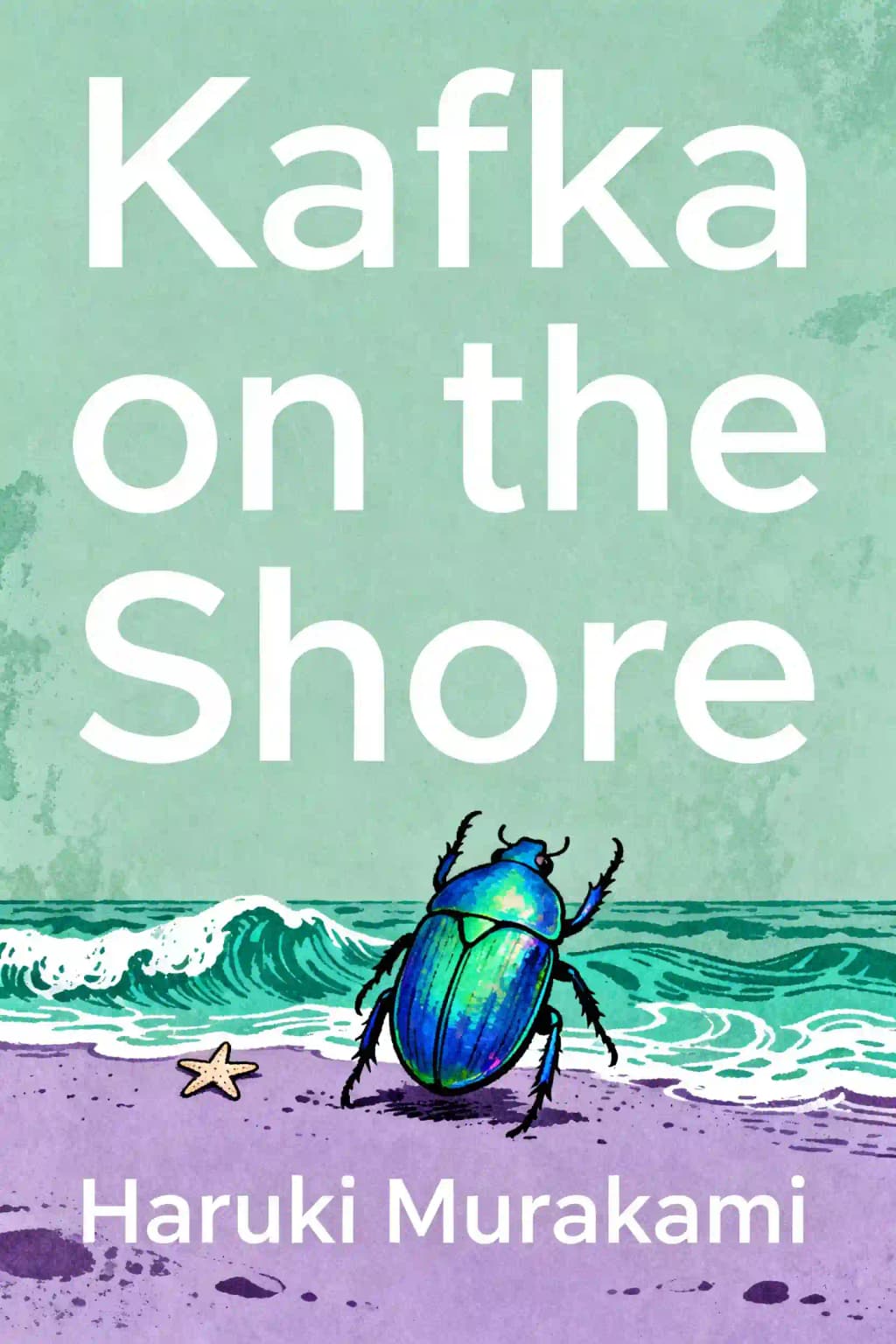
In Haruki Murakami's surreal masterpiece "Kafka on the Shore," reality and fantasy dance together in a mesmerizing tango. This novel has captivated millions worldwide since its publication, earning praise from literary giants like Philip Roth and becoming a staple on celebrity bookshelves from David Bowie to Emma Watson. Its cultural impact extends beyond literature-inspiring music, art installations, and even theatrical adaptations. The novel's exploration of identity, fate, and consciousness continues to resonate with readers seeking to understand the boundaries between dreams and reality in their own lives. As we step into this labyrinth of interconnected stories, prepare to question everything you thought you knew about the nature of existence itself.
2장
The Runaway and the Prophet: Two Journeys Begin
Fifteen-year-old Kafka Tamura sits in his carefully organized room with his imaginary friend Crow, meticulously reviewing his escape plan one final time. With 400,000 yen stolen from his father's desk and a small backpack containing only essential items, he's resolved to flee on his fifteenth birthday. "You need to be the world's toughest fifteen-year-old," Crow tells him, his voice both mentor and conscience, warning of an approaching metaphorical sandstorm that will strip away everything familiar and transform him completely. "When you come out of the storm, you won't be the same person who walked in."
Meanwhile, in a modest apartment in Nakano Ward, Tokyo, elderly Nakata lives a carefully structured life. After a mysterious childhood accident left him unable to read, write, or retain complex memories, he developed an extraordinary ability to communicate with cats. He lives on a government subsidy, maintaining simple daily routines and speaking in an peculiarly formal third-person manner that reflects his altered consciousness: "Nakata is not very bright," he often tells people, with disarming honesty.
These parallel stories form the novel's intricate backbone, weaving together themes of loss, destiny, and transformation. Kafka, physically disciplined from years of weight training and running, carries emotional wounds that have hardened into armor. His preparations have been exhaustive: learning to live on minimal sleep, studying maps and bus schedules, and carefully cultivating an expressionless face that reveals nothing. In his backpack, he carries precisely chosen items: three changes of clothes, a small toiletry kit, his precious Walkman with fifteen carefully selected music discs, and a single worn photograph showing himself at age four with his sister. His mother and sister's abandonment when he was four left a void that shaped his entire childhood, forcing him to navigate life with a brilliant but emotionally distant father, a renowned sculptor whose cold presence fills their large house like a shadow.
Nakata's journey originates in a mysterious wartime incident. During a school mushroom-gathering expedition in the mountains of Yamanashi Prefecture, sixteen children inexplicably collapsed in a field. When Nakata finally awoke weeks after the others, he had been transformed - his memories and intellectual capabilities erased, but replaced with an inexplicable ability to converse with cats. This gift becomes his primary connection to the world, leading him to work as a finder of lost cats in his neighborhood, where he's known as an odd but gentle presence. His simple life follows predictable patterns until the search for a particular cat named Goma begins to pull him toward extraordinary events.
As Kafka boards the night bus to Takamatsu on his birthday, watching Tokyo's lights recede through tinted windows, and Nakata accepts a new missing cat case from an elegant woman in expensive clothes, neither can comprehend how their destinies are already entangled. Their separate journeys will converge through a series of events that challenge the boundaries between dreams and reality, drawing them both inexorably toward a mysterious "entrance stone" that serves as a portal between parallel worlds. Their paths, though beginning miles apart, are destined to intersect in ways that will forever alter both their lives and the very fabric of reality itself.
3장
The Library: A Sanctuary of Knowledge and Secrets
The Komura Memorial Library emerges as Kafka's sanctuary in Takamatsu, its imposing structure a testament to traditional Japanese architecture. This elegant private library, specializing in tanka and haiku poetry collections dating back to the Meiji period, is housed in a stately two-story building surrounded by ancient stone walls and meticulously maintained gardens. Here, Kafka meets two pivotal figures: Oshima, a refined young librarian whose encyclopedic knowledge spans Western philosophy to Japanese literature, and Miss Saeki, the mysterious middle-aged head librarian whose presence seems to exist between past and present.
The library transcends its role as mere setting to become a living entity, its rooms and corridors housing not just books but layers of memory and meaning. The building's careful preservation extends to every detail, from the original wood paneling to the antique reading lamps that cast warm pools of light across polished tables. The special guest room, where literary giants like Tanizaki once worked, becomes Kafka's temporary home, its walls seemingly absorbing the creative energy of past occupants. Each morning, sunlight filters through the high windows, creating patterns that seem to map the intersection of different timeframes.
Oshima, who becomes Kafka's mentor and protector, gradually reveals the complexity of his identity. His character embodies the novel's exploration of gender fluidity and self-determination. "My body is physically female, but my mind's completely male," he explains during a confrontation with feminist visitors who challenge the library's traditional classification system. This scene becomes a powerful meditation on identity politics and the limitations of binary thinking. Oshima's extensive knowledge of Greek tragedy and German philosophy provides Kafka with intellectual tools to understand his own journey.
Miss Saeki's connection to the library runs deeper than her professional role. In her youth, she and her boyfriend spent countless hours in these rooms, their love story intertwined with the building's history. The song "Kafka on the Shore," which she wrote for him, became a cultural phenomenon of its era, its lyrics echoing through Japan's coffee shops and radio stations. His death during the student protests of the 1960s - a case of mistaken identity during a violent demonstration - transformed both Miss Saeki and the library into repositories of grief. After vanishing for two decades, she returned changed, moving through the library's spaces like a living ghost.
The library functions as a metaphysical crossroads where different planes of existence intersect. Its reading rooms witness the blurring of boundaries between the physical and spiritual worlds, particularly at night when the fifteen-year-old version of Miss Saeki appears, drawn to the place where her happiness peaked. For Kafka, hiding from authorities investigating his father's murder, the library becomes both refuge and revelation - a place where he can explore the labyrinth of his own identity while seeking connections to his lost mother. The building's architecture seems designed for such temporal slippages, its quiet corners and hidden spaces perfect for encounters that challenge the laws of reality.
4장
Parallel Worlds: When Metaphors Become Reality
In Murakami's universe, metaphors don't merely describe reality-they become reality. The boundaries between the literal and figurative dissolve, creating a world where cats speak, fish rain from the sky, and spirits move between different planes of existence. This slippage between metaphor and reality is central to understanding the novel's structure and meaning.
Oshima explains this concept directly: "It's all a question of imagination. Our responsibility begins with the power to imagine." Later, he tells Kafka, "The world is a metaphor," suggesting that what we perceive as concrete reality is actually fluid and interpretable. This perspective helps explain the novel's more fantastical elements, from Nakata's ability to talk with cats to the entrance stone that opens pathways between worlds.
The forest surrounding Oshima's mountain cabin exemplifies this metaphorical landscape. When Kafka ventures into its depths, he's not merely walking through trees but entering his own subconscious. "This forest is basically a part of me," he realizes. "The journey I'm taking is inside me." The labyrinthine woods represent his internal confusion, while the soldiers he meets-deserters from Imperial Japan who haven't aged in decades-embody aspects of historical trauma and suspended time.
Similarly, the strange figures who appear to Nakata and his companion Hoshino-Johnnie Walker who harvests cats' souls, and Colonel Sanders who helps find the entrance stone-aren't merely surreal characters but personifications of conceptual forces. Colonel Sanders explicitly states he's "neither god nor Buddha" but an "overseer" who maintains "the correlation between different worlds."
Perhaps most striking is how prophecy functions in the novel. When Kafka's father predicts his son will kill his father and sleep with his mother and sister, these metaphorical statements manifest in complex ways that both fulfill and subvert the Oedipal prophecy. Kafka wakes covered in blood the night his father is murdered (though Nakata is the actual killer), and he has sexual encounters with both Miss Saeki (who may be his mother) and Sakura (who may be his sister).
This slippage between metaphor and reality creates the novel's dreamlike quality, where meaning is both elusive and overdetermined. Characters must navigate a world where symbols become substance and where, as Oshima says, "everything's a metaphor."
5장
The Ghosts Among Us: Memory, Loss, and Lingering Spirits
Ghosts haunt the pages of "Kafka on the Shore," not as supernatural horrors but as manifestations of memory and unresolved emotion. The most prominent is the fifteen-year-old version of Miss Saeki who visits Kafka's room at night, gazing at the painting "Kafka on the Shore" that depicts her lost love as a boy. This apparition isn't merely a specter but what Oshima calls a "living spirit"-an aspect of Miss Saeki that became detached when her life effectively ended at twenty.
"In Japanese literature, there's a lot about living spirits," Oshima explains. "The Tale of Genji is filled with living spirits who wander the earth. They're different from ghosts. Ghosts are the residue of the dead, while living spirits are the residue of the living." This distinction is crucial to understanding how memory functions in the novel-not as something past and separate, but as an active force that shapes and intrudes upon the present.
Miss Saeki herself exists in a liminal state, physically present but emotionally elsewhere. "I went off to some other world, a place beyond anybody's reach," she tells Kafka. "A place beyond the flow of time." Her hit song "Kafka on the Shore" serves as a bridge between worlds, its lyrics eerily prophetic of events in Kafka's life. When she finally decides to die, she describes herself as "waiting for death... like sitting on a bench at the station, waiting for the next train."
Other characters experience different forms of haunting. Nakata is haunted by his lost abilities and memories, living as half a person with "only half a shadow." Kafka is haunted by the absence of his mother and sister, carrying their photographs and searching for their faces in strangers. Even Hoshino, initially the most pragmatic character, becomes haunted by Nakata after his death, hearing his voice and continuing his mission.
The novel suggests that these hauntings aren't supernatural anomalies but natural extensions of human experience. Memory doesn't simply record the past; it actively shapes the present and future. The dead don't simply disappear; they linger in our consciousness, influencing our actions and perceptions. As Miss Saeki tells Kafka before her death: "I want you to remember me. If you don't care if everybody else forgets."
6장
Violence and Redemption: The Price of Transformation
Violence permeates "Kafka on the Shore," from the gruesome cat murders committed by Johnnie Walker to Nakata's retaliatory stabbing, from Kafka's prophesied patricide to the rape-like dream encounter with Sakura. Yet the novel treats violence not as sensational but as transformative-a painful but sometimes necessary catalyst for change and growth.
The most explicit violence occurs when Nakata confronts Johnnie Walker, who systematically kills cats to harvest their souls for a special flute. Walker forces Nakata to watch as he cuts open cats, removes their still-beating hearts, and eats them. This grotesque scene culminates in Nakata stabbing Walker repeatedly-an act that seems to fulfill the prophecy that Kafka would kill his father, as Walker is later revealed to be Kafka's father Koichi Tamura.
This violence initiates a chain of events that propels both narratives forward. Nakata leaves Tokyo for the first time in his life, drawn toward Takamatsu by forces he doesn't understand. Meanwhile, Kafka, who wakes covered in blood the night of his father's murder despite being hundreds of miles away, must confront the possibility that he somehow participated in the killing through supernatural means.
Less physical but equally significant forms of violence appear throughout the novel. The sexual encounters between Kafka and Miss Saeki contain elements of violation-she initially mistakes him for her dead lover, while he suspects she might be his mother. His dream of raping Sakura explicitly crosses moral boundaries, fulfilling another part of his father's curse. Even Oshima's hemophilia represents a kind of internal violence-his body unable to stop bleeding without external intervention.
Yet from these violent acts come possibilities for redemption and transformation. Nakata's killing of Walker frees him to discover his true purpose. Kafka's transgressions force him to confront his deepest fears and desires. By the novel's end, both have undergone profound changes that wouldn't have been possible without these violent catalysts.
The boy named Crow tells Kafka: "Sometimes fate is like a small sandstorm that keeps changing directions... This storm is you. Something inside of you." This metaphor suggests that violence isn't external but internal-a necessary disruption of comfortable patterns that allows for growth and change. The novel doesn't glorify violence but acknowledges its transformative power in human experience.
7장
Music as Gateway: Harmony Between Worlds
Music serves as a powerful connector between worlds in "Kafka on the Shore," bridging gaps between characters, time periods, and dimensions. From Miss Saeki's haunting song "Kafka on the Shore" to the classical compositions that transform Hoshino, music functions as both plot device and thematic element, creating resonances that words alone cannot achieve. Throughout the novel, musical moments mark pivotal transformations and revelations, serving as waypoints on characters' journeys.
The titular song "Kafka on the Shore" forms the novel's emotional core. Written by nineteen-year-old Miss Saeki for her boyfriend, it unexpectedly became a hit that continues generating royalties decades later. The lyrics describe a boy sitting on a shore-the same image captured in the painting in Kafka's room-and contain eerily prophetic lines about fish falling from the sky and knives piercing dreams. The song's structure mirrors the novel's own cyclical nature, with verses that loop back on themselves like memory itself. When Kafka finally hears the record, he's struck by its unusual chords that create "something both direct and mysterious," recognizing how the song connects to his own experiences. The melody haunts him, appearing in dreams and memories that may not be his own, suggesting music's ability to transcend individual consciousness.
Classical music plays an equally important role, particularly for Hoshino. Initially a truck driver with little cultural refinement, he undergoes a profound transformation after hearing Beethoven's Archduke Trio in a coffee shop. "Like my body's spitting out all the toxins that have built up inside," he describes the experience. This musical awakening leads him to explore other composers - from Mozart's playful complexity to Bach's mathematical precision - each piece adding layers to his understanding of both music and himself. Later, listening to Schubert with Oshima, Kafka learns about the beauty of imperfection-how every pianist struggles with the D Major Sonata's paradoxical nature, adding their own interpretation to make it work. This becomes a metaphor for life itself: the necessity of finding personal meaning within apparent contradictions.
Even pop music carries significance. Kafka's collection of Radiohead, Prince, and John Coltrane recordings provides not just entertainment but emotional anchoring during his isolation in Oshima's cabin. Each artist represents different aspects of his emotional journey - Radiohead's alienation, Prince's sexuality, Coltrane's spiritual seeking. When his batteries die and silence descends, he discovers "silence itself is something you can actually hear"-a revelation that prepares him for deeper listening to the world around him. This progression from recorded music to silence mirrors his journey from external seeking to internal understanding.
Music in the novel represents the possibility of communication beyond language. It expresses what characters cannot say directly and connects them across boundaries of time and space. When Oshima quotes Berlioz saying life without music would be "like a life spent in a coal mine," he's articulating the novel's view that music isn't merely entertainment but essential to human experience-a gateway between the visible world and what lies beyond. The various musical references create a complex tapestry of meaning, where classical pieces intersect with pop songs and silence itself becomes a form of music, all working together to illuminate the novel's themes of identity, memory, and transcendence.
8장
Fate and Free Will: Can We Escape Our Prophecies?
A central tension in "Kafka on the Shore" is whether characters can escape their predetermined fates or whether their attempts at freedom merely fulfill prophecies in unexpected ways. This question manifests most explicitly in Kafka's struggle against his father's Oedipal curse that he will kill his father and sleep with his mother and sister.
"It's like everything's been decided in advance," Kafka tells Oshima. "I feel like I'm losing my free will... Like I'm caught in a maze." Despite fleeing Tokyo to escape this prophecy, Kafka finds himself potentially fulfilling it anyway. His father is murdered while Kafka is far away, yet he wakes covered in blood. He becomes sexually involved with Miss Saeki, who may be his mother, and has an erotic dream about Sakura, who may be his sister.
This pattern suggests that resistance to fate may be futile or even counterproductive. As Oshima tells Kafka: "For you, the prophesy is like a timing device buried inside your genes... And nothing can change what's already decided." Yet the novel doesn't present a simplistic view of determinism. Instead, it suggests that how we respond to our fate-the meaning we create from predetermined events-matters profoundly.
Nakata's story offers a different perspective on fate. After his childhood accident, he accepts his limitations with remarkable equanimity, never questioning why he lost his abilities or lamenting what might have been. "Nakata's not so bright, but I know what I have to do," he repeatedly states. His acceptance of his circumstances allows him to fulfill his purpose-finding and moving the entrance stone-with a clarity that more self-aware characters lack.
The entrance stone itself symbolizes this tension between fate and free will. It must be turned over at the right moment by the right person to open a passage between worlds. This action is both predetermined (only certain people can move it) and a matter of choice (they must decide to do so). Similarly, when the soldiers guide Kafka through the forest to the strange village where time doesn't exist, they tell him he must choose whether to stay or return: "You need to use your own judgment."
By the novel's end, Kafka makes peace with the ambiguity of his situation. Whether or not he literally fulfilled his father's curse becomes less important than his decision to return to the world and "live." As the boy named Crow tells him: "You're the toughest fifteen-year-old in the world. No one can get you now." This toughness isn't about escaping fate but about facing it with courage and integrity.
9장
The Return: Closing the Circle
The novel concludes with both protagonists completing their journeys, though in dramatically different ways. Nakata dies peacefully in his sleep after fulfilling his mission to burn Miss Saeki's memories and locate the entrance stone. Kafka, after venturing into the forest's depths and meeting the fifteen-year-old Miss Saeki in a timeless village, chooses to return to the world he left behind.
Nakata's death represents a completion rather than a tragedy. Having restored balance by moving the entrance stone and helping Miss Saeki, he can finally rest. His companion Hoshino inherits his unfinished task-closing the entrance stone to prevent a strange, slug-like entity from passing through. This transfer of responsibility shows how connections between people continue beyond death, with Hoshino acknowledging how Nakata will always live inside him.
Kafka's return journey is more complex. In the forest village where time doesn't exist, he meets the fifteen-year-old Miss Saeki and finally asks if she's his mother. Though her answer remains ambiguous-"You already know the answer"-she confesses to abandoning someone she shouldn't have out of fear. Kafka forgives her, and they share a ritual-like moment where he tastes her blood. "Farewell, Kafka Tamura," she tells him. "Go back where you belong, and live."
This instruction to "live" echoes throughout the final chapters. Despite the temptation to remain in the timeless village with the eternally young Miss Saeki, Kafka chooses to return to the world of consequences and linear time. He plans to face the police in Tokyo, return to school, and build a new life. This choice represents not a defeat but a victory-an acceptance of reality with all its imperfections and responsibilities.
On the train back to Tokyo, Kafka remembers Miss Saeki's words: "If you remember me, then I don't care if everyone else forgets." This memory, like the painting "Kafka on the Shore" that she leaves him in her will, becomes his connection to what he's experienced. The boy named Crow reassures him he did the right thing, promising that when he wakes, he'll be "part of a brand-new world."
The novel thus ends not with resolution but with possibility-the entrance stone closed but the characters transformed by their encounters with what lies beyond it. In Murakami's world, closure isn't about answering all questions but about learning to live with ambiguity and finding meaning in the journey itself.