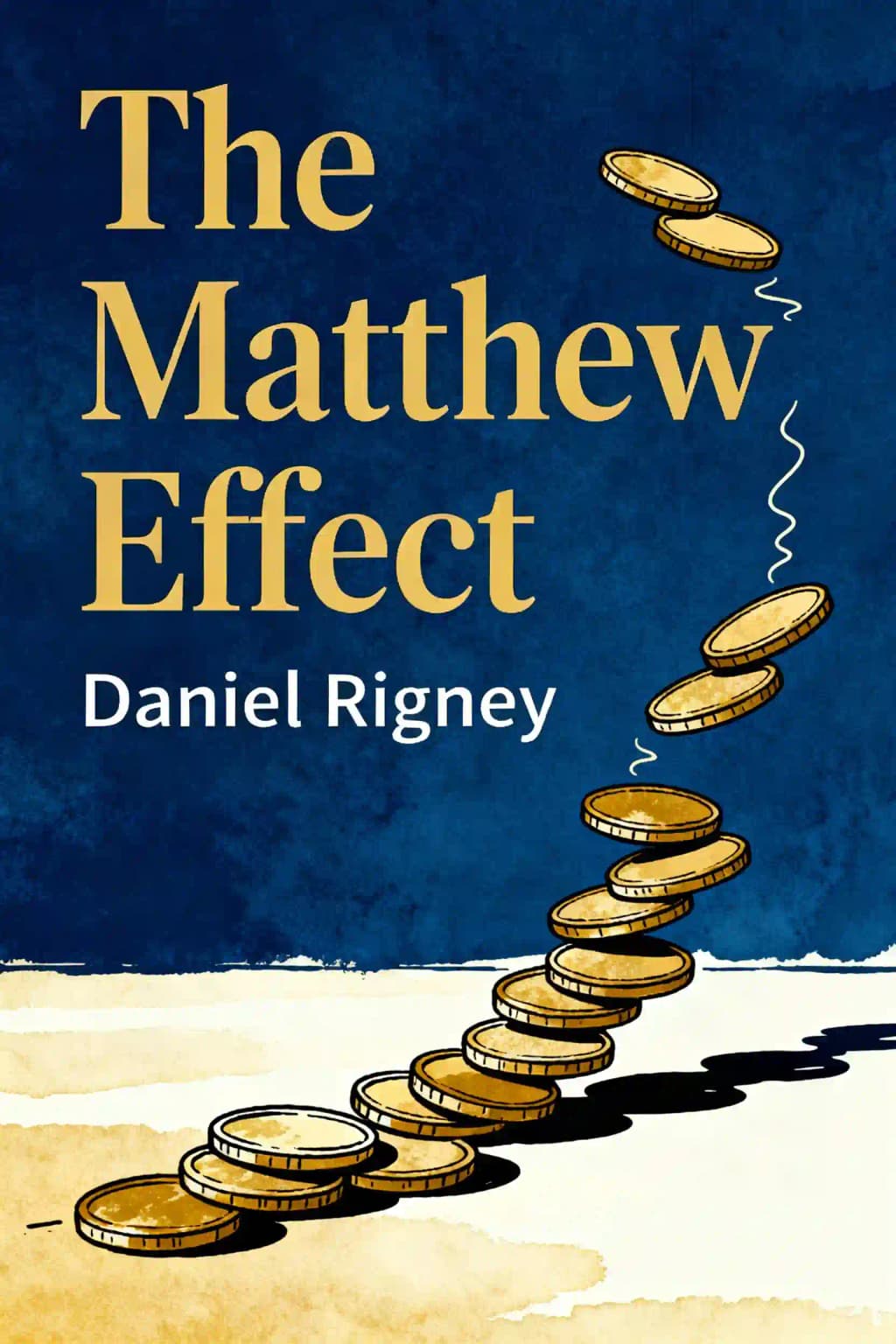
Why do the rich get richer? "The Matthew Effect" reveals how advantage snowballs across science, education, and economics. Praised for making complex sociology accessible, Rigney's work challenges our assumptions about inequality - sparking crucial debates among policymakers and social scientists worldwide.
Daniel Rigney, sociologist and educator, is the author of The Matthew Effect: How Advantage Begets Further Advantage, a foundational work exploring systemic inequality through the lens of cumulative advantage.
A Professor Emeritus at St. Mary’s University and Visiting Scholar at Rice University, Rigney blends academic rigor with accessible prose to dissect societal patterns affecting education, economics, and culture. His expertise in structural disparities stems from decades analyzing how small initial advantages amplify over time, a theme central to his acclaimed book.
Rigney’s broader portfolio includes The Metaphorical Society, which examines how language shapes social understanding, and contributions to educational platforms like Region 13’s Blog, where he advocates for inclusive pedagogy. Known for bridging sociological theory with real-world applications, his work is frequently cited in discussions on equity and resource distribution. The Matthew Effect remains widely referenced in academic circles for its incisive critique of meritocracy and its enduring relevance in debates about opportunity gaps.
The Matthew Effect explores how initial advantages in social, economic, or political contexts lead to further advantages, perpetuating inequality across fields like science, education, and technology. Daniel Rigney examines sociologist Robert Merton’s concept of cumulative advantage, questioning whether these disparities are inevitable or can be mitigated through policy and social action.
This book is essential for sociologists, policymakers, educators, and readers interested in inequality dynamics. It offers insights for those analyzing systemic biases or seeking strategies to address widening social gaps through interventions like equitable resource distribution.
Yes, it provides a rigorous yet accessible analysis of a foundational sociological concept, linking academic research to real-world implications. Critics praise its interdisciplinary relevance and thought-provoking examination of countervailing forces like government policies that can disrupt disadvantage cycles.
Rigney defines it as a societal pattern where initial advantages (e.g., wealth, education) lead to further gains, while disadvantages deepen exclusion. Originating from a biblical verse in Matthew 25:29, the concept challenges assumptions about meritocracy and “natural” inequality.
While Outliers focuses on individual success factors like timing and effort, The Matthew Effect emphasizes systemic forces that structurally reinforce privilege. Rigney’s work critiques systemic inequities rather than celebrating exceptional achievement.
Some argue Rigney’s left-leaning perspective may oversimplify solutions to inequality. Others note the Matthew effect’s context-dependent complexity, where initial advantages don’t always guarantee success.
Schools in under-resourced areas often face compounded disadvantages, such as fewer advanced courses or experienced teachers. Rigney advocates for targeted funding and mentorship programs to disrupt these cycles.
A sociology professor at St. Mary’s University, Rigney specializes in inequality research. His accessible writing style bridges academic and public audiences, though some reviewers note his liberal leanings influence policy recommendations.
With AI and globalization accelerating inequality, Rigney’s analysis of systemic bias remains critical. The book’s framework helps policymakers address disparities in emerging technologies and labor markets.
저자의 목소리로 책을 느껴보세요
지식을 흥미롭고 예시가 풍부한 인사이트로 전환
핵심 아이디어를 빠르게 캡처하여 신속하게 학습
재미있고 매력적인 방식으로 책을 즐기세요
The probability of going from rags to riches remains minuscule.
The opposite of Matthew effects occurs rarely without deliberate intervention.
Social actions often produce results different from what actors intended.
Elite institutions and scientists create mutually reinforcing advantages.
The Matthew effect의 핵심 아이디어를 이해하기 쉬운 포인트로 분해하여 혁신적인 팀이 어떻게 창조하고, 협력하고, 성장하는지 이해합니다.
The Matthew effect을 빠른 기억 단서로 압축하여 솔직함, 팀워크, 창의적 회복력의 핵심 원칙을 강조합니다.

생생한 스토리텔링을 통해 The Matthew effect을 경험하고, 혁신 교훈을 기억에 남고 적용할 수 있는 순간으로 바꿉니다.
무엇이든 물어보고, 목소리를 선택하고, 진정으로 공감되는 인사이트를 함께 만들어보세요.

샌프란시스코에서 컬럼비아 대학교 동문들이 만들었습니다
"Instead of endless scrolling, I just hit play on BeFreed. It saves me so much time."
"I never knew where to start with nonfiction—BeFreed’s book lists turned into podcasts gave me a clear path."
"Perfect balance between learning and entertainment. Finished ‘Thinking, Fast and Slow’ on my commute this week."
"Crazy how much I learned while walking the dog. BeFreed = small habits → big gains."
"Reading used to feel like a chore. Now it’s just part of my lifestyle."
"Feels effortless compared to reading. I’ve finished 6 books this month already."
"BeFreed turned my guilty doomscrolling into something that feels productive and inspiring."
"BeFreed turned my commute into learning time. 20-min podcasts are perfect for finishing books I never had time for."
"BeFreed replaced my podcast queue. Imagine Spotify for books — that’s it. 🙌"
"It is great for me to learn something from the book without reading it."
"The themed book list podcasts help me connect ideas across authors—like a guided audio journey."
"Makes me feel smarter every time before going to work"
샌프란시스코에서 컬럼비아 대학교 동문들이 만들었습니다

The Matthew effect 요약을 무료 PDF 또는 EPUB으로 받으세요. 인쇄하거나 오프라인에서 언제든 읽을 수 있습니다.
Imagine playing Monopoly where one player starts with $5,000 while everyone else begins with just $500. The outcome is virtually guaranteed. This rigged game perfectly illustrates what sociologist Daniel Rigney calls "The Matthew Effect" - named after the biblical verse where "the rich get richer and the poor get poorer." This powerful social principle explains why initial advantages, however small, tend to compound dramatically over time, creating widening gaps between the haves and have-nots across nearly every domain of human life. The Matthew Effect operates through two mechanisms. In absolute Matthew effects, the advantaged gain while the disadvantaged actually lose ground - like when a corporate giant drives smaller competitors into bankruptcy. In relative Matthew effects, everyone may improve, but the advantaged improve faster - like compound interest growing a $1,000 investment to $2,594 over ten years while a $100 investment reaches only $259. Though both grew by the same percentage, the absolute gap expanded from $900 to $2,335. This snowball effect explains why success breeds success, popularity creates more popularity, and wealth generates more wealth - unless deliberately counteracted.