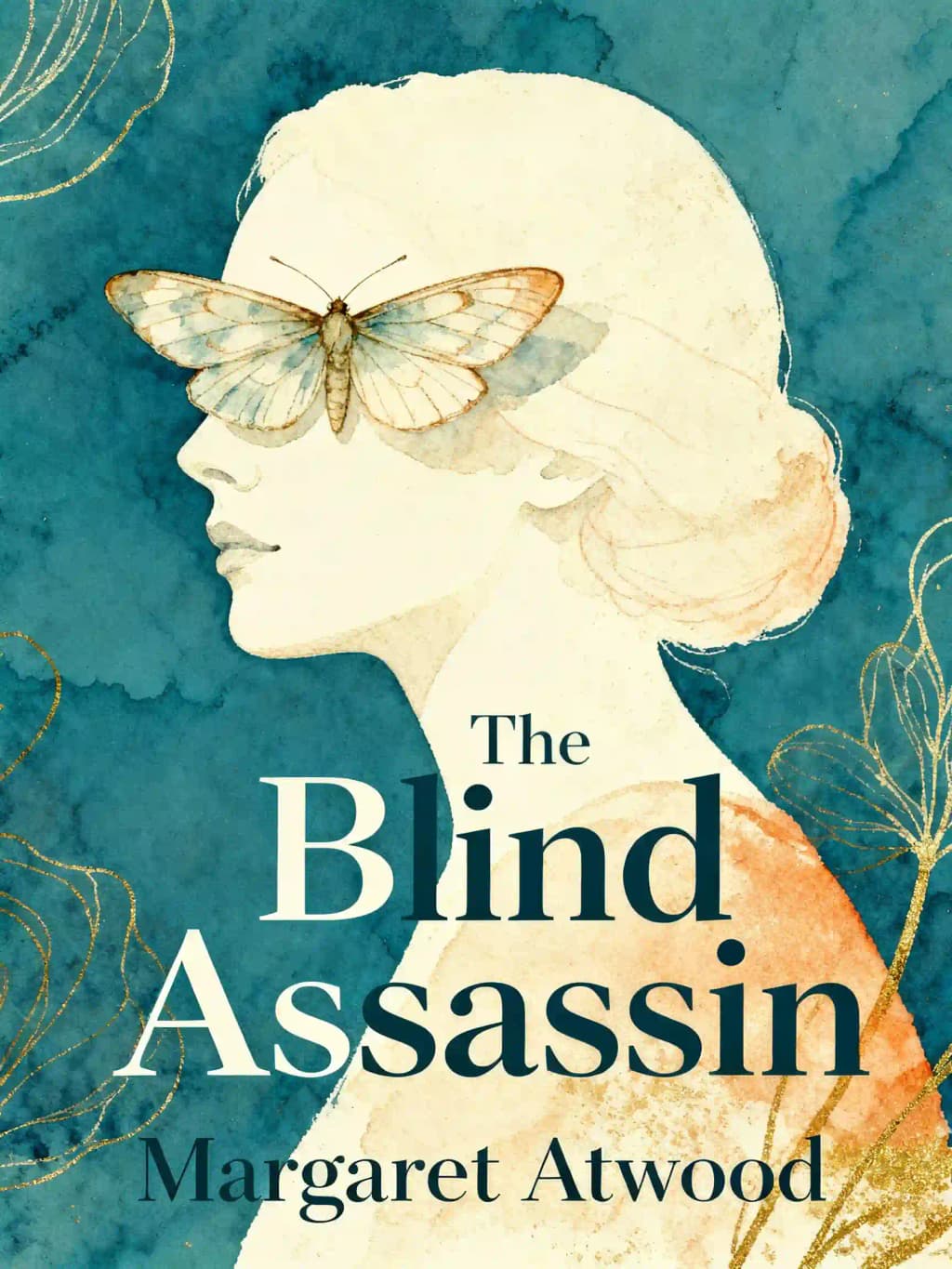
Booker Prize-winning masterpiece weaving family secrets, political upheaval, and a novel-within-a-novel. Atwood's layered narrative explores trauma, power, and female relationships during Canada's turbulent mid-20th century. Literary scholars still debate: which story reveals the true blind assassin?
Margaret Atwood, acclaimed author of The Blind Assassin, is a bestselling Canadian novelist and poet renowned for her incisive explorations of dystopian societies, gender dynamics, and speculative fiction. Born in Ottawa in 1939, Atwood’s literary career spans over six decades, anchored by her background in English literature from the University of Toronto and Radcliffe College. The Blind Assassin, a Booker Prize-winning novel, intertwines family secrets and metafiction, reflecting her signature themes of memory and identity.
A trailblazer in feminist literature, Atwood’s works include The Handmaid’s Tale—a cultural phenomenon adapted into an Emmy-winning series—and Alias Grace, which became a critically acclaimed Netflix miniseries. Her novels often blend historical context with speculative elements, cementing her authority in both literary and genre fiction.
Atwood’s influence extends beyond prose; she has penned poetry collections, essays, and contributed to environmental activism. Translated into over 40 languages, her works remain staples in academic curricula and global bestseller lists. The Blind Assassin notably marked her first Booker Prize win, further solidifying her legacy as a defining voice of contemporary literature.
The Blind Assassin intertwines the life of Iris Chase, an elderly woman recounting her family’s tragic history, with a novel-within-a-novel attributed to her deceased sister Laura. The story explores Iris’s forced marriage, Laura’s suicide, and a clandestine affair that reveals decades of betrayal, abuse, and the corrosive power of secrets. Central to the plot is Iris’s act of posthumously publishing a provocative novel under Laura’s name to expose their husband Richard’s crimes.
Fans of layered literary fiction, Margaret Atwood enthusiasts, and readers drawn to complex narratives about memory, identity, and gender dynamics will appreciate this book. Its blend of historical fiction (set in post-WWI Canada), meta-fiction elements, and psychological depth makes it ideal for those who enjoy structurally inventive stories like The Handmaid’s Tale or The Thirteenth Tale.
Key themes include:
The embedded sci-fi tale of Sakiel-Norn’s blind assassin and the doomed lovers mirrors Iris and Alex Thomas’s secret affair while commenting on the destructive consequences of willful ignorance. This nested narrative acts as both a thematic parallel and a plot device, blurring the lines between Iris’s reality and fiction to underscore how stories can conceal or reveal truth.
Laura’s suicide results from cumulative trauma: Richard Griffen’s sexual coercion and blackmail, her forced abortion, and the devastating news of Alex Thomas’s death in WWII. Her fatal car crash symbolizes both escape from oppression and the collapse of her idealized worldview.
Water symbolizes emotional turbulence and transformative reckoning. Examples include Laura’s fatal plunge off a bridge, Iris’s reflective visits to the river, and recurring rainstorms that punctuate key revelations. This motif ties to the novel’s exploration of memory’s fluidity and the inevitability of buried truths surfacing.
Iris embodies pragmatism, sacrificing her autonomy to preserve family stability, while Laura represents rebellious idealism. Their dynamic reflects divergent responses to oppression: Iris internalizes her struggles through secretive acts (writing, affair), whereas Laura externalizes hers through radical honesty and ultimate self-destruction.
As Iris’s wealthy, manipulative husband, Richard personifies patriarchal corruption. His exploitation of both sisters—economic control over Iris and sexual violence against Laura—drives the novel’s central tragedies. His eventual suicide after being framed for Laura’s novel underscores the destructive cycle of power and shame.
The conclusion reveals Iris’s confessional memoir to her granddaughter, finally exposing Richard’s crimes and reconciling Laura’s legacy. By intertwining this revelation with the sci-fi lovers’ ambiguous fate, Atwood emphasizes storytelling’s dual role as both deception and catharsis.
Some readers find the nonlinear timeline and multiple narrative layers challenging to follow. Others note the bleak portrayal of female agency, though this aligns with Atwood’s critique of systemic misogyny. Despite these critiques, the novel’s Pulitzer Prize win and enduring acclaim highlight its literary merit.
The title references both the embedded sci-fi tale about a sightless killer and the metaphorical “blindness” of characters to truth. It underscores themes of willful ignorance (Iris’s denial of Richard’s abuse) and the destructive consequences of societal complacency.
Atwood masterfully interweaves gothic family saga, political allegory, and metafiction through three distinct narratives: Iris’s memoir, Laura’s posthumous novel, and 1940s newspaper clippings. Her non-linear storytelling and rich symbolic language (e.g., button factories as fading traditions) create a haunting exploration of memory’s unreliability.
Set against Canada’s post-WWI industrialization and the Great Depression, the novel critiques class inequality and gender roles through the Chase family’s decline. References to union strikes, wartime propaganda, and McCarthy-era paranoia ground the personal drama in broader societal shifts.
저자의 목소리로 책을 느껴보세요
지식을 흥미롭고 예시가 풍부한 인사이트로 전환
핵심 아이디어를 빠르게 캡처하여 신속하게 학습
재미있고 매력적인 방식으로 책을 즐기세요
Laura wasn't the author of the novel at all.
The science fiction elements serve as more than mere entertainment.
The sisters are portrayed as fundamentally different yet inextricably linked.
Iris is the dutiful daughter who sacrifices her own happiness.
The blind assassin의 핵심 아이디어를 이해하기 쉬운 포인트로 분해하여 혁신적인 팀이 어떻게 창조하고, 협력하고, 성장하는지 이해합니다.
생생한 스토리텔링을 통해 The blind assassin을 경험하고, 혁신 교훈을 기억에 남고 적용할 수 있는 순간으로 바꿉니다.
무엇이든 묻고, 학습 스타일을 선택하고, 나에게 맞는 인사이트를 함께 만들어보세요.

샌프란시스코에서 컬럼비아 대학교 동문들이 만들었습니다
"Instead of endless scrolling, I just hit play on BeFreed. It saves me so much time."
"I never knew where to start with nonfiction—BeFreed’s book lists turned into podcasts gave me a clear path."
"Perfect balance between learning and entertainment. Finished ‘Thinking, Fast and Slow’ on my commute this week."
"Crazy how much I learned while walking the dog. BeFreed = small habits → big gains."
"Reading used to feel like a chore. Now it’s just part of my lifestyle."
"Feels effortless compared to reading. I’ve finished 6 books this month already."
"BeFreed turned my guilty doomscrolling into something that feels productive and inspiring."
"BeFreed turned my commute into learning time. 20-min podcasts are perfect for finishing books I never had time for."
"BeFreed replaced my podcast queue. Imagine Spotify for books — that’s it. 🙌"
"It is great for me to learn something from the book without reading it."
"The themed book list podcasts help me connect ideas across authors—like a guided audio journey."
"Makes me feel smarter every time before going to work"
샌프란시스코에서 컬럼비아 대학교 동문들이 만들었습니다

The blind assassin 요약을 무료 PDF 또는 EPUB으로 받으세요. 인쇄하거나 오프라인에서 언제든 읽을 수 있습니다.
What happens when you discover that everything you believed about a beloved story was a carefully constructed lie? Margaret Atwood's "The Blind Assassin" opens with a suicide - Laura Chase drives off a bridge ten days after World War II ends - and then spends the next five hundred pages unraveling why. But this Booker Prize-winning masterpiece isn't just a mystery. It's a meditation on how we construct meaning from memory, how power shapes the stories we're allowed to tell, and how silence can be both survival strategy and slow poison. Iris Chase Griffen is eighty-two, her heart failing, her time running out. From her cramped apartment in Port Ticonderoga, Ontario, she finally decides to tell the truth about her sister's death and the scandalous novel that followed it. Her narrative unfolds in fragments - memoir, newspaper clippings, obituaries - but the most compelling thread is the novel itself, "The Blind Assassin," supposedly written by Laura before her death.
The embedded novel depicts a wealthy young woman's dangerous 1930s affair with a fugitive radical, meeting in shabby rooms where he spins science fiction tales about planet Zycron-where blind children train as assassins and virgins face sacrifice. These stories-within-stories create a Russian doll effect, each narrative concealing another. We initially believe these lovers are Laura and Alex Thomas, the charismatic left-wing writer the Chase sisters once hid. But the devastating truth emerges: the lovers were Iris and Alex. Laura never wrote the novel at all. Iris crafted it as a memorial to her lost love, allowing the world to believe her dead sister was the author. This revelation forces us to reread every interaction between the sisters with fresh eyes. The novel becomes evidence-proof that Iris, not Laura, was Alex's lover, because only Iris heard these stories firsthand.
The Chase sisters grew up in Avilion - named for King Arthur's final resting place, foreshadowing tragedy. After their mother's death and the Depression's devastation of their father Norval's button factory, eighteen-year-old Iris is sold into marriage with Richard Griffen, a wealthy industrialist who sees her youth and social standing as valuable acquisitions. This is a business transaction dressed in wedding lace. Richard is controlling and cold, his sister Winifred a master manipulator who teaches Iris that "Grace comes from indifference." The marriage is socially sanctioned kidnapping where the ransom is paid upfront and the hostage must smile through dinner parties. Meanwhile, Laura - eight years younger, ethereal and otherworldly - takes words literally and maintains an unshakable moral compass. As a child, she tried drowning herself in the river, believing her sacrifice might resurrect their mother - revealing both her capacity for self-destruction and her peculiar logic. When labor unrest erupts at the Chase factory, Alex Thomas becomes a fugitive. The sisters hide him in their attic before helping him escape. Laura falls in love with Alex's idealism. Iris falls in love with Alex himself. Neither sister knows about the other's feelings until it's far too late.
During their secret meetings, Alex weaves science fiction tales for Iris about Sakiel-Norn, where blind assassins serve cruel masters and young women are sacrificed on stone altars. These stories create a coded language for discussing forbidden topics-class warfare, political resistance, power and exploitation. Through an imaginary world's safety, they speak truths too dangerous to articulate directly. One story centers on a blind assassin who falls in love with the sacrificial virgin he's supposed to kill. His blindness forces him to "see" her through touch, breathing, and warmth-a heightened perception that reveals her humanity in ways sighted people cannot. The parallel is clear: Iris and Alex's affair is also a kind of blindness, refusing to see the impossible obstacles society has placed between them. These embedded narratives serve as foreplay, political allegory, and prophecy. The science fiction elements reveal imagination as resistance-when powerless in the real world, you create other worlds where different rules apply. Alex's stories aren't escapism-they're rehearsals for revolution, testing ideas about power and freedom where consequences aren't immediately fatal.
Laura returns after escaping BellaVista, revealing something devastating: she had sex with Richard, believing this sacrifice would save Alex's life. She thought Richard knew Alex's whereabouts and her submission would buy his silence. Iris, consumed by rage, tells Laura the truth: Alex was her lover for years, and he's now dead, killed in the Spanish Civil War. This revelation-delivered as punishment-destroys Laura. Within days, she drives her car off a bridge. The novel refuses simplification. Laura's "sacrifice" achieved nothing-Richard didn't know where Alex was. Both sisters love Alex but cannot save him. Both try protecting each other, but their protection becomes betrayal. Atwood's insight: we often hurt those we love most deeply not despite our love but because of it. Atwood maps Canada's social landscape from the 1920s through the post-war era with precision. The Chase button factory represents paternalistic capitalism-Norval refuses Depression-era layoffs. Richard Griffen represents modern corporate capitalism viewing workers as disposable. Once married, Iris has no legal right to her money, household decisions, or her own body. Winifred wields power through social manipulation, teaching Iris the performative skills required of upper-class women-how to hide fear, deploy charm strategically, survive by becoming impenetrable.
Class divisions permeate every relationship. The Griffens' Rosedale mansion versus Port Ticonderoga's shabby workers' homes illustrates how economic inequality shapes material comfort, education, healthcare, justice, and the right to tell one's story. When labor unrest erupts, workers burn Chase family effigies-their rage a response to generations of exploitation. The political backdrop-the Depression, the Spanish Civil War, World War II-shapes personal relationships concretely. Richard supports Franco's Nationalists and Chamberlain's appeasement as bulwarks against Communism. Alex fights for the Republicans in Spain, representing left-wing resistance. Their positions determine who lives, who dies, who has power, who must hide. *The Blind Assassin* is ultimately about who controls stories and how narrative shapes reality. For decades, Iris remained silent while Richard and Winifred spread lies about Laura, the novel, and Iris herself. This silence poisoned the next generation-Aimee became an alcoholic who neglected her daughter Sabrina. Now, approaching death, Iris writes her memoir for Sabrina, raised on carefully constructed lies. The memoir is Iris's final rebellion-refusing to let the powerful control the narrative after she's gone. She hopes truth, however painful, will free Sabrina from family mythology. But Atwood leaves uncertain whether Sabrina will ever read it, reflecting the novel's themes about communication across barriers of time, convention, and fear.
In a world valuing convenience over complexity, "The Blind Assassin" reminds us that truth is rarely simple and never comes without cost. Iris's memoir is both an act of love - for her sister, for Alex, for the granddaughter she barely knows - and defiance against a society that silenced women. The novel's nested narratives become a meditation on storytelling's power and limitations. Newspaper clippings distort private truths. The embedded novel reveals what cannot be spoken directly. Iris's memoir attempts to set the record straight, yet she acknowledges memory's unreliability: "The only way you can write the truth is to assume that what you set down will never be read." Atwood shows us that some truths take a lifetime to articulate, that silence can be both survival strategy and slow poison. The novel asks: What do we owe the dead? The living? When is silence protection, and when is it complicity? Iris's final act reminds us that breaking silence, even when too late to save ourselves, might still save someone else.