The ultimate expose of how advertisers hijack our attention, praised as a "bracing intellectual tour de force" by critics. Tim Wu's elegant history reveals the hidden cost of "free" content and why tech insiders like James Williams warn against the attention economy's growing power.
Tim Wu, author of The Attention Merchants and a leading authority on technology policy and antitrust, is the Julius Silver Professor of Law, Science, and Technology at Columbia Law School.
His groundbreaking work on net neutrality—a term he coined—and critiques of corporate power in media and tech anchor this exploration of how industries monetize human attention.
Wu’s expertise stems from roles as a White House antitrust advisor, FTC senior counsel, and New York Attorney General fellow, alongside influential books like The Master Switch (a World Technology Award winner) and The Curse of Bigness.
A contributing opinion writer for The New York Times, his insights on digital culture and monopolies have been featured in The New Yorker, Slate, and global forums like the World Economic Forum, which named him a Young Global Leader.
The Attention Merchants, praised for its incisive analysis of advertising and media empires, solidified Wu’s reputation as a preeminent critic of attention-driven capitalism. His works are widely cited in academic and policy debates, bridging law, technology, and economics.
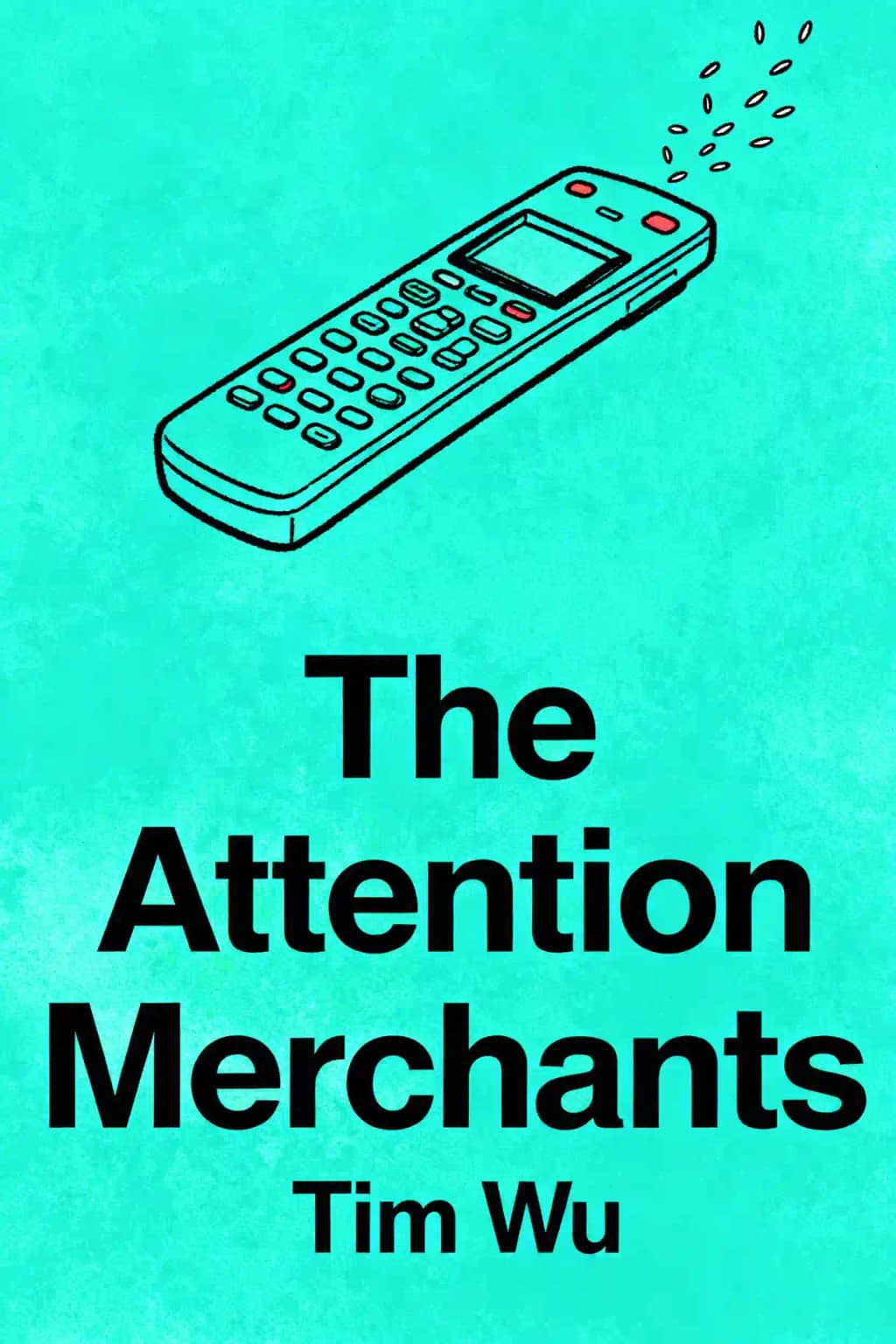
The Attention Merchants explores how human attention became a trillion-dollar commodity, tracing its commercial exploitation from 19th-century penny newspapers to modern social media algorithms. Wu reveals how industries monetize "free" content by selling audience focus to advertisers, exposing the societal costs of constant distraction and information overload. The book blends historical analysis with critiques of digital culture’s impact on mental health and democracy.
This book is essential for media professionals, marketers, tech enthusiasts, and anyone interested in understanding how advertising, news, and entertainment industries manipulate attention. It’s particularly valuable for critics of surveillance capitalism and readers seeking strategies to reclaim focus in an age of endless digital stimuli.
Yes—Wu’s gripping narrative combines rigorous research with vivid storytelling, offering a revelatory lens to examine modern media ecosystems. Its insights into attention-harvesting tactics make it a critical resource for navigating today’s information-saturated world. The book has been widely praised for its prescient analysis of social media’s societal repercussions.
Wu describes them as industries that profit by capturing and reselling human attention. Examples include early newspaper publishers selling ad space, TV networks demanding viewer time for commercials, and platforms like Facebook optimizing engagement to boost ad revenue.
The book argues that relentless attention-grabbing erodes critical thinking, promotes outrage-driven content, and undermines democratic discourse. Wu highlights how platforms prioritize engagement over truth, creating filter bubbles that amplify polarization.
Wu’s analysis foresaw platforms like Instagram and Twitter weaponizing algorithmic personalization to maximize screen time. The book explains how infinite scrolling and notifications exploit psychological vulnerabilities, making it a foundational text for understanding Web3-era attention economies.
While The Master Switch examines tech monopolies’ rise and fall, The Attention Merchants focuses on capitalism’s colonization of human cognition. Both critique centralized control over information but through distinct lenses—corporate power versus individual agency.
Wu advocates for conscious consumption habits, ad-free subscription models, and regulatory reforms to limit manipulative design. He emphasizes rebuilding public spaces free from commercial intrusion, though critics note the book focuses more on diagnosing problems than prescribing fixes.
As generative AI and metaverse platforms intensify competition for attention, Wu’s framework helps users recognize extraction tactics in emerging technologies. The book remains a touchstone for debates about digital wellness and ethical tech design.
저자의 목소리로 책을 느껴보세요
지식을 흥미롭고 예시가 풍부한 인사이트로 전환
핵심 아이디어를 빠르게 캡처하여 신속하게 학습
재미있고 매력적인 방식으로 책을 즐기세요
The basic business model of the Internet is to give away valuable stuff for free and then sell the attention of the people who consume that free stuff.
Attention is a limited resource, which makes it a currency of sorts.
The history of attention capture is, in many ways, the history of capitalism itself.
Attention being ultimately zero-sum, these new commercial claimants contributed significantly to religion's decline.
Content naturally gravitates toward the more sensational, lurid, and outrageous.
The Attention Merchants의 핵심 아이디어를 이해하기 쉬운 포인트로 분해하여 혁신적인 팀이 어떻게 창조하고, 협력하고, 성장하는지 이해합니다.
The Attention Merchants을 빠른 기억 단서로 압축하여 솔직함, 팀워크, 창의적 회복력의 핵심 원칙을 강조합니다.

생생한 스토리텔링을 통해 The Attention Merchants을 경험하고, 혁신 교훈을 기억에 남고 적용할 수 있는 순간으로 바꿉니다.
무엇이든 물어보고, 목소리를 선택하고, 진정으로 공감되는 인사이트를 함께 만들어보세요.

샌프란시스코에서 컬럼비아 대학교 동문들이 만들었습니다
"Instead of endless scrolling, I just hit play on BeFreed. It saves me so much time."
"I never knew where to start with nonfiction—BeFreed’s book lists turned into podcasts gave me a clear path."
"Perfect balance between learning and entertainment. Finished ‘Thinking, Fast and Slow’ on my commute this week."
"Crazy how much I learned while walking the dog. BeFreed = small habits → big gains."
"Reading used to feel like a chore. Now it’s just part of my lifestyle."
"Feels effortless compared to reading. I’ve finished 6 books this month already."
"BeFreed turned my guilty doomscrolling into something that feels productive and inspiring."
"BeFreed turned my commute into learning time. 20-min podcasts are perfect for finishing books I never had time for."
"BeFreed replaced my podcast queue. Imagine Spotify for books — that’s it. 🙌"
"It is great for me to learn something from the book without reading it."
"The themed book list podcasts help me connect ideas across authors—like a guided audio journey."
"Makes me feel smarter every time before going to work"
샌프란시스코에서 컬럼비아 대학교 동문들이 만들었습니다

The Attention Merchants 요약을 무료 PDF 또는 EPUB으로 받으세요. 인쇄하거나 오프라인에서 언제든 읽을 수 있습니다.
Every morning, you wake up and reach for your phone. Before your feet touch the floor, you've already handed over the first minutes of your day to invisible merchants trading in the most valuable currency of the modern age: your attention. This isn't an accident. It's the result of a carefully engineered system that's been perfecting itself for nearly two centuries. What began with a simple newspaper trick in 1833 has evolved into a sophisticated apparatus that shapes not just what you buy, but how you think, feel, and experience your own life. The question isn't whether your attention is being harvested-it's whether you'll ever get it back.