1장
Why Your Brain Is a Terrible Decision Maker
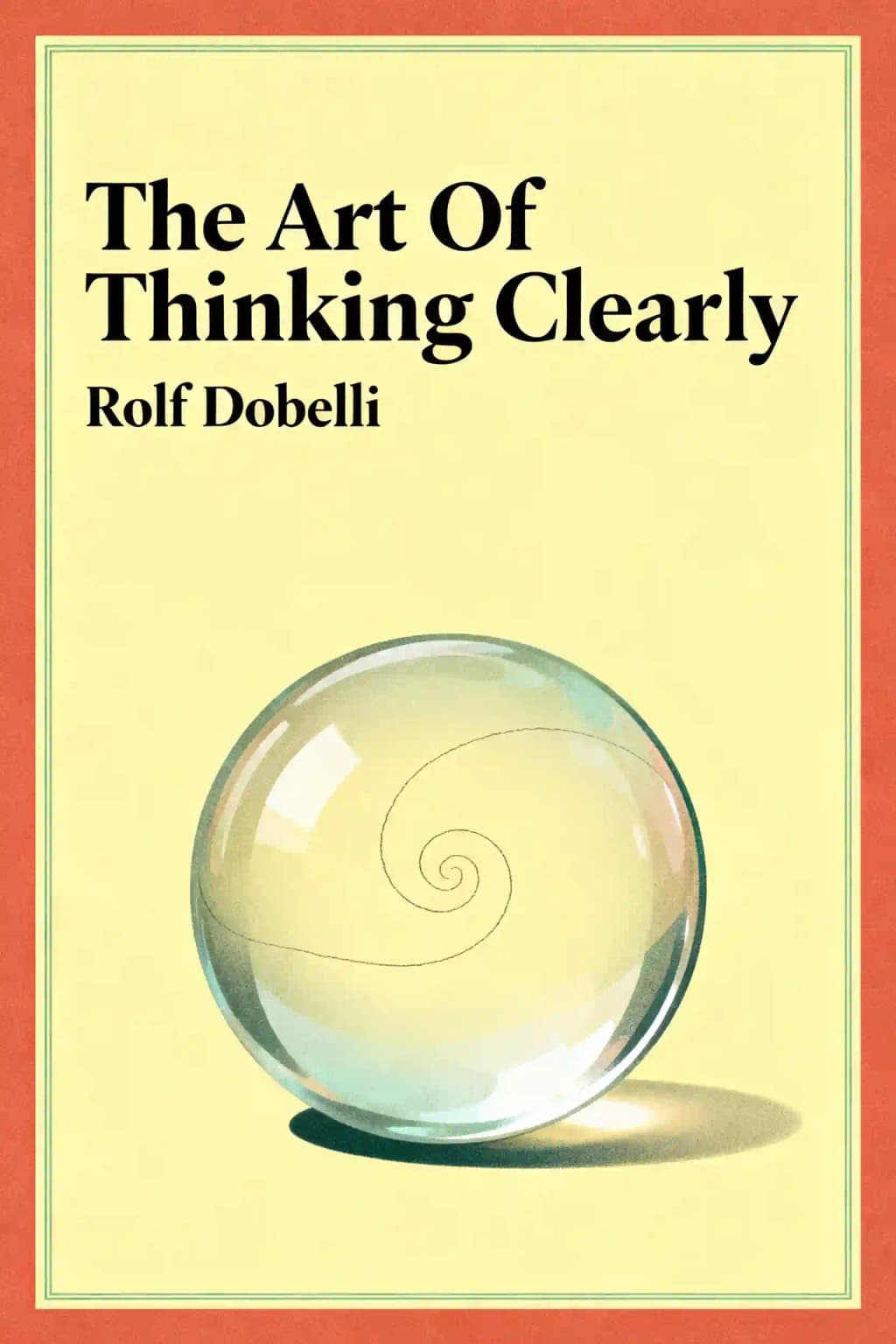
Ever notice how smart people make dumb mistakes? I certainly have. While reading Rolf Dobelli's "The Art of Thinking Clearly," I found myself nodding in recognition at the systematic errors we all make. This isn't just another self-help book-it's a survival guide for your mind. Since its 2013 publication, it has sold over 1.5 million copies worldwide, been translated into 40 languages, and earned praise from Nobel laureates and business titans alike. Even Bill Gates called it "a fascinating exploration of human psychology." What makes this book so compelling is its practical approach to cognitive biases-those predictable mental traps we fall into again and again. As Dobelli puts it, these aren't random errors but "systematic deviations from logic" that have plagued humanity for generations. Let's explore how these thinking errors affect everything from your investments to your relationships-and how to avoid them.
2장
The Invisible Failures That Shape Our Perception
When you see a successful musician on stage, it's easy to think: "With enough passion and practice, I could do that too." This dangerous illusion stems from survivorship bias-we see only the winners, never the thousands who failed pursuing the same dream. Behind every bestselling author stand hundreds of unpublished writers, each equally passionate but ultimately unsuccessful. For every Taylor Swift, there are countless talented singers performing in small bars. Stock indices represent only successful companies, not the majority that fail - the S&P 500 regularly removes failing companies, creating an illusion of consistent growth. Even scientific research suffers-statistically significant but coincidental results gain attention while correct but "boring" studies remain unpublished, creating a skewed view of scientific progress.
This bias extends beyond career choices into education and professional development. When Harvard graduates succeed, we attribute it to their education rather than recognizing they were exceptional before admission. Consider that Harvard's acceptance rate is below 5% - these students were already extraordinary achievers. The "swimmer's body illusion" operates similarly-professional swimmers don't have perfect physiques because they swim; they're good swimmers because of their natural physiques. Michael Phelps, with his unusual arm span and double-jointed ankles, exemplifies this principle. Advertisers exploit this constantly, showing us MBA graduates' high incomes without acknowledging that ambitious, capable people select these programs in the first place. They showcase the Ferrari-driving entrepreneur but not the three failed businesses that preceded their success.
Even personal happiness falls victim to this illusion. When naturally cheerful people advise "see the glass half full," they don't realize they were born that way. Studies suggest happiness is largely a fixed personality trait, with genetic factors accounting for approximately 50% of individual differences, not something easily changed through mindset. The self-help industry thrives on selling the exception as the rule. Before pursuing ideals like perfect abs, wealth, or happiness, honestly assess whether you're confusing selection factors with achievable results. A fitness model's physique might be more about genetics than their specific workout routine.
To combat survivorship bias, regularly visit the metaphorical graves of failed projects and investments. Study defunct companies like Blockbuster and Kodak, not just Apple and Amazon. Examine failed restaurants, not just successful chains. This sobering practice helps calibrate your expectations to reality and prevents you from mistaking luck for skill or conflating correlation with causation. For every successful startup that began in a garage, thousands failed in similar circumstances. Remember: what you don't see - the failures, abandonments, and quiet exits - is often more important than the visible successes that capture our attention.
3장
How Your Brain Creates False Patterns
Our brains evolved to detect patterns-a survival advantage that helped our ancestors spot camouflaged predators, track prey, and identify edible plants amid forest foliage. This pattern-recognition system was crucial for survival, but in today's complex world, this same machinery often leads us astray by finding meaning in random noise. Swedish opera singer Friedrich Jorgensen became convinced he heard voices of the dead in his recordings, spawning the pseudoscience of EVP (Electronic Voice Phenomena). Diane Duyser's famous "Virgin Mary toast" sold on eBay for $28,000, while millions saw religious figures in water stains and tree bark. The "face on Mars," which captivated public imagination for decades, proved to be nothing more than natural rock formations when NASA's high-resolution cameras finally captured clear images.
This clustering illusion becomes particularly dangerous in financial markets, where investors desperately seek predictable patterns in inherently chaotic data. Technical analysts draw elaborate trend lines on stock charts, convinced they've discovered reliable trading signals. One friend developed a complex algorithm correlating gold prices with oil futures and S&P 500 movements. The formula appeared brilliant during back-testing but failed catastrophically with real money, costing him his life savings. When presented with truly random sequences like "oxxxoxxxoxxoooxooxxoo," study participants consistently refuse to accept their random nature, spending hours searching for hidden patterns and meaning.
Our pattern-seeking tendency works in dangerous concert with confirmation bias-our unconscious habit of embracing information that supports our existing beliefs while discounting or ignoring contradictory evidence. Business executives routinely celebrate minor successes as validation of their strategy while dismissing major failures as "temporary setbacks" or "unusual circumstances." Even sophisticated investors fall prey to this bias. Warren Buffett frequently warns about the human tendency to filter information so that prior investment theories remain intact, regardless of mounting contrary evidence.
Charles Darwin developed an innovative approach to combat this cognitive blind spot. He maintained a special notebook dedicated to observations that seemed to contradict his theories of evolution, knowing that the mind naturally "forgets" or rationalizes away disconfirming evidence. This bias manifests in everyday life-whether you believe people are fundamentally good or bad, you'll unconsciously collect supporting evidence while filtering out contradicting examples. The bias thrives especially well in domains like astrology, economics, and political punditry, where predictions are deliberately vague enough to claim validation regardless of outcomes.
To overcome these deeply ingrained cognitive biases, we must actively seek evidence that challenges our most cherished beliefs. When you hear phrases like "exception to the rule" or "special case," pay particular attention-these often signal the dismissal of important contradictory evidence. Following literary critic Arthur Quiller-Couch's advice to "murder your darlings," we must ruthlessly examine our most precious assumptions, especially when they comfort us most. Regular practice in identifying and questioning apparent patterns helps develop more rigorous critical thinking.
4장
The Social Traps That Cloud Our Judgment
We're dangerously susceptible to authority figures despite their often poor track records. Stanley Milgram's famous 1961 experiment revealed this starkly: most subjects administered what they believed were lethal electrical shocks simply because an authority figure insisted they continue. This authority bias combines with our deep-seated social proof instinct-our tendency to believe ideas are better when more people follow them.
Solomon Asch's experiments showed people will deny obvious truths to conform with group opinion. This "herd instinct" makes us follow crowds in everything from stock market bubbles to fashion trends. While occasionally useful (finding restaurants in foreign cities), social proof is manipulated by advertisers and propagandists who use crowd dynamics to promote their agendas.
These social biases create particularly dangerous group dynamics. When smart people make reckless decisions because everyone aligns with the perceived consensus, that's groupthink-a special branch of social proof. The 1961 Bay of Pigs invasion exemplifies this phenomenon. President Kennedy and his brilliant advisers unanimously approved an invasion plan based on completely erroneous assumptions, resulting in one of American foreign policy's biggest failures.
Psychology professor Irving Janis identified the pattern: close-knit groups cultivate illusions, including beliefs in invincibility ("our leader is confident, so luck will favor us") and unanimity (dissent must be wrong). No one wants to risk exclusion by challenging group consensus-an evolutionary fear stemming from times when banishment meant death.
To combat these social traps: always speak your mind in unanimous groups, question tacit assumptions despite potential rejection, and if you're a leader, appoint someone as devil's advocate. They may not be popular, but they could be your most valuable team member. Remember Somerset Maugham's wisdom: "If fifty million people say something foolish, it is still foolish."
5장
Why We Can't Let Go of Bad Investments
I couldn't convince my wife to leave a terrible movie because we'd "already spent thirty dollars"-a perfect example of the sunk cost fallacy. This thinking error appears everywhere: marketing teams continuing failed campaigns despite mounting evidence, people staying in toxic relationships for years because they've "invested so much time," and investors holding losing stocks because they've "invested so much already." Even corporations fall prey to this, like Kodak's persistent investment in film technology long after digital cameras became dominant.
The more we invest-time, money, energy, love-the harder abandoning the endeavor becomes. This irrational behavior stems from our deep-seated need for consistency and our profound fear of admitting we were wrong. The "Concorde effect" (named after Britain and France's continued investment in the doomed supersonic aircraft despite clear economic warnings) leads to costly errors, from personal decisions to military campaigns like Vietnam, where escalating commitment led to years of continued warfare despite mounting evidence of futility.
This tendency connects intimately to loss aversion-our tendency to feel losses about twice as painfully as equivalent gains please us. Studies show that losing $100 feels approximately twice as bad as finding $100 feels good. This evolved because in our ancestral past, one mistake could be fatal; cautious individuals survived to pass on their genes. This asymmetry profoundly affects persuasion: highlighting how something helps avoid disadvantages works better than emphasizing benefits, as demonstrated by breast self-examination pamphlets framed in terms of "decreased chance" rather than "increased chance" of early detection. Similar effects appear in marketing, where "don't miss out" messages often outperform "gain this benefit" messaging.
We're simply more sensitive to negative stimuli-scary faces stand out more than smiling ones in crowd experiments, and we remember bad behavior longer than good. This negativity bias appears in numerous contexts: investors often hold declining stocks rather than realize losses, employees avoid risks that might bring modest rewards but career-threatening failures, and organizations continue failing projects rather than admit defeat. Research shows that negative feedback has roughly three times the impact on performance as positive feedback.
Rational decision-making requires developing the discipline to forget past investments and focus solely on future costs and benefits. Whether evaluating a failing business venture, a disappointing relationship, or a boring book you've half-finished, ask yourself: "Knowing what I know now, would I still make this choice?" If the answer is no, it's time to walk away, regardless of what you've already invested. This applies equally to small decisions (abandoning a mediocre Netflix series) and major life choices (changing careers despite years of training). The key is recognizing that past investments are irrelevant to future outcomes-only future costs and benefits matter.
6장
The Stories We Tell Ourselves
Life is a jumble of disconnected events, yet we compulsively knit these details into neat narratives we call "meaning" or "identity." We do the same with history, creating stories that explain why the Treaty of Versailles led to World War II or why the Iron Curtain fell. Stories simplify and distort reality by filtering out what doesn't fit.
The media exemplifies story bias: when a bridge collapses, we hear about the driver's life story rather than the engineering failure that caused the accident. Our brains prefer emotionally linked narratives to factual reports-we remember "The king died, and the queen died of grief" better than "The king died, and the queen died." Advertisers exploit this by creating stories around products rather than focusing on benefits.
This storytelling tendency combines with hindsight bias-our belief that past events were predictable when they weren't. Reading my great-uncle's 1940 diary revealed his certainty that German occupation of Paris would end within months-it lasted four years. The 2008 financial crisis, Reagan's 1980 election victory, Google's dominance-all seem predictable now but weren't at the time.
This "I told you so" phenomenon makes us believe we're better predictors than we actually are, leading to arrogance and excessive risk-taking. We apply it to everything from global events to relationship breakups, crafting post-hoc explanations that seem perfectly logical.
To combat these biases, keep a journal documenting your predictions about politics, career, stocks, and more. Compare these forecasts with actual outcomes. Read historical documents rather than textbooks, and old newspapers rather than contemporary analyses. You'll discover just how unpredictable the world truly is. And when examining your own life, try to see events outside their narrative context-you might be surprised how differently you interpret them.
7장
The Illusions of Control and Expertise
Like the man waving a red cap to "keep giraffes away," we routinely overestimate our influence over uncontrollable events. Lottery players insist on picking their own numbers, gamblers throw dice harder for higher numbers, and sports fans believe their TV-side gestures affect game outcomes.
This illusion of control explains why people endure more noise in rooms with fake panic buttons and why pedestrians patiently wait after pressing placebo crosswalk buttons that aren't connected to anything. The same psychological trick works with fake office thermostats and central bankers' pronouncements that move markets despite minimal real-world impact.
Our overconfidence extends to knowledge as well. Psychologists Howard Raiffa and Marc Alpert studied this by asking people to estimate ranges for factual questions with 98% certainty. Remarkably, participants were wrong 40% of the time instead of the expected 2%. This overconfidence effect applies equally to forecasts and personal abilities-84% of Frenchmen consider themselves above-average lovers, 93% of U.S. students rate themselves "above average" drivers.
Even experts suffer from overconfidence. After receiving the Nobel Prize, Max Planck allowed his chauffeur to deliver his lecture while he sat in the audience wearing the driver's cap-until a professor asked a question the chauffeur couldn't answer. This illustrates Charlie Munger's distinction between real knowledge (earned through deep understanding) and chauffeur knowledge (superficial expertise performed convincingly).
News anchors are obvious examples-they're simply actors reading scripts. With journalists, the distinction is harder: veterans with specialized knowledge produce thoughtful, nuanced work, while the majority generate hasty, one-sided articles from quick Google searches.
The lesson? Know your "circle of competence"-understand what you truly know versus what lies beyond your expertise. True experts readily admit when they don't know something; charlatans never do. Focus only on the few important things you can genuinely influence-for everything else: Que sera, sera.
8장
The Hidden Forces Behind Our Choices
We judge things relatively, not absolutely. Like the clothing store brothers who tricked customers by contrasting a falsely inflated price with a seemingly bargain price, or how lukewarm water feels hot to a hand previously immersed in ice water, the contrast effect distorts our judgment. Industries exploit this weakness through strategic pricing-$3,000 leather seats seem reasonable against a $60,000 car price tag.
We irrationally walk ten minutes to save $10 on food but not on a $1,000 suit, though the time and money values remain identical. The discount business thrives on this illusion, making reduced prices seem more valuable than consistently low ones.
How information is presented-framing-dramatically changes our responses. In Kahneman and Tversky's epidemic study, people preferred "saving 200 lives" over a "33% chance of saving all 600 lives," but when the same options were reframed as "400 people will die" versus a "33% chance nobody will die," preferences reversed entirely. Similarly, meat labeled "99% fat free" seems healthier than "1% fat" despite being identical.
We're also susceptible to anchoring-our tendency to rely heavily on the first piece of information we receive. When estimating unknown values like Abraham Lincoln's birth year, we instinctively use anchors as reference points. Studies show that random numbers like Social Security digits affect how much people bid on wine, spinning wheel results influence estimates of UN member states, and telephone numbers impact guesses about historical dates.
Even real estate professionals' property valuations are swayed by random price anchors. Sales professionals exploit this by establishing high opening prices early in negotiations, knowing we'll adjust from that initial figure rather than evaluating independently.
The scarcity effect further distorts our judgment. When I spilled a bag of glass marbles for three children to play with, they fought over the single blue one despite all marbles being identical in size and quality. Similarly, I once desperately wanted a Gmail account simply because they were invitation-only, not because I needed another email address.
To combat these hidden forces, evaluate products solely on their price and benefits, ignoring whether they're disappearing quickly or attracting interest from others. And always be skeptical of initial price anchors-they shape your perception more than you realize.
9장
Breaking Free from Mental Traps
Though decision theory suggests we should calculate expected values by listing pros and cons, weighing their importance, and multiplying by probability, nobody actually decides this way. Our brains aren't built for such calculations-they're too time-consuming and require data we don't have. Instead, we rely on mental shortcuts like the affect heuristic-instant emotional judgments about whether we like or dislike something.
This emotional reaction determines how we assess risks and benefits, which we incorrectly perceive as dependent variables. If you like something (like a Harley-Davidson), you'll unconsciously minimize its risks and exaggerate its benefits. If negative information forces you to acknowledge higher risks, you'll compensate by inflating the benefits even more.
We're also plagued by the planning fallacy-our tendency to systematically take on too much with absurdly ambitious plans. In a study of final-year students, only 30% met their "realistic" thesis deadlines, with most needing 50% more time than planned and a full week beyond their "worst-case scenario" date.
The Sydney Opera House, planned in 1957 for completion in 1963 at $7 million, finally opened in 1973 after $102 million was spent-fourteen times the original estimate! Why are we such poor planners? First, wishful thinking makes us want to succeed at everything we undertake. Second, we focus too much on the project itself and overlook outside influences like unexpected events.
To overcome these mental traps, shift focus from internal factors to external ones-look at similar projects' track records. If comparable ventures took three years and $5 million, yours likely will too. Before making decisions, conduct a "premortem" session: have team members imagine the project has failed a year later and write about what went wrong.
For emotional biases, become your own toughest critic and regard your internal observations with the same skepticism you'd apply to claims from strangers. Define your criteria before exploring options, accept that perfect decisions are impossible, and embrace "good enough" as the new optimum.
Remember that clear thinking comes from eliminating errors rather than pursuing success directly. This is the via negativa-the negative path of renunciation and reduction. As Warren Buffett confirms: "Charlie and I have not learned how to solve difficult business problems. What we have learned is to avoid them." By eliminating thinking errors, better thinking naturally follows.
10장
The Path to Clearer Thinking
We constantly misattribute improvements to interventions when they're simply natural statistical variations. When extreme conditions (back pain, golf performance, stock prices) naturally move toward average values, we credit whatever intervention happened between measurements. A man visits his chiropractor when his back pain is unbearable, then feels better afterward-not because of treatment, but because pain naturally fluctuates.
This regression to the mean affects education too-Boston's lowest-performing schools improved after entering support programs, but this was likely statistical normalization, not program effectiveness. The most dangerous consequence appears when teachers praise high performers and punish low performers, then see the opposite results next time-falsely concluding that punishment works and praise doesn't.
Similarly, we judge decisions by results rather than process. Imagine a million monkeys trading stocks randomly. After twenty weeks, only one remains successful-the "success monkey." Media would analyze this monkey's habits, attributing its performance to eating more bananas or unique grooming patterns. This outcome bias leads us to overvalue results and undervalue the quality of decision-making.
The paradox of choice further complicates our thinking. Modern abundance has become overwhelming. My sister agonizes over countless bathroom tile options while grocery stores stock 48 yogurt varieties and 30,000 total items. Though choice represents progress, excessive options destroy quality of life through what psychologists call the "paradox of choice."
Barry Schwartz demonstrates three destructive effects: First, large selections cause paralysis (customers bought ten times more jelly when offered six flavors versus twenty-four). Second, broader choice leads to poorer decisions (online dating's endless options overwhelm men into using just physical attractiveness as their criterion). Finally, abundant options create dissatisfaction since we can never be certain we've made the optimal choice.
To think more clearly, judge decisions by the reasoning process, not just results. Define your criteria before exploring options, accept that perfect decisions are impossible, and embrace "good enough" as the new optimum. Create a "not-to-pursue" list as part of your life strategy, and test new opportunities against it. Most doors aren't worth entering, even when the handle turns effortlessly.
Remember that our brains evolved for a hunter-gatherer environment but now operate in a vastly more complex world. In our ancestral past, quick reactions were more valuable than reflection, and following the crowd was safer than independent thinking. For important decisions with significant consequences, use a checklist to avoid cognitive errors; for minor decisions or within your "circle of competence," let intuition lead. By understanding the systematic errors in our thinking, we can make better decisions and lead more fulfilling lives.