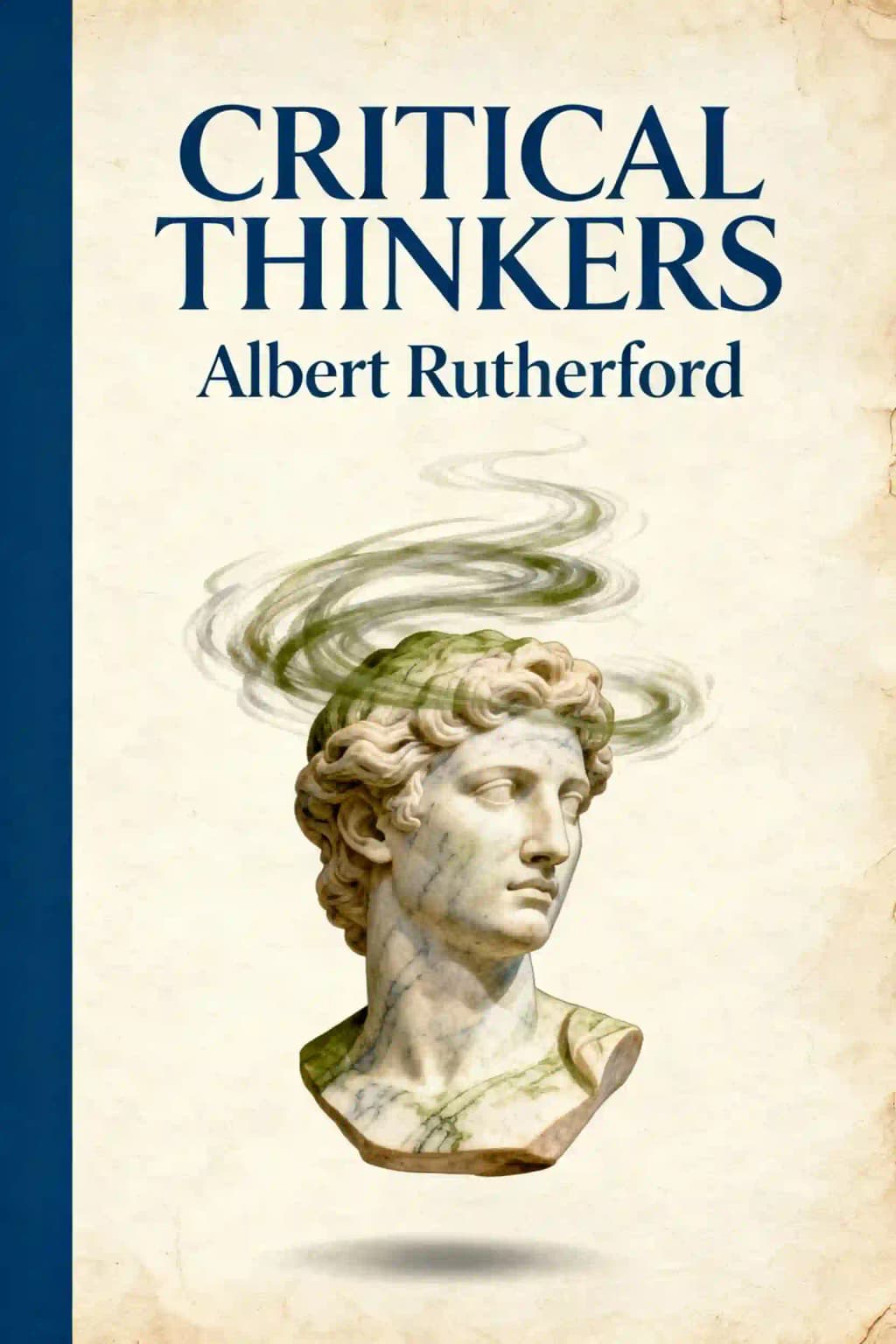
Critical Thinkers
Methods for Clear Thinking and Analysis in Everyday Situations from the Greatest Thinkers in History
Critical Thinkers 개요
In a world of cognitive chaos, "Critical Thinkers" distills wisdom from history's greatest minds into practical tools for everyday decisions. This internationally bestselling guide has transformed how professionals analyze information, making logical reasoning not just an academic skill but a life-changing superpower.
Critical Thinkers의 핵심 주제
- logical reasoning
- cognitive bias identification
- systematic doubt
- intellectual standards
- objective decision making
Critical Thinkers의 명언
Never jump to conclusions.
Critical thinking should be governed by intellect and reason.
Be ready to argue intellectually.
Take control of our own thoughts.
Critical Thinkers의 등장인물
- Albert RutherfordAuthor and expert on critical thinking systems
- Richard PaulFounder of the Center for Critical Thinking
- Linda ElderEducational psychologist and critical thinking expert
Critical Thinkers 요약 다운로드
Critical Thinkers 요약을 무료 PDF 또는 EPUB으로 받으세요. 인쇄하거나 오프라인에서 언제든 읽을 수 있습니다.
이 책에 대한 FAQ
Critical Thinkers by Albert Rutherford explores methods for clear thinking, logical analysis, and effective decision-making. It synthesizes philosophies from historical thinkers like Immanuel Kant, emphasizing critical reasoning, self-reflection, and structured problem-solving. The book covers concepts like synthetic a priori judgments, cognitive biases, and frameworks for evaluating arguments, aiming to help readers navigate complex ideas and improve intellectual rigor.
This book is ideal for students, professionals, and lifelong learners seeking to sharpen their analytical skills. It’s particularly valuable for those interested in philosophy, decision-making frameworks, or overcoming cognitive biases. Readers who enjoy practical guides to logical reasoning or systems thinking will find actionable strategies.
Yes, the book is praised for distilling complex philosophical concepts into accessible insights. Reviewers highlight its structured approach to critical thinking, practical frameworks for problem-solving, and relevance to everyday decision-making. However, some note it serves better as an introductory text rather than an advanced resource.
Key ideas include:
- Synthetic a priori judgments: Combining experiential knowledge with innate reasoning.
- Categorical imperative: Acting only on principles universally applicable.
- Cognitive bias mitigation: Techniques to identify and counter flawed assumptions.
- Critical reading strategies: Distilling arguments into clear, personal interpretations.
Rutherford integrates Kant’s concepts of phenomena (observable reality) and noumena (ultimate reality), explaining how human cognition structures perception through categories like space, time, and causality. The book also explores Kant’s a priori vs. a posteriori judgments and their role in critical analysis.
- Trust-but-verify: Balancing intuition with evidence-based validation.
- Systems thinking: Analyzing interconnected components of complex problems.
- Argument deconstruction: Breaking claims into premises and conclusions for scrutiny.
The book offers tools for clarifying workplace decisions, resolving conflicts logically, and avoiding groupthink. It emphasizes structured note-taking, bias recognition, and applying ethical frameworks like the categorical imperative to team dynamics.
Some reviewers note the book avoids deep dives into advanced philosophical debates, focusing instead on foundational concepts. Others suggest it could benefit from more real-world case studies to illustrate abstract theories.
Unlike The Systems Thinker (focused on interconnected systems) or Statistics for the Rest of Us, this book prioritizes philosophical reasoning and logic. However, all share Rutherford’s trademark clarity and multidisciplinary approach.
In an era of information overload and AI-driven content, the book’s emphasis on discernment, source verification, and structured analysis remains vital. Its lessons on cognitive biases are particularly applicable to navigating digital misinformation.
- “Question claims before accepting them”: Encourages skepticism and evidence-based thinking.
- “Reality is shaped by our mental frameworks”: Reflects Kantian influences on perception.
- “Slow thinking beats rushed judgments”: Advocates deliberate reasoning over snap decisions.
Yes, the book includes techniques like:
- Rewriting complex arguments in simpler terms.
- Applying the categorical imperative to ethical dilemmas.
- Mapping cause-effect relationships in personal or professional challenges.