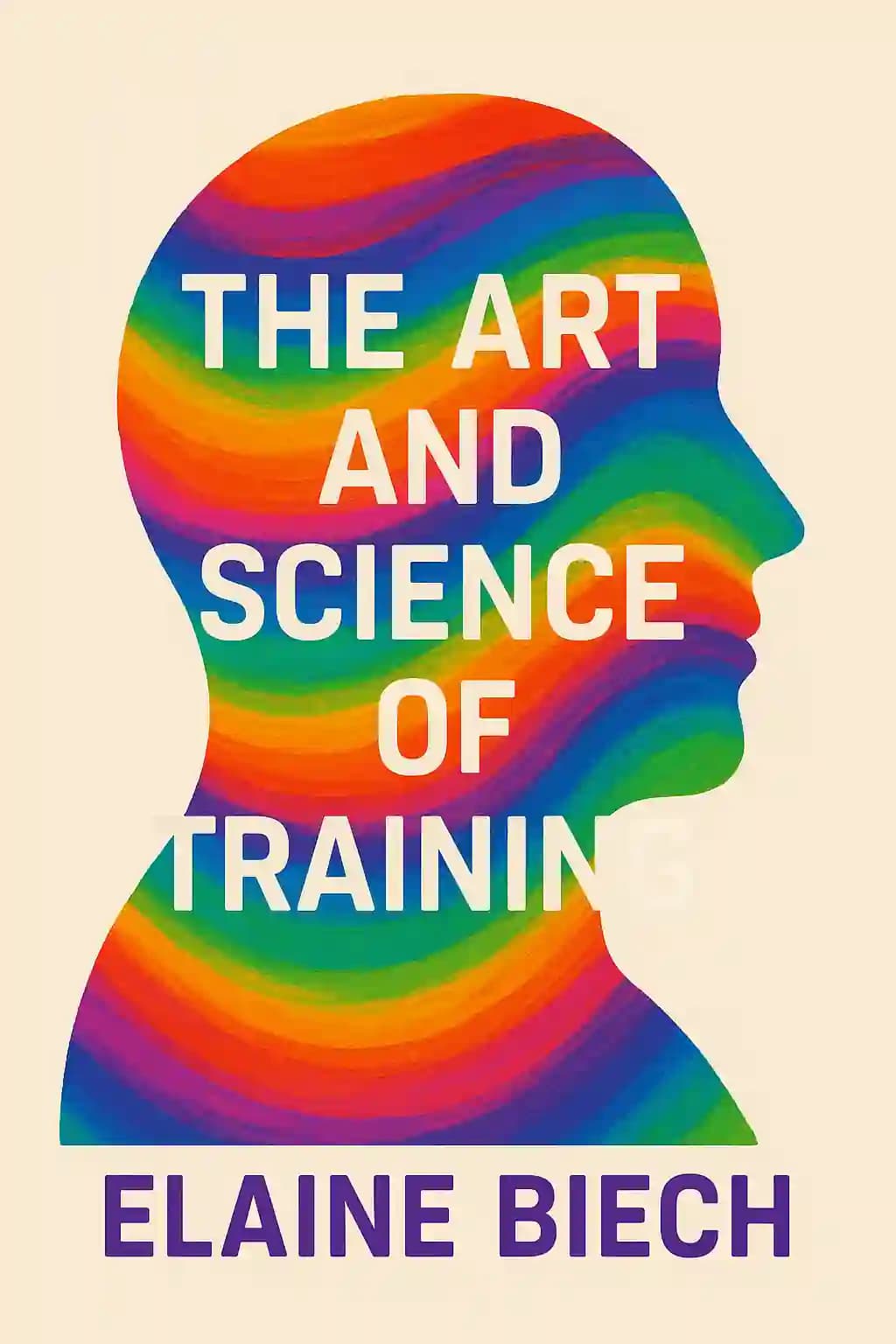
Master trainer Elaine Biech blends psychology with practical methods in this industry-defining guide. Revered by learning professionals with a 3.91 Goodreads rating, it's transformed corporate training across sectors. What counterintuitive approach makes even the toughest teams suddenly receptive to change?
Elaine Biech, bestselling author of The Art and Science of Training, is a titan of talent development renowned for bridging organizational strategy with experiential learning. With over 40 years shaping workplace training, her book merges scientific learning principles with creative facilitation techniques. This draws from her roles designing groundbreaking programs for organizations such as NASA, McDonald’s, and Hershey.
A 2020 ATD Distinguished Contribution Award recipient, Biech has authored 89 books, including the TDBoK Guide™, and served on the Center for Creative Leadership’s board of governors.
Her work has been featured in the Wall Street Journal, Harvard Management Update, and Fortune, while her practical frameworks are implemented by Fortune 500 companies and government agencies alike.
A Washington Post #1 bestseller, The Art and Science of Training reflects her signature approach: equipping professionals to handle real-world challenges through evidence-based yet adaptable methods. Biech’s legacy includes scholarships for emerging leaders and 38 consecutive years presenting at ATD’s premier conferences.
The Art and Science of Training by Elaine Biech explores the intersection of evidence-based learning principles (science) and adaptive facilitation skills (art). It provides actionable strategies for designing effective training programs, handling challenging learner scenarios, and measuring outcomes. The book emphasizes balancing cognitive research with creativity to address real-world L&D challenges like disengaged audiences or mismatched delivery methods.
This book is essential for corporate trainers, HR professionals, and learning designers seeking to improve program efficacy. It’s particularly valuable for those navigating complex training environments, such as hybrid workplaces or resistance to upskilling. Biech’s insights also benefit managers overseeing team development initiatives.
Yes—the book is a Washington Post #1 bestseller and distills Elaine Biech’s 30+ years of L&D expertise. It offers timeless frameworks for adult learning, troubleshooting common training pitfalls, and aligning programs with organizational goals. Readers gain practical tools for evaluating training ROI and adapting methods to modern workplace needs.
Key ideas include:
Biech argues exceptional training requires equal mastery of instructional science and interpersonal artistry.
The book provides scripts for handling 10+ challenging personas, such as skeptics or overparticipators. Biech emphasizes pre-emptive strategies like setting clear expectations, while also offering real-time fixes (e.g., redirecting tangents with focused questions). A core theme: understanding learners’ motivations trumps rigid content delivery.
Biech advocates a blended approach:
The book contrasts methods using a decision matrix based on content complexity, audience size, and resource constraints.
Two standout models:
Unlike purely theoretical texts, Biech merges academic research (e.g., Bloom’s Taxonomy) with battlefield-tested tactics—like converting a disengaged group into co-facilitators. The book also includes 23 ready-to-use templates, from needs assessment surveys to ROI calculators.
Some practitioners note the book focuses more on corporate contexts than nonprofit or academic settings. A minority of readers desire deeper dives into gamification and AI-driven personalization, though Biech addresses these trends in later works.
The principles remain vital for navigating post-pandemic shifts like distributed teams and AI-augmented workflows. Updated examples in recent editions cover virtual reality training and microlearning apps, ensuring alignment with modern tech-enabled L&D practices.
While both emphasize client-centric approaches, The Art and Science of Training targets internal L&D teams, whereas Consulting focuses on external advisors. They share core themes: needs analysis, stakeholder alignment, and outcome measurement. Trainers managing hybrid roles benefit from reading both.
Absolutely—it’s frequently cited in ATD certification prep and internal promotion cases. Mastering Biech’s frameworks demonstrates strategic thinking in talent development. The book’s ROI focus helps HR professionals quantify training’s impact on retention, productivity, and innovation metrics.
저자의 목소리로 책을 느껴보세요
지식을 흥미롭고 예시가 풍부한 인사이트로 전환
핵심 아이디어를 빠르게 캡처하여 신속하게 학습
재미있고 매력적인 방식으로 책을 즐기세요
Adults learn because they want or need to.
Words matter and should be chosen carefully.
Moderate stress levels optimize learning.
Attention must be high.
The art lies in stretching learners appropriately without overwhelming them.
The Art and Science of Training의 핵심 아이디어를 이해하기 쉬운 포인트로 분해하여 혁신적인 팀이 어떻게 창조하고, 협력하고, 성장하는지 이해합니다.
생생한 스토리텔링을 통해 The Art and Science of Training을 경험하고, 혁신 교훈을 기억에 남고 적용할 수 있는 순간으로 바꿉니다.
무엇이든 묻고, 학습 스타일을 선택하고, 나에게 맞는 인사이트를 함께 만들어보세요.

샌프란시스코에서 컬럼비아 대학교 동문들이 만들었습니다
"Instead of endless scrolling, I just hit play on BeFreed. It saves me so much time."
"I never knew where to start with nonfiction—BeFreed’s book lists turned into podcasts gave me a clear path."
"Perfect balance between learning and entertainment. Finished ‘Thinking, Fast and Slow’ on my commute this week."
"Crazy how much I learned while walking the dog. BeFreed = small habits → big gains."
"Reading used to feel like a chore. Now it’s just part of my lifestyle."
"Feels effortless compared to reading. I’ve finished 6 books this month already."
"BeFreed turned my guilty doomscrolling into something that feels productive and inspiring."
"BeFreed turned my commute into learning time. 20-min podcasts are perfect for finishing books I never had time for."
"BeFreed replaced my podcast queue. Imagine Spotify for books — that’s it. 🙌"
"It is great for me to learn something from the book without reading it."
"The themed book list podcasts help me connect ideas across authors—like a guided audio journey."
"Makes me feel smarter every time before going to work"
샌프란시스코에서 컬럼비아 대학교 동문들이 만들었습니다

The Art and Science of Training 요약을 무료 PDF 또는 EPUB으로 받으세요. 인쇄하거나 오프라인에서 언제든 읽을 수 있습니다.
A manufacturing plant invests $50,000 in safety training. Three months later, accident rates haven't budged. Meanwhile, a small startup spends a fraction of that amount and sees immediate behavioral change. What's the difference? Training that transforms isn't about bigger budgets or fancier presentations - it's about understanding how adults actually learn and creating conditions where knowledge becomes action. Most training fails not because the content is wrong, but because it ignores fundamental truths about how our brains process, retain, and apply new information. The gap between knowing something and doing something is where most corporate training dollars disappear, yet bridging that gap is entirely possible when we blend scientific principles with artful delivery. Adults don't learn like children. This isn't opinion - it's neuroscience. When your manager sends you to a compliance training, you're asking "Why does this matter to my work?" before the first slide loads. Children learn for tomorrow; adults learn for today. This distinction reshapes everything about effective training design.
Malcolm Knowles identified six principles separating adult learning from childhood education. Adults need to understand why something matters before investing mental energy. They see themselves as capable decision-makers, not empty vessels. They arrive with rich life experience that becomes either asset or barrier. They gravitate toward content solving immediate problems, driven by practical application over theory. They respond to internal motivation-the desire to excel, contribute, or grow-far more than external rewards. Think about cooking: children follow recipes step-by-step; adults taste as they go, adjust based on past meals, and skip mastered steps. Your brain holds only 2-4 chunks of information in short-term memory simultaneously. Yet most training dumps dozens of concepts in one session, wondering why nothing sticks. Multitasking during learning uses your striatum instead of your hippocampus, creating memories you can't generalize or recall when needed. That participant checking email during your webinar isn't just rude-they're neurologically incapable of learning your content. The AGES model explains what makes learning stick: Attention must be high-grab it immediately through strategic variation. Generate mental maps by connecting new information to existing knowledge. Emotions need engagement-stories and visuals activate centers that cement memories. Spacing learning over time is non-negotiable-cramming creates illusions of mastery that evaporate within days.
A SMART objective isn't "understand customer service"-it's "resolve 90% of customer complaints within 24 hours using company protocol by Q3." Learning objectives serve as contracts specifying exactly what success looks like. Visual elements aren't decoration-they're cognitive tools. Participants grasp information 40% faster with relevant visuals and retain it up to six times longer. But "seductive details"-eye-catching but irrelevant graphics-actually harm learning by splitting attention. A process flow diagram supports learning; a stock photo of people shaking hands does not. Practice design separates effective training from time-wasting exercises. Realistic application beats content repetition. High-stakes tasks require more practice than simple procedures. Surgeons need hundreds of supervised repetitions; password resetters need quick reference guides and two practice runs. Analyzing mistakes produces 15-20% better learning than reviewing correct examples. Active engagement with errors creates deeper processing and more durable memory traces. The Yerkes-Dodson law reveals that stress and performance follow an inverted U curve. Too little stress and learners coast, disengaged. Too much and fight-or-flight shuts down higher thinking. The sweet spot-moderate challenge that stretches without breaking-is where transformation happens.
Formal training represents only 10% of professional learning. The other 90% happens through job experience (70%) and developmental relationships (20%). Studies of successful executives show they attribute 72% of their most impactful learning to on-the-job challenges. The power lies in integration: formal training provides theoretical foundations, social learning makes it applicable, and experiential learning makes it permanent. This changes your role as a trainer. You're not just owning learning during the workshop-you're facilitating it before, during, and after. Before training, meet with managers to align expectations. During training, provide feedback and debriefing questions that link to workplace application. After training, schedule follow-ups and establish peer practice groups. The other 90% isn't someone else's problem-it's your primary responsibility. The classroom is one touchpoint in a comprehensive learning ecosystem.
Virtual reality isn't science fiction - Walmart uses it for management training, Boeing for aircraft maintenance. Wearable technology provides real-time feedback during practice. Adaptive algorithms create personalized learning paths. MIT's landmark study confirmed that well-designed online classes match traditional classroom effectiveness across all student preparation levels. Technology amplifies good instructional design and exposes bad design faster. The principles remain constant - engagement, interaction, clear objectives, relevant practice - but delivery mechanisms expand dramatically. Performance support systems shift from "just-in-case" training to "just-in-time" support. Instead of memorizing procedures, workers access step-by-step guides at the moment of need. QR codes link to tutorials, chatbots answer questions, wikis capture institutional knowledge. This respects how people actually work - you don't memorize your phone's manual, you search when needed. Social media revolutionizes informal learning: Twitter enables microlearning, YouTube democratizes instruction, LinkedIn groups facilitate peer learning. The trainer's role evolves from content deliverer to curator and connector, helping learners navigate abundant resources rather than being the sole knowledge source.
Transfer of learning-applying training to actual work-is where most training investments evaporate. Only 10-50% of training content gets implemented, yet research shows well-designed transfer strategies consistently work through systematic attention before, during, and after training. Pre-training preparation is half the battle. When supervisors receive training first, they become effective mentors. If that's not feasible, brief them on objectives and implementation support. Learner expectation-specifically, their belief they'll be held accountable-is the strongest predictor of transfer success. During training, realistic practice matters more than content coverage. Learners need 4-6 deliberate practice sessions for basic skill acquisition, encountering real workplace obstacles and hearing detailed success stories from previous participants. Confidence grows through structured practice, specific feedback, and facilitated discussions about real concerns. Post-training follow-up transforms learning into performance. Send relevant resources and reflection questions. Organize monthly review sessions. Establish accountability partnerships. Studies show up to 4x higher transfer rates with systematic follow-up. This shared accountability-trainers provide resources, managers provide coaching, learners take ownership-transforms training from an event into sustained development.
We live in a VUCA world-volatile, uncertain, complex, ambiguous. By 2020, over 40% of American workers became independent contractors, with teams increasingly fluid and temporary. Traditional team building fails when membership changes quarterly. The future demands accessible experiences delivered when and where learners need them. Your role isn't delivering content-it's building capability by teaching people how to learn, not just what to learn. Mindfulness programs now show measurable returns. Aetna saves $2,000 per employee annually in healthcare costs while gaining $3,000 in productivity. Agility and resilience aren't soft skills-they're survival skills. The profession is evolving new roles: experience designers crafting learning journeys, analytics engineers measuring impact, corporate curators organizing knowledge ecosystems. Only 38% of learning functions were prepared for 2020's challenges. The question facing every trainer: are you building the capabilities-in yourself and others-that tomorrow demands? The art and science of training isn't about perfecting yesterday's methods-it's about continuously learning how to help others learn in a world that never stops changing.