1장
The Dawn of Thinking Machines
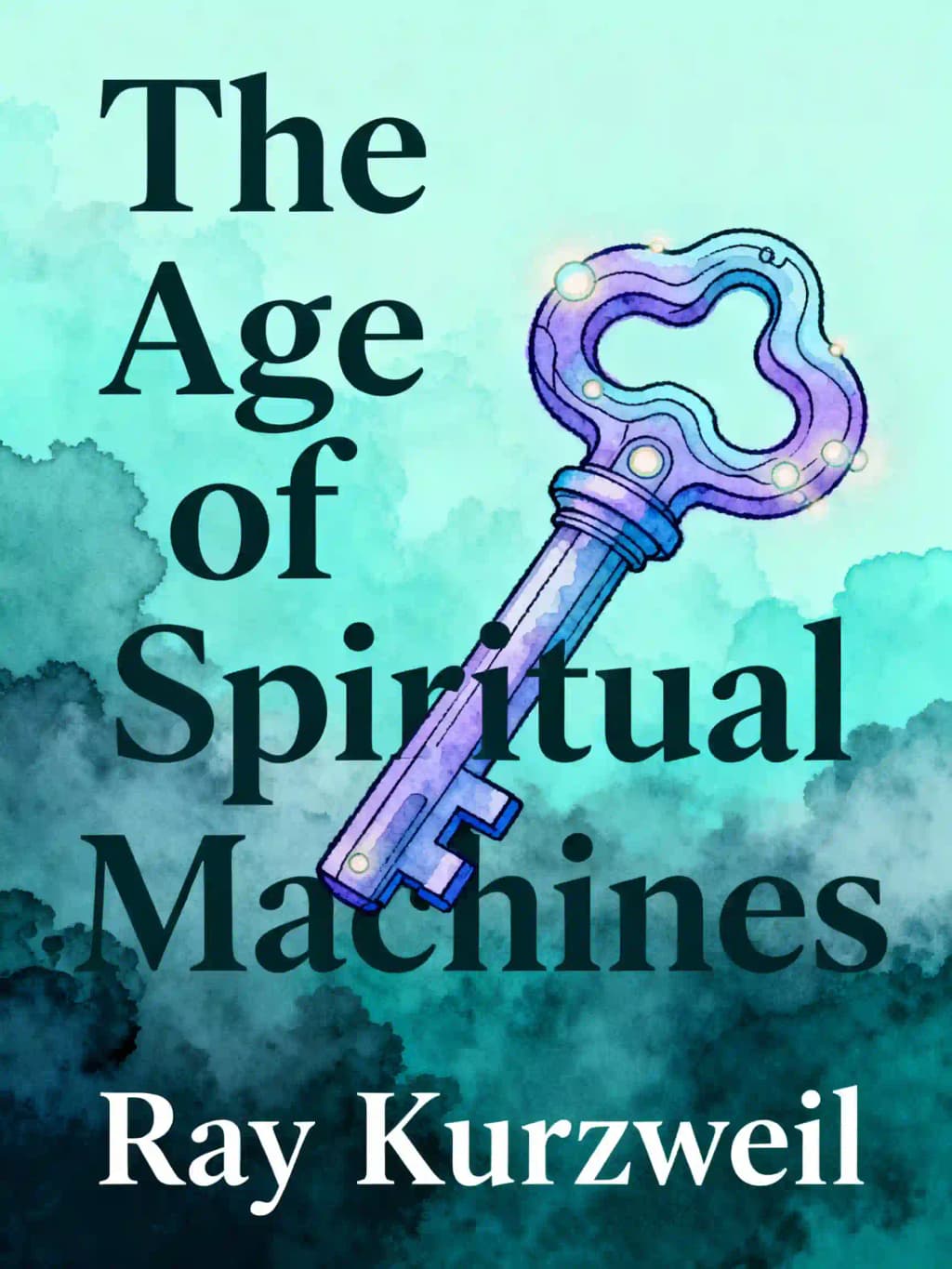
In 1965, Gordon Moore observed that computing power doubled approximately every two years-a pattern that has held remarkably steady for over half a century. But what happens when this exponential growth reaches a critical threshold? What occurs when machines surpass human intelligence? Ray Kurzweil's "The Age of Spiritual Machines" tackles these profound questions with remarkable foresight. Published in 1999, this visionary work has become required reading in technology circles, with luminaries like Bill Gates calling it "the book I'd most recommend to understand the future." Kurzweil, a renowned inventor whose creations include reading machines for the blind and music synthesizers used by Stevie Wonder, brings his unique perspective as both technologist and philosopher to explore humanity's technological destiny. His predictions have proven startlingly accurate-so much so that Google hired him as Director of Engineering in 2012 specifically to bring his vision of artificial intelligence to life. As we stand at what Kurzweil calls "the knee of the curve"-the point where exponential growth becomes explosive-his insights have never been more relevant or urgent.
2장
The Universe's Exponential Heartbeat
The universe operates on an exponential timeline, not a linear one. In the first fraction of a second after the Big Bang, fundamental forces emerged at a breathtaking pace. Gravity appeared after just 10^-43 seconds. By 10^-34 seconds, electrons and quarks materialized. After 10^-10 seconds, electromagnetic and weak forces separated. This pattern-extraordinarily rapid change at the beginning, followed by progressively slower developments-characterizes not just cosmic evolution but technological advancement as well.
Einstein demonstrated that time is relative to the observer. A person traveling near light speed might experience seconds while decades pass on Earth. We see this relativity of time experience throughout nature-short-lived birds perceive time differently than humans do, and children experience time differently than adults. The exponential nature of time means events develop extremely slowly for long periods, but once we reach what Kurzweil calls "the knee of the curve," they erupt at an increasingly furious pace.
This exponential pattern applies to evolution as well, but in reverse-accelerating rather than decelerating. After Earth formed, the sun's energy caused elements to form increasingly complex molecules. Two billion years later, self-perpetuating patterns emerged-life began. Early innovations included simple genetics, mobility, and photosynthesis. The most crucial development was DNA-based genetics, which would guide evolutionary development for billions of years.
Evolution's pace quickened dramatically after establishing DNA as its digital recording system. Multicellular plants and animals appeared 700 million years ago. After dinosaurs disappeared 65 million years ago, mammals rose to prominence. Progress accelerated from billions to millions of years-primates emerged in tens of millions of years, humanoids in 15 million years, and Homo sapiens about 500,000 years ago, genetically almost identical to other primates but distinct in their creation of technology.
What does this mean for us today? We're approaching another "knee of the curve"-the point where technological evolution will explode at an unprecedented rate, transforming humanity and intelligence itself in ways we can barely imagine.
3장
Technology: Evolution's Next Phase
Technology represents evolution's continuation through different means, inheriting the same pattern of exponential acceleration. While other animals use tools, humans uniquely record and progressively improve their technological knowledge, creating a kind of "genetic code" for technological evolution. This record began with the tools themselves, evolved into written language, and now exists in computer databases.
The pace of technological innovation has consistently accelerated-from taking thousands of years to develop basic stone tools to the nineteenth century's explosion of inventions like railroads, telephones, and automobiles. Today, transformative technologies emerge in just a few years, as exemplified by the World Wide Web's recent emergence.
True technology transcends its physical components, producing effects greater than the sum of its parts-like Bell's telephone magically transmitting human voice across distances. This transcendence also occurs in art (another form of human technology) when materials combine to create music that evokes emotional responses.
Language represents another uniquely human technology. While other animals communicate through gestures or sounds, only human communication methods evolve beyond DNA-based evolution, with increasingly sophisticated recording and distribution technologies.
Once life establishes itself on a planet, technology becomes inevitable. Survival advantages accrue to organisms that can both intelligently use limited resources and manipulate their environment. Eventually, a species combining these attributes will emerge, as happened with humans, whose technology has enabled us to dominate our ecological niche.
From the specialized organs in early life-forms to increasingly sophisticated nervous systems, computation has been the cutting edge in multicellular organism evolution, just as it has been in human technology. The exponential growth of computing power, often called Moore's Law, has driven technological advancement for decades. While the specific implementation of integrated circuits may reach physical limits around 2020, the underlying pattern of accelerating computational power shows no signs of slowing-it will simply shift to new technologies like three-dimensional circuits, optical computing, DNA computing, or quantum computing.
4장
The Law of Time and Chaos
The universe exhibits diverse exponential trends: the slowing pace of universal development (with three epochs in the first billionth of a second followed by events taking billions of years), the slowing pace of organism development (rapid changes in early months followed by milestones taking years or decades), the quickening pace of life-form evolution on Earth, and the accelerating evolution of human technology.
These contrasting patterns of exponential change-some slowing, some accelerating-suggest fundamental principles governing time and development across different systems. Kurzweil proposes the Law of Time and Chaos: time moves in relation to chaos-when chaos increases, time slows down; when order increases, time speeds up. This explains why the universe and aging organisms experience slower development while evolution and technology experience accelerating returns.
Order isn't merely the opposite of randomness or predictability. True order represents information that fits a purpose. In evolution, this purpose is survival. Order may increase or decrease complexity depending on what best serves the purpose. Evolution draws from chaos for options while building on its own increasing order, creating a self-reinforcing cycle of accelerating returns.
This leads to Kurzweil's Law of Accelerating Returns: in evolutionary processes, order increases exponentially, time speeds up exponentially, and returns accelerate exponentially-all while the universe cosmologically continues to slow down.
Most exponential trends eventually terminate-like rabbits in Australia hitting environmental limits-but the growth of computing power is an exception. Evolution builds on its past achievements, including improvements in its own means for further evolution. The Law of Accelerating Returns applies uniquely to computation because it draws on two unbounded resources: the growing order of evolving technology and the chaos from which evolution draws options for diversity.
To appreciate geometric trends, consider the legend of chess's inventor and the Chinese emperor. The inventor requested one grain of rice on the first square, doubled on each subsequent square. By the chessboard's completion, this would require rice fields twice Earth's surface area. The first half of the chessboard was manageable-4 billion grains by square thirty-two. But the second half quickly became impossible. We've experienced about thirty-two doublings in computing power since the 1940s-completing the first half of the chessboard. Now, heading into the next century, we're entering the second half, where things become truly interesting.
5장
Evolution's Intelligence and Limitations
Can an intelligence create another intelligence more intelligent than itself? To answer this critical twenty-first century question, we must first examine evolution-the intelligent process that created us. Evolution functions as a master programmer, designing millions of diverse species through the digital data encoded in DNA. While prolific, evolution is also sloppy-leaving us object code without documentation, comments, or user manuals. Through the Human Genome Project, we're recording this 6-billion-bit code, though understanding how it works remains a laborious process.
Evolution's inefficient programming leaves 97% of code non-functional, with the active portion containing just 23 megabytes-less than Microsoft Word. Despite its crude technique of random changes evaluated through organism survival, evolution has created remarkably complex designs like the human eye through incremental refinements over vast timespans.
Evolution has evolved its own evolutionary mechanisms. The DNA-coding itself represents one such mechanism. Within the code, certain critical design elements like eye shape have error detection systems making mutations unlikely, while other elements like retinal layout have fewer protections and show more evolutionary change.
By simulating evolution through programs like Thomas Ray's Network Tierra, we've confirmed evolution's ability to build complex designs through incremental steps. Ray's digital organisms evolve from single-celled to multicellular forms with parasites, immunities, and social interactions emerging. Practical applications include evolutionary algorithms, where competing computer programs harness evolution's intelligence to solve real-world problems.
Evolution deserves praise for creating designs of indescribable beauty, complexity, and elegance-including human intelligent brains. Yet it has one critical deficiency: it's extraordinarily slow. While creating remarkable designs, evolution required billions of years to develop life forms, whereas human technological development has required only tens of thousands of years. Speed matters in evaluating intelligence-which is why IQ tests are timed.
Despite its extraordinary design record, if we factor evolution's achievements by its ponderous pace, its intelligence quotient is only infinitesimally greater than zero-just enough to beat entropy and create wonderful designs given sufficient time. Our human-created evolutionary algorithms are effective because we speed up time a million- or billionfold to concentrate its otherwise diffuse power.
In just thousands of years, humans have created sophisticated technology that will soon match and exceed human intelligence. We've vastly outpaced evolution, achieving in millennia what evolution accomplished in billions of years. Human intelligence, itself a product of evolution, has proven far more intelligent than its creator. Similarly, the machine intelligence we're creating will soon exceed our own intelligence.
6장
The Spiritual Machine Emerges
Sexuality and spirituality represent two ways humans transcend everyday physical reality, with notable links between sexual and spiritual ecstatic experiences. We're discovering that direct brain stimulation can trigger specific feelings previously thought to require actual experiences. UCLA researchers found that electrically stimulating a specific point in a teenage girl's brain caused genuine perception of humor-not just laughter, but finding ordinary situations funny.
Similarly, animal experiments show that stimulating specific hypothalamus areas with testosterone triggers gender-specific sexual behaviors. Once neural implants become commonplace, we'll be able to produce virtual sensory experiences along with their associated feelings, or even add feelings not normally associated with particular experiences.
Spiritual experiences-feelings of transcending physical and mortal bounds to sense deeper reality-play fundamental roles across disparate religions and philosophies. Though these experiences vary widely, from Baptist revival ecstasy to Buddhist monk transcendence, they represent a consistent phenomenon throughout history and across cultures. As we gain access to the computational processes underlying these experiences, we'll have opportunities to understand their neurological correlates, capture them, call them up at will, and enhance them.
Brain Generated Music (BGM), pioneered by NeuroSonics, offers technology that appears to generate aspects of spiritual experience. This brain-wave biofeedback system evokes the Relaxation Response associated with deep meditation. Users attach leads to their head while a computer monitors their unique alpha wavelength (8-13 cycles per second) associated with meditative states.
Neuroscientists at the University of California at San Diego have discovered what they call the "God module," a small cluster of nerve cells in the frontal lobe that activates during religious experiences. They found this neural machinery while studying epileptic patients who experience intense mystical states during seizures. Using sensitive skin monitors to track brain electrical activity, they observed similar responses when highly religious non-epileptic people viewed words and symbols connected to their spiritual beliefs.
As we determine the neurological correlates of spiritual experiences, we'll likely enhance these experiences just as we'll enhance other human experiences. With the next evolutionary stage creating humans trillions of times more complex than today, our capacity for spiritual experience and insight will likely deepen tremendously. Twenty-first-century machines, based on human thinking, will claim consciousness and spiritual experiences, and given our tendency to anthropomorphize, we'll likely believe them when they report meditating, praying and transcending to connect with their spiritual dimension.
7장
The Consciousness Conundrum
What would convince us that a computer possesses consciousness? A simple message like "I am lonely" wouldn't suffice-it's just programming. Even with speech synthesis or complex game interactions, we recognize these as clever simulations. But what about a massive neural net reverse-engineered from the human brain, running a million times faster than human neurons, having read all human literature and developed its own conceptions of reality? At what point might we consider it conscious?
From the opposite direction, consider a human gradually replacing neural functions with implants-first cochlear implants, then phonic-cognition circuits, visual processing, memory enhancement, and eventually a complete neural replacement. Is this person still the same individual? What if the transition happens all at once through scanning and reinstantiation in a new electronic medium? If the original brain still exists, we have two versions of the same person. Does destroying the original after creating the copy constitute murder?
This raises profound questions about identity. Are we the specific particles that make up our bodies, or the patterns they form? Since our particles constantly change while our patterns remain relatively stable, many philosophers favor the "pattern theory" of identity. Yet the original person facing extinction after being copied might suddenly question this view.
Some experiences cannot be fully communicated through language-the sensation of diving into water, the rapture of sex, or the emotions evoked by music to someone deaf. Similarly, the subjective experience of color perception defies complete description. While we can understand the wavelengths of light that create red (0.000075 centimeters) or violet (0.000035 centimeters), and how mixing colored lights differs from mixing pigments, the actual subjective experience remains personal and incommunicable.
In his 1950 paper, Alan Turing described the Turing Test, where a human judge interviews both a computer and human foils using terminals. If the judge cannot reliably identify the computer, it wins. While often described as a computer IQ test, Turing intended it as a test of thinking, implying conscious intentionality. Turing predicted that by the end of the century, machines would pass his test and "the use of words and general educated opinion will have altered so much that one will be able to speak of machines thinking without expecting to be contradicted."
Turing's prediction foreshadows how the computer thought issue will resolve: machines will convince us they're conscious with their own agendas worthy of respect. We'll believe they're conscious much as we believe that of each other. We'll empathize with their professed feelings and struggles because their minds will be based on human thinking design. They will embody human qualities, claim to be human, and we'll believe them.
8장
Building New Brains: The Hardware of Intelligence
Building an intelligent machine requires three essential resources. First, we need the right set of formulas-the three quintessential ones being recursive search, self-organizing networks, and evolutionary algorithms. Second, we need knowledge-some as seed information and the rest automatically learned through adaptive methods. Third, we need raw computational power.
The human brain excels through massive parallelism but is severely limited by the slow speed of its neural computing medium. DNA-based evolution has reached a computational dead end with carbon-based neurons, but evolution has cleverly created organisms that invented computational technology a million times faster than neurons.
By 2020, $2,000 of neural computer chips will match the human brain's 20 million billion neural connection calculations per second. Memory capacity will reach human-equivalent levels (estimated at a million billion bits) for $1,000 by 2023. Supercomputers will reach human brain capacity around 2010, a decade earlier than personal computers. By 2030, a personal computer will simulate a small village's brainpower; by 2048, the entire U.S. population; and by 2060, a trillion human brains. By 2099, one penny's worth of computing will have a billion times greater capacity than all humans on Earth combined.
The Law of Accelerating Returns guarantees exponential growth in computing power through increasing order and environmental chaos-both essentially limitless resources. While evolutionary theories suggest progress should be irregular, computer advancement has been remarkably predictable. As Moore's Law approaches its 2020 limit with near-atomic circuit dimensions causing quantum interference, the industry will expand into three-dimensional circuitry.
Quantum computing harnesses quantum mechanics' fundamental ambiguity to achieve computational power vastly exceeding digital systems. Unlike digital bits that are either 0 or 1, quantum bits (qu-bits) exist in both states simultaneously until forced to "decide" through quantum decoherence. A quantum computer with 1,000 qu-bits could represent 2^1000 possible solutions simultaneously-more calculations than a theoretical Universe-sized conventional computer could perform in billions of years. Problems like factoring large encryption codes that would take billions of years on digital computers could be solved in billionths of seconds.
9장
Reverse Engineering the Human Brain
Rather than simulating the entire evolution of the human brain, we can reverse engineer it-analyzing and copying nature's proven design that took billions of years to develop. By probing the brain's circuits, we can accelerate our understanding of intelligence design, an endeavor already underway with technologies like Synaptics' vision chip that mimics early mammalian visual processing.
Human experts typically master 50,000-100,000 concepts in their specialized fields, while general human knowledge might encompass around 100 million "chunks" of understanding, concepts, patterns, and skills. With 100 billion neurons and 100 trillion connections in the human brain, we have roughly a million connections per knowledge chunk-far more than needed based on computer neural models that can represent knowledge chunks with just thousands of connections. The brain's apparent inefficiency likely stems from its conservative design, using redundancy and low-density information storage to maintain reliability despite neuron loss during aging. This suggests we don't need to contemplate significantly more complex neuron models to explain human capabilities-the brain is big enough.
The most immediate approach to using brain scans is understanding the architecture and algorithms of interneuronal connections in different regions. Since brain circuitry is highly repetitive within regions, we only need to scan representative portions to reverse engineer their parallel algorithms. Once understood, these algorithms can be refined, extended, and implemented in synthetic neural equivalents that operate millions of times faster than biological neurons. We can combine these revealed algorithms with existing machine intelligence methods, while carefully discarding aspects of human computing that aren't useful in machines.
A more challenging but ultimately feasible scenario will be scanning someone's brain to map its entire neural structure and contents, then recreating it on a sufficiently powerful neural computer. This approach requires capturing every detail-connections, synapses, neurotransmitters-though we need only copy these elements, not necessarily understand the brain's complete global organization. We must identify which neural structures contribute to information processing rather than mere biological maintenance, including potential quantum computing mechanisms. Early downloads will be imprecise, but as scanning technology improves, reinstantiating a person's brain should eventually change their mind no more than it naturally changes day to day.
The twenty-first century will see a growing trend toward this mind-porting leap. Initially, we'll see partial porting-replacing aging memory circuits and extending capabilities through neural implants. Eventually, people will port their entire mind files to new thinking technologies. Though nostalgia for our carbon-based roots will persist, the benefits will prove irresistible. As we port ourselves, we'll vastly extend our capabilities, multiplying memory a trillion-fold and integrating all human knowledge as an accessible internal database.
10장
The Destiny of Intelligence in the Universe
Our popular conception of alien visitors imagines creatures similar to ourselves with spaceships and advanced technologies. But this vision is unlikely. Far more probable is that any visiting intelligent entities represent a merger of an evolved species with its even more evolved computational technology. A civilization advanced enough to reach Earth has likely long passed the "merger" threshold.
Such visitors would likely be microscopic in size, not requiring large spaceships. Their purpose wouldn't be mining material resources, as advanced civilizations can manipulate their environments through nano/pico/femtoengineering. The only resource of interest would be knowledge, requiring only small observation and communication devices-possibly smaller than a grain of sand or even microscopic. Perhaps that's why we haven't noticed them.
Common wisdom suggests intelligence has little relevance to the universe's grand mechanisms-just froth amid inexorable cosmic forces. But intelligence will ultimately prove more powerful than these impersonal forces. Consider Earth: An asteroid eliminated the dinosaurs 65 million years ago, but our descendants will detect and neutralize such threats. Intelligence doesn't repeal physics but manipulates forces to bend to its will.
Currently, Earth's computational density is remarkably low-human brains operate at about 2 calculations per second per cubic micrometer, while nanotube circuitry could be a trillion times higher. And only a tiny fraction of Earth's matter (about one part per hundred trillion) is devoted to computation. The Law of Accelerating Returns suggests computational density will increase by trillions of trillions during this century. As hardware capabilities expand exponentially, software sophistication follows. Intelligence will spread across our solar system and likely throughout the universe.
So will the universe end in a big crunch or infinite expansion? The primary issue isn't mass or antigravity-it's a decision we'll intelligently consider when the time is right. Life in the universe is both rare and plentiful-much like matter itself. Particles are incredibly spread out (less than one in a trillion trillion chance of finding one in a random proton-sized region), yet we have trillions of trillions of them. Similarly, heavenly bodies occupy tiny fractions of space, yet exist in billions of trillions.
Following this pattern, even if the probability of a star having a life-bearing planet were one in a million, our galaxy alone would host 100,000 such worlds. The evolution from basic life to technology-creating species appears inevitable, as does the progression to computation. Once computation emerges, the Law of Accelerating Returns takes over, with technology advancing exponentially faster than the species that created it. The final inevitable step is the merger of the species with its computational technology-the brain and nervous system gradually being replaced by the more advanced computational technology.