1장
The Future is Now: AI's Transformative Path to 2041
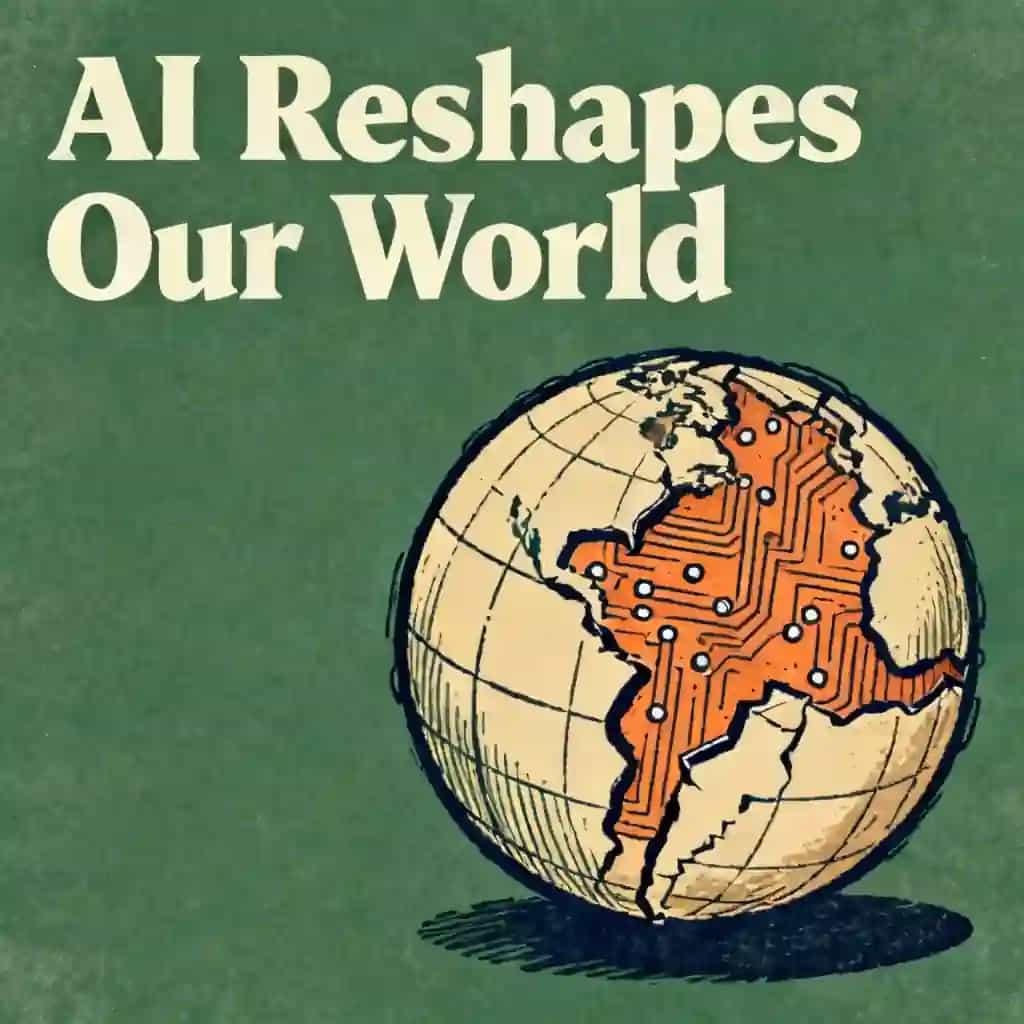
What if you could glimpse the world twenty years from now? A world where deepfakes are indistinguishable from reality, autonomous vehicles navigate our streets, and AI companions know us better than we know ourselves. Kai-Fu Lee and Chen Qiufan's "AI 2041" offers precisely this window, blending scientific expertise with narrative imagination to create what Bill Gates called "a thoughtful, nuanced, and engaging" exploration of AI's future impact. The book has garnered praise from tech luminaries like Satya Nadella and cultural icons alike, with The New York Times hailing it as "required reading for anyone trying to navigate our technological future." Unlike typical futurist manifestos, this unique collaboration between China's leading AI investor and acclaimed science fiction author creates an accessible roadmap to understanding how artificial intelligence will reshape our world-not through abstract predictions, but through vivid stories grounded in technological reality.
2장
The Golden Elephant: When AI Knows You Better Than You Know Yourself
In Mumbai, 2041, the story of Nayana and her family reveals how AI-powered insurance will transform our relationship with technology. Ganesh Insurance's "GI" app monitors their every move, offering discounts for healthy behaviors while subtly nudging them toward better choices. This personalized system represents the culmination of deep learning-AI that constructs layers of artificial neural networks to recognize patterns in massive datasets without explicit programming.
Unlike traditional software that follows human-written rules, deep learning systems teach themselves. They adjust millions of parameters through training on labeled data, creating mathematical equations that can perform "inference" on new information. This technology has already revolutionized image recognition, speech processing, and recommendation systems, but by 2041, it will penetrate every aspect of our lives.
The finance industry stands particularly ripe for AI transformation. Traditional banking and insurance rely on limited data points and crude risk assessments, but AI-based fintech can incorporate thousands of signals from our digital footprints-shopping habits, location data, social media activity-to make comprehensive evaluations instantly. This explains why Ganesh Insurance operates through a family of interconnected apps covering everything from e-commerce to social networking.
However, this power comes with significant downsides. AI systems optimized solely for corporate objectives can manipulate our behavior without regard for our well-being. They can perpetuate or amplify unfairness by making discriminatory inferences based on correlations-as happened to Sahej in the story when his Dalit status was indirectly inferred. Most troublingly, deep learning's decisions lack explainability; unlike humans who can articulate their reasoning, AI's complex equations with millions of parameters create an impenetrable "black box."
The question becomes not whether AI will transform our world, but whether we can harness its benefits while mitigating these risks-a theme that resonates throughout Nayana's journey as she ultimately chooses human connection over algorithmic guidance.
3장
Gods Behind the Masks: When Seeing Is No Longer Believing
In 2041 Lagos, Nigeria, a young undocumented migrant named Amaka finds himself blackmailed into creating deepfake videos to undermine FAKA-a popular virtual avatar with the face of legendary musician Fela Kuti who has become an influential social commentator. This story explores how visual deception technologies will evolve to become virtually indistinguishable from reality.
By 2041, "DeepMask" technology will achieve nearly perfect visual deception. Creating these convincing fakes requires sophisticated computer vision capabilities-teaching machines not just to capture images but to understand what they see. This includes increasingly complex abilities: image capturing, object detection and segmentation, object recognition, tracking, gesture recognition, and full scene understanding.
The technology behind deepfakes employs Generative Adversarial Networks (GANs)-two competing neural networks engaged in a continuous battle of creation and detection. The "forger" network generates synthetic content while the "detective" network determines whether images are real or fake. This adversarial relationship drives continuous improvement as both networks retrain themselves millions of times-the forger minimizing the difference between fake and real images while the detective tries to maximize it.
By 2041, deepfakes will be so convincing that people cannot discern them from real content, though high-quality detection software will exist for critical platforms. The ultimate solution may involve blockchain authentication of all original media, though this won't be universally implemented by then.
The story highlights how these technologies will impact developing countries where regulation lags behind, creating environments where deception flourishes. Despite the dangers, Amaka ultimately chooses integrity over betrayal, using the same technology to reveal truth rather than perpetuate lies-a powerful reminder that technology itself is neutral, but human choices determine whether it becomes a force for good or ill.
4장
Twin Sparrows: When AI Becomes Our Personal Teacher
In Korea, 2041, orphaned identical twins Golden Sparrow and Silver Sparrow receive personalized AI companions through Fountainhead Academy's "vPal" system. Despite sharing identical DNA, the twins display dramatically different personalities-Golden Sparrow competitive and aggressive, Silver Sparrow creative and introspective. Their AI companions, Atoman and Solaris, adapt to these differences, providing customized support that helps each twin develop their unique potential.
This story explores how natural language processing (NLP)-AI's ability to understand and generate human language-will revolutionize education. By 2041, AI companions will communicate fluently with humans, drawing on advanced language models exponentially more sophisticated than today's GPT systems.
The breakthrough enabling this future began with "sequence transduction" and the "transformer" model invented in 2017, which allows AI to teach itself language from naturally occurring material without special labeling. With sufficient data and processing power, these systems detect complex patterns and relationships in language independently.
While today's GPT-3 model (trained on 45 terabytes of text using one of the world's most powerful supercomputers) already generates remarkably human-like text, it still has significant limitations-fabricating information, struggling with causal reasoning, and absorbing human biases. By 2041, these limitations will be partially addressed through exponential growth in model parameters and more sophisticated architectures.
Education remains one of the few domains largely untransformed by technology, with today's classrooms resembling those from a century ago. AI promises to revolutionize this field by addressing its fundamental flaws-particularly the one-size-fits-all approach that ignores individual differences and the high costs that limit access in poorer regions.
AI tutors like Atoman and Solaris can provide constant attention to each student, noticing subtle cues like pupil dilation or drooping eyelids to optimize teaching methods. Human teachers won't disappear but will evolve to focus on developing students' critical thinking, creativity, empathy, and emotional intelligence-the human qualities AI cannot replicate.
The story concludes with the twins reconciling and merging their AI companions, symbolizing how technology can help us integrate different perspectives and grow beyond our limitations-"a game that isn't divided into wins and losses. One with boundless possibilities instead."
5장
Contactless Love: When Healthcare Goes Digital
In a post-pandemic Shanghai, 2041, Chen Nan suffers from severe germophobia and physical contact aversion. She relies on her "smartstream"-a digital assistant that monitors her vital signs and warns her of potential contamination. When her online friend Garcia falls critically ill with a mysterious virus, Chen Nan must decide whether to risk physical contact to save him.
This story explores how AI will transform healthcare, particularly accelerated by pandemic conditions. By 2041, healthcare will likely become the industry most dramatically changed by AI through comprehensive digitization of medical records, drug development, diagnostics, and patient care systems.
AI promises to dramatically accelerate drug discovery while reducing its $1 billion price tag and multi-year timeline. DeepMind's AlphaFold 2, described as "AI's greatest achievement for science to date," can now simulate 3D protein structures with accuracy comparable to traditional techniques that take years per protein. This capability will enable rapid development of treatments for diseases that currently take decades to address.
Beyond drug development, AI will revolutionize healthcare through precision medicine-tailoring individualized treatments using comprehensive digital patient information. Diagnostic AI is expected to exceed all but the best doctors within twenty years, starting with fields like radiology where algorithms already outperform good radiologists on certain scans.
Even complex surgeries will become increasingly automated, with robot-assisted procedures growing from 1.8% of all surgeries in 2012 to 15.1% in 2018. By 2041, all surgeries will likely involve some robotic participation, with fully autonomous procedures becoming the majority.
Wearable devices and smart environments will continuously monitor vital signs and detect health crises, while aggregated data will help predict future pandemics. The story concludes with Chen Nan overcoming her fears to embrace Garcia, choosing human connection despite her technology's warnings-a reminder that even in our digitized future, human touch remains irreplaceable.
6장
My Haunting Idol: When Reality and Virtual Reality Merge
In Tokyo, 2041, Aiko participates in an immersive detective experience investigating her idol Hiroshi X's mysterious death. Using XR (extended reality) technology, she interacts with a virtual recreation of Hiroshi while solving clues in both physical and digital spaces. The story explores how immersive technologies will blur the boundaries between real and virtual worlds.
By 2041, XR technologies will create truly seamless experiences combining three approaches: Virtual Reality (VR) creates fully synthesized environments that transport users elsewhere; Augmented Reality (AR) captures the real world and overlays digital information; and Mixed Reality (MR), the most advanced form, integrates virtual elements so seamlessly with the physical world that they appear to interact naturally with it.
Creating truly immersive XR experiences requires fooling our most acute sense-sight. While early devices were clunky helmets tethered to mainframes, by 2041, XR contact lenses combined with nearly invisible earsets will create an "invisible smartstream" that can display information, translate languages, and provide haptic feedback through specialized suits that simulate touch, temperature, and other physical sensations.
Future XR input will move beyond today's handheld controllers toward more natural interfaces combining eye tracking, movement tracking, gesture recognition, and speech understanding. For movement in virtual worlds, omnidirectional treadmills will allow users to run, crawl, and climb while remaining safely centered.
These technologies raise profound ethical questions. Systems that can appear at "convenient times" must constantly monitor users-is this acceptable? Wearing XR devices all day means capturing everything we see and hear, creating an "infinite memory repository" with serious privacy implications. As XR becomes more realistic, the possibility of "digital immortality" emerges, where deceased individuals might be recreated from their digital footprints.
The story concludes with Aiko discovering that her immersive detective experience was a sophisticated AI-enabled game created by historiz, a subsidiary of Viberz founded by the real Hiroshi X. Their technology allows fans to interact with personalized virtual idols, giving them agency in crafting their own narratives rather than passively consuming manufactured personas-showing how these technologies might actually enhance rather than diminish authentic human connection.
7장
The Holy Driver: When Vehicles Drive Themselves
In Sri Lanka, 2041, thirteen-year-old Chamal, a virtuoso VR racing gamer, is recruited to operate autonomous vehicles remotely during emergencies. The story reveals how autonomous vehicles will evolve through six levels of automation: from L0 (no automation, AI only alerts) to L5 ("steering wheel optional" with complete autonomy).
Autonomous vehicles replicate human driving functions through AI systems: perception (using cameras, LiDAR, and radar instead of eyes), navigation (high-definition digital mapping), inference (predicting pedestrian and vehicle movements), decision-making (applying road rules), and vehicle control.
While L0-L3 vehicles are commercially available and limited L4 deployment began in 2018, achieving L5 autonomy remains challenging due to the immense data requirements for training AI on countless driving scenarios. The story's remote "ghost driver" system offers one solution-using 6G networks and AR to allow human experts to remotely control vehicles in emergencies.
By 2041, L5 autonomous vehicles will revolutionize transportation through on-demand, lower-cost services with greater convenience and safety. AI-managed ride-hailing fleets will optimize routes, minimize wait times, and eliminate human driver costs (currently 75% of fares), making car ownership less necessary.
Safety will improve dramatically as AVs accumulate trillions of collective driving hours compared to a human driver's mere thousands. The average American will reclaim 8.5 hours weekly, with vehicle interiors reconfigured for work, communication, play, and sleep.
However, autonomous vehicles face significant non-technical barriers including ethical dilemmas, liability questions, and media sensationalism. The "trolley problem" exemplifies difficult ethical choices AVs must make, while "explainable AI" remains challenging as complex mathematical decisions must be simplified for human comprehension.
The story concludes with Chamal sacrificing himself to save others during a terrorist attack-a poignant reminder that while technology may advance, human courage and sacrifice remain our most profound qualities.
8장
Quantum Genocide: When Technology Becomes a Weapon
In Iceland, 2041, three hackers attempt to crack Satoshi Nakamoto's legendary Bitcoin wallet using quantum computing. Meanwhile, a grieving scientist named Marc Rousseau deploys autonomous weapons to exact revenge for his sister's death from climate change-related disasters. This intersection of advanced technologies sets the stage for a global crisis that explores the darkest potential of human innovation.
This story delves deep into two transformative technologies that hold both promise and peril for humanity's future: quantum computing and autonomous weapons. Quantum computers harness the bizarre principles of quantum mechanics to perform computations at speeds that dwarf classical computers. While traditional computers use bits that exist as either 0 or 1, quantum computers employ qubits that can exist in multiple states simultaneously through superposition. Even more remarkably, these qubits can be entangled, creating a phenomenon Einstein called "spooky action at a distance," where the state of one qubit instantly affects another, regardless of physical separation.
The computational power of quantum systems grows exponentially with each additional qubit. A 300-qubit quantum computer could perform more calculations simultaneously than there are atoms in the observable universe. When fully realized, quantum computing will revolutionize numerous fields: enabling the discovery of new life-saving drugs through molecular simulation, creating ultra-precise climate models to predict environmental changes, forecasting pandemic patterns through complex biological modeling, and dramatically advancing artificial intelligence by processing vast amounts of data in parallel.
However, this same computational power poses existential threats to current cryptographic systems. Modern encryption relies on the practical impossibility of factoring large numbers quickly - a limitation quantum computers could overcome using Shor's algorithm. This puts cryptocurrencies like Bitcoin at particular risk, especially the estimated two million bitcoins (worth $120 billion at 2021 prices) stored in older P2PK addresses where public keys are exposed. The ability to crack these addresses could destabilize the entire cryptocurrency ecosystem.
The narrative also examines the emerging threat of autonomous weapons systems (AWS), which represent a paradigm shift in warfare. Unlike traditional weapons that require human decision-making, AWS can independently identify, track, and eliminate human targets using advanced AI algorithms. These weapons can take various forms - from autonomous drones and robots to swarms of microscopic devices. Unlike nuclear weapons, which are constrained by mutually assured destruction and clear attribution, autonomous weapons can be deployed covertly, with plausible deniability, and at a fraction of the cost. This accessibility makes them attractive to smaller nations and non-state actors, potentially democratizing the ability to wage mass-casualty attacks.
The story reaches its climax when Robin faces an impossible choice: allow Marc's autonomous weapons to execute their deadly mission or shut down the global networks that modern society depends on. This dramatic decision illustrates how advanced technologies, developed with the best intentions, can be weaponized with catastrophic consequences. The narrative serves as a stark warning about the dual-use nature of emerging technologies and the critical importance of establishing ethical frameworks and control mechanisms before these tools become widely available.
9장
The Job Savior: When AI Transforms Work
In 2041, Jennifer Greenwood trains at Synchia, a job reallocation firm helping workers displaced by AI automation. The story explores how AI will transform employment, potentially eliminating millions of jobs across industries while creating new opportunities for human-AI collaboration.
AI's primary advantage lies in detecting subtle patterns within massive datasets. For example, while human loan underwriters examine a handful of variables, AI algorithms can process thousands of data points instantaneously for more accurate assessments. This capability allows AI to easily displace routine white-collar work like bookkeeping and data entry, while robotics combined with AI increasingly threatens complex blue-collar jobs.
Unlike previous technological revolutions that created new jobs while destroying others, AI specifically aims to replace human tasks across hundreds of industries simultaneously. While the Industrial Revolution took over a century to spread globally, AI is already being adopted worldwide, accelerating job displacement at an unprecedented pace.
Beyond unemployment figures, AI-driven job displacement creates cascading social problems. As workers compete for fewer jobs, wages decline while wealth inequality worsens dramatically. Perhaps most devastating is the loss of meaning. With work ethic central to modern identity, watching algorithms outperform humans at tasks they've spent lifetimes mastering leads to feelings of futility and obsolescence.
However, AI falls short in three key areas that will likely persist even by 2041: CREATIVITY (AI cannot create, conceptualize, or plan strategically across domains); EMPATHY (AI cannot genuinely feel or make others feel understood and cared for); and DEXTERITY (AI cannot accomplish complex physical work requiring precise coordination in unstructured environments).
To address AI job displacement, we must relearn (acquire AI-resistant skills like creativity and empathy), recalibrate (reimagine jobs as human-AI partnerships), and renaissance (envision AI catalyzing a flowering of human creativity once people have more freedom and time).
The story concludes with Michael voting to integrate AI into SynchiaAlliance's workflow, embracing the inevitable transformation while recognizing that humans and AI must learn to work together in this new reality.
10장
Dreaming of Plenitude: When Scarcity Becomes Obsolete
In Brisbane, Australia, 2041, Keira participates in Project Jukurrpa-a dual-currency system where basic necessities are provided through a Basic Life Card while community service earns "Moola," a virtual credit system rewarding contribution rather than consumption. The story explores how AI and other technologies will create a world of abundance where traditional economic models based on scarcity no longer apply.
By 2041, renewable energy will power much of the world as costs plummet-solar energy dropped 82% from 2010-2020, wind 46%, and battery storage 87%. With continued investment, energy costs could fall to less than a quarter of today's prices. This clean energy transformation will eliminate over 50% of greenhouse gas emissions while dramatically reducing costs of water, materials, manufacturing, and computation.
Simultaneously, the Materials Genome Initiative has revolutionized materials science, using open-source methods and AI to double innovation pace. Scientists can now build materials atom by atom, creating artificial muscles and lightweight nanomaterials. As production shifts from limited resources to nature's plentiful building blocks (photons, molecules, atoms, bits), we move steadily toward the dream of plenitude-where scarcity becomes increasingly obsolete.
AI and automation will transform production by taking over manufacturing, delivery, design, and marketing of most goods. Robots work continuously without complaints or wages, reducing costs to just above materials. Combined with nearly free energy and inexpensive materials, these advances usher in the age of plenitude.
However, economics has always operated on the fundamental premise of scarcity-that human wants exceed available resources. All major economic theories (Smith, Marx, Keynes) share this assumption. But when scarcity disappears, these models collapse. The transition requires a new social contract that redefines work, money, purpose, and institutions while maintaining balance.
The story concludes with Keira deciding to help reform Project Jukurrpa to truly help young people realize their potential rather than widening inequality-a reminder that technology alone cannot solve social problems without thoughtful human guidance.
11장
The AI Story: Our Shared Responsibility
AI 2041 presents artificial intelligence's potential to create unprecedented wealth, amplify human capabilities, improve work and play, liberate us from routine tasks, and usher in an age of abundance. From healthcare diagnostics that can detect diseases years before symptoms appear to personalized education systems that adapt to each student's learning style, AI promises to revolutionize every aspect of human life. Smart cities could optimize energy usage and traffic flow, while AI-powered scientific research could accelerate discoveries in fields from climate change solutions to space exploration.
Yet AI also brings significant challenges: algorithmic biases that perpetuate social inequalities, security risks from sophisticated cyber attacks, deepfakes that threaten truth and democracy, privacy infringements through ubiquitous surveillance, autonomous weapons that could revolutionize warfare, and widespread job displacement across industries. These concerns are already manifesting - from facial recognition systems showing racial bias to deepfake videos influencing elections and automated systems making critical decisions about loans, jobs, and criminal sentencing.
These problems stem not from AI itself but from humans using AI maliciously or carelessly. In the book's stories, these challenges were overcome through human creativity, resourcefulness, wisdom, courage, and compassion. For instance, communities developed AI literacy programs, established ethical frameworks for AI development, and created new social systems to ensure technology's benefits were distributed equitably. We are not passive spectators but authors of AI's story. Our values and beliefs about AI will become self-fulfilling prophecies, shaping how the technology evolves and is implemented.
If we appreciate AI's potential to liberate humanity from routine work and poverty, cherish our free will, and believe in human-AI symbiosis, we can mold AI into our perfect complement. AI will handle the routine and computational tasks - from data analysis to logistics optimization - freeing us to explore what makes us uniquely human: creativity, emotional intelligence, moral reasoning, and determining our collective destiny. This requires thoughtful regulation, inclusive dialogue about AI's role in society, and investment in human skills that complement rather than compete with AI.
If we get the dance between artificial intelligence and human society right, it would be the single greatest achievement in human history. This means developing AI systems that are transparent, accountable, and aligned with human values. The future depicted in these stories isn't inevitable-it's a possibility that depends on the choices we make today. By understanding AI's potential and pitfalls now, we can shape a tomorrow where technology enhances rather than diminishes our humanity, creating a world where AI serves as a tool for human flourishing rather than a replacement for human agency.





![[ai-2041-by-kaifu-lee:c0000] AI 2041 p1-1](/_next/image?url=https%3A%2F%2Fd1y2du6z1jfm9e.cloudfront.net%2Fassets%2Fpodcast%2Fgreen.png&w=1024&q=50)
![[ai-2041-by-kaifu-lee:c0002] AI 2041 p1-1](/_next/image?url=https%3A%2F%2Fd1y2du6z1jfm9e.cloudfront.net%2Fassets%2Fpodcast%2Fyellow.png&w=1024&q=50)


![[74a8d9b6-9102-469d-97ab-4684e1cc0cd9:c0001] [(00:00:00)](https://www.youtube.com/watch?v=xlEwah5QEkY&… p1-1](/_next/image?url=https%3A%2F%2Fd1y2du6z1jfm9e.cloudfront.net%2Fassets%2Fpodcast%2Fpurple.png&w=1024&q=50)
![[74a8d9b6-9102-469d-97ab-4684e1cc0cd9:c0003] [(00:00:00)](https://www.youtube.com/watch?v=xlEwah5QEkY&… p1-1](/_next/image?url=https%3A%2F%2Fd1y2du6z1jfm9e.cloudfront.net%2Fassets%2Fpodcast%2Fblue.png&w=1024&q=50)