4장
The Boundaries Between Worlds
Throughout the novel, characters repeatedly encounter boundaries between different worlds or states of being. These boundaries-between reality and dreams, presence and absence, connection and isolation-form the philosophical heart of the story.
Sumire explores this theme in her writing when she contemplates the inseparable nature of knowing and not knowing, describing them as "Siamese twins" existing in confusion. She questions distinctions like theme and style, object and subject, cause and effect-seeing them as indistinguishable rather than black-and-white pairs. For Sumire, dreams offer an escape from these distinctions, a place where boundaries don't exist and reality doesn't bite.
In her recurring dream, Sumire climbs an endless spiral staircase to meet her dead mother, who has critical information she needs. When she finally reaches the top, her mother is crammed into a small ventilation hole in a stone wall. Before her mother can speak, she's sucked away into darkness. The staircase disappears, leaving Sumire trapped at the top of a tower. This dream vividly illustrates the tantalizing yet impossible desire to cross the boundary between life and death, to retrieve what has been irretrievably lost.
Miu's story presents the most literal example of boundary-crossing in the novel. Fourteen years before the main events, while staying in a small Swiss town, Miu became trapped overnight on a Ferris wheel. Looking through binoculars at her apartment, she saw herself inside with a man named Ferdinando. She watched, horrified yet unable to look away, as this other Miu engaged in increasingly explicit sexual acts with him. The experience split her in two-the Miu who remained "on this side" lost her sexuality, her fertility, and her musical ability. The other half remained forever on "the other side" of an invisible mirror she could never cross.
After this incident, Miu's hair turned completely white overnight. She abandoned her musical career and returned to Japan, eventually taking over her father's import business. At 29, she married a man she'd known since childhood, after explaining her frigidity to him. They live as good friends and life partners who trust each other implicitly, though they never touch.
When Sumire disappears from the Greek island, the narrator develops a theory: perhaps she has "gone over to the other side"-breaking through the mirror to meet the other Miu. This possibility suggests that boundaries between worlds might be permeable after all, though crossing them may mean abandoning the known world entirely.
These explorations of boundaries reflect Murakami's ongoing interest in the divided nature of human experience-how we exist simultaneously in multiple realms (physical/spiritual, conscious/unconscious, connected/isolated) and how these divisions shape our understanding of ourselves and others.
5장
Islands of Isolation
Islands-both literal and metaphorical-appear throughout the novel as powerful symbols of isolation. The Greek island where Sumire disappears represents the ultimate physical isolation, a place cut off from the mainland and from ordinary life. Its remoteness creates a setting where extraordinary things become possible-where reality itself seems to thin, allowing Sumire to potentially slip through to "the other side."
But long before this physical isolation, each character exists on their own emotional island. The narrator describes how he drew invisible boundaries between himself and others from a young age, finding solace only in books and music. From a bland, normal family in Tsudanuma, he was opposite to his high-achieving sister-doing minimal schoolwork while reading novels constantly. With Sumire, he found someone who genuinely listened, their conversations more intimate than lovers', though she had no romantic interest in him.
Miu lives on perhaps the most profound island of isolation, having been split in two by her Ferris wheel experience. She explains to the narrator that what he sees is just a shadow of who she was-she's no longer truly alive, just an echo. Her marriage, though based on trust and friendship, lacks physical intimacy, leaving her perpetually separated from genuine connection.
Sumire's isolation manifests in her struggle to write. Living in a tiny apartment in Kichijoji filled with books rather than furniture, she follows a solitary routine: rising at noon, walking through Inogashira Park, reading on benches or in coffee houses with classical music playing, then settling at her desk by 11 p.m. with coffee, cigarettes, and her word processor. Despite her clear mind and burning desire to write, she struggles to complete anything. Her writing had a remarkable freshness and honesty, though it sometimes resembled "a patchwork quilt sewn by stubborn old ladies."
These islands of isolation reflect the fundamental human condition-we are all, in some sense, separate from one another, unable to fully bridge the gap between self and other. Yet the characters continually attempt to reach across this divide, seeking connection despite its impossibility. Their efforts, though ultimately frustrated, represent the essential human drive toward relationship and understanding.
6장
The Impossibility of Complete Connection
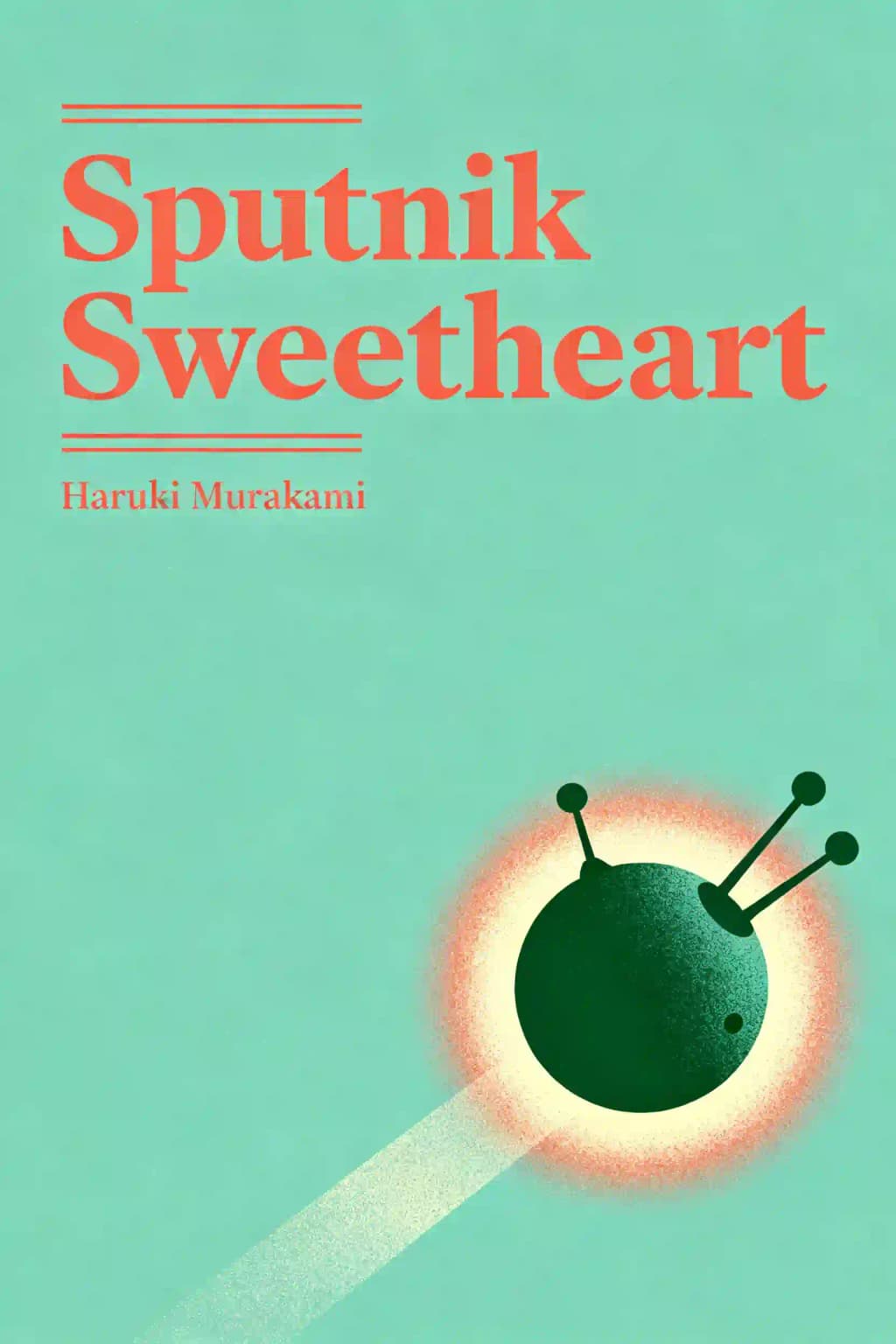
At its core, "Sputnik Sweetheart" explores the fundamental impossibility of complete connection between human beings. Like satellites orbiting in space-close enough to see one another but never to touch-the characters circle each other in patterns of desire and longing that can never be fully satisfied.
This impossibility is most painfully illustrated when Sumire finally acts on her desire for Miu. After months of working together and traveling through Europe, Sumire reaches for Miu one night on the Greek island, confessing "I really like you" as she begins unbuttoning Miu's pajamas. Despite her mind being willing, Miu's body remains unresponsive. She explains to Sumire that since the incident fourteen years ago that turned her hair white overnight, she hasn't been able to "give myself to anyone in this world."
Though she offers alternatives, Sumire only wanted genuine connection. As Miu comforts the sobbing Sumire, she realizes they are "wonderful travelling companions but in the end no more than lonely lumps of metal on their own separate orbits." This metaphor perfectly captures the novel's central theme-we may travel alongside others for a time, but ultimately we remain separate, unable to merge our orbits completely.
The narrator's relationship with Sumire demonstrates another form of impossible connection. Though they share deep intellectual and emotional intimacy, their physical desires never align. To ease his unrequited feelings, he begins sleeping with older, attached women-including a pupil's mother-but these relationships lack "the unconditional, natural intimacy" he shares with Sumire.
Even language itself proves insufficient for true connection. When Sumire asks the narrator about the difference between a sign and a symbol, his explanation highlights the inherent limitations of communication. A symbol represents something in one direction only, while a sign makes things equivalent and interchangeable-but neither can fully capture the complexity of human experience or bridge the gap between separate consciousnesses.
This impossibility of complete connection isn't presented as tragic, exactly, but rather as an inherent condition of existence. The characters continue to reach toward one another despite knowing they can never fully connect-and it's in this reaching, this persistent desire for connection despite its impossibility, that their humanity most fully expresses itself.
7장
The Mystery of Disappearance
Sumire's sudden disappearance from the Greek island forms the central mystery of the novel, creating ripples that destabilize the narrative and challenge our understanding of reality itself. After her failed attempt to connect physically with Miu - a moment of profound emotional vulnerability - she vanishes without explanation, wearing only Miu's silk pajamas and flip-flops. The sparse physical evidence becomes almost mythological in its simplicity: footprints in the sand leading nowhere, a half-drunk glass of water, and rumpled bedsheets that still hold her warmth. Despite extensive searching involving local police, harbor patrols, and neighboring islands, no concrete evidence of her whereabouts emerges.
This disappearance resonates with earlier stories of vanishing that weave through the narrative. During one of their daily visits to a harbor cafe - a ritual that had become sacred to their friendship - Sumire had read aloud a newspaper article about a woman who died alone in her apartment and was discovered only when neighbors noticed her cats behaving strangely. The woman's body had been partially consumed by her pets, a detail that haunted Sumire deeply. This prompted her to share a childhood memory of her own beloved cat, a grey tabby that exhibited increasingly peculiar behavior around an old pine tree in her backyard. The cat had spent days circling the tree before finally climbing high into its branches, vanishing "like smoke" into the evening air. Despite weeks of searching, leaving out food, and calling into the darkness, Sumire never saw it again, eventually imagining it died alone, clinging to a branch in some unreachable place.
These parallel disappearances suggest a pattern in which vanishing becomes a response to unbearable emotional pain or impossible situations. When human connection proves elusive, when desire cannot find fulfillment in the physical world, perhaps disappearance becomes the only viable alternative - a way of escaping the constraints of reality when that reality becomes too painful to bear. The pattern suggests that some souls, when faced with overwhelming emotional turmoil, choose to step outside the boundaries of the known world rather than continue existing within its limitations.
The narrator's theory that Sumire has "gone over to the other side" offers a metaphysical interpretation of her disappearance that transforms it from tragedy to transcendence. This perspective suggests she hasn't simply vanished but has broken through the membrane separating ordinary reality from something more profound. If Sumire has indeed crossed over to join the other half of Miu - the part Miu lost in her own traumatic experience years before - her disappearance represents not an ending but a transformation, a movement into another state of being where the rules of normal reality no longer apply.
This ambiguity around Sumire's fate creates a haunting open-endedness that extends beyond the novel's conclusion. Is she dead? Has she crossed to another world? Will she return? The final scene intensifies this uncertainty when the narrator receives a phone call that sounds like Sumire, claiming she's back after going through "bloody hell" to return. The call's authenticity remains unclear - is this truly Sumire speaking from some physical location, or is it a dream, hallucination, or message from another realm? This ambiguity serves not just as a plot device but as a meditation on the nature of presence and absence, reality and dreams, connection and isolation.
8장
The Lingering Echo of Loss
The novel's final chapters explore how characters continue living in the aftermath of profound loss. Six months after Sumire's disappearance, the narrator spots Miu driving her navy-blue Jaguar in Tokyo. Her hair has turned completely white, and she appears transformed-like an empty shell, devoid of the vital energy that once attracted Sumire. Her icy expression never changes as she drives away.
This glimpse of Miu suggests that she has been further hollowed out by Sumire's disappearance, perhaps losing whatever remained of her former self. The narrator imagines her keeping her silence, clutching memories close-a poignant image of grief held private, of loss internalized rather than expressed.
The narrator himself continues his life despite the profound absence Sumire has left. He reflects on how we perform endless everyday deeds while drawing ever closer to our allotted time, leaving behind immeasurable emptiness. With Sumire gone, he's left in a "distorted, empty world" where what they had will never happen again.
At the Acropolis in Athens, gazing at the illuminated temple, he feels "an incomparable loneliness," seeing his future life as desolate as "the surface of a deserted planet." He understands anew how irreplaceable Sumire was to him-how she had "kept me tethered to the world" and how they had "exposed our hearts to one another, an experience I'd never have with anyone else."
He reflects on how we each have a "special something" we can get only at a special time in our lives-"like a small flame" that a fortunate few cherish. But once that flame goes out, it's gone forever. This recognition of the irreplaceability of certain relationships, of the unique quality of connection that cannot be reproduced, forms the emotional heart of the novel's conclusion.
To connect with memories of Greece and Sumire, he repeatedly listens to Elisabeth Schwarzkopf singing Mozart's lieder, feeling as if their hearts are momentarily one-like a tiny farmhouse light glimpsed from a night train, briefly preserved when you close your eyes. This image beautifully captures the ephemeral nature of connection, how it flashes briefly before disappearing into darkness, leaving only memory in its wake.
9장
The Redemptive Power of Understanding
Despite its exploration of isolation and impossible connection, "Sputnik Sweetheart" ultimately suggests that understanding-even partial understanding-offers a form of redemption. Though characters cannot fully connect, their attempts to understand one another create moments of profound meaning and beauty.
This redemptive understanding emerges most clearly in the narrator's interaction with Carrot, his girlfriend's son who has been caught shoplifting staplers. When the security guard Nakamura berates the boy, the narrator defends him, suggesting shoplifting stems from emotional imbalance rather than criminal intent. Later, alone with Carrot in a coffee shop, the narrator opens up about his trip to Greece and his missing friend. He shares his childhood loneliness, how he imagined being adopted, and how his only companion was a dog that died when he was in fifth grade.
As he speaks about standing alone at the mouth of a river watching water flow into the sea, Carrot finally begins to look at him with interest. This moment of connection, though wordless, suggests the possibility of understanding across the divide of age and experience. When the narrator later takes Carrot's hand, he experiences a nostalgic sensation he can't quite place-perhaps a recognition of shared loneliness, of the universal human condition.
Similarly, when Miu finally shares her story about the Ferris wheel with the narrator, she reveals a closely-guarded secret she's kept for fourteen years. Though this sharing doesn't change her condition, it creates a moment of intimate understanding between them. The narrator, unable to find the right words, simply holds her, realizing he loves both the Miu on "this side" and the one on "the other side."
These moments of understanding don't resolve the novel's central tensions or heal its characters' wounds. Sumire remains missing; Miu remains split in two; the narrator remains alone. Yet they offer glimpses of what might be possible if we continue reaching toward one another despite the impossibility of complete connection-if we accept the limitations of our separate orbits while still seeking points where those orbits might momentarily align.
In a universe of lonely satellites, understanding becomes a kind of gravity-a force that draws us toward one another even as it maintains the distance necessary for orbit. It's not the complete merger we might desire, but it's what's possible within the constraints of human existence. And in that possibility lies a quiet, modest redemption-not the erasure of loneliness, but its transformation into something bearable, even beautiful.