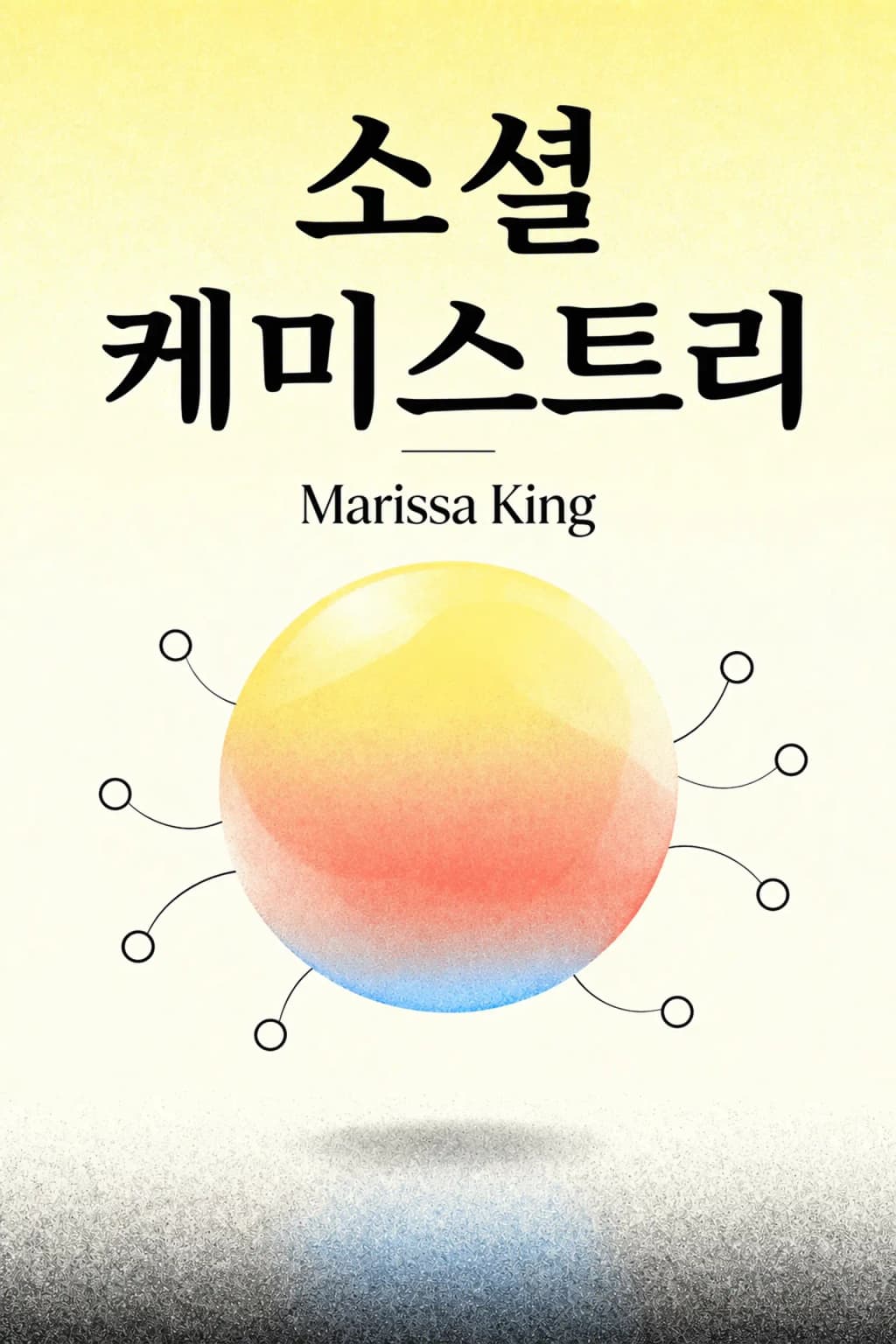
Social Chemistry
Decoding the Elements of Human Connection
Social Chemistry 개요
In "Social Chemistry," Yale professor Marissa King decodes the science of human connection, revealing why Jim Cramer thrives with expansive networks while Anna Wintour succeeds through deep, interconnected ones. What's your networking style - broker, expansionist, or convenor?
Social Chemistry의 핵심 주제
- network architecture
- social capital
- brokerage and convening
- weak ties
- reciprocity dynamics
Social Chemistry의 명언
Networks are far more than just collections of individual relationships.
Strategic networking [can trigger] feelings of moral impurity.
Authenticity may be the antidote to networking discomfort.
People consistently underestimate how much others enjoy conversations.
Everyone has something to offer.
Social Chemistry의 등장인물
- Marissa KingAuthor and researcher of social networks
- Vernon JordanInfluential presidential confidant and broker
- David RockefellerBusinessman known for his massive contact network
저자 소개
Social Chemistry의 저자 소개
Marissa King, PhD, is the acclaimed author of Social Chemistry and a leading expert on human connection and social networks. A professor at the Wharton School of the University of Pennsylvania, where she holds the Alice Y. Hung President’s Distinguished Professor chair, King combines rigorous academic research with practical insights into how relationships shape health, behavior, and organizational success.
Her work, funded by the National Institutes of Health, has been published in JAMA, Health Affairs, and top management journals, and she previously taught at Yale School of Management.
Social Chemistry, a blend of sociology and behavioral science, draws from King’s decades of research on social influence and network dynamics. The book decodes how interpersonal connections drive outcomes in healthcare, workplace culture, and personal well-being—themes amplified through her frequent contributions to The New York Times, Wall Street Journal, and NPR.
King’s frameworks are applied by healthcare institutions and Fortune 500 companies to tackle challenges ranging from clinician burnout to team productivity. Recognized for bridging scholarly depth with accessibility, her work has shaped both academic discourse and real-world strategies for building meaningful networks.
Social Chemistry 요약 다운로드
Social Chemistry 요약을 무료 PDF 또는 EPUB으로 받으세요. 인쇄하거나 오프라인에서 언제든 읽을 수 있습니다.
이 책에 대한 FAQ
Social Chemistry explores how the structure and quality of social networks—not just size—impact personal and professional success. Marissa King identifies three networking styles: Expansionists (broad networks), Brokers (bridging diverse groups), and Conveners (deep, tight-knit circles). The book combines neuroscience, psychology, and real-world examples to show how intentional relationship-building enhances resilience, creativity, and career outcomes.
Professionals, leaders, and anyone seeking to improve relationships or career trajectories will benefit. It’s ideal for those navigating career changes, leadership roles, or remote work dynamics. The research-backed insights also appeal to readers interested in sociology, organizational behavior, or self-improvement.
Yes. Critics praise its blend of academic rigor and accessibility, with Publishers Weekly calling it “wise, well-reasoned advice” for career growth. Kirkus notes its “personable approach” to social dynamics, making complex concepts like network analytics relatable through celebrity examples (e.g., Anna Wintour, Yo-Yo Ma).
- Expansionists: Build wide networks (e.g., Vernon Jordan).
- Brokers: Connect disparate groups (e.g., Yo-Yo Ma’s Silk Road Ensemble).
- Conveners: Foster dense, interconnected circles (e.g., Anna Wintour’s fashion network).
King argues that hybridizing these styles maximizes impact.
The book shifts focus from transactional interactions to cultivating “high-quality connections” that boost cognitive function and job satisfaction. King emphasizes authenticity, showing how networks affect health and longevity as much as smoking or obesity.
Adam Grant endorsed it as “one of the most interesting and useful books ever written on networking.” Another standout insight: “The structure of your network predicts your pay and ideas more than your IQ.”
By teaching readers to audit their network’s diversity and depth. Brokers, for instance, excel in innovation-driven roles by linking unrelated fields, while Conveners thrive in stable industries requiring trust.
Some reviewers note it leans more on conceptual frameworks than step-by-step guides. The Open Letters Review highlights its balanced tone but suggests practical applicators might crave more tactics.
While Atomic Habits focuses on individual behavior change, Social Chemistry examines how social structures shape outcomes. Both emphasize small, intentional shifts but target different levers of success.
Yes. King explains how “relationship audits” identify underinvested connections. For example, Conveners’ deep ties correlate with emotional resilience, while Brokers’ bridging reduces workplace conflict.
As remote work and AI reshape collaboration, King’s strategies for intentional networking help maintain creativity and trust in hybrid environments. Her research on digital communication’s limits remains timely.
Pair with Never Eat Alone (tactical networking) or Dare to Lead (trust-building). For deeper dives into social science, try Connected by Nicholas Christakis.