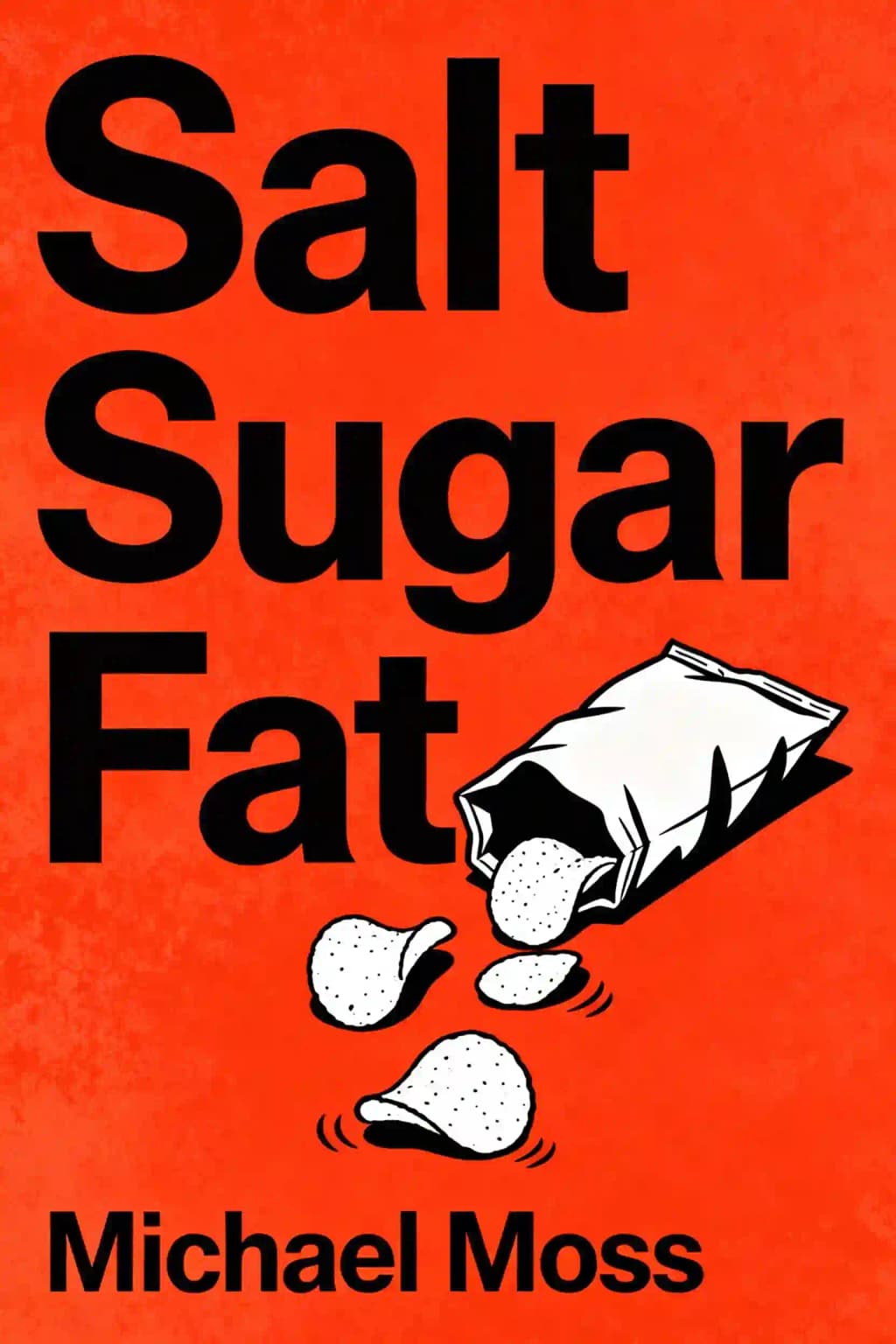
1장
The Secret Formula That Drives America's Processed Food Industry
In the heart of America's processed food industry lies a carefully guarded secret-the precise formulations of salt, sugar, and fat that make products irresistible. Michael Moss's groundbreaking investigation exposes how food giants like Kraft, General Mills, and Coca-Cola engineer their products to hit our "bliss points," creating cravings that keep us coming back for more. This book became a cultural phenomenon upon its 2013 release, with celebrities from Oprah to Bill Clinton citing its influence on their dietary choices. Named one of the best books of the year by The Atlantic and The New York Times Book Review, it transformed public understanding of processed food, revealing how these companies knowingly design products that override our body's natural satiety signals-not unlike the tobacco industry's manipulation of nicotine. As obesity rates soared to affect more than one-third of Americans, Moss's expose arrived at a critical moment, forcing us to reconsider our relationship with the foods we consume daily.
2장
The Industry's Hidden Crisis Meeting
In April 1999, the CEOs of America's largest food companies gathered secretly in Minneapolis for an unprecedented summit. Michael Mudd, Kraft's vice president, delivered a stark presentation about the emerging obesity epidemic: over half of American adults overweight, nearly one-quarter obese, childhood obesity rates doubled since 1980, with social costs estimated between $40-$100 billion annually. He boldly compared their industry to cigarette manufacturers, noting how both advertised to children and warning that trial lawyers fresh from tobacco litigation victories were eyeing food companies next.
Mudd proposed industry-wide limits on salt, sugar, and fat in mainstream products (not just diet alternatives), a marketing code for children's advertising, and campaigns promoting exercise. He emphasized they didn't need to solve obesity alone but must make "a sincere effort to be part of the solution" to avoid being "demonized."
Stephen Sanger, General Mills' CEO, forcefully rejected these ideas. He argued consumers cared about taste, not nutrition, and the industry had always weathered health concerns with minor adjustments. Sanger refused to "screw around with the company jewels" by changing formulations because "a bunch of guys in white coats are worried about obesity." His stance effectively ended the meeting.
The executives spurned even Mudd's modest proposal for a $15 million research fund. Instead, America's food companies charged ahead, using more salt, sugar, and fat to edge out competition. Even Kraft eventually abandoned its anti-obesity initiative when Hershey threatened its cookie market share, responding with fat-laden Oreo variations and acquiring Cadbury to expand globally.
This meeting revealed the industry's fundamental dilemma: they understood their products contributed to the obesity epidemic but couldn't sacrifice the ingredients that drove profits. The moment represented a pivotal missed opportunity for the food industry to address growing health concerns before they became a full-blown crisis.
3장
Engineering the Perfect Bliss Point
Howard Moskowitz, a Harvard-trained experimental psychologist with a PhD in mathematics, revolutionized the food industry by scientifically mapping our taste preferences. In his Manhattan office, this sandy-haired scientist developed the concept of the "bliss point"-the precise amount of sugar, salt, or fat that triggers maximum pleasure without overwhelming the palate. "There's no moral issue for me," Moskowitz explains. "I did the best science I could. I was struggling to survive and didn't have the luxury of being a moral creature."
His journey began with the U.S. Army, which hired him to solve a critical problem: soldiers weren't eating enough field rations. Working with MREs (Meals, Ready to Eat), Moskowitz discovered "sensory-specific satiety"-the tendency for strong, distinct flavors to quickly make people feel full, while bland foods could be eaten continuously. This principle became foundational for processed food companies, explaining why products like Coca-Cola and Doritos succeed by piquing taste buds without overwhelming them with any single flavor.
By the early 1980s, Moskowitz had become an industry star. His breakthrough came when analyzing Maxwell House coffee data, where he made a revolutionary observation: people's preferences clustered around three different roasts (weak, medium, strong), each considered perfect by their respective fans. Rather than seeking one perfect formulation, he convinced General Foods to sell all three roasts simultaneously-a breakthrough that saved the Maxwell House brand against Folgers.
This insight transformed the food industry as Moskowitz applied the same principle across grocery products. For Campbell's struggling Prego sauce, he identified three distinct consumer clusters: those preferring plain, spicy, or extra chunky sauce. The extra chunky revelation generated $600 million over the next decade. What Malcolm Gladwell's famous TED talk about Moskowitz didn't mention was sugar's role in these formulations. Prego sauces, regardless of variety, contain sugar as their second-largest ingredient after tomatoes-with just half a cup delivering as much sugar as three Oreo cookies.
Moskowitz's most sophisticated work came in his "Crave It!" research for ingredient giant McCormick, which studied consumer reactions to thirty grocery staples including cheesecake, ice cream, and chips. He discovered that hunger rarely drives cravings. Instead, we eat due to emotional needs and sensory factors: taste, aroma, appearance, and texture. Sugar, remarkably, can satisfy all these pillars of craving.
His methods reached their zenith with Cherry Vanilla Dr Pepper in 2004. Creating sixty-one distinct formulations and testing them on 415 carefully selected Dr Pepper fans across four cities, Moskowitz discovered the "bliss point" for sugar wasn't a single point but a range that generates equal pleasure. This allowed Cadbury to use slightly less flavoring syrup without reducing consumer satisfaction, saving "millions" in production costs while creating a product that drove tremendous sales growth.
4장
The Convenience Revolution That Transformed American Eating
The processed food revolution began in earnest after World War II when returning veterans like Al Clausi joined companies like General Foods with a mission to reinvent how Americans ate. Clausi's breakthrough came with instant Jell-O pudding, which he developed between 1947-1950 after overcoming the company's initial resistance to using chemical additives. When competitor National Brands filed a patent using synthetics, General Foods abandoned its "pure ingredients" stance, allowing Clausi to create a superior instant pudding using phosphates that gelled milk perfectly within minutes.
Meanwhile, marketing executive Charles Mortimer was championing "convenience foods," calling convenience "the super-additive changing the face of competitive business." In 1956, during a pivotal meeting, Mortimer expanded his team's vision: "Who says the only food should be cereal? You are not just a breakfast cereal company, you are a breakfast foods company." His revelation that his own daughter "likes to eat cake for breakfast" became what Clausi called a "mind spreader," freeing inventors to reimagine breakfast entirely.
This philosophy transformed American eating habits as General Foods battled competitors in the increasingly sugar-laden cereal market of the early 1950s. Following Mortimer's directive to innovate beyond cereal, Clausi discovered scientists in Hoboken developing synthetic juices. Their orange drink had impressive mouthfeel and authentic flavor but tasted bitter when nutritionally fortified. Clausi's diplomatic solution was simple: focus solely on vitamin C, which consumers most associated with orange juice and didn't affect taste.
Tang debuted in 1958 as the "Happiest thing that ever happened to breakfast," eliminating the hassles of squeezing or defrosting juice. Its breakthrough moment came when NASA selected it for space missions due to its "low-residue" properties, with John Glenn's 1962 endorsement sending sales skyrocketing. Tang eventually achieved global success, particularly in China and Latin America where consumers preferred even sweeter versions.
Post's Battle Creek team embraced Mortimer's vision with increasingly dessert-like breakfast innovations. First came "breakfast in a glass" powder drinks, then in 1963, the revolutionary Pop-ups-pastry sandwiches filled with sweet fruit mash that could be toasted and eaten on-the-go. Kellogg quickly countered with Pop-Tarts, containing up to four teaspoons of sugar each and eventually expanding to dessert-inspired flavors like Chocolate Fudge and S'mores.
However, this convenience revolution faced resistance from home economics teachers who promoted cooking from scratch. The food industry countered by hiring its own army of glamorous home economists and creating the fictional Betty Crocker, who became America's most influential cooking authority despite being entirely invented. By 1959, when Time magazine put Charles Mortimer on its cover celebrating "Just Heat and Serve" convenience foods, the battle was largely lost. Home economics shifted from teaching cooking skills to consumer education, though as Al Clausi now notes, modern consumers have begun questioning what they're trading for convenience.
5장
The Hidden Power of Fat in Food Engineering
Fat is the most powerful yet subtle ingredient in processed foods-if sugar is the methamphetamine of food ingredients, fat is the opiate, with effects less obvious but equally powerful. Unlike sugar's blunt assault on our taste buds, fat operates surreptitiously, transforming listless chips into crunchy marvels, parched breads into silky loaves, and extending shelf life. The hamburger industry's seven billion pounds of annual production revolves entirely around fat content, with meat trimmings purchased and mixed based on their fat percentages.
Fat's culinary magic includes its ability to simultaneously mask and convey flavors. In sour cream, fat coats the tongue to shield it from harsh acids while prolonging absorption of subtle, aromatic flavors-precisely what food manufacturers want delivered to the brain. Neuroscientist Edmund Rolls at Oxford University discovered that fat stimulates the brain's reward centers just as powerfully as sugar. Using fMRI technology, he observed subjects' brains responding to vegetable oil with the same intensity as sugar solutions-both lit up the reward centers that generate feelings of pleasure.
Major food manufacturers have invested heavily in similar brain research. Unilever alone spent $30 million on a twenty-person team using advanced neurological tools to study food's sensory powers. Their leader, Francis McGlone, explained: "There is not a lot to be gained from asking people why they like something, because they don't bloody know. These are very low-level processes that drive these fundamental behaviors."
Polish-born scientist Alina Szczesniak revolutionized food science at General Foods by recognizing that fat creates powerful textural experiences rather than just taste. She developed a comprehensive system for describing fatty foods' textures-smooth, firm, bouncy, wiggly, slippery, gummy, melts, moist-collectively termed "mouthfeel." Neurological science confirms her insights: we experience fat primarily through the trigeminal nerve, which extracts tactile information from lips, gums, teeth and jaw.
Adam Drewnowski, professor of epidemiology at the University of Washington, made two groundbreaking discoveries about fat's power. First, unlike sugar which has a bliss point where additional sweetness becomes unpleasant, fat has no upper limit-"The more fat there was, the better," with test subjects never reaching a breaking point even with heavy cream. Second, and more alarming, Drewnowski found fat operates "invisibly" in foods. In his 1990 study, participants could accurately detect sugar levels but struggled to identify fat content. When sugar was added to fatty formulations, subjects mistakenly thought fat had been reduced.
This invisibility creates a perfect scenario for food manufacturers: they can load products with fat without triggering the body's satiety signals, and adding sugar makes the fat even more undetectable. This explains why researchers focusing on obesity sometimes misattribute the problem to carbohydrates when examining foods like Snickers or M&Ms. As Drewnowski noted, "They are not carbohydrate foods-60 to 70 to 80 percent of their calories was coming from fat. The fat was invisible, even to the investigators themselves."
6장
Lunchables: Engineering the Perfect Kid-Targeted Product
In summer 1988, Oscar Mayer launched Lunchables on a makeshift assembly line at their Madison headquarters. The product represented a strategic repositioning of bologna, which had been losing appeal due to its high saturated fat and salt content. Rather than selling it alone in half-pound packs, Oscar Mayer's vice president Bob Drane led a team that spent two and a half years developing compartmentalized trays where bologna became just one component alongside cheese and crackers, packaged in bright yellow sleeves that signaled fun rather than meat.
The development process revealed the sophisticated marketing strategies food companies employ. Through focus groups with mothers, Drane discovered their biggest challenge wasn't fat content but time-the morning rush to prepare lunches while getting everyone ready. "It's a goldmine of disappointments and problems," Drane realized. He assembled a fifteen-person team with diverse skills and enrolled them in what he called "Montessori School," a creative curriculum to spark innovation.
They studied successful product transformations like the Walkman and Krispy Kreme, developed an alliterative wish list ("Faster, fresher, foolproof, fortified, flavorful, flexible, funner, and for me"), and settled on creating a prepackaged lunch. With bologna and ham as foundations, they added crackers instead of bread for shelf stability, and processed cheese from their new parent company Kraft. Every component was evaluated through cost-benefit analysis, including cheese shape (rounds scored 80 out of 100 for likability versus 70 for squares, but squares were cheaper to produce).
Despite Drane's concerns about the launch, Lunchables proved immediately successful, with phenomenal first-year sales of $217 million. However, production challenges created a financial paradox-the more trays they sold at $1.29 each, the more money they lost, resulting in a $20 million net loss despite the product's popularity with consumers. After nearly failing financially, the Lunchables team slashed production costs-even sacrificing Drane's beloved yellow napkin to save pennies per unit-and automated assembly lines.
Their next growth strategy followed processed food's cardinal rule: "When in doubt, add sugar." They introduced Lunchables with Dessert, adding cookies and puddings that allowed them to charge thirty cents more while keeping "busy mothers" and "working women" as their target market. As children increasingly became consumers, they created Fun Packs with Snickers, M&Ms, or Reese's cups plus sugary drinks.
When the Lunchables team discovered kids wanted pizza, they faced a challenge-cold pizza seemed impossible. Moms hated the concept, giving it "the worst score in our history," but kids loved it. Unlike adults who primarily taste food, children judge food visually. The unassembled format maximized fun, letting kids build their own pizzas while classmates watched enviously. Kraft's marketing brilliantly leveraged child psychology, shifting from targeting guilty working mothers to empowering children with the slogan "lunchtime is all yours." As CEO Bob Eckert explained, "Lunchables aren't about lunch. It's about kids being able to put together what they want to eat, anytime, anywhere."
By 2009, the health consequences of convenient processed foods became evident. Nearly one in four American adolescents were developing or had type 2 diabetes, compared to one in ten in the 1990s. Ultrasound studies revealed ten-year-olds with arterial stiffening typical of forty-five-year-olds. The Cancer Project rated several Lunchables among the worst ready-to-eat meals, with the "Maxed Out" ham and cheese containing 57 grams of sugar and 1,600 milligrams of sodium-two-thirds the daily recommended maximum for children.
7장
Salt: The Food Industry's Essential Addiction
Salt consumption in America vastly exceeds recommended limits, with most adults consuming more than ten grams daily-far above the 2,300 mg guideline. A 1991 study by the Monell Chemical Senses Center revealed the shocking truth: only 6 percent of sodium intake came from table salt, while more than three-quarters came from processed foods. Companies were adding massive amounts of salt to everything from frozen dinners to diet products.
Paul Breslin, a biologist and experimental psychologist at Monell and Rutgers University, studies why humans crave salt so intensely. Despite his own borderline hypertension history, Breslin loves salty foods-from Greek feta to brined olives-which give him a sense of well-being beyond mere pleasure. Unlike sugar and fat, which provide calories, salt is merely a mineral, yet it triggers powerful cravings. Breslin explains that salt receptors exist throughout the mouth and digestive tract, not just on limited tongue areas as outdated "tongue maps" suggest.
A groundbreaking 2012 study from Monell revealed that babies aren't born loving salt-they must be taught to crave it. Researchers tracked sixty-one children from infancy, dividing them into two groups: those fed processed foods with salt and those given fresh fruits and vegetables. At two months, all babies were indifferent or averse to salty solutions. By six months, however, the babies exposed to salty foods preferred salty water, while the others still preferred plain water.
When health authorities urged Americans to reduce salt intake in 2005, major food companies secretly formed the "Salt Consortium" to address this threat to their business. They hired Monell to help them understand salt's allure and find ways to reduce sodium without sacrificing sales. What they discovered was that manufacturers themselves were hooked on salt-using a staggering 5 billion pounds annually. Beyond enhancing flavor and driving consumption, salt serves as the processed food industry's "great fixer": it eliminates metallic tastes in cornflakes, prevents crackers from becoming bitter and soggy, keeps ham from turning rubbery, and even prevents commercial bread-making machinery from gumming up.
Cargill, the industry's largest salt supplier, has transformed ordinary salt into a sophisticated arsenal of forty different engineered products, each designed to maximize salt's power in food despite costing mere pennies per pound. These "finely tuned bliss machines" include specially designed flakes that cling to popcorn's irregular surface for immediate taste bud impact, texture-less powders for processed meats that assimilate quickly into our bodies, and kosher salt with hollow pyramidal crystals that dissolve three times faster than regular salt.
The food industry's salt addiction was starkly illustrated when Campbell's tried reducing sodium in their soups. After investing heavily in lower-sodium formulations, the company faced Wall Street pressure after flat revenue and falling stock prices. Their incoming CEO announced they would actually increase sodium levels in their Select Harvest soups from 480mg back up to 650mg. The stock price rose 1.3% that day, with analysts praising the emphasis on "tasty soup products" over health concerns.
8장
The Government's Conflicting Role in Our Food Crisis
The Department of Agriculture faces a profound conflict of interest: protecting public health while placating the $1 trillion food manufacturing industry. This tension is most evident in its handling of fat, particularly in cheese and red meat-the largest sources of saturated fat in American diets.
The Department of Agriculture, housed in massive buildings along the National Mall, was created by Abraham Lincoln in 1862 as "The People's Department." With 117,000 employees, it oversees America's food supply from farm to fork. Yet the agency is caught between serving public health and nurturing the food industry. The Center for Nutrition Policy and Promotion, relegated to a satellite office in Alexandria, Virginia, operates on a minuscule budget of $6.5 million-just 0.0045 percent of the USDA's total spending.
The USDA's own research revealed cheese as the top source of saturated fat in American diets, followed closely by pizza (essentially a cheese delivery vehicle), with these two contributing over 14 percent of consumed saturated fat. Red meat ranked second at 13 percent, while desserts contributed less than 6 percent and chips only 2.4 percent. Despite this evidence, the USDA buried these findings deep in their report and avoided explicitly recommending reduced consumption of meat and cheese-prompting nutrition experts like Harvard's Walter Willett to accuse the agency of being influenced by "big beef, big dairy" interests.
The USDA's relationship with the food industry transformed from regulator to promoter, particularly for meat and cheese. This partnership began in earnest in 1985 when the Reagan administration attempted to curb milk subsidies by paying for the slaughter of 339,000 dairy cows. To prevent this from harming beef prices, Congress created "checkoff" marketing programs for both industries, putting the Secretary of Agriculture in charge. Dairy farmers paid fifteen cents per 100 pounds of milk produced, while beef sellers paid one dollar per cow transaction. These programs generated over $80 million annually for beef marketing alone-totaling $2 billion over time compared to just $6.5 million yearly for the USDA's nutrition center.
In 2007, the beef industry faced an even greater threat than fat concerns when twenty-one international scientists found "convincing" evidence linking red and processed meats to colon cancer. Unlike fat issues, which could be addressed through trimming, this cancer connection-potentially from substances like haem in meat or compounds formed during high-temperature cooking-posed an existential threat. The scientists concluded eating processed meat increased colorectal cancer risk by 21% per 1.7 ounces consumed daily.
Nine months before the report's release, the beef industry mobilized a $1.2 million "Cancer Team" using checkoff funds. They hired Exponent, a consulting firm specializing in defending industries under legal pressure, to find flaws in the research. The Cancer Team analyzed media coverage, conducted focus groups, and developed messaging that emphasized cancer's "complex" causes beyond diet alone, stressing "moderation and balance." Their counterprogramming succeeded-despite the alarming findings, consumer surveys showed "no change in consumers' likelihood to eat less processed meat or red meat."
9장
We're Hooked on Inexpensive Food
After three and a half years investigating the food industry, the fundamental conclusion is clear: companies won't relinquish salt, sugar, and fat without a major fight. These ingredients form the foundation of processed food, with companies focused on maximizing their allure. Food manufacturers aren't wired to care empathetically about consumers-they're preoccupied with crushing rivals and pleasing shareholders.
The industry argues their products make eating affordable, particularly important with a growing global population. They position salt, sugar, and fat not as villains but as safe, reliable ways to deliver necessary calories. Yet many industry insiders avoid their own products-Kraft's John Ruff gave up sweet drinks and fatty snacks, Nestle's Luis Cantarell eats fish, Frito-Lay's Bob Lin avoids chips, and Howard Moskowitz won't drink the sodas he engineered. As James Behnke, former Pillsbury executive noted, "We're hooked on inexpensive food, just like we're hooked on cheap energy," with the obesity problem falling heaviest on those with fewest resources and least understanding.
For many people, processed foods create dependencies as powerful as drugs. At Overeaters Anonymous meetings, members speak of sugar like heroin, their cars littered with wrappers from food consumed before even reaching home. Nora Volkow, director of the National Institute on Drug Abuse, confirms through brain imaging research that processed sugar produces compulsive intake patterns in certain individuals. Her advice for these people mirrors addiction counseling: complete avoidance rather than attempted moderation.
In Philadelphia, promising experiments in resisting overeating are underway. Michael Lowe at Drexel University addresses a fundamental social change that coincided with rising obesity-the breakdown of structured mealtimes. His program helps participants reorient themselves to processed foods by avoiding the worst products, buying healthier substitutes, and controlling portions.
The grocery store itself is a battlefield of psychological tactics-from gentle music and bakery aromas to strategic product placement and packaging designed to excite children. Nothing is accidental; everything is engineered to maximize allure. Yet awareness gives us power. We can see past the bright packaging to recognize the formulas, psychology, and marketing that compels us to buy. Though they have salt, sugar, and fat on their side, we ultimately decide what to buy and how much to eat.
In Strawberry Mansion, where corner stores sell 360-calorie snack combinations to children for just $1.06, one family's struggle illustrates the industry's persistent deception. Despite parents' efforts to improve their family's diet-even taking taxis to distant supermarkets for fresh food-they still get fooled by misleading packaging. "Fruit and yogurt" breakfast bars with "calcium" actually contained more sugar and less fiber than Oreos. This tactic of promoting one healthy ingredient while hiding unhealthy components dates back to the 1920s when companies added vitamins to sugary cereals. Today, as more people try to eat better, this marketing ploy seems even more pernicious.