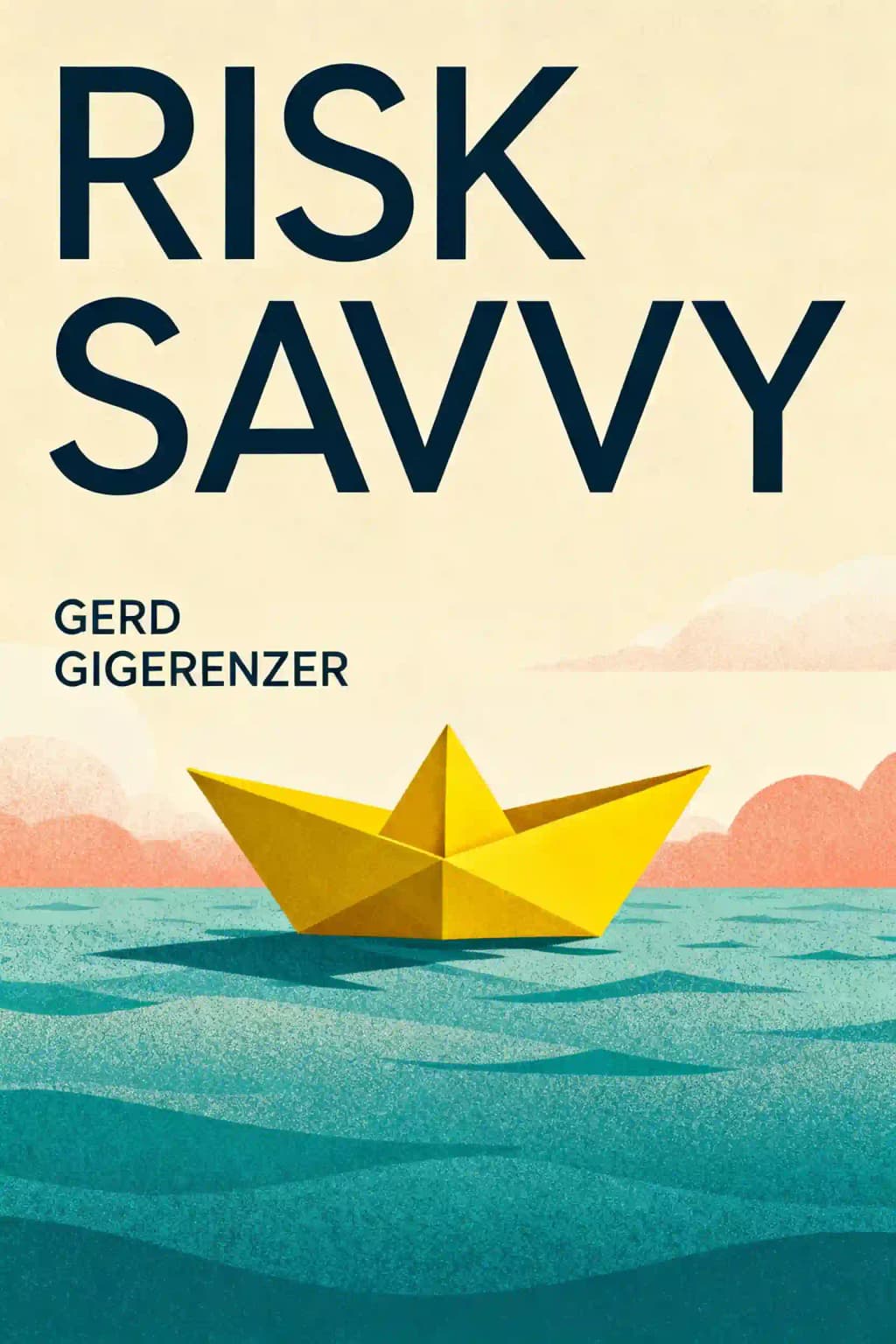
In "Risk Savvy," Gerd Gigerenzer reveals why gut instinct often beats complex analysis when making life's crucial decisions. This counterintuitive approach has revolutionized risk management across healthcare and finance. What if less information actually leads to better choices?
Gerd Gigerenzer, author of Risk Savvy: How to Make Good Decisions, is a German psychologist and pioneering expert in decision-making, bounded rationality, and risk literacy. A director emeritus at the Max Planck Institute for Human Development and founding director of the Harding Center for Risk Literacy, his work bridges behavioral science and practical strategies for navigating uncertainty. Risk Savvy distills decades of research into accessible insights about heuristics, statistical literacy, and why intuitive judgments often outperform complex analyses in real-world scenarios.
Gigerenzer’s influential works—including Gut Feelings and Calculated Risks—have been translated into over 20 languages, establishing him as a global authority on human judgment. His research underpins frameworks taught in business schools and applied by institutions like the Bank of England.
Recognized with the AAAS Prize for Behavioral Science Research and the German Psychology Prize, he has trained U.S. federal judges, physicians, and executives in risk communication. Risk Savvy synthesizes his contrarian yet empirically grounded philosophy: that simplicity, not complexity, often holds the key to smarter decisions in an uncertain world.
Risk Savvy explores decision-making in uncertain environments, advocating for simple heuristics over complex models. Gigerenzer teaches readers to interpret statistics accurately, critiques overreliance on experts, and provides tools for smarter choices in healthcare, finance, and daily life. The book emphasizes "less is more" logic, showing how streamlined decision rules often outperform exhaustive data analysis.
This book suits professionals in medicine, finance, or education seeking better risk communication strategies, as well as general readers aiming to improve everyday decision-making. Its insights on statistical literacy and cognitive biases are particularly valuable for those navigating high-stakes choices or teaching critical thinking.
Yes—it combines accessible explanations of probabilistic reasoning with practical frameworks for real-world decisions. While some criticize its repetitive structure, its challenges to conventional risk-assessment methods and emphasis on empowering individuals make it a standout in behavioral science literature.
Gigerenzer argues patients and doctors often misunderstand screening statistics, leading to overdiagnosis. He advocates shared decision-making using transparent risk communication, exemplified by his "No decision about me without me" principle for informed consent.
The book stresses that traditional statistical models fail in uncertain environments, necessitating intuitive heuristics.
Some reviewers note its heavy focus on medical examples over other domains and occasional oversimplification of financial models. However, these critiques are balanced by praise for its paradigm-shifting perspective on risk literacy.
While Kahneman emphasizes cognitive biases, Gigerenzer focuses on harnessing intuitive heuristics as adaptive tools. Both explore decision-making flaws but offer different solutions—Kahneman advocates slow thinking; Gigerenzer recommends refining fast, frugal heuristics.
Yes—it demonstrates how complex financial models often create false precision. The book advises using simple rules like “1/n investing” (equal asset allocation) to avoid overconfidence in unstable markets.
As Director of the Harding Center for Risk Literacy, Gigerenzer draws on decades of research training doctors, judges, and policymakers. His work combines psychological rigor with practical applications, reflected in the book’s blend of academic insights and real-world case studies.
In an era of AI-driven analytics and misinformation crises, its lessons on discerning signal from noise remain vital. The book equips readers to critically evaluate algorithmic predictions and pandemic-style risk communications.
저자의 목소리로 책을 느껴보세요
지식을 흥미롭고 예시가 풍부한 인사이트로 전환
핵심 아이디어를 빠르게 캡처하여 신속하게 학습
재미있고 매력적인 방식으로 책을 즐기세요
The problem isn't that humans are irrational-it's that we've never been taught how to understand risk properly.
Terrorists effectively strike twice: first with physical force, then through our psychological reactions.
Humans have a deep psychological need for certainty that makes us cling to stereotypes.
Intelligence means going beyond available information and taking risks.
A system that makes no errors will learn little and discover even less.
Risk Savvy의 핵심 아이디어를 이해하기 쉬운 포인트로 분해하여 혁신적인 팀이 어떻게 창조하고, 협력하고, 성장하는지 이해합니다.
Risk Savvy을 빠른 기억 단서로 압축하여 솔직함, 팀워크, 창의적 회복력의 핵심 원칙을 강조합니다.

생생한 스토리텔링을 통해 Risk Savvy을 경험하고, 혁신 교훈을 기억에 남고 적용할 수 있는 순간으로 바꿉니다.
무엇이든 물어보고, 목소리를 선택하고, 진정으로 공감되는 인사이트를 함께 만들어보세요.

샌프란시스코에서 컬럼비아 대학교 동문들이 만들었습니다
"Instead of endless scrolling, I just hit play on BeFreed. It saves me so much time."
"I never knew where to start with nonfiction—BeFreed’s book lists turned into podcasts gave me a clear path."
"Perfect balance between learning and entertainment. Finished ‘Thinking, Fast and Slow’ on my commute this week."
"Crazy how much I learned while walking the dog. BeFreed = small habits → big gains."
"Reading used to feel like a chore. Now it’s just part of my lifestyle."
"Feels effortless compared to reading. I’ve finished 6 books this month already."
"BeFreed turned my guilty doomscrolling into something that feels productive and inspiring."
"BeFreed turned my commute into learning time. 20-min podcasts are perfect for finishing books I never had time for."
"BeFreed replaced my podcast queue. Imagine Spotify for books — that’s it. 🙌"
"It is great for me to learn something from the book without reading it."
"The themed book list podcasts help me connect ideas across authors—like a guided audio journey."
"Makes me feel smarter every time before going to work"
샌프란시스코에서 컬럼비아 대학교 동문들이 만들었습니다

Risk Savvy 요약을 무료 PDF 또는 EPUB으로 받으세요. 인쇄하거나 오프라인에서 언제든 읽을 수 있습니다.
Picture a woman receiving a positive mammogram. Her doctor's face grows serious. "We need to schedule a biopsy immediately," he says. She leaves the office convinced she has cancer, her mind racing through worst-case scenarios. But here's the shocking truth: only one in ten women with positive mammograms actually has breast cancer. And her doctor? He likely doesn't know this either. This isn't an isolated case of medical incompetence. When 160 gynecologists were asked to calculate the probability that a woman with a positive mammogram has cancer, given standard statistics, only 21% answered correctly. The rest vastly overestimated the risk, believing eight or nine out of ten positive results meant cancer. These aren't poorly trained physicians-they're specialists who interpret these tests daily. The problem runs deeper than individual ignorance. We've built a society that demands risk literacy as urgently as reading and writing, yet we've never actually taught people how to understand uncertainty. We teach algebra, geometry, and calculus-the mathematics of certainty-while ignoring statistics and probability, the tools we actually need to navigate real life. The result? A world where smart people consistently make catastrophic decisions, not because they're irrational, but because they've been set up to fail.